.png?updatedAt=1779992389202)
Polymarket Alternatives in 2026: Kalshi, Azuro, Manifold, and Where Each One Fits
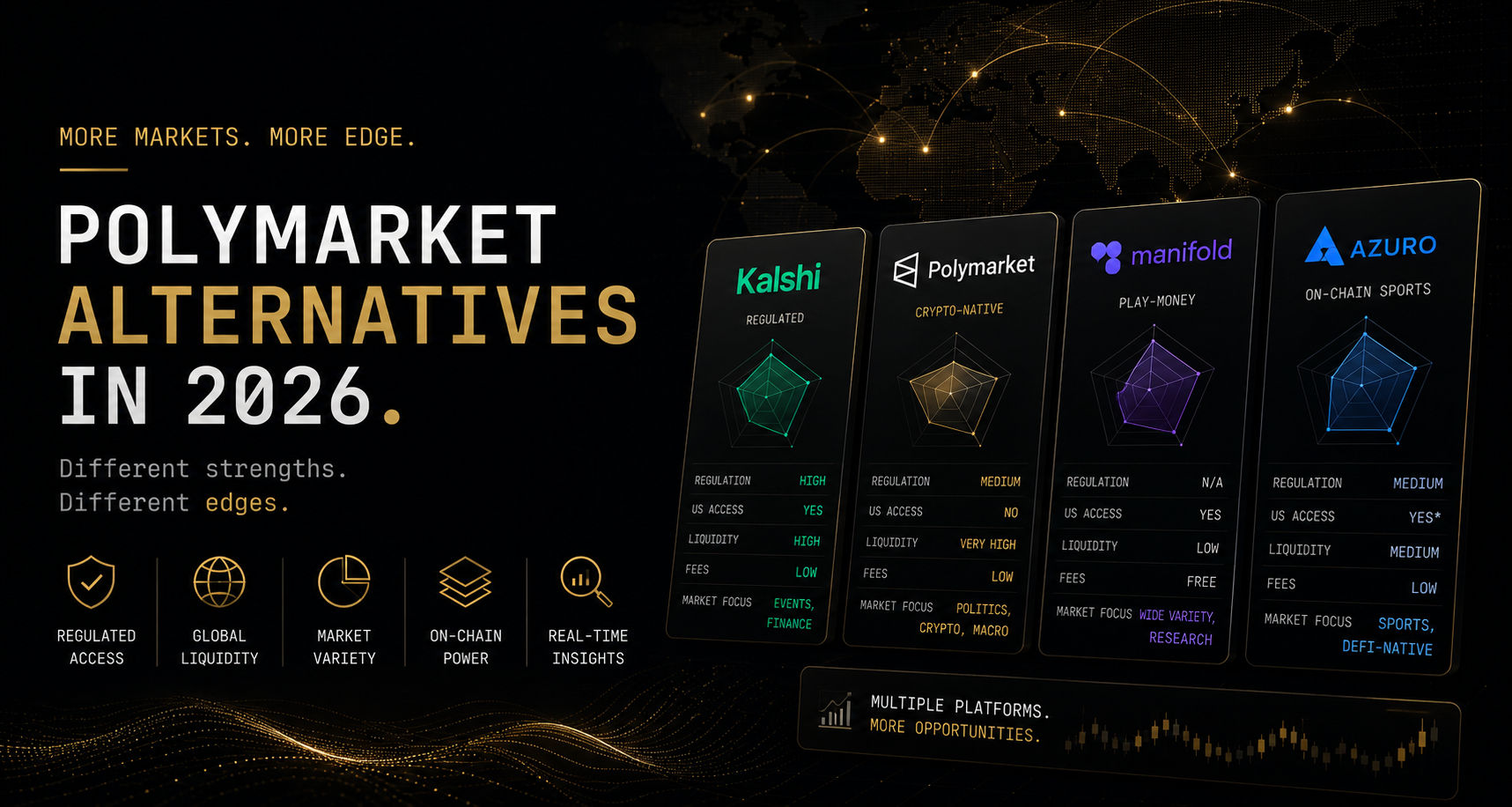
Polymarket has liquidity. Kalshi has US regulatory clearance. Manifold has the widest market variety and the most active research community. Azuro has the deepest on-chain sports coverage. Each platform has a structural advantage that the others do not. The traders who understand those differences do not ask "which platform should I use?" - they ask "which platform fits this specific trade?"
This guide answers that question by mapping each major alternative against the dimensions that actually matter: liquidity, regulatory access, market variety, fee structure, and the type of edge each venue rewards.
Quick Answer
The main Polymarket alternatives in 2026 are Kalshi (CFTC-regulated, US-accessible, real-money), Manifold Markets (play-money, massive market variety, strong research community), and Azuro (on-chain, sports-focused, blockchain-native). No single alternative replicates Polymarket's combination of liquidity depth and market breadth. Most serious traders use two or more venues depending on where the edge is, not where they prefer to trade.
Why Traders Look Beyond Polymarket
Polymarket is the dominant venue by liquidity volume. But it has limitations that push active traders to explore alternatives.
Regulatory access. Polymarket is not legally accessible to US residents under current interpretation of CFTC regulations. Kalshi cleared US regulatory hurdles in 2023 and expanded significantly into political and economic markets through 2024 and 2025. For US-based traders, Kalshi is the only major regulated real-money option.
Market variety. Polymarket's market creation is community-driven and concentrates heavily on political, crypto, and macro events. Niche sports markets, local election markets, and experimental market types appear more consistently on Manifold.
On-chain composability. Polymarket operates as a CLOB (central limit order book) on Polygon. Traders who want prediction market exposure inside a broader DeFi strategy, or who want to build on top of market contracts, often look at Azuro's protocol-level architecture.
Price discovery differences. Because each venue draws different participant types, the same underlying event can trade at meaningfully different prices across platforms. These gaps are arbitrage opportunities - but only for traders who are monitoring multiple venues simultaneously.
Key Takeaways
- Polymarket dominates on raw liquidity but is not legally accessible to US residents under current regulations
- Kalshi is the primary regulated alternative for US traders covering political, economic, and financial markets
- Manifold Markets uses play money, making it a research and calibration tool rather than a direct trading alternative
- Azuro operates on-chain with deep sports market coverage and DeFi-native architecture
- Price differences for the same event across venues create exploitable arbitrage for multi-venue traders
- Tool stacks that cover multiple venues simultaneously are more valuable than any single-venue analytics tool
- The right platform depends on your regulatory situation, market focus, and whether you prioritize liquidity or variety
The Prediction Market Landscape in 2026
The prediction market ecosystem has consolidated significantly since 2022. The fringe of small experimental platforms has mostly collapsed, leaving a clearer tier structure:
Two observations stand out from this table. First, real-money liquidity is concentrated almost entirely at Polymarket and Kalshi. Second, play-money platforms like Manifold and forecasting aggregators like Metaculus serve a different function than trading venues - they are calibration and research tools, not places to deploy capital.
Kalshi: The Regulated Alternative
Kalshi is the most significant Polymarket alternative for real-money trading, and it exists in a different regulatory universe.
What Kalshi is: A CFTC-regulated designated contract market (DCM) based in the United States. It trades event contracts - binary outcomes on political, economic, weather, and financial events. US residents can open accounts, fund in USD, and trade without the jurisdictional friction that comes with Polymarket.
Where Kalshi wins:
- US regulatory clarity is a structural advantage that cannot be replicated quickly
- Its political and economic market suite covers most of the same events as Polymarket's top-traded markets
- Institutional traders and funds that cannot touch unregulated platforms have Kalshi as the only compliant real-money option
Where Kalshi trails Polymarket:
- Liquidity is significantly lower on most markets outside major political events
- Market creation is centralized and slower - Kalshi approves new contracts rather than allowing community creation
- The fee structure is higher than Polymarket's in most market types
The arbitrage angle: Kalshi and Polymarket frequently show 3 to 8 cent price differences on the same event. During the 2024 US election cycle, the Republican presidential candidate market showed persistent gaps of 4 to 6 cents between the two venues for weeks. Traders with accounts on both platforms and the tools to monitor both in real time had a consistent edge window that closed only as election day approached. This is the same mechanism behind closing line value - the gap between where a market sits now and where it settles is where the edge lives.
Manifold Markets: The Play-Money Research Layer
Manifold is not a Polymarket alternative in the sense of somewhere to deploy capital. It is a prediction market in a different category entirely - one that is arguably more useful for certain research tasks than any real-money venue.
What Manifold is: A play-money prediction market platform where users create markets on anything, trade with fictional "mana" currency, and build track records of forecasting accuracy. There is no real financial risk or reward.
Why it matters anyway:
Play-money markets with active, calibrated user bases often produce probability estimates that track real-world outcomes with surprising accuracy. Manifold's political markets, scientific forecasting markets, and long-horizon event markets have demonstrated calibration comparable to professional forecasting services in several documented studies.
For prediction market traders, Manifold's value is as a signal source, not a trading venue. If Polymarket has a major event at 58 cents and Manifold's calibrated users are consistently putting it at 65 cents in a market with 300 traders, that is a data point worth noting.
Limitations: Play-money removes the financial incentive that keeps real-money markets efficient. Manifold markets are more susceptible to groupthink, overconfidence, and community narrative effects than venues where traders face real consequences for inaccuracy.
Azuro: The On-Chain Sports Layer
Azuro is the on-chain prediction market with the deepest sports market coverage. Its architecture is meaningfully different from both Polymarket and Kalshi.
What Azuro is: A decentralized protocol on which sports betting operators can build, using Azuro's smart contract infrastructure for liquidity pools, market creation, and settlement. Traders interact through apps built on top of the protocol rather than through Azuro itself.
Where Azuro fits:
- Traders who want sports market exposure in a DeFi-native environment
- Markets and structures that are not available on CLOB-based venues
- Protocol-level participation for developers building prediction market products
The tradeoff: Azuro's liquidity model relies on liquidity providers rather than a traditional order book, which creates different spread dynamics. Markets can be less price-efficient than CLOB venues in the absence of competing market makers, but more accessible for niche sports events that would not attract enough order book liquidity on Polymarket. If you are weighing how venue mechanics change your edge, our breakdown of sports betting versus prediction markets covers why the same wager prices differently across structures.
Other Platforms Worth Knowing
Metaculus: Not a trading venue. A structured forecasting aggregator where questions are resolved against real-world outcomes and users build track records. Useful as a calibration benchmark and for long-horizon event research.
PredictIt: US-accessible political prediction market operating under a CFTC no-action letter. Historically focused on US political markets with strict position limits ($850 per contract) and relatively high fees. Liquidity has declined significantly since 2023 as Kalshi expanded.
Augur: The original decentralized prediction market protocol. Largely inactive in terms of trading volume since 2021. Retains historical significance but is not a practical trading venue in 2026.
How to Choose the Right Platform for Your Trading Style
The decision framework is simpler than the platform list makes it appear:
If you are a US resident: Kalshi is your real-money option. Use Polymarket for price discovery research, not for actual positions.
If you trade primarily political and macro markets: Polymarket has deeper liquidity on most major events. Kalshi is worth monitoring for arbitrage on overlapping markets.
If you trade sports markets: Azuro covers sports at a depth that Polymarket and Kalshi do not, especially for soccer and combat sports.
If you want to research calibration and market forecasts across a wider event set: Manifold is the best research layer, used as a signal source rather than a trading venue.
If you want to monitor all of the above without managing five separate interfaces: A multi-venue intelligence terminal is not optional at this point - it is the infrastructure requirement for trading at this level of sophistication. This is the same problem we describe in the 5-Tab Problem.
Common Mistakes When Switching or Expanding to New Venues
Assuming price discovery is equivalent across venues. Polymarket and Kalshi draw different participant pools. Kalshi tends to attract more institutional and US-based traders. Polymarket has a higher concentration of crypto-native participants. These participant differences create genuine and persistent pricing differences on the same events.
Ignoring fee structure differences. Polymarket charges 2% on winnings in most markets. Kalshi's fee structure varies by contract type and can be higher on some market categories. This matters for Kelly sizing - identical edge positions have different expected value on different venues after fees.
Treating play-money calibration as equivalent to real-money price discovery. Manifold is a useful signal source. It is not a substitute for real-money market data. The financial stakes that make real-money markets efficient are absent.
Under-weighting regulatory risk. Polymarket's regulatory situation can change. US traders who have built their entire trading workflow around Polymarket access face structural risk that Kalshi users do not. Diversifying venue exposure is partial risk mitigation.
Missing cross-venue arbitrage by monitoring only one venue. The 3 to 8 cent gaps between Polymarket and Kalshi on major political events are real and persistent enough to trade. Traders who only monitor one venue are leaving this edge unread.
How DG3 Helps
The multi-venue problem is a data problem. Monitoring Polymarket, Kalshi, and Azuro simultaneously through separate native interfaces requires three separate browser sessions, three separate data refresh cycles, and manual mental arithmetic to identify price gaps.
DG3's terminal architecture is built around the multi-venue reality of prediction markets in 2026. The Signal Layer monitors order flow patterns across venues and surfaces anomalies. The Edge Finder compares price levels across overlapping markets to flag arbitrage windows. The Intelligence Pane consolidates news, whale activity, and price data in a single workspace so traders do not lose signal by context-switching between platforms.
Frequently Asked Questions
What is the best Polymarket alternative for US traders? Kalshi is the only major CFTC-regulated real-money prediction market accessible to US residents. It covers political, economic, and financial event markets with a growing liquidity base. US traders who want to trade prediction markets with real money should start with Kalshi given the regulatory clarity.
Is Kalshi better than Polymarket? Neither is strictly better - they serve different use cases. Kalshi is the right choice for US residents who need regulatory compliance. Polymarket has significantly higher liquidity on most major markets and a wider community-driven market set. Many serious traders monitor both for arbitrage opportunities on overlapping markets.
How does Manifold Markets compare to Polymarket? They are fundamentally different products. Polymarket is a real-money exchange where financial stakes enforce price discipline. Manifold uses play money, making it a research and calibration tool rather than a trading venue. Manifold's value is in its large, active user base producing probability estimates that can serve as a useful signal source.
Are prediction market prices the same across platforms? No. The same event can trade at meaningfully different prices on Polymarket versus Kalshi depending on participant composition, liquidity depth, and information flow. During the 2024 US election, documented gaps of 4 to 6 cents between platforms persisted for weeks on major political markets.
What is Azuro protocol? Azuro is a decentralized prediction market protocol built on blockchain infrastructure. Operators build sports and event betting applications on top of Azuro's smart contracts. It offers deeper sports market coverage than CLOB-based venues and is designed for DeFi-native traders who want on-chain prediction market exposure.
Can you arbitrage between prediction market platforms? Yes, cross-venue arbitrage is possible when the same event trades at different prices on different platforms. The practical constraints are account access (US regulatory restrictions limit Polymarket access), settlement timing differences, and transaction costs. Real-time monitoring of both venues simultaneously is required to execute this reliably.
Are there free prediction market alternatives? Manifold Markets is free to use and offers the widest market variety of any prediction market platform, though it uses play money rather than real currency. Most real-money alternatives including Kalshi have account minimums and fee structures.
What happened to PredictIt? PredictIt operates under a CFTC no-action letter with strict position limits of $850 per contract and relatively high fees. Its market share has declined significantly since Kalshi expanded into political markets with better fee structures and higher position limits. PredictIt remains active but is no longer the primary US political prediction market.
How many prediction market platforms should serious traders use? Most active traders maintain accounts on at least two real-money venues (typically Polymarket and Kalshi) to capture cross-venue arbitrage and access markets that are not available on either platform alone. Adding Manifold as a research layer and monitoring Azuro for sports markets rounds out the stack for traders across multiple market categories.
Final Thoughts
The prediction market landscape in 2026 is not a winner-take-all competition. Polymarket, Kalshi, Manifold, and Azuro each serve different trader types, market categories, and trading objectives. The question is not which platform to use - it is how to build a workflow that captures the advantages of each without drowning in data management overhead. DG3 is built to solve exactly that problem.
Author note
Written by the DG3 research desk. We build tools for traders who treat probability as a number to beat, not a line to accept. We track market microstructure, order flow, and cross-venue pricing across prediction markets every day.
Polymarket, Kalshi, and on-chain venues in one workspace, with cross-venue gaps flagged automatically. See it at the DG3 terminal, dg3.trade.
Open the terminal →