.png?updatedAt=1779992389202)
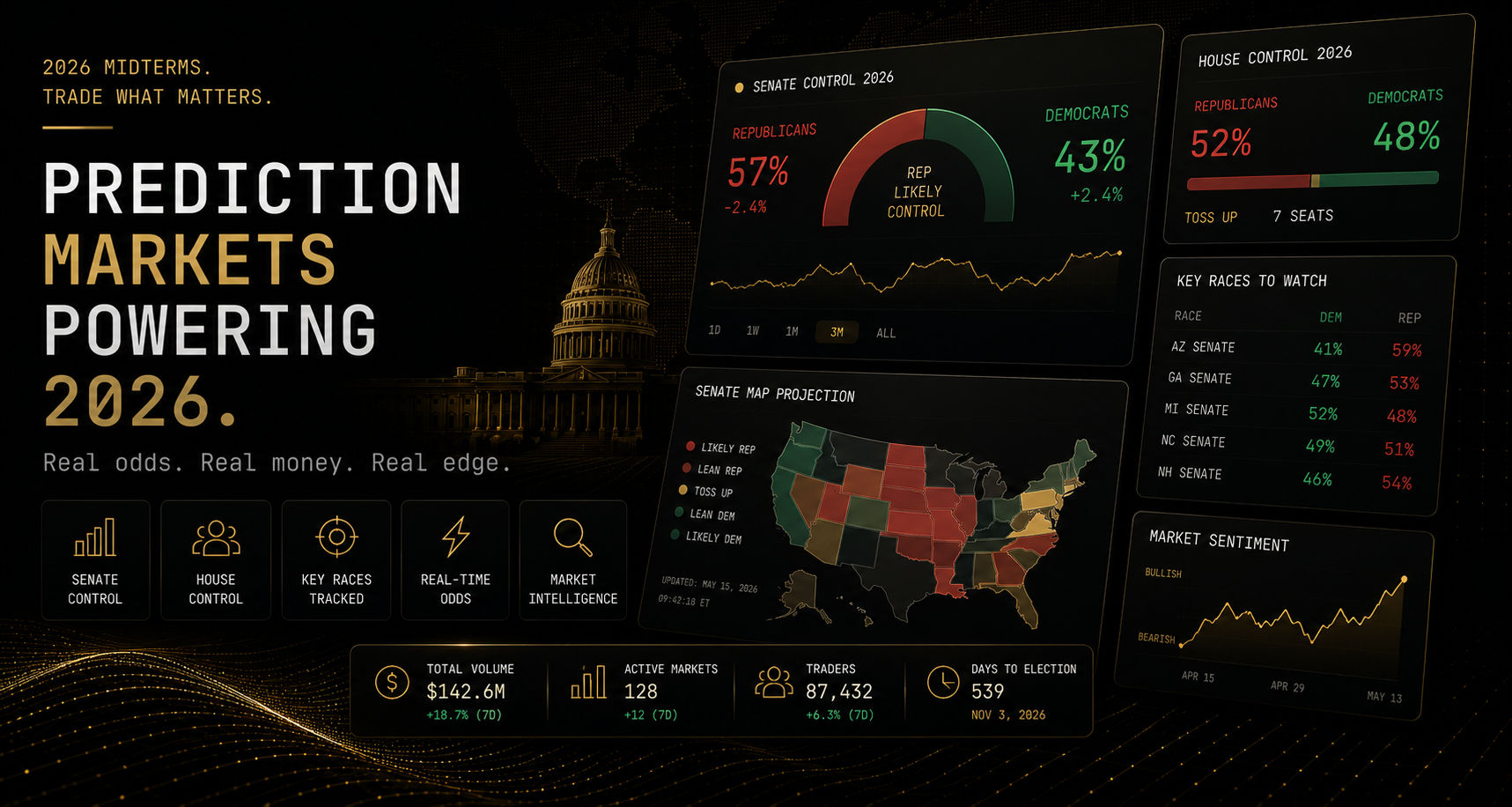
2026 Midterm Election Prediction Markets: A Complete Trader Guide
Every two years, the largest predictable liquidity event in prediction markets opens for trading. Midterm elections are not a niche market type - they are the category that built prediction markets' modern reputation, generated the most documented evidence of market accuracy, and attracted the most institutional attention to the space.
The 2026 US midterm elections are different from the 2022 cycle in one structural way: prediction markets are significantly more mature, more liquid, and more widely followed than they were four years ago. The 2024 presidential election proved that political prediction markets can process and price information faster than traditional media and polling. That credibility compounds into the 2026 cycle with more participants, more liquidity, and a larger audience watching.
This guide covers everything a trader needs: how election prediction markets work, when to enter, where the edge lives in a 2026 midterm cycle, and what the 2024 record teaches about accuracy.
Quick Answer
The 2026 US midterm election prediction markets are trading on both Polymarket and Kalshi, covering Senate control, House control, and individual congressional race outcomes. Election markets typically develop their deepest liquidity in the 60 to 90 days before election day (early August to November 2026). Edge opportunities are highest in the 6 to 12 months before the election, when markets are thin, pricing is imprecise, and informed traders have a larger informational advantage over the aggregate market.
Why Midterm Election Markets Are Different
Election markets are not like sports markets or crypto event markets. Several structural features make them distinct:
Long resolution timelines. A major political market might open 18 months before resolution. Capital is locked in for longer periods, which changes how position sizing and portfolio management work relative to short-resolution markets.
Polling data as a competing signal source. Every prediction market trader in election cycles is processing the same public polling data, historical base rates, and pundit commentary. The edge is not in reading the news faster - it is in reading the market's reaction to that news more accurately than other participants.
High correlation across markets. Senate race outcomes are correlated with each other and with national political environment indicators. A trader with a heavy YES position on Republican Senate control and separate YES positions on three individual Republican Senate races has more concentrated exposure than the position count suggests.
Liquidity timing patterns. Election market liquidity follows a predictable pattern: thin in the early cycle, building through summer, reaching peak depth in the final 60 days. This pattern creates specific windows where different types of traders have different edge advantages.
Key Takeaways
- The 2026 midterm cycle is the largest predicted liquidity event in prediction markets for the year - live positions should be established before August to capture pre-peak pricing
- Election markets develop edge windows that are different at different points in the cycle: thin early markets reward informed traders, liquid late markets reward line movement readers
- Polymarket and Kalshi both cover the 2026 cycle, with Kalshi holding structural advantages for US institutional traders
- Price gaps between Polymarket and Kalshi on equivalent markets are wider in early-cycle thin markets and typically narrow as election day approaches
- Polling-to-market comparisons are a primary signal source but require understanding systematic biases in both polling and market pricing
- Correlated exposure across Senate races is a risk management problem that most casual election traders underestimate
- The 2024 presidential market's accuracy record is a genuine data point but should not be over-extrapolated to 2026 midterm dynamics
How Election Prediction Markets Work
An election prediction market is a binary event contract that resolves YES at 100 cents if the named outcome occurs and NO at 0 cents if it does not. If you buy YES on "Democrats win Senate control" at 42 cents and Democrats win the Senate, your position pays 100 cents - a 58-cent profit per unit. If Republicans hold or gain the Senate, your position pays 0.
The current price of a contract is the market's implied probability of the outcome. A price of 42 cents means the aggregate of buyers and sellers has priced this outcome at 42% probability.
Key terms every election market trader needs:
Implied probability - the current market price expressed as a percentage chance of the event occurring. A 55-cent YES contract implies 55% probability.
Liquidity depth - the total volume available at or near the current price. High liquidity means you can take a large position without significantly moving the price. Thin liquidity means a moderate-sized position can move the market 2 to 5 cents.
Line movement - the change in implied probability over time as new information enters the market. Sharp line movement before any obvious news event is often driven by informed traders entering positions - a signal worth noting.
Resolution - the market settles when the outcome is confirmed. Most election markets resolve within 24 to 72 hours of results being called by the major networks or official certification.
The 2026 Midterm Cycle: What's at Stake
The 2026 US midterms will determine control of both chambers of Congress with the full House of Representatives and roughly one-third of the Senate up for election.
The structural setup entering 2026:
- Republicans control the House with a narrow majority from 2024
- Republicans hold a Senate majority with several seats up in competitive states
- The historical base rate for the president's party losing seats in midterm elections is strong - in 22 of the last 25 midterm elections, the president's party has lost House seats
That historical base rate is the starting point, not the conclusion. Prediction markets price in base rates along with current polling, candidate quality, fundraising data, and political environment signals. The trader's job is to identify where the market is miscalibrated relative to the true probability - not to predict the outcome.
Primary markets to watch:
- Republican House control: YES/NO (currently trading, exact price depends on date of reading)
- Republican Senate control: YES/NO
- Individual swing district and swing state races as they develop
Timing the Trade: When Prediction Market Edge Is Highest
Election market edge is not uniformly distributed across the cycle. Different windows favor different trading approaches.
Thin markets, highest research edge
Prices are set primarily by base rates and early polling. Volume is thin. Individual traders with proprietary research on specific Senate races - candidate quality, fundraising data, district-level analysis - have their highest informational advantage. Position sizing must account for the long capital lockup period.
Field solidifies, polling firms up
The candidate field solidifies and polling becomes more reliable as the election approaches. Markets begin to price in specific candidate and race dynamics rather than just national environment. This period rewards traders who have done the research on individual races that market prices have not yet fully reflected.
Liquidity grows, research edge compresses
Liquidity grows significantly. National polling averages become the dominant market signal. Line movement starts tracking news events tightly. Edge from independent research compresses as the market becomes more informationally efficient. This period rewards traders who are better at reading order flow and line movement than the average participant.
Peak liquidity, execution edge only
Peak liquidity. Prices are most efficient. The edge for independent research is minimal. The value here is execution - taking positions on narrow but well-defined opportunities, managing correlation risk, and reading intraday line movement for short-term signals.
The practical implication: early cycle positions carry higher expected edge but require longer capital commitment. Late cycle positions are lower edge but higher liquidity. The optimal strategy combines both.
Where the 2026 Elections Are Trading: Polymarket vs Kalshi
Both Polymarket and Kalshi will have comprehensive 2026 midterm coverage, and the differences between how each platform covers the cycle matter for trading strategy.
Polymarket coverage: Polymarket will likely offer broader market variety - individual House races, Senate races, state legislative contests, and aggregate chamber control markets. Its community-driven market creation model captures niche races that Kalshi will not formally list. Liquidity will be higher on the top-tier markets (House control, Senate control) in the final 90 days.
Kalshi coverage: Kalshi has focused heavily on major political markets and has regulatory legitimacy that Polymarket does not for US participants. Its Senate and House control markets are the primary product for US-based institutional traders. Kalshi's pricing on these markets will reflect more institutional participation and potentially different information flows than Polymarket.
The arbitrage opportunity: In 2024, Kalshi and Polymarket showed persistent price gaps on the presidential election markets. The 2026 cycle will produce similar opportunities on Senate and House control markets. Early-cycle gaps may be larger given thinner liquidity. Late-cycle gaps will compress as both venues attract more participants.
Finding Edge in Election Markets
Edge in election prediction markets comes from three sources:
Calibration advantage: Your probability estimate is more accurate than the market's. This requires genuine research - reading primary sources, understanding the difference between partisan and independent polling, doing base-rate analysis on specific race types, and distinguishing between structural and cyclical factors. In practice this is an exercise in estimating fair value and trading the gap between it and the market price.
Timing advantage: You identify information before the market prices it in. This is harder in highly watched national markets and more available in lower-profile races. A Senate race in a mid-tier state may take 24 to 48 hours to fully price in a relevant development that a dedicated researcher would catch immediately.
Order flow advantage: You read the market's behavior - who is moving prices, how markets are reacting to news, where sharp money is entering - better than the average participant. Distinguishing informed positioning from noise is the same discipline behind reading sharp money versus public money, and it is the skill that prediction market tools are specifically built to support.
A worked example: In early 2024, the presidential election market on Polymarket was trading the Republican candidate at approximately 40 cents, in line with major polling averages. Several documented sharp wallets began building positions at this price over a period of weeks. By mid-summer, those wallets had accumulated large YES positions at an average entry of around 44 cents. The market moved significantly in the fall as the political environment shifted. Traders who had the whale tracking tools to observe that early accumulation had a signal that was not visible in the polling data or public narrative at the time.
Prediction Markets vs Polls: The 2024 Record
The 2024 presidential election was a significant data point for prediction market credibility, and understanding exactly what it demonstrated matters for 2026 positioning.
What the record shows: Prediction markets moved to price in a Republican victory earlier and more decisively than most major polling averages. In the final weeks, Polymarket's Republican presidential candidate contract reached probabilities in the high 60s to low 70s while major polling aggregators showed a race within 1 to 3 percentage points. The Republican candidate won.
What this does not prove: A single election is not a definitive accuracy test. Prediction markets were also wrong about the 2022 midterms, where several high-confidence Republican gains in the House did not materialize at the magnitudes priced. Polling and prediction markets both have systematic biases that vary by election type and cycle.
What it means for 2026: Prediction markets in 2026 will be watched more closely than ever. More institutional participation, more media coverage, and higher public awareness mean the market's pricing will be scrutinized and contested in real time. This attention is a double-edged development: higher liquidity and better price discovery, but also more participants trying to exploit the same signals, which compresses edge over time.
Common Mistakes Trading Election Markets
Conflating political opinion with probability assessment. The prediction market does not care about your views on who should win. The only relevant question is: what is the true probability, and is the market price above or below that?
Ignoring correlated exposure. A position in Republican Senate control, plus positions in three competitive Republican Senate races, plus a position in Republican House control adds up to a heavily correlated book. If the political environment shifts against Republicans, all four positions move against you simultaneously. Sizing each position as if it were independent - rather than applying expected value and Kelly logic across the correlated book - is how traders over-concentrate without realizing it.
Over-weighting national polls and ignoring market microstructure. Late-cycle national polling averages are already incorporated into market prices within hours of publication. The information edge is in what is not in the polls - candidate-specific developments, local factors, early voting patterns, and order flow signals.
Entering positions at peak liquidity without an edge thesis. The final 30 days of an election cycle are the most liquid and least edgy. Entering large positions at peak liquidity because you feel more confident is backwards - confidence should be highest when liquidity is thinnest and the research edge is clearest.
Misunderstanding line movement causation. Not all line movement carries equal signal. News-driven movement (a major candidate gaffe, a significant polling release) is publicly available information. Movement that precedes any obvious news catalyst is the more interesting signal - it may reflect informed money entering before news becomes public.
How DG3 Helps
Election cycle trading at scale requires monitoring dozens of markets across two platforms simultaneously, tracking order flow in real time, and maintaining awareness of correlated exposure across positions. DG3's Intelligence Pane brings together the Sharps feed, Signals panel, and News integration in one workspace, giving traders a single view of market movement across the election cycle. The Edge Finder flags markets where current pricing diverges from estimated fair value, surfacing early-cycle opportunities before the liquidity rush compresses them.
For traders who want to run the 2026 midterm cycle as a systematic strategy rather than ad hoc position-taking, the terminal infrastructure matters as much as the research.
Frequently Asked Questions
Are there prediction markets for the 2026 midterm elections? Yes. Both Polymarket and Kalshi list prediction markets on House control, Senate control, and individual congressional race outcomes for the 2026 midterm elections. Markets typically open 12 to 18 months before election day and develop their deepest liquidity in the final 60 to 90 days.
Are prediction markets more accurate than polls for elections? The evidence is mixed and cycle-dependent. Prediction markets outperformed polling aggregators in the 2024 presidential election by moving earlier and more decisively toward the eventual winner. They were less accurate than leading polling models in the 2022 midterms on several key races. Neither method is systematically superior - each has characteristic error patterns worth understanding.
When is the best time to enter 2026 election markets? Early-cycle positions (12 to 18 months out) carry higher potential edge because markets are thin and pricing is imprecise. Late-cycle positions have higher liquidity but lower edge. The optimal entry timing depends on whether your thesis is based on calibration advantage (enter early) or order flow reading (enter when liquidity builds in the final 60 days).
How do I trade the 2026 elections on Polymarket? Search for markets labeled "2026 House control," "2026 Senate control," or individual race names. Buy YES positions on outcomes you believe are underpriced (current market probability is below your fair value estimate) or NO positions on outcomes you believe are overpriced.
What is the historical base rate for midterm elections? The president's party has lost House seats in 22 of the last 25 midterm elections. This base rate is strong but not deterministic - it reflects the general pattern of the out-party performing well in midterms, but individual cycles can diverge significantly based on economic conditions, candidate quality, and political environment.
How do correlated election market positions work? Positions on individual Senate races, Senate chamber control, and House chamber control are all correlated with the same underlying national political environment. A shift in political conditions that moves one market will typically move all correlated markets simultaneously. Traders should account for this correlation when sizing positions.
Can I trade 2026 election markets in the US? US residents can trade on Kalshi, which is CFTC-regulated and specifically covers major political markets including the 2026 midterms. Polymarket is not legally accessible to US residents under current regulatory interpretation.
What happened to prediction market accuracy in 2024? Polymarket's US presidential election markets moved earlier and more decisively toward the eventual Republican winner than most major polling averages. Markets reached probabilities in the high 60s to low 70s in the weeks before the election while polls showed a much tighter race. This created significant media and academic attention to prediction market accuracy, though a single election cycle is not a definitive test of systematic accuracy advantage.
How do I find edge in 2026 election markets? Edge comes from calibration advantage (your probability estimate is more accurate than the market's), timing advantage (you process information before the market prices it in), or order flow advantage (you read market microstructure signals - whale activity, line movement before news events - better than average participants).
Final Thoughts
The 2026 midterm elections are the largest predictable trading opportunity in the prediction market calendar. The traders who capture the most from this cycle will enter positions before peak liquidity compresses early-cycle edge, maintain awareness of correlated exposure across a multi-market book, and use monitoring tools that surface order flow signals before they become obvious in the price. The window to position before the liquidity rush closes around August. DG3 is built to give traders the intelligence infrastructure this level of systematic election trading requires.
Author note
Written by the DG3 research desk. We build tools for traders who treat probability as a number to beat, not a line to accept. We track market microstructure, order flow, and cross-venue pricing across prediction markets every day. Nothing here is political endorsement or investment advice - it is a guide to how these markets price and move.
Track 2026 election markets across Polymarket and Kalshi, with order flow and cross-venue gaps surfaced in real time. See it at the DG3 terminal, dg3.trade.
Open the terminal →