.png?updatedAt=1779992389202)
The Number That Tells You If You're Actually Good.
Sofia went 14 from 20 last month. 70% win rate. She screenshot it. She sent it to her betting group. Then Luca asked one question.
"What were your closing lines like?"
She didn't know what he meant.
Four weeks later she understood.
Her 70% win rate was built on short-priced favourites who won when they were supposed to win. She hadn't found value. She'd found certainty and paid a premium for it. She was good at picking winners. She was not good at betting.
"Winning bets don't prove you're good. Beating the closing line does."
What the closing line actually is
Every bookmaker publishes an opening line when betting first opens - sometimes days before kickoff. These early odds are imperfect. Team news is incomplete. Sharp money hasn't moved yet.
Then professional bettors, syndicates, and algorithms bet into the market. The bookmaker adjusts. More information enters. By kickoff, the closing line - the final odds before the event starts - represents the most informed, most contested, most accurate price the market can produce.
Decades of research confirm one thing consistently: the closing line is the best collective assessment of true probability that money can create.
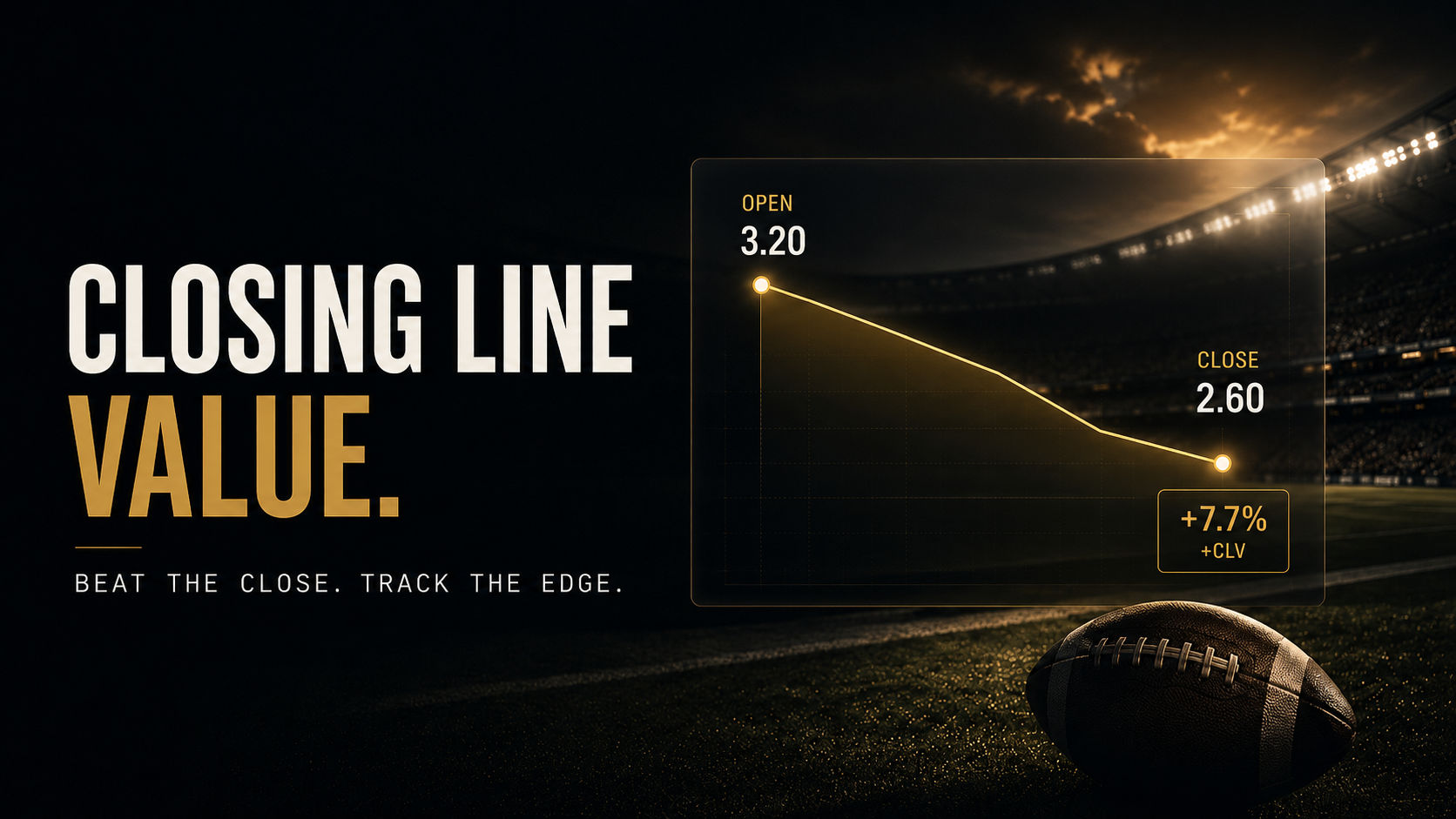
Opening line opens - 3.20
Imperfect info. Early sharp money starts entering. This is where the best CLV is found.
Line moves to 2.95
Team news drops. Recreational volume enters. Market is still being shaped.
Closing line - 2.60
Most accurate price available. All information now in the market. This is the benchmark.
If you bet at 3.20 and the market closed at 2.60 - you had genuine edge. The market confirmed it.
CLV - the only metric that actually measures edge
Closing Line Value is the difference between the odds you got and the odds the market closed at. The formula is simple. The implications are not.
CLV% = ((Your odds ÷ Closing odds) − 1) × 100
Market moved against your position. Value was real. The market confirmed it.
You paid more than the true price. The result does not change this.
The match result is irrelevant to whether the bet was right. The closing line is the only honest judge.
Why win rate lies - and CLV tells the truth
Win rate is highly manipulable without any dishonesty. Back enough short-priced favourites and it looks impressive. Back 1.15 shots all season and you'll win 85% of bets - and lose money, consistently, because the pricing requires closer to 88% just to break even.
Average CLV: -4.2%
Wins often. Backs overpriced favourites. Feels good. Balance trending down.
Average CLV: +3.8%
Wins less often. Backs genuine value at longer odds. Balance trending up.
The number that matters is not on your bet slip. It is the price the market eventually agreed the bet was worth.
How to track CLV - no software needed
A spreadsheet and discipline. That is all. For every bet you place, record four things. Over 50 bets, patterns emerge. Over 100, the picture becomes clear. Over 200, you have a genuine read on whether your process generates edge or merely generates outcomes.
Odds taken and time of bet
The earlier you bet, the more potential CLV - but also more timing risk.
Closing odds at kickoff
Check the bookmaker's final odds before the match starts. Record it immediately.
CLV for that bet
((Your odds ÷ Closing odds) minus 1) x 100. Positive is good. Negative is a red flag.
The result
Separate from CLV. Over time, results follow edge. But they are not the same thing.
The pro mindset shift
The most important thing CLV does is not mathematical. It is psychological. It changes the question you ask after every bet.
"Did I win?"
"Was I right?"
A bet that loses with positive CLV is a good bet. You were ahead of the market. The outcome was variance. A bet that wins with negative CLV is a bad bet - the market had already told you the price was wrong before the match started.
Professionals who track CLV consistently report the same thing: it makes losing runs easier to handle - because they can see their process is working even when results are not cooperating. And it makes winning runs less dangerous, because they know some of those wins were variance, not edge.
Win rate is the story you tell people.
CLV is the truth underneath it.
Build a process that consistently gets you better odds than the market closes at - in any sport, at any odds level - and you have a genuinely profitable operation. The results will follow. They always follow the edge. But they follow it on the market's timeline, not yours.
"Beat the close.
The rest takes care of itself."