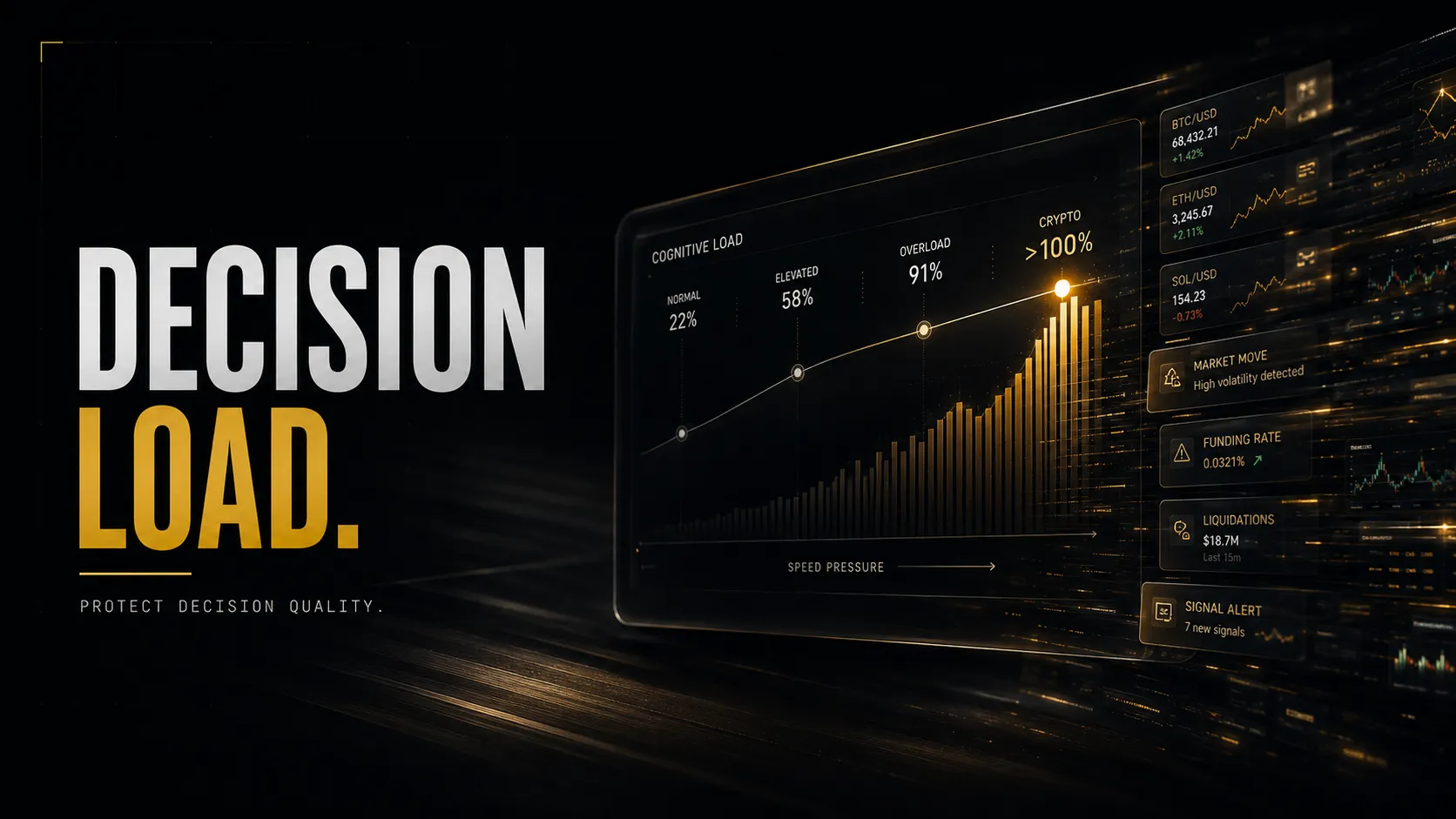
Cognitive Load in Fast Markets
How decision quality degrades under speed pressure.
This is about how decision quality degrades under speed pressure, and why the prediction market pace amplifies every failure mode severely.
Speed is not neutral. Every millisecond of pressure applied to a decision is a tax on the cognitive machinery doing the deciding.
In prediction markets, that tax is already steep. In crypto, it is punishing.
Table of Contents
The Science of Too Much, Too Fast
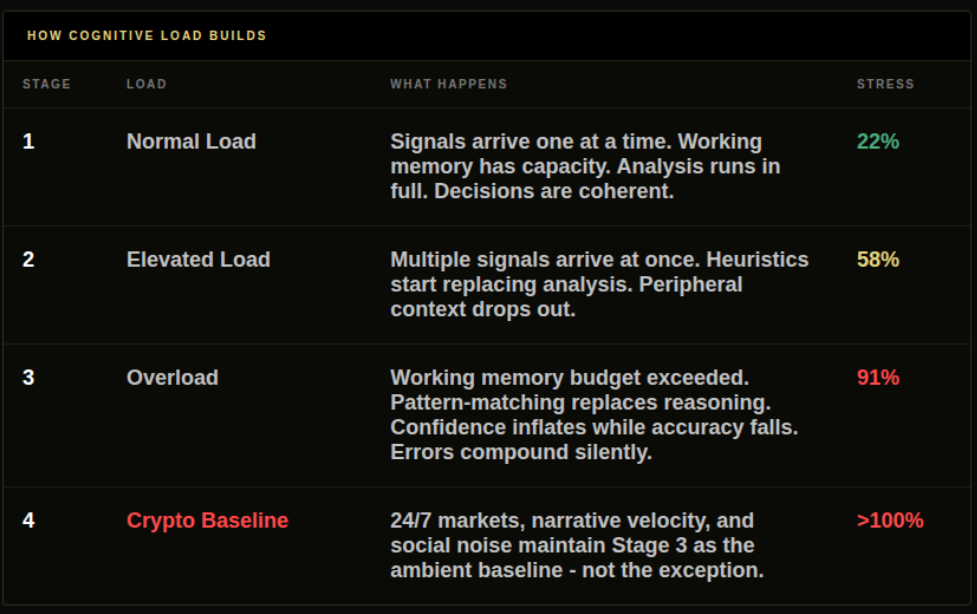
Cognitive load theory tells us that working memory – the active, processing part of the brain – is finite. It operates on a budget. When that budget is exceeded, the brain does not simply slow down. It degrades. It takes shortcuts. It reaches for pattern-matching instead of analysis, for heuristics instead of reasoning.
In a slow market, that budget is manageable. You have time to process the signal, cross-reference it against your model, size accordingly. The cognitive pipeline runs cleanly. In a fast market, the pipeline floods. New prices arrive before you have processed the last ones. The system does not throw an error – it keeps running. But the output degrades quietly, in ways you often will not notice until the position is already on.
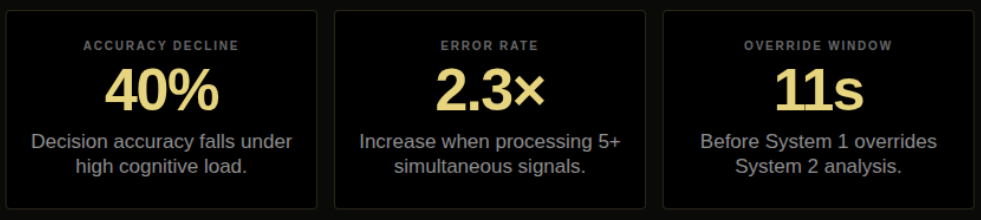
Three Ways Quality Degrades
Cognitive load does not produce random errors. It produces predictable ones – the same failure patterns appear across traders, across experience levels, across market contexts. Understanding the mechanism means you can anticipate and prepare, rather than diagnose after the fact.
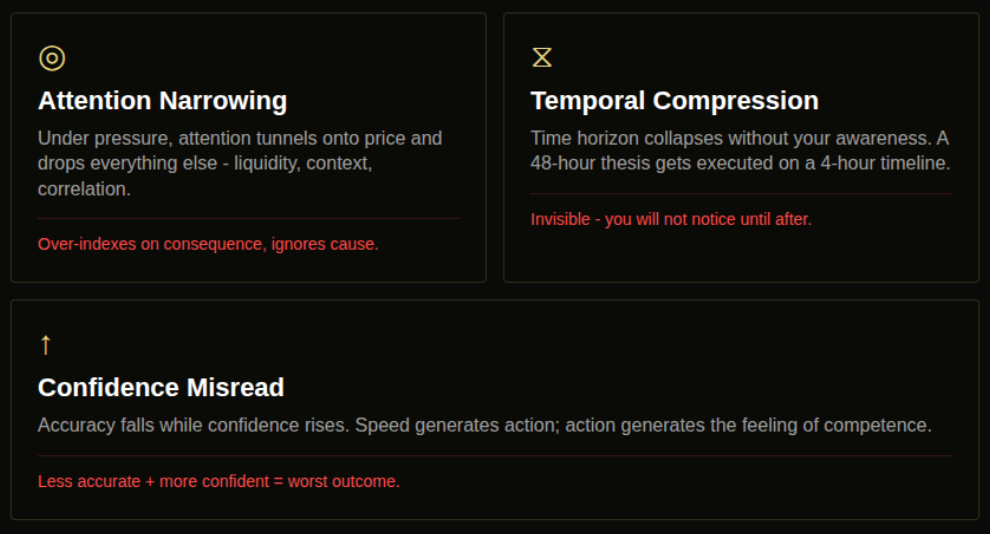
Attention narrowing: Traders in fast markets consistently over-index on the most salient signal, typically price movement, and under-weight everything else. The irony is that the signal you see most clearly is often the least informative. Price is a consequence. The causes – flow, narrative, structural positioning – are peripheral.
Temporal compression: A trader with a well-reasoned 48-hour thesis starts making decisions that implicitly assume a 4-hour timeline. They do not decide to shorten it. The pressure shortens it for them. Tilt is visible. Temporal compression is invisible.
You think you are executing the same strategy – same edge, same logic. But the pressure has already changed when you are measuring it against, and that changes everything.
Confidence miscalibration: High-load environments create a consistent pattern – traders become simultaneously less accurate and more confident. Speed generates action, and action generates the feeling of competence. Markets are probabilistic. Overloaded brains are not.
Field Note The degradation pattern is consistent across experience levels. Experienced traders make different errors under cognitive load than novices – but they still make more of them. Expertise changes the error type, not the error rate.
Crypto Is the Extreme Case
Every prediction market context produces cognitive load. Crypto amplifies it to a degree that deserves its own analysis. The combination of factors below is genuinely unusual in financial markets – not just individually, but in how they compound against each other.
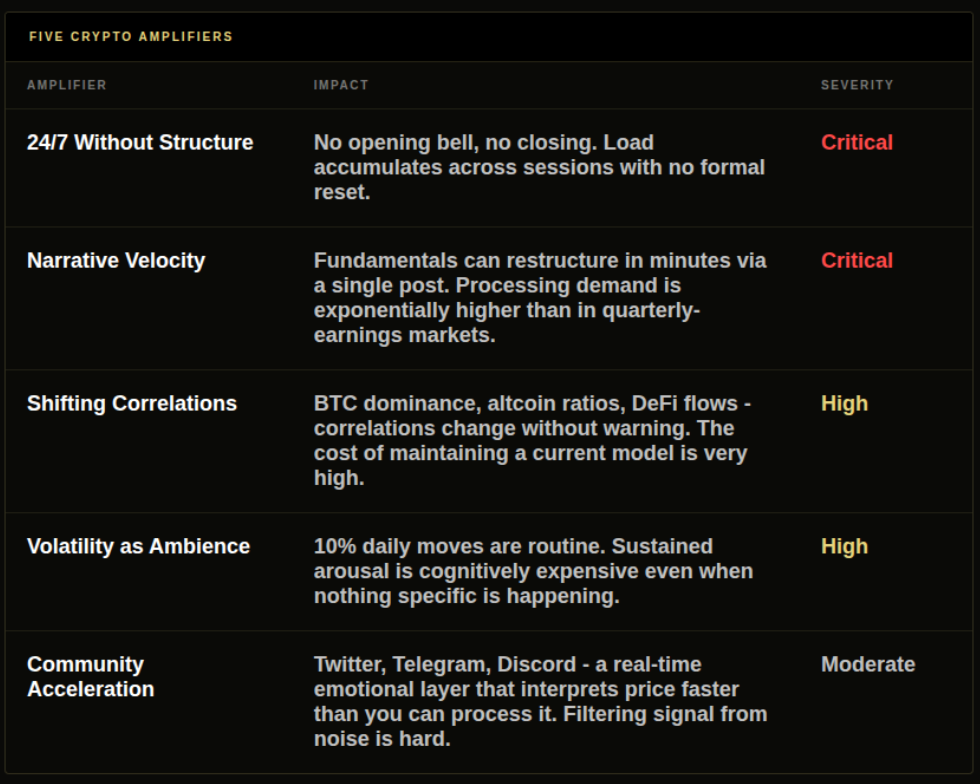
What Sharp Traders Do Differently
The answer is not slower reflexes. The traders who manage cognitive load well have, through deliberate practice, reduced the cost of routine decisions so their budget is available for the non-routine ones. Pre-defined decision rules are not about rigidity. They are load management.
If the rule is already written, executing it is cheap. If it has to be derived under pressure, it is expensive – and the quality will reflect that.
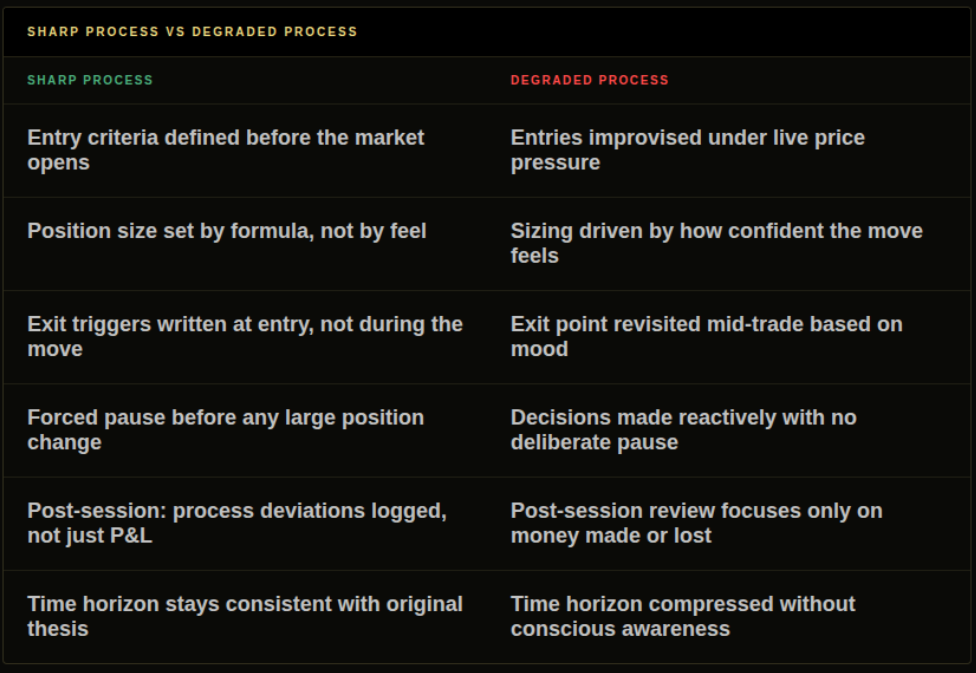
The sharpest operators also practice environment management: limiting simultaneous information streams, building forced pauses before position changes above a certain size, creating temporal separation between monitoring and decision-making. These are not psychological tricks. They are structural solutions to a structural problem.
The Takeaway Cognitive load is not a personality trait. It is not discipline or the lack of it. It is a structural feature of fast markets that affects every participant, produces predictable error patterns, and is substantially worse in crypto than in most other trading contexts.
Understanding the mechanism does not make you immune. But it changes where you look when performance degrades. Instead of questioning your edge, you start questioning your decision environment. That is a much more solvable problem.
The market’s pace is not going to slow down. Your cognitive architecture is not going to fundamentally change. What can change is the environment in which you are deploying it – and how deliberately you design that environment around the real constraints of human cognition under pressure.
Also read:
Tilt Management
The 5-Tab Problem
Why Rule-Followers Beat Gut Traders
Sign up now – DG3 Terminal