.png?updatedAt=1779992389202)
Fair Value in Prediction Markets: How to Tell When a Contract Is Mispriced
Every trade you make is a bet on one number. Not the price on the screen - the number behind it.
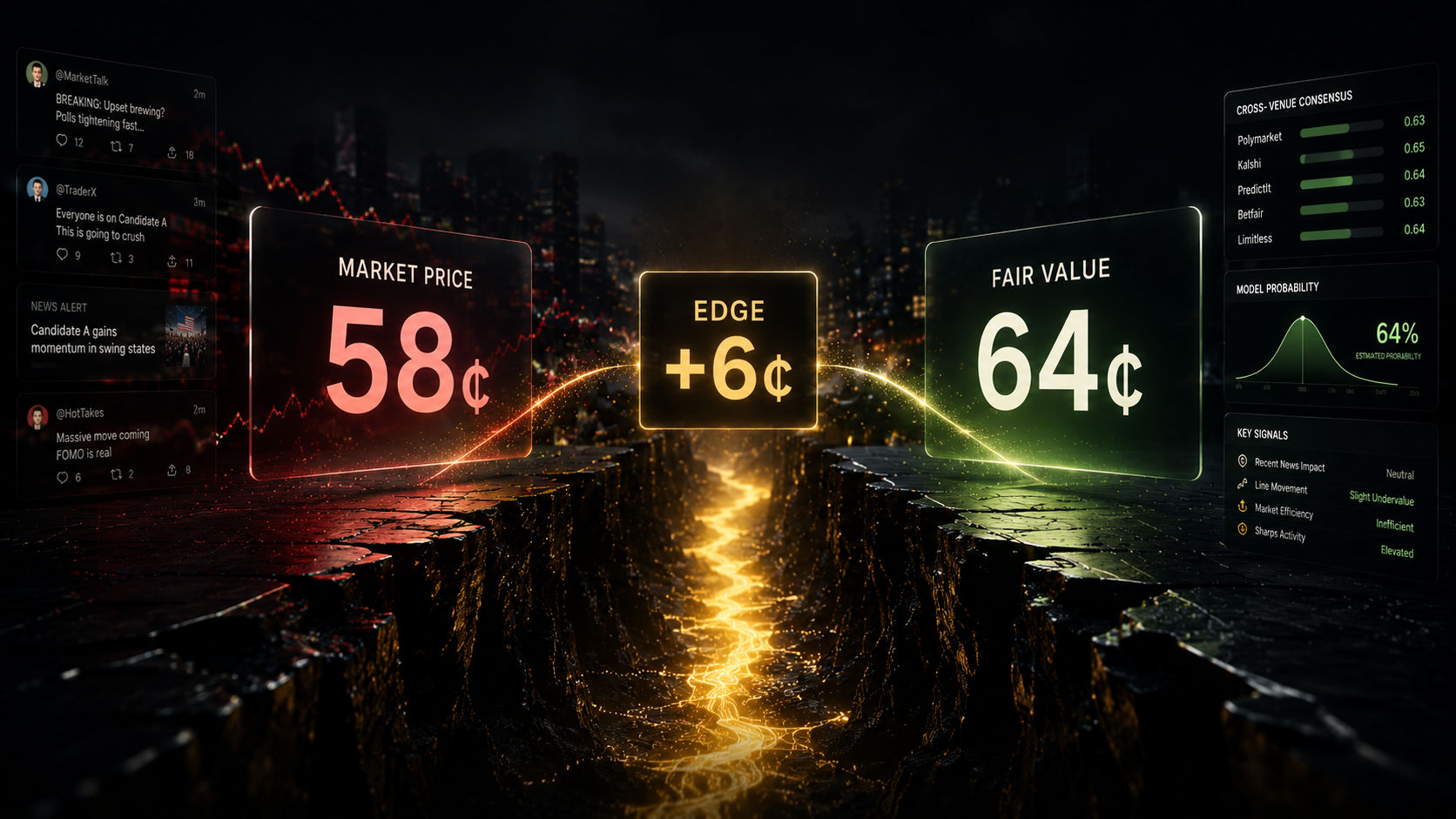
A contract trades at 58 cents. The crowd reads that as a price. A sharp reads it as a claim: the market is telling you this thing happens 58% of the time. The only question that matters is whether that claim is true.
Most of the time it isn't quite right. Prices drift on stale news, on one loud account, on a fee structure nobody recalculated, on a venue that hasn't caught up to the venue next door. The gap between what something trades at and what it's worth is the entire game. Find it, size it, take it. Everything else is decoration.
This is the one skill underneath all the others. Expected value, closing line value, edge detection are all just ways of acting on a fair-value read you already trust. So let's build that read from scratch.
Price is an opinion. Fair value is your estimate of the truth.
Start with the vocabulary, because the words get used loosely and that's where people lose money.
Market price is what you can buy or sell at right now. On a binary contract that settles at $1 or $0, a price of 0.58 means you pay 58 cents today for $1 that may or may not arrive tomorrow.
Implied probability is that same price read as a forecast. 0.58 implies a 58% chance. The contract and the probability are the same object wearing different clothes.
Fair value is your independent estimate of the true probability, converted back into a price. If you think the real chance is 64%, fair value is 0.64. The market says 0.58. That six-cent spread is your edge, assuming your estimate is better than theirs.
That last clause is the whole job. Fair value isn't a fact you look up. It's a judgment you defend. The market is a very smart, very fast crowd, and most of the time it's close to right. Your job isn't to disagree for sport. It's to find the specific moments when you have better information, cleaner math, or faster eyes than the price reflects, and to stay flat the rest of the time.
The mid is not the truth either
Quick trap before we go further. People see a bid at 0.56 and an ask at 0.60 and call the mid of 0.58 the “fair” price. It isn't. The mid is just the middle of the spread, a convenience. Fair value can sit anywhere relative to the mid. Sometimes the truth is 0.64 and the whole book is lagging. The mid tells you where the market is. It tells you nothing about where it should be.
Step one: turn price into probability, and back again
On a clean binary market, the math is almost insultingly simple. The price is the probability: a contract at 0.58 implies a 58% chance, and one at 0.07 implies 7%. To go the other way, take your probability estimate and that's your fair price. A 64% read gives you a 0.64 fair value.
Where it gets interesting is multi-outcome markets and odds-format markets, where the conversion hides a tax.
Decimal odds to probability
If a venue quotes decimal odds instead of cents, implied probability is 1 divided by the decimal odds. Odds of 1.80 imply 1 / 1.80 = 0.556, or 55.6%. Odds of 3.50 imply 1 / 3.50 = 0.286. Convert everything to probability first. Always work in probability space, never in odds space, because probabilities are the things you can add, compare, and sanity-check.
The sum-to-one test
Here's the test that catches almost everything. In a market with mutually exclusive outcomes that cover every possibility, the true probabilities must sum to exactly 100%. Three candidates, one winner: their real chances add to 1, without exception.
So convert each outcome's price to a probability and add them up. On a real market, you will never get exactly 100%. The total will run over, and that overage is the vig.
Step two: remove the vig (this is where most edge hides)
The vig, or overround, is the house's margin baked into the prices. It's why the implied probabilities sum to more than 100%. The market is quietly charging you to play, and if you read prices as fair probabilities without stripping it out, every contract looks worse than it is and you'll talk yourself out of real edges.
Removing it is called devigging, and producing the cleaned-up estimate gives you a no-vig fair value. Walk through it once with numbers and it stops feeling like jargon.
A worked example
Two-outcome market. Team A and Team B. The book quotes:
The probabilities sum to 105%. That extra 5% is the overround. To devig with the simple proportional method, divide each raw probability by the total:
Team A fair: 55.0 / 105.0 = 52.4%
Team B fair: 50.0 / 105.0 = 47.6%
Now they sum to 100%, as truth must. Your no-vig fair value for Team A is 0.524, not the 0.55 on the screen. If you were about to buy Team A at 0.55 because you “agreed with the market,” you were actually paying almost three cents over fair. The edge you thought you had was the vig wearing a disguise.
Proportional vs. the sharper methods
The divide-by-the-total method is fast and fine for a first read. It assumes the vig is spread evenly across outcomes, which isn't always true. Favorites and longshots get taxed differently, a quirk known as the favorite-longshot bias, and on lopsided markets the proportional method nudges your estimate off.
There are better tools. The multiplicative and Shin methods adjust for that skew and tend to land closer to true probability on uneven books. You don't need to hand-roll them every trade. You need to know they exist, know the simple method is an approximation, and lean on a system that applies the right one for you. More on that at the end.
Step three: triangulate across venues and signals
One devigged price is a data point. It is not the truth. The truth is what you converge on when several independent reads agree, and what you stay suspicious of when they don't.
This is where prediction markets get genuinely fun, because the same event often trades in several places at once, and those places disagree.
Cross-venue triangulation
The same outcome might trade at 0.58 on one platform and 0.63 on another. That five-cent gap is information. Either one venue is stale, or they have different liquidity, different participants, different fee drag. Your job is to ask which price is doing more work.
A few questions that sort it out fast:
Which venue has deeper liquidity and tighter spreads? Deep books move on real flow, not on one impatient buyer. They're usually closer to fair.
Which venue just printed volume? A price that moved on size is fresher than a price that hasn't traded in an hour.
Are the fee structures comparable? A venue with higher take or gas costs will show prices shaded to cover it. Devig before you compare, or you're comparing apples to taxed apples.
When a deep, active, low-friction venue says 0.63 and a thin, stale one says 0.58, you don't average them. You weight toward the one carrying more information and treat the gap as a possible edge against the laggard.
Signals beyond the order book
Price is the loudest signal but not the only one. Fair value sharpens when you fold in what the price hasn't absorbed yet:
Related markets. If a correlated contract just moved and yours hasn't, your contract is carrying stale information.
News and event flow. A lineup change, a ruling, a headline. The first price to react is rarely the one you're staring at.
Order-book shape. A wall of resting bids or a thin, gappy book tells you how much conviction is actually behind the last print.
Time to resolution. Probabilities should drift toward 0 or 1 as the event nears. A contract sitting at 0.50 the morning of resolution is either a true coin flip or a market asleep at the wheel.
None of these is decisive alone. Together they're how you build a fair-value read you can actually size a position behind.
Step four: the gap is the edge, but only if your number is better
Once you have a no-vig fair value you trust, the trade reveals itself. Fair value above market price means the contract is underpriced: you're buying a dollar of expected value for less than a dollar. Fair value below market means it's overpriced, and the smart move is to pass, or to sell if the venue lets you.
Fair 0.64 vs. market 0.58 is a six-cent edge per contract. That feeds straight into expected value: multiply the edge by your size and you have the dollar value of the trade before resolution ever happens.
But hold the discipline here, because this is where confidence turns into account damage. The edge is only real if your fair value is genuinely better than the market's. A six-cent gap built on a sloppy estimate isn't an edge. It's just you being wrong six cents louder than usual.
Two guardrails keep this honest:
Demand a margin of safety. Your estimate has error bars. Don't act on one or two cents of perceived edge, because that's inside your own noise. Want a gap wide enough that you'd still be ahead if your read were a little off.
Respect the closing line. If your fair-value reads keep landing on the right side of where the market settles at resolution, your process works. If they don't, the market was the sharper read and you were the vig.
That second point is exactly what closing line value measures, and it's the only honest scoreboard for whether your fair-value process is actually adding edge or just adding trades.
The catch: this is a lot to do by hand, every time, fast
Read back through what fair value actually requires. Convert prices to probabilities, then add them up. Strip the vig with the right method for the book's shape. Pull the same market from every venue it trades on. Weight by liquidity and freshness. Fold in correlated moves and news. Compare your number to the screen. Decide if the gap clears your margin of safety.
Now do all of that in the seconds before a fast market moves on without you.
This is the 5-tab problem in its purest form. The math isn't hard. Doing it across seven browser tabs, by hand, while the price you wanted evaporates, is what's hard. Most traders solve it by checking two signals and guessing the rest. That's not a fair-value process. That's a hunch with extra steps.
What the terminal does instead
The whole point of the DG3 terminal is to collapse that work into a number you can act on. It pulls prices across venues, devigs them, weights for liquidity and freshness, and surfaces the comparison directly: Fair 0.64 vs. Mid 0.58.
You're not opening a calculator. You're not reconciling tabs. You're reading one line that already did the triangulation, and spending your attention on the only thing a human should be spending it on, which is judgment about whether the edge is real.
The skill in this post is still yours to own. You need to understand what fair value is, why the vig matters, and why a six-cent gap can be either an edge or a trap, or you'll trust the number for the wrong reasons. But once you understand it, you shouldn't be the one doing the arithmetic in your head while the market runs.
The one thing to take with you
Price is what the crowd will pay. Fair value is what the thing is worth. Almost every dollar you make in prediction markets lives in the space between those two, and almost every dollar you lose comes from mistaking one for the other.
Devig everything you read. Triangulate before you trust. Demand a margin of safety. And when the market's moving too fast to do the math by hand, let the terminal hand you the number so you can spend your edge on judgment instead of arithmetic.
Fair 0.64 vs. Mid 0.58 - that line on the terminal. Learn to see that gap everywhere. Then go get the side of it that pays.
Expected Value - turn a fair-value edge into a dollar number before resolution.
Closing Line Value - the honest scoreboard for whether your fair-value process actually works.
The 5-Tab Problem - why doing this by hand across venues is the real bottleneck.
Sign in →