Kalshi vs Polymarket: Fees, Liquidity, Markets, and Who Should Trade Where
Two platforms, different structural advantages.
Two prediction market platforms. One is regulated. One has more liquidity. Neither is obviously better.
Kalshi and Polymarket are the two most serious real-money prediction market venues operating in 2026. They cover much of the same event territory – political outcomes, economic indicators, major news events – but they are built on different infrastructure, regulated differently, and draw meaningfully different participant pools. Those differences produce persistent pricing gaps on identical events, real regulatory implications for US traders, and distinct fee structures that affect expected value calculations on every position.
This is a full breakdown of how they compare across every dimension that matters.
Table of Contents
Quick Answer
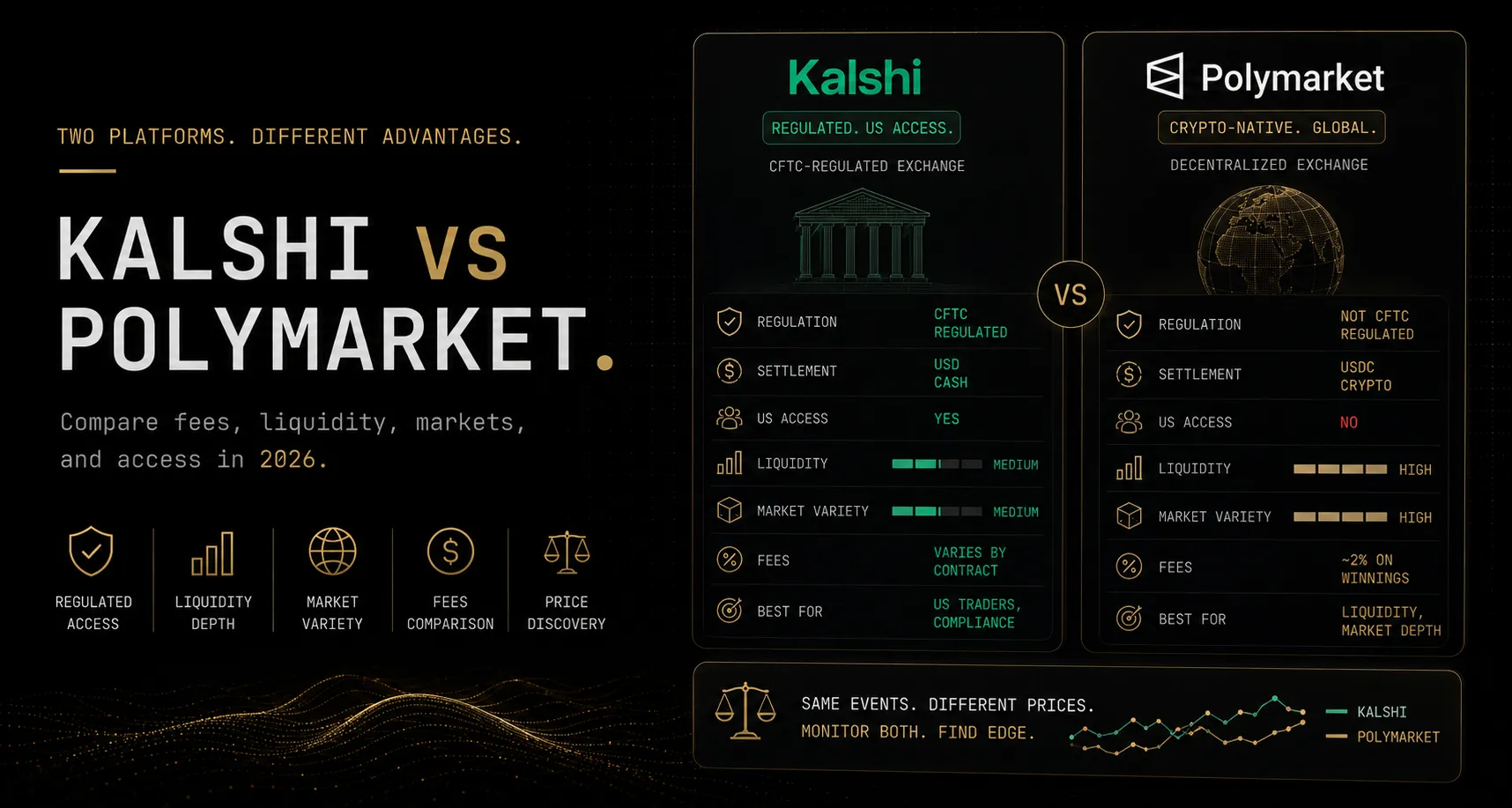
Kalshi is a CFTC-regulated US-accessible prediction market with USD settlement and institutional compliance. Polymarket is a crypto-native prediction market with higher liquidity on most major markets and a wider community-driven event catalog. US residents are legally restricted from trading on Polymarket. Both platforms frequently show different prices on the same events, creating arbitrage opportunities for traders who monitor both in real time.
Why This Comparison Matters in 2026
The decision is not purely about preference. For US-based traders, Polymarket’s regulatory status makes it a non-option for real-money trading without significant jurisdictional risk. That makes Kalshi the starting point, not the alternative. For non-US traders, the comparison is genuinely open – and the answer depends on what you are trading.
Beyond individual trader decisions, the Kalshi-Polymarket price relationship has become one of the most watched signals in prediction markets. During the 2024 election cycle, the gaps between the two platforms on presidential election markets attracted significant analytical attention. Traders who understood that these gaps were not noise – they reflected different participant compositions and information flows – extracted real edge from them.
Key Takeaways
- Polymarket has significantly higher liquidity on most major markets, especially political and crypto events
- Kalshi is the only major regulated real-money prediction market accessible to US residents in 2026
- Kalshi settles in USD, Polymarket settles in USDC – a distinction that matters for institutional participants
- Fee structures differ by market type: Polymarket charges roughly 2% on winnings, Kalshi’s structure varies by contract
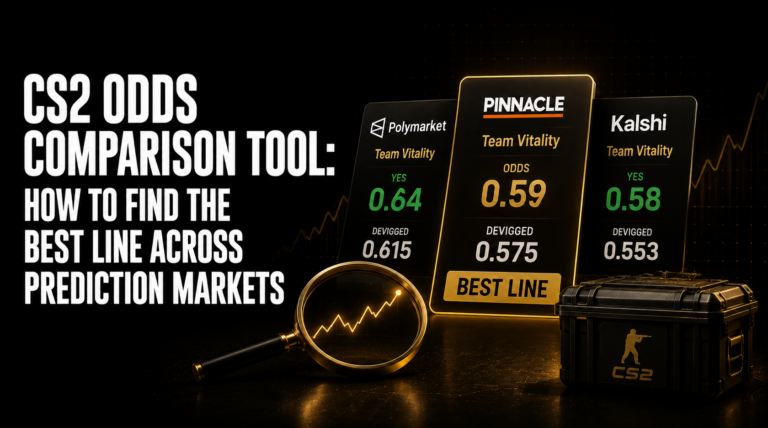
- The same event frequently trades at different prices on each platform, creating cross-venue arbitrage opportunities
- Market variety is wider on Polymarket (community-created) versus Kalshi (centrally approved contracts)
- Both platforms have covered major US political events, with Kalshi winning on regulatory legitimacy and Polymarket winning on pre-event liquidity depth
Fees: What You Actually Pay on Each Platform
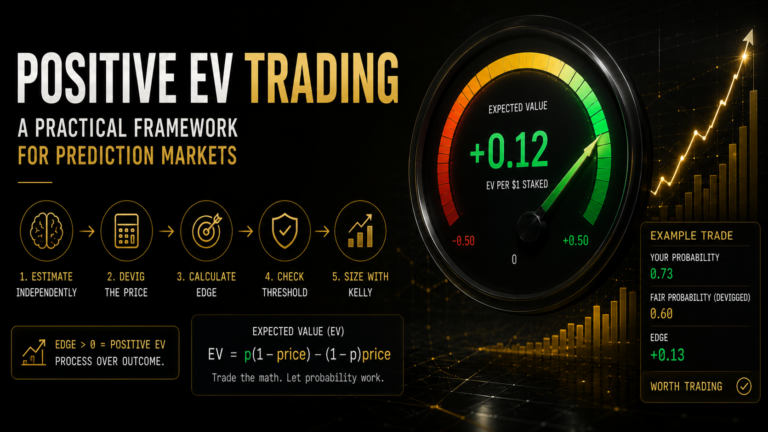
Fees are not just a cost center – they affect the expected value calculation on every position you take. A 5-cent edge in a market with a 3% fee structure is a materially different trade than a 5-cent edge in a 1% fee environment.
Polymarket fee structure: Polymarket charges a 2% fee on winning positions, taken at settlement. There are no fees on losing positions. The 2% applies to the gross payout, meaning a position that pays out $100 yields $98 net. For high-turnover traders taking many small positions, this 2% compounds meaningfully across a trading portfolio.
Kalshi fee structure: Kalshi’s structure is more complex. Fees vary by contract type and market category. Political contracts, economic indicator markets, and financial event markets each carry different fee schedules. In some market categories, Kalshi’s fees are lower than Polymarket’s 2%. In others, they are higher. The exact fee is disclosed at the point of position entry.
The fee comparison in practice:
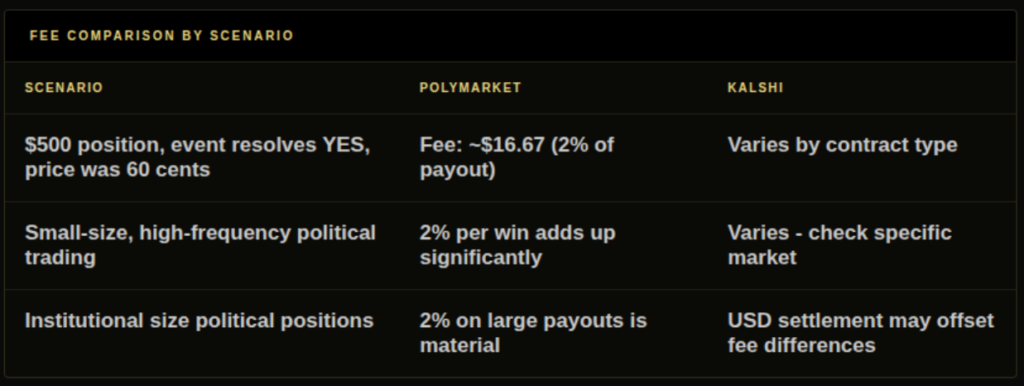
The practical takeaway: always check the specific fee for the specific market type before comparing edge across platforms. Do not assume lower fees on either platform without verifying.
Liquidity: Where the Volume Lives
Liquidity depth is the single biggest advantage Polymarket holds over Kalshi in 2026.
What liquidity depth means for traders: Liquidity is not just about whether a market exists. It is about how much of your position you can take at the current price before the market moves against you. A 7-cent edge in a market with $10,000 in liquidity means you might take $500 to $1,000 of that position before the price moves. A 7-cent edge in a market with $500,000 in liquidity means you can size appropriately.
Polymarket’s major political and crypto markets routinely attract millions of dollars in total liquidity. The 2024 US presidential election markets on Polymarket reached over $1 billion in aggregate trading volume. Kalshi’s political markets are growing but remain a fraction of Polymarket’s liquidity depth on equivalent events.
Where Kalshi’s liquidity is competitive: On economic indicator markets – Fed rate decisions, inflation readings, unemployment reports – Kalshi’s institutional participant base creates deeper liquidity than Polymarket for certain financial events. Institutional traders who are comfortable trading on regulated markets concentrate their activity on Kalshi, not Polymarket, which creates competitive liquidity pools for those specific contract types.
The liquidity gap in practice: A trader taking a $5,000 position on a major political event at the start of a news cycle will face meaningfully different price impact on Polymarket versus Kalshi. On Polymarket, $5,000 might move the price 0.5 to 1 cent in a liquid market. On Kalshi, the same position in a comparable market might move the price 2 to 3 cents, resulting in worse execution.
Market Variety: What You Can Trade
Polymarket’s community-driven market creation model produces a significantly wider event catalog than Kalshi’s centrally approved contract structure.
Polymarket market creation: Any user can propose a market on Polymarket. Community proposals are reviewed and approved by Polymarket’s resolution team, which assesses whether the event is clearly defined and resolvable. This produces markets on obscure political races, niche sports events, technology milestones, and cultural events that would not meet Kalshi’s contract approval process.
Kalshi market creation: Kalshi creates markets through an internal approval process designed to ensure legal compliance with CFTC standards. This produces a more curated catalog with fewer exotic markets but stronger institutional confidence in resolution integrity.
Category comparison:
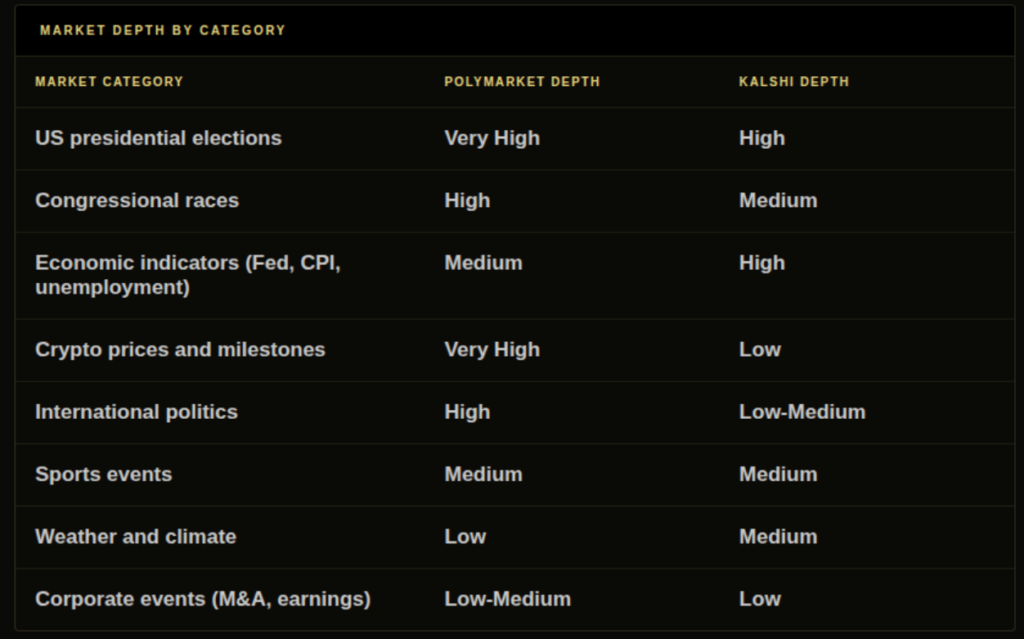
For traders focused on US political markets, both platforms provide adequate coverage. For traders who want international politics, crypto, or niche event markets, Polymarket’s catalog is substantially broader.
Regulatory Access: The Non-Negotiable Difference
This is the dimension that overrides all the others for US-based traders.
Polymarket and US access: Polymarket is incorporated outside the United States and has historically blocked US IP addresses. US residents who access Polymarket through VPNs or other means do so outside the platform’s terms of service and without regulatory protection. The CFTC has taken enforcement actions against unregulated prediction markets in the past.
Kalshi and US regulation: Kalshi received CFTC approval as a designated contract market in 2023. This is a different category of regulatory status than the unregulated prediction markets that have faced enforcement actions. US residents can open Kalshi accounts, fund with USD from US bank accounts, and trade with the same regulatory protections that apply to other CFTC-regulated exchanges.
What this means in practice: For individual non-institutional traders outside the US, the regulatory distinction is primarily a business risk consideration for Polymarket. For US residents, it is determinative – Kalshi is the regulated real-money option and Polymarket is not legally accessible without accepting meaningful regulatory risk.
Price Discovery: Do They Agree?
They frequently do not, and that disagreement is informative.
Price gaps between Kalshi and Polymarket on the same events are not random. They reflect:
- Different participant composition (institutional US traders on Kalshi vs. international crypto-native traders on Polymarket)
- Different information flows and market maker behaviors on each venue
- Different liquidity depths that affect how quickly information gets priced in
During the weeks before the 2024 US election, the Republican presidential candidate market showed consistent gaps of 3 to 8 cents between the two platforms. At various points, Polymarket showed higher probabilities than Kalshi – reflecting its higher proportion of participants who skewed toward the Republican outcome based on crypto and betting market information flows. At other points, Kalshi was higher – reflecting institutional money with different information sets.
Neither venue was simply right or wrong during this period. Both were aggregating different information sets from different participant pools. The gap between them was a measurable signal about where each participant base was positioned, and reading it is closely related to understanding fair value in prediction markets.
How to Trade Both (The Arbitrage Case)
Cross-venue arbitrage between Kalshi and Polymarket is real, accessible, and underexploited by most participants.
The mechanics:
- Identify events that trade on both platforms
- Monitor prices on both in real time
- When a persistent gap develops beyond transaction costs and fees, take the YES position on the cheaper platform and the NO position on the more expensive platform
- Collect the spread at resolution
The practical constraints:
- USDC versus USD settlement means position funding is different on each platform
- Resolution timing can differ if one platform resolves faster than the other
- The bid-ask spread on each venue must be included in the calculation – a 5-cent gap may narrow to 2 cents after realistic execution
The floor for profitable arbitrage is roughly 4 to 5 cents after fees and execution costs in most market conditions. During the 2024 election cycle, gaps above this floor were available for several weeks on major markets. This is the same dynamic that drives closing line value – the relationship between where a market sits now and where it settles.
Common Mistakes When Choosing Between Them
Choosing based on interface rather than trade economics. Both platforms have workable interfaces. The decision should be driven by fee structure, liquidity depth, and regulatory access – not which UI you prefer.
Assuming Polymarket’s higher liquidity makes it universally superior. For economic indicator and financial event markets, Kalshi’s institutional liquidity base may produce tighter spreads and better execution despite lower headline volume.
Ignoring the fee calculation on each specific market. The 2% vs. variable fee structure means that on some market types, Kalshi is materially cheaper. Run the fee calculation before assuming Polymarket is the better execution venue.
Missing cross-venue arbitrage by monitoring only one platform. The price gap between Kalshi and Polymarket on major events is a documented and recurring phenomenon. It is not visible at all if you are watching only one venue – the core multi-tab monitoring problem every serious trader runs into.
Treating USD and USDC as functionally equivalent for institutional purposes. For individual traders, the difference is minor. For institutions with regulatory and compliance constraints on cryptocurrency holdings, USD settlement on Kalshi versus USDC settlement on Polymarket is a structural differentiator.
Monitoring Both Venues at Once
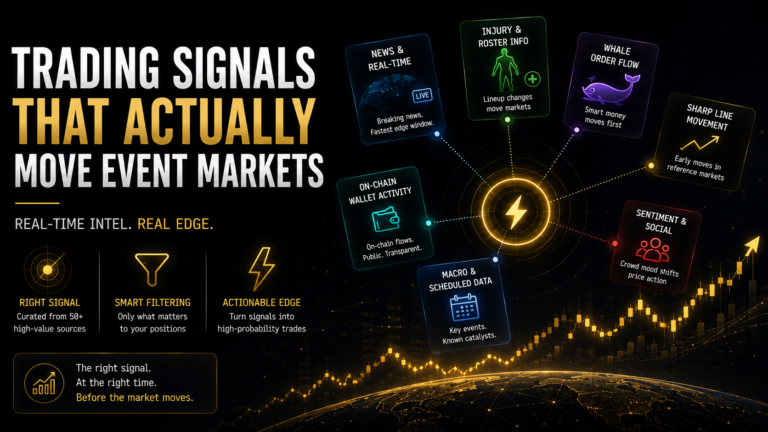
Tracking the Kalshi-Polymarket price relationship in real time requires pulling data from both platforms simultaneously and comparing prices on equivalent markets. No native interface provides this. The Edge Finder surfaces price and EV data on Polymarket markets. Multi-venue expansion is on the roadmap. The Intelligence pane’s Signals tab alerts traders to unusual order flow activity, often a precursor to price movement that creates the gap in the first place. Distinguishing that informed flow from noise is the same discipline behind reading sharp money versus public money.
For traders who want to run both platforms as a coherent strategy rather than two separate workflows, a unified terminal is the infrastructure requirement.
Frequently Asked Questions
Can US traders legally use Polymarket? US residents are blocked by Polymarket’s terms of service and face regulatory risk under CFTC rules regarding unregulated prediction markets. The platform blocks US IP addresses. Kalshi is the regulated, legally accessible alternative for US-based traders.
Which has lower fees, Kalshi or Polymarket? Polymarket charges a flat 2% on winning positions. Kalshi’s fees vary by contract type – some markets are cheaper than Polymarket’s 2%, others are higher. Always check the specific fee for the specific market before comparing net expected value across platforms.
Is Polymarket regulated? Polymarket is not regulated by the CFTC or any US financial authority. It operates as an offshore platform and blocks US users. Kalshi is a CFTC-designated contract market – a fundamentally different regulatory status.
Which prediction market has more liquidity? Polymarket has significantly higher liquidity on most major political, crypto, and macro markets. Kalshi has competitive or superior liquidity on certain financial and economic indicator markets where its institutional participant base concentrates.
How often do Kalshi and Polymarket disagree on prices? Price gaps between the two platforms on equivalent markets are common. Gaps of 2 to 4 cents are routine on major political events. Gaps above 5 cents on the same event have been documented and persisted for extended periods during high-profile political cycles. These gaps reflect different participant compositions, not random noise.
What does USDC settlement mean for Polymarket traders? Polymarket settles positions in USDC, a USD-pegged stablecoin on the Polygon blockchain. Funding and withdrawing positions requires cryptocurrency wallet infrastructure. Kalshi settles directly in USD via bank transfer or card, with no cryptocurrency requirement.
Does Kalshi have more markets than Polymarket? No. Polymarket’s community-driven market creation model produces a significantly wider catalog than Kalshi’s centrally approved contracts. Kalshi has more depth on specific financial and regulatory-compliant market categories, but Polymarket covers a broader event universe overall.
Can you trade both Kalshi and Polymarket at the same time? Yes, and many sophisticated traders do. Operating both accounts simultaneously enables cross-venue arbitrage on overlapping markets, access to Kalshi’s regulated market suite, and the ability to trade event types that are better covered on one platform than the other. The main operational complexity is managing two separate funding pools in different currencies.
Final Thoughts
Kalshi and Polymarket are not interchangeable. They are complementary – two different bets on how prediction markets evolve, with different regulatory frameworks, participant bases, and liquidity profiles. The most sophisticated prediction market traders in 2026 do not choose between them. They run both, monitor the gap between them, and trade both sides when that gap becomes wide enough to capture. DG3’s cross-venue monitoring makes that strategy operational rather than theoretical.
Author note
Written by the DG3 research desk. We build tools for traders who treat probability as a number to beat, not a line to accept. We track market microstructure, order flow, and cross-venue pricing across prediction markets every day.
Track the gap between venues Kalshi and Polymarket prices side by side, with cross-venue gaps flagged the moment they open. Sign up now – DG3 Terminal
Also read:
Polymarket Alternatives in 2026: Kalshi, Azuro, Manifold, and Where Each One Fits
Price Discovery in Prediction Markets vs Sportsbooks
Sports Betting vs Prediction Markets