.png?updatedAt=1779992389202)

No favourite, No script: What Prediction Markets reveal about the most open Roland Garros
By the time the first ball was struck at Roland Garros 2026, the tournament had already lost two of its three biggest names. Carlos Alcaraz - the two-time defending champion, the man Polymarket had priced at 51 cents on the dollar back in January - was watching from home with a wrist in a splint.
Lorenzo Musetti, who'd made the semis a year ago and somehow carried the highest trading volume of any player market at $8.33 million, had torn a muscle in Rome and wouldn't make it either.
And then most surprisingly, four days into the draw, Jannik Sinner - who'd ridden the chaos to 71.5% favourite - walked off Court Philippe-Chatrier having lost five sets to a man ranked 56th in the world.
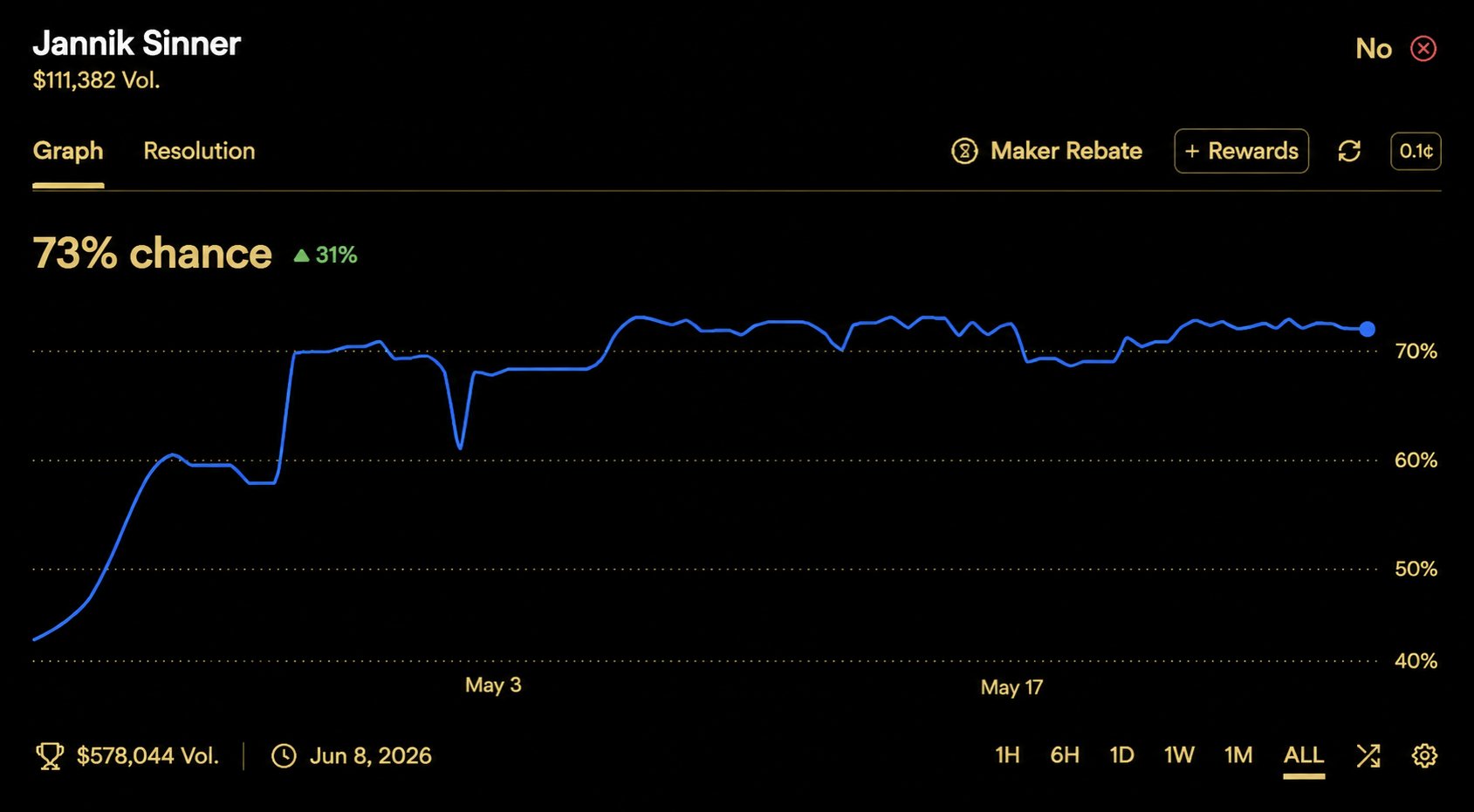
It didn't stop there. Novak Djokovic, the last Grand Slam champion left standing, was beaten in the third round. Casper Ruud, a three-time Roland Garros finalist, followed him out in the fourth. Both lost to the same 19-year-old Brazilian who had no Polymarket contract when the tournament began.
For only the fifth time in 42 years, two teenagers have reached the men's quarterfinals at a Grand Slam. This is not a normal French Open - it is about as far from one as you can get.
The January Signal
When Polymarket listed the 2026 Men's French Open Winner markets on January 2nd, every player opened at roughly 45-51% - binary yes/no contracts that hadn't been priced yet. Within the first sixty minutes, the corrections came fast.
Alcaraz dropped from 51% to 31.5% in a single hour.
Sinner fell from 48.5% to 38%.
Djokovic fell from 49.5% to 9.5% - before the first day of trading had closed.
This movement is normal and was expected. The markets were finding their level, and so they did very quickly. But look closer: Musetti's contract, which would go on to trade $8.33 million - more than any other player in the field - was immediately faded to 5% before most of Europe had finished breakfast.
Someone had a strong opinion on him from the jump. Four months later, he withdrew injured. The 5% price is the signal - that is where the sharp money sat from the very first hour. The $8.33 million in volume that followed is the noise: liquidity providers, arbitrage activity, retail punters trading against each other around a well-known name. The market didn't predict his injury. It simply decided, very quickly, that he wasn't worth 45%.
One contract that didn't move much in that first hour was Joao Fonseca - opened at 5%, held at 5%. Not a favourite, not ignored. Just quietly there. Remember that number.
The Alcaraz Chapter
Alcaraz had won Roland Garros back-to-back, and for all the tennis fans around the world, the final played in Paris last year became the most celebrated comeback story in the history of the sport. Carlos was the story of the tournament before it started, and at 51%, Polymarket agreed.
The horror, however, unfolded on April 24th, when this announcement came: a right wrist injury - tenosynovitis, picked up during a first-round win in Barcelona - had taken him out of Rome, then Paris, and eventually Wimbledon too.
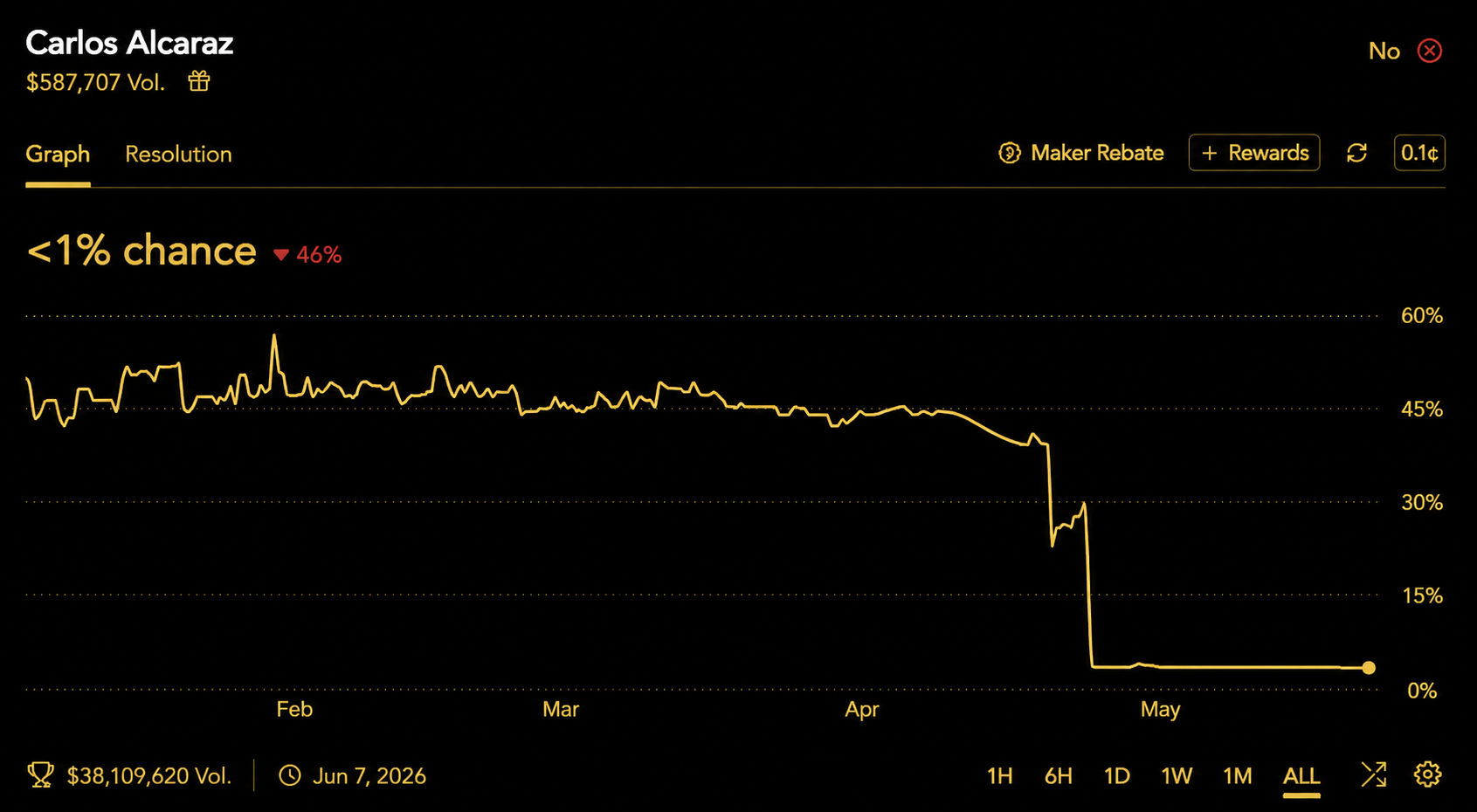
Within hours, his contract went from 35.5% to 0.4%. The speed of that move tells you something. This wasn't a slow bleed or a rumour gradually priced in. It was a cliff edge. And as one would expect, the money that had been sitting behind Alcaraz didn't wait around - it moved straight to Sinner like a tracer bullet.
At 17:00 UTC on the same day, Zverev picked up +1.8 cents without winning a match, without any news - purely from Alcaraz's exit repricing the field. Sinner's contract jumped from 41.5% to 65.5% in the same week as Alcaraz's announcement. The market didn't panic. It just picked a new favourite, and it did that fast.
The Rise and the Fall
For four months, Sinner looked like the story was writing itself, and honestly, it felt like the best story that was ever written in this sport. He won 30 consecutive matches, achieved the career golden masters, and played at a level no other player could match.
With Alcaraz sitting at home, Sinner consolidated his grip firmly on the world No. 1 ranking. Week by week, his contract climbed - 65%, 69%, 70.5%, and finally 71.5% in the week before the final showdown of the clay season began. The market had essentially decided the winner already.
Then May 28th happened. In 35-degree heat on Court Philippe-Chatrier, Sinner led Juan Manuel Cerundolo (World Ranking 56) in a match that was about to be wrapped up. He was leading 6-3, 6-2, 5-1, and was twenty minutes from the third round.
But his entire body started cramping at what should have been the finish line. He was not halfway through the match - he was five games from winning it. In what should have been the final games, Sinner was found battling heat exhaustion - his legs had nothing left.
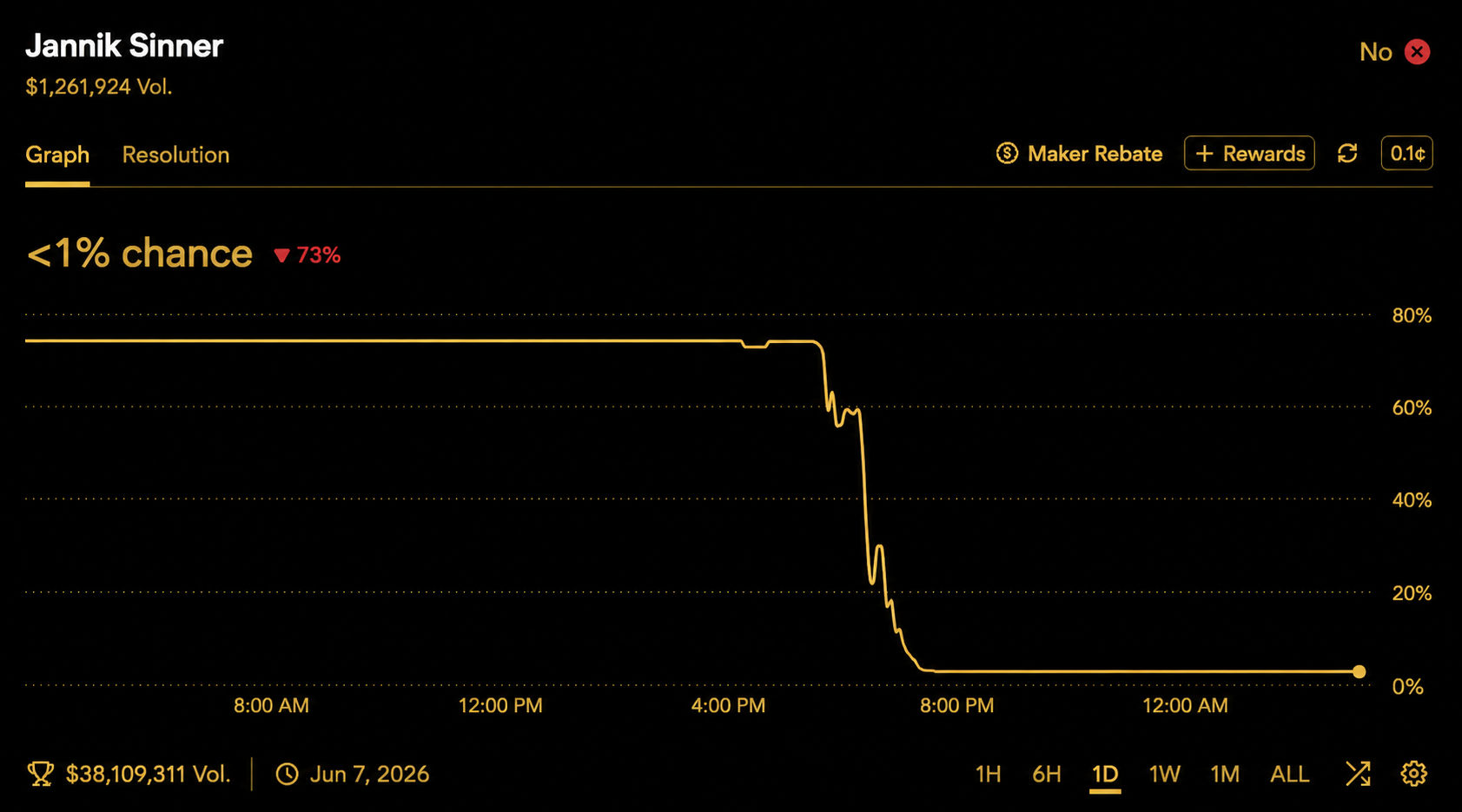
The underdog reeled off 20 of 21 points, including a run of 18 consecutive, turning a 5-1 deficit into a 6-5 lead, and then two more sets of 6-1. The final score, from Cerundolo's side: 3-6, 2-6, 7-5, 6-1, 6-1. On Polymarket, the reaction was instant: Sinner's contract fell from 71.5% to 0.1% within the duration of the match - a 71.4-cent collapse - among the largest single-player drawdowns ever recorded on Polymarket.
Zverev gained +10.7 cents at 13:00 UTC and another +16 cents at 14:00 UTC as the result spread. The man who was supposed to win this tournament was already on a plane home. And the man who sent him there didn't even have a Polymarket contract.
While you may think this is not the end of the upsets that took place. Somewhere in the draw, a 19-year-old Brazilian was sitting at 1.5%. In January, during the Australian Open, his contract had briefly touched 27% as he went deep in that draw and defeated one of the veterans - Andrey Rublev.
The market had seen him, respected him, and then forgotten him entirely when he lost. His name was Joao Fonseca. Remember that name, and remember that he started his Roland Garros run as a 1.5% favourite.
Who's Left
With the pre-tournament favourites gone and the draw in freefall, the market has reshuffled completely. Four names that nobody was talking about in January now carry the weight of this tournament.
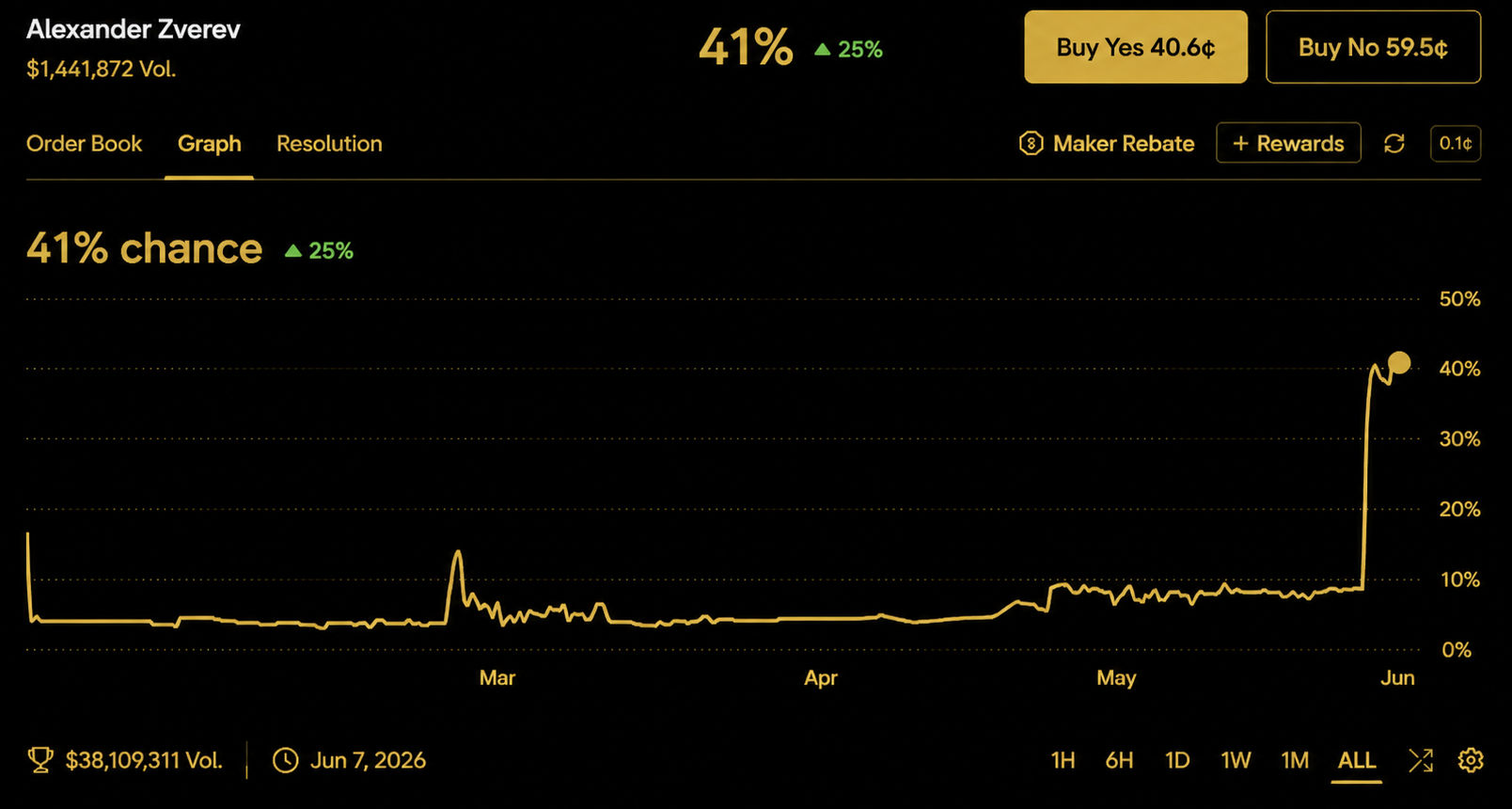
Alexander Zverev sits at 40.6% - the runaway favourite on paper, but a number that only materialised this week. For the first four months of this market's life, Zverev traded between 3% and 8%. Nobody wanted him. His contract picked up +1.8 cents when Alcaraz withdrew in April, crept to 7.6% by the time the tournament began, then exploded: +10.7 cents at 13:00 UTC and +16 cents at 14:00 UTC on May 28th as Sinner's collapse spread across the internet. Every elimination since has fed his price further. He gained another +4.3 cents on May 29th when Djokovic fell, and +4.4 cents on May 31st as he advanced through the fourth round. Two Roland Garros finals on his record. The last man standing with real clay pedigree. The market has finally caught up to that.
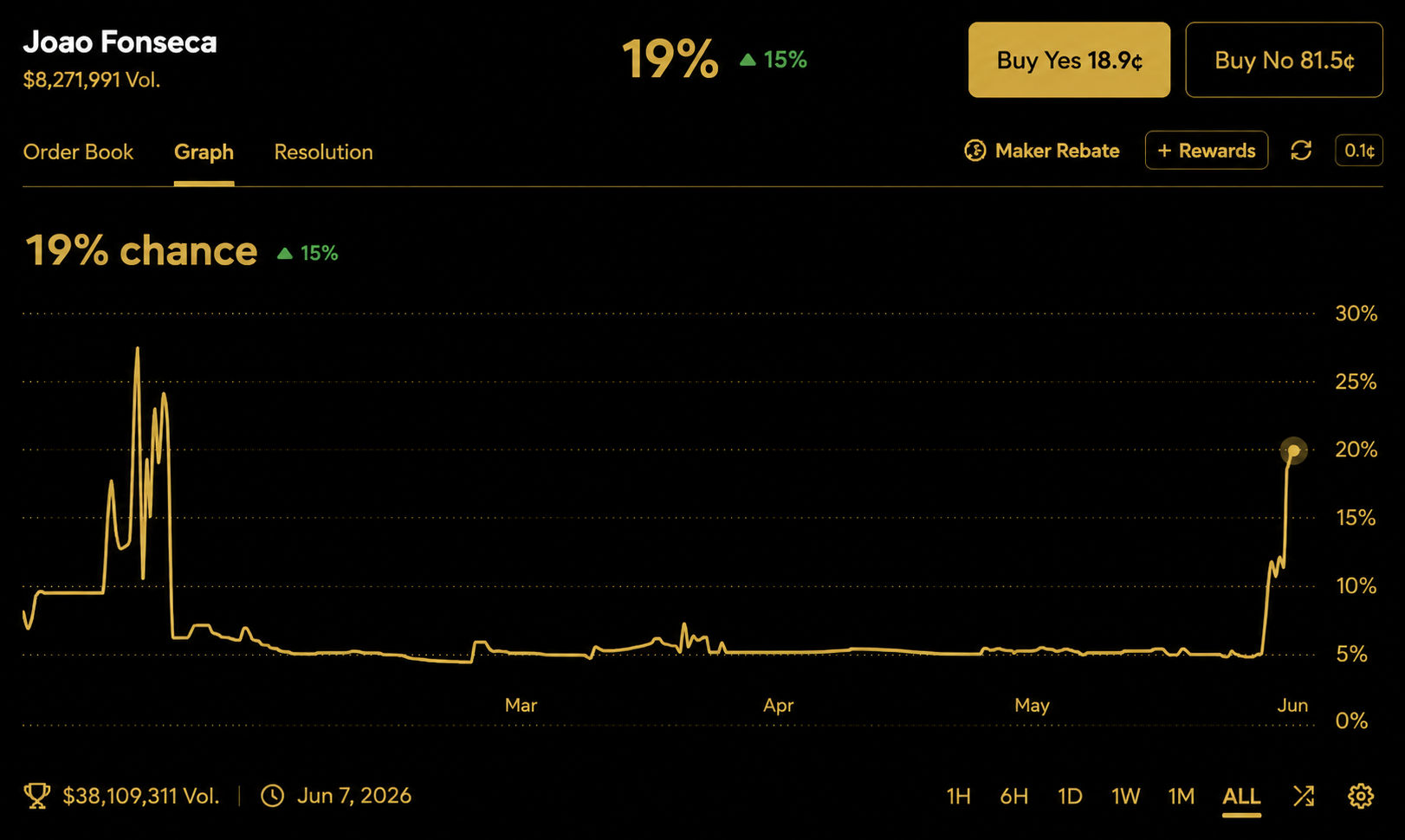
Joao Fonseca is at 18.6%. That number needs to be read alongside what happened to get there. On May 29th, his contract moved +3.1 cents at 17:00 UTC and +5.0 cents at 19:00 UTC - that is the Djokovic match closing out in real time. On May 31st, it moved +4.1 cents, then +3.9 cents, then +2.7 cents across three consecutive hours - that is Casper Ruud being eliminated, set by set. He was at 1.5% when the tournament began. He is now in his first Grand Slam quarterfinal, having beaten two of the biggest names left in the draw back to back.
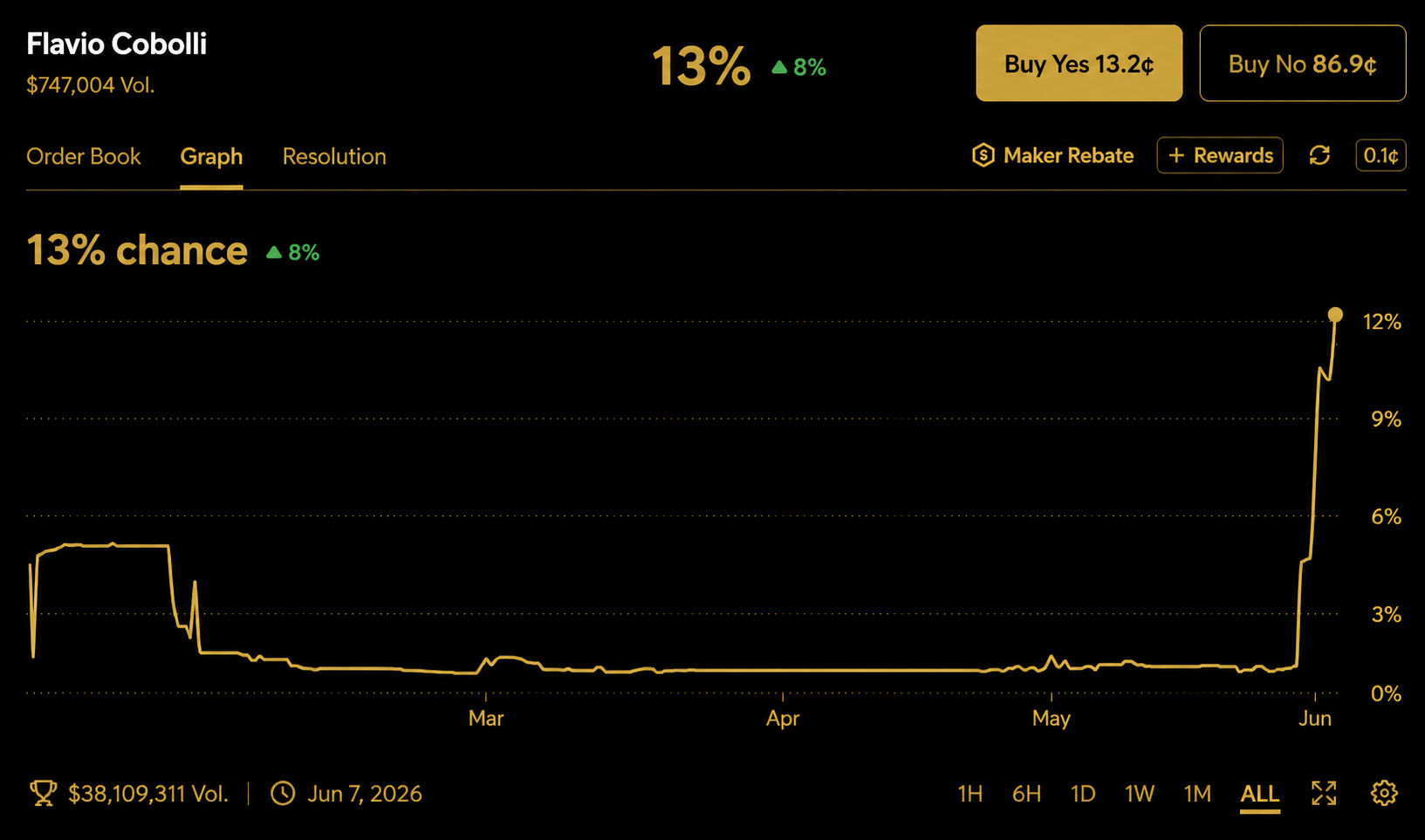
Flavio Cobolli is at 12.1%. He was at 0.4% when the draw began. The market had completely ignored him for five months. On May 30th, three consecutive moves of +2.7 cents, +1.6 cents, and +1.8 cents repriced him in real time as his results came through. Nobody had a position on him. Now he is third favourite.
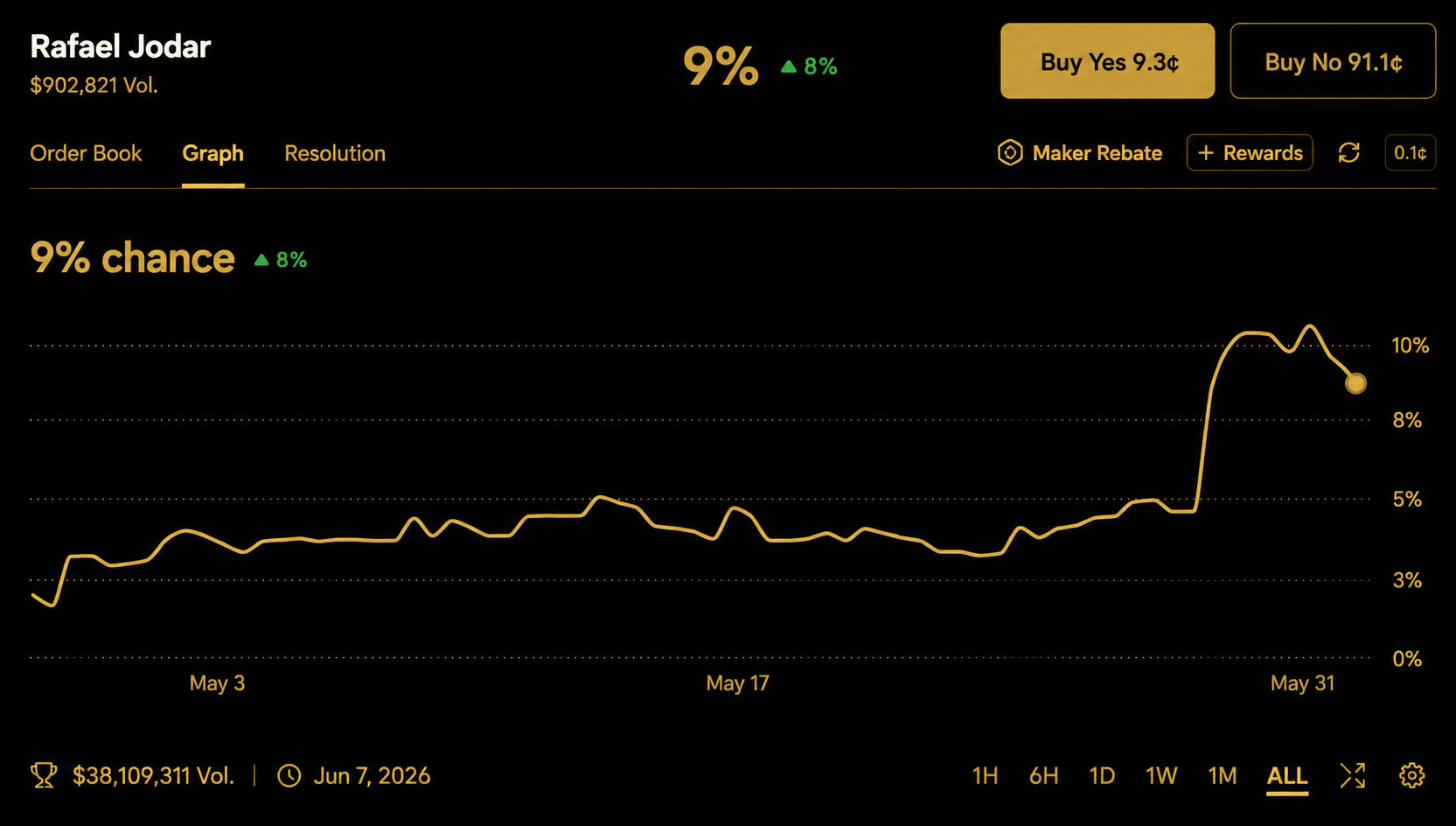
Rafael Jodar is at 9.8%. His contract did not exist in January - it was added in late April as an afterthought. It opened at 0.1%. On May 31st, his price collapsed 8 cents in one hour as he fell two sets down against Pablo Carreno Busta, then recovered +4.3 cents and +3.8 cents in the next two hours as he turned the match completely around, winning the final three sets 6-1, 6-2, 6-2. The market was watching his match in real time, set by set, cent by cent. He is 19 years old and in his first Grand Slam quarterfinal.
The honest answer though is that none of these numbers feel particularly convincing. When the entire top of the draw has been cleared, what does a 40% favourite even mean?
The Bracket Nobody Is Talking About
When we first started researching for Roland Garros, we noted that Zverev, Djokovic, and Ruud were all in the same half of the draw - on a collision course with each other, with at least two guaranteed to eliminate each other before the final. That prediction was correct. What nobody predicted was the manner of it.
They did not eliminate each other. A 19-year-old with no Grand Slam quarterfinal to his name walked through both of them. Djokovic fell in the third round on May 29th - his contract moved from 25.4% to 0.1% across two price drops of 11.3 cents and 14.2 cents as the match closed out. Ruud followed on May 31st, his contract dropping 5.1 cents and then 4.3 cents in the final two hours of his match. Both losses to the same player. The same-half collision happened - it just had an unexpected referee.
The other half of the draw, where Jodar, Cobolli, FAA, and Mensik are all still alive, has produced no such carnage. Four quarterfinalists, none of them priced above 12% when the tournament began, have found their way through a draw the market never mapped. The bracket did not make one side easier and one side harder. It made the entire draw impossible to read.
Where the Markets Disagree
The most useful thing prediction markets can do is disagree with the bookmakers. Here is where they do.
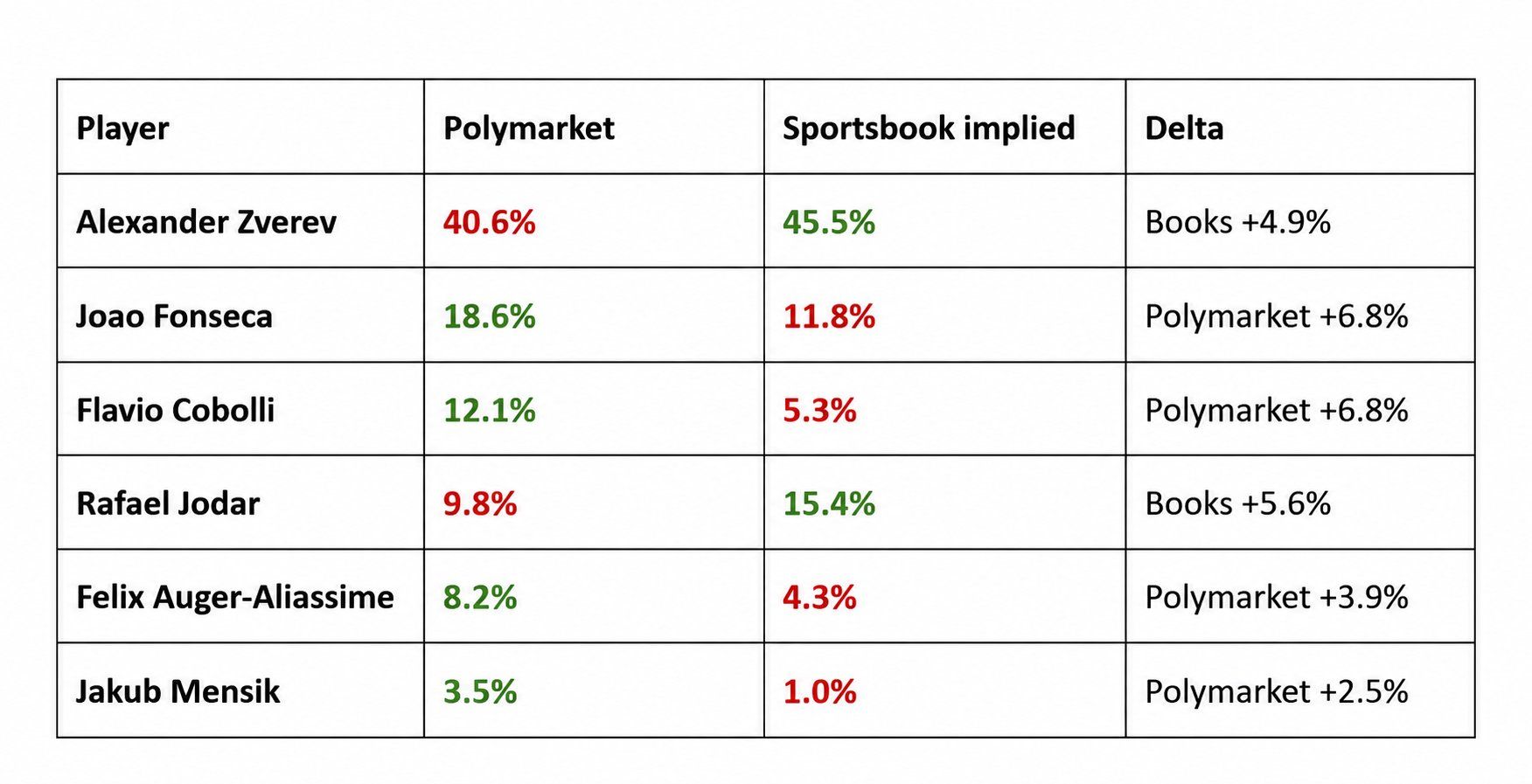
Sportsbook odds carry built-in margin, so the implied probabilities above are not a clean apples-to-apples comparison. But the direction of the gaps tells you something. Polymarket traders are significantly more bullish on Fonseca and Cobolli than traditional books.
Books are more bullish on Zverev and Jodar. The two biggest divergences - Fonseca at +6.8% and Cobolli at +6.8% - represent the market's collective bet that the teenager and the Italian who nobody priced in January are undervalued by the mainstream. Whether that is correct is what the quarterfinals will answer.
The Unwritten Chapter
In a nutshell, this is what Roland Garros 2026 has become. A tournament where the defending champion is injured, the world No. 1 is eliminated in the second round by a man with no Polymarket contract, two teenagers are in the quarterfinals for the first time in 42 years, and the current favourite spent most of the year priced below 8%.
The markets didn't predict this. Nobody did. But they showed it happening in real time - cent by cent, hour by hour, match by match. Every major upset in this tournament was written into the Polymarket data before the mainstream narrative caught up. Sinner's collapse, Djokovic's exit, Fonseca's rise, Cobolli's emergence from 0.4% - it was all there, if you knew where to look and how to read it.
That is exactly the problem DG3 was built to solve. The terminal tracks line movements, whale positions, and market signals across prediction markets in real time - finding the kind of edge this article spent thousands of words reconstructing by hand.
The alpha cohort waitlist is open now at dg3.trade, with about 50 seats left. If you trade on prediction markets, or want to, this is where the serious money is already watching.
The quarterfinals in Paris begin. The next chapter is genuinely unwritten. But the market will price it before anyone else does. Make sure you catch it before it is too late.
Sign in →