.png?updatedAt=1779992389202)
Prediction Market Platforms Have Failed Both Casual & Pro Traders
There's a moment, sometimes an hour before kickoff, sometimes ten minutes before a Fed statement, when the price on a prediction market starts to drift.
Not crash. Drift.
A penny here. Two pennies there. By the time the news hits Twitter, the line has already settled into its new home. The casual trader sees the headline, opens the app, and thinks they're early.
They're not. They're late. And they’re just watching the receipt print.
This is the part of prediction markets nobody warned you about - the part where the price is the news, not a reaction to it.
The headline arrives after the market has already moved.
The signal is scattered across too many tools.
The gap between knowing and acting leaks value.
What a casual trader actually sees
The strange thing about prediction markets is that they look like betting and behave like trading.
A casual user opens a contract - "Will the Fed cut in December?" trading at 62¢ - and sees a price. They don't see what's underneath. The order book skewing one way. Liquidity thinning. A top-50 wallet that took a position three minutes ago. Implied vol suddenly compressing.
That's the iceberg. Most prediction market platforms only show you the tip.
So the retail user does what anyone does when overwhelmed - they go with feeling. A team they like. A take from Twitter ninety minutes ago. By which point the smart money has already eaten lunch and gone home.
It's not that retail is slow. It's that the screen is lying about what it's showing them.
How pros actually trade
Pros work differently because they have to.
Open a real prediction market trader's screen and you'll find a cluttered mess. Discord scrapers feeding alerts. A spreadsheet pulling APIs from three venues. A Telegram bot pinging on whale flow. Two browser windows for sportsbooks, one for crypto, one for politics.
It's not because they like operating like that. It's because nobody built the trading terminal yet. So they built one themselves, badly.
Too little signal
The casual trader is overwhelmed by what's on screen.
They see the market price, but not the order-flow, wallet movement, liquidity changes, or venue divergence underneath it.
Too much fragmentation
The pro is overwhelmed by what isn't on screen.
They are forced to stitch together signals manually across tabs, bots, APIs, sportsbooks, dashboards, and spreadsheets.
The casual trader is overwhelmed by what's on screen. The pro is overwhelmed by what isn't. Same product. Same category. Two different failures.
Sports prediction markets are the front line
The category that's outgrown its tools fastest is sports prediction markets.
A few years ago, pre match analysis meant watching the pundits at noon. Post match analysis meant a podcast on Tuesday. Now the analysis is happening live, onchain, in the order book.
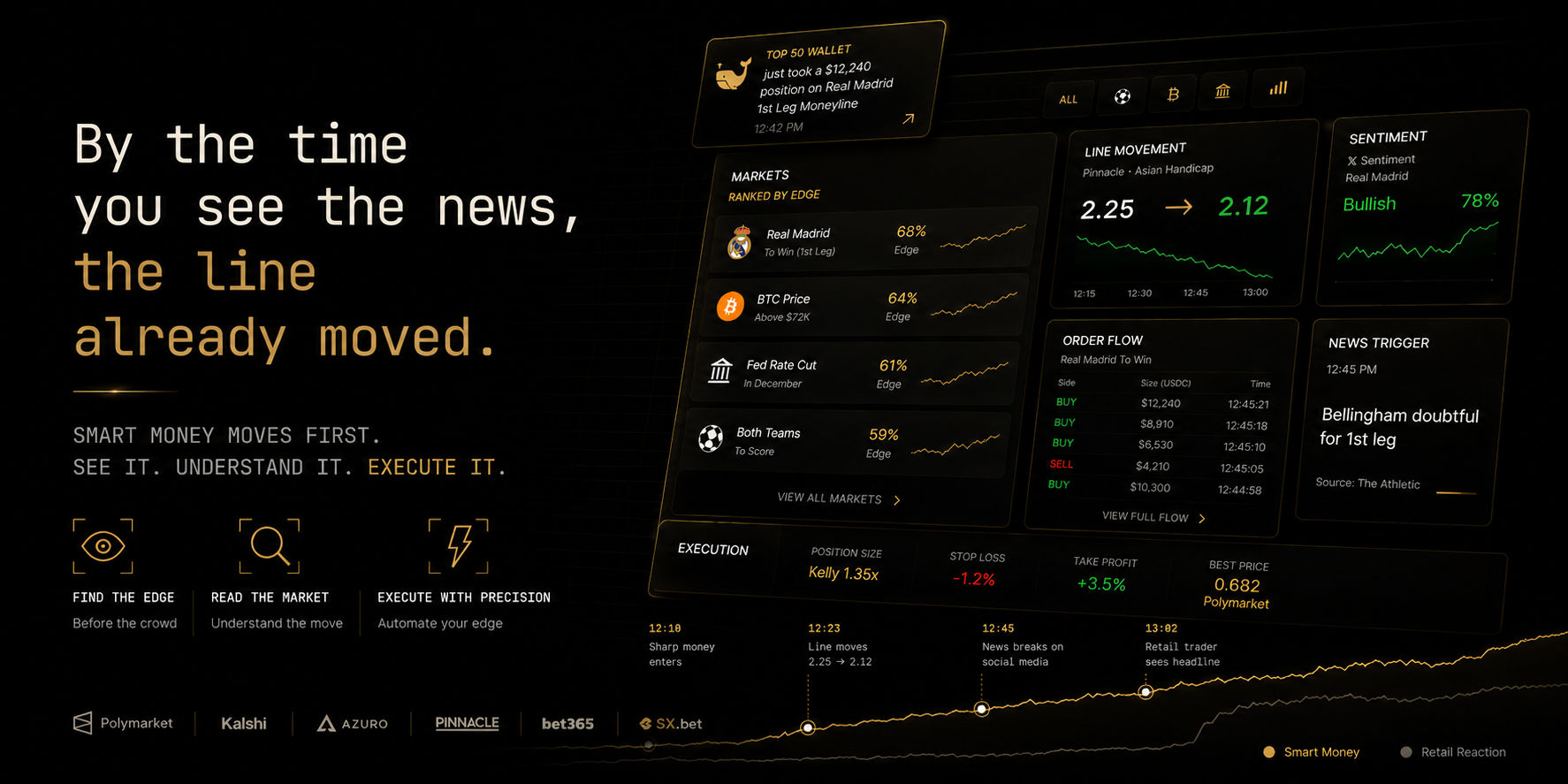
An asian handicap line on Pinnacle drifts from 2.25 to 2.12 - sharp money confirmed. A correct score contract reprices on Polymarket twenty seconds later. A both-teams-to-score market on Azuro starts to lean. By the time the average punter pulls up a soccer games analysis blog or a football match analysis breakdown, the entire conversation has already happened in the prices.
Match analysis used to live in editorial. Now it lives in the spread.
The gap between knowing and acting
When something happens - Bellingham pulled with a hamstring, BTC rips through a key level, an exit poll leaks - the line moves first. Then the news catches up. Then Twitter catches up. Then the trader catches up.
By that point, the edge is already a memory. Casual traders aren’t slow. Their stack is. The information exists. It's just not on their screen.
A real prediction market trading terminal would surface the move before you went looking for it. It would tell you a top-50 wallet just took a $12K position on Madrid's first-leg moneyline before you had to scroll Twitter to find out. It would chart the sharp line move from Pinnacle 2.25 to 2.12 alongside the X sentiment shift and the news headline that triggered it. It would Kelly-size the position before you even decided to enter.
That tool didn't exist a year ago.
What the best trading terminal for prediction markets actually looks like
DG3 was built around one idea - that the gap between knowing and acting is the entire game.
Markets ranked by edge before you start hunting. Signals filtered to the specific position you're in, not a generic feed. Execution that runs while you sleep. Discover. Analyze. Automate.
The interesting thing isn't that pros want this. Pros have always wanted this. The interesting thing is that casual traders want it too, even if they don't know what to call it yet. With this stack they start to see what high-conviction flow looks like. Starts to notice when smart money fades the public. Starts to think a level deeper than the team they happen to like.
The terminal doesn't make you a pro. It just levels the playing field for you.
The next phase of prediction market trading
The next phase of prediction markets is going to look a lot like the first two decades of equities - a slow professionalization of an asset class that started as retail entertainment and ended up institutional.
The platforms that win this phase won't be the loudest. They will be the ones that reduce latency between signal and action.
More markets are not enough. More contracts are not enough. More feeds are not enough. Traders do not need another place to click. They need a layer that tells them what matters, why it matters, and how quickly the opportunity is closing.
Prediction markets have already become serious. The tooling has not caught up.
Casual traders need context. Pro traders need consolidation. Both need the same thing: a cleaner path from information to action.
The price is often the news. The trader who sees that first gets the edge.