.png?updatedAt=1779992389202)
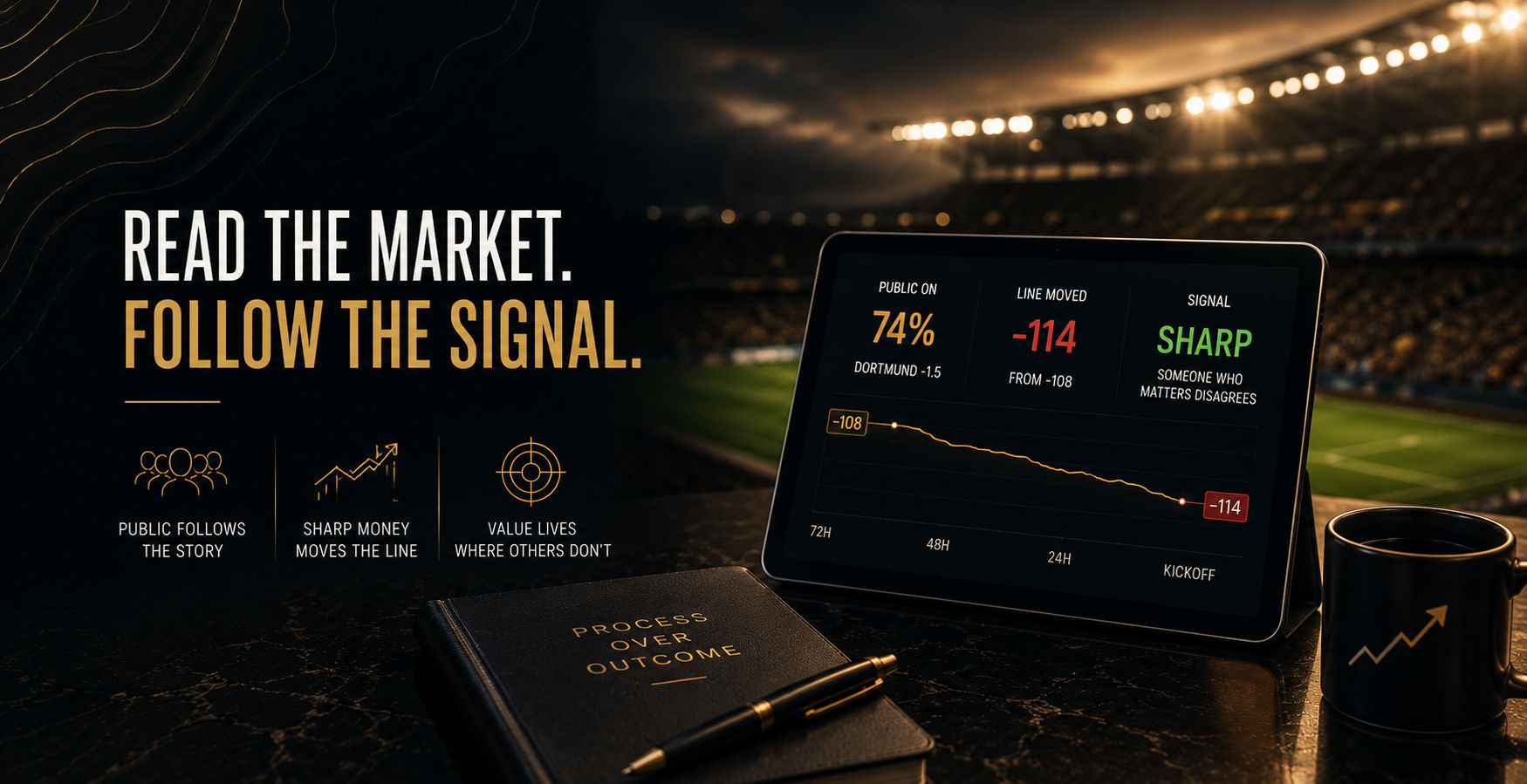
The Public Was Loud. The Line Said Otherwise.
Dortmund -1.5. All morning.
From -108. Against them.
Someone who matters disagrees.
"Sofia had 74% of the market with her. Luca had the line. He didn't touch Dortmund. He took the other side."
When 74% of tickets are on one side and the line moves against that side - the market is not making a mistake. It is telling you something the percentages aren't. A small number of accounts the bookmaker respects have bet the other way. That is all the information you need.
This is what reading sharp money actually looks like. Not a subscription. Not a tipster. Just the market disagreeing with the crowd - in public, in plain sight.
Books don't balance action.
They manage exposure.
Three syndicate bets can shift a line further than five hundred recreational tickets. The bookmaker tracks which accounts are right over time. When those accounts place a bet, the price adjusts - immediately, regardless of ticket flow on the other side.
The move from -108 to -114 against 74% public backing was not noise. It was the book repricing risk because it knows who is on the other side. Ticket percentages tell you what the crowd believes. Line movement tells you what the market knows.
Three signals.
No subscription required.
Professional action leaves tracks in public data. You don't need access to proprietary feeds to read them. These three signals are visible in any market - and when they converge, they are pointing at the same edge the syndicates are sitting on.
The line moves against the majority.
When public ticket flow is heavily on one side but the spread or moneyline moves the opposite direction - with no news catalyst - a respected account has been at the window. The book doesn't move for volume. It moves for source.
The money doesn't follow the tickets.
Recreational bettors stake similar amounts. Professionals don't. When a large gap appears between ticket percentage and money percentage, it means a small number of accounts placed outsized bets on the unpopular side. That is professional action by definition.
When the line moves changes what it means.
Sharp money hits when lines are softest - the opening hour, days before the event, when prices haven't been shaped by public volume yet. Late movement is almost always recreational. The same six-point shift means something entirely different at 72 hours out versus match morning.
The public bets stories.
Professionals fade them.
Dortmund's narrative was real. Three consecutive wins, strong home record, a forward the press had featured five times by Wednesday. The story was compelling - which is exactly what made it expensive.
When a narrative reaches peak volume, recreational bettors pile in. The bookmaker adjusts. The price inflates past what true probability justifies. The value doesn't disappear - it migrates. To the side nobody is writing about.
"Narratives are what sharps fade. Not because they're wrong. Because they're already priced in. The value was always on the other side of the story."
Bets momentum. Whoever is winning, whoever is trending, whatever the headlines say this week.
The most talked-about team is almost always the most overpriced.
Bets mathematical edge. Where the true probability diverges from the implied probability. Story is noise.
Found on the unfashionable side. The quiet away draw. The market nobody is watching.
Loudness is the enemy of value. The edge lives where the story isn't.
Five questions.
Read the market, not the headlines.
You don't need to know who placed the sharp bet. You need to know whether the market is telling you something the public hasn't processed yet. Run this before you commit.
Where did the line open?
Find the opening price. Compare to now. Movement without a news catalyst is market intelligence - not coincidence.
Does the money match the tickets?
Pull both percentages separately. A gap of 15+ points between ticket % and money % is the clearest fingerprint of sharp action in any market.
When did the line move?
Early-week movement is professional. Match-morning movement is public. The timing of a shift changes everything about what it means.
How loud is the public story?
If everyone is writing about one team, the price is already distorted by the people who read it and bet it. Loudness inflates. Look at the unfashionable side first.
Do all three signals align?
Reverse line movement, ticket/money gap, and early timing all pointing the same direction is a high-confidence read. Don't discount it because it feels counterintuitive. That discomfort is the edge.
"70% of people can be on the right side and still be on the wrong price."
The market is not a democracy. Seventy percent of tickets tells you what the crowd believes. The line moving against that seventy percent tells you what the market knows. On a long enough timeline, those are different things - and only one of them pays.