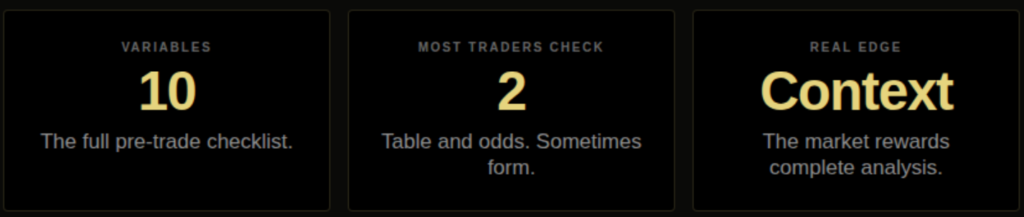
Ten Things That Move Football Markets. Most Traders Check Two.
A guide for prediction market traders who want to stop leaving money on the table.
Icarus had wings, a clear sky, and complete confidence. He also had no risk management. Football prediction markets are full of Icaruses. They fly well until they do not.
Every week, favourites lose to teams they should have beaten comfortably. Every week, traders who did their homework still get burned. Not because they were unlucky, because they were incomplete. They checked the table and called it research, saw the odds and called it analysis. They placed the trade and called it a decision.
This covers everything worth knowing before a single position gets opened.
Table of Contents
One
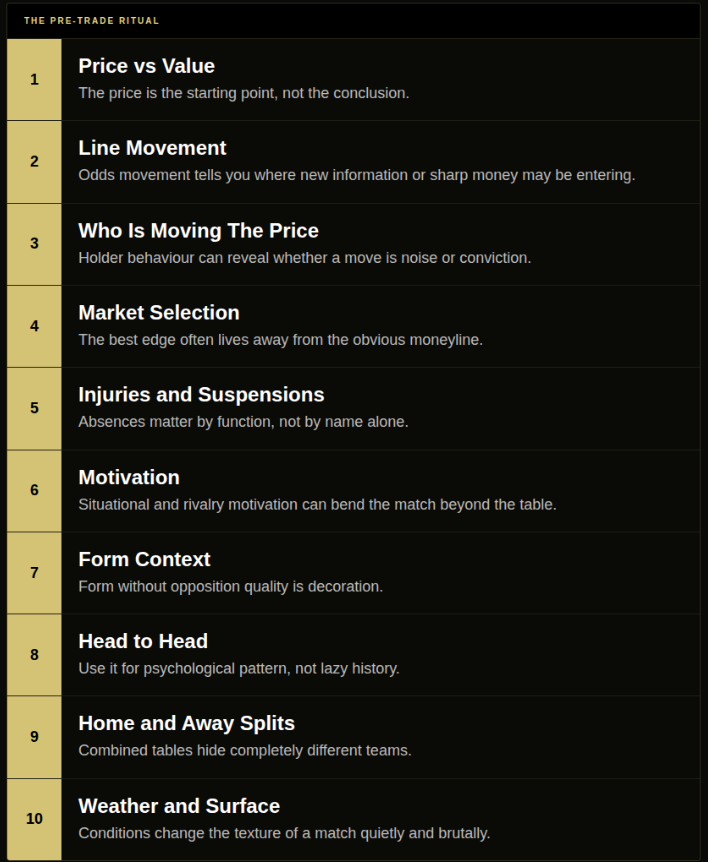
The Price and the Value Are Not the Same Thing
The last thing to check is the one most traders do first. The price shapes the opinion before the analysis even begins, and once that happens, most people aren’t really analysing anything. They’re justifying.
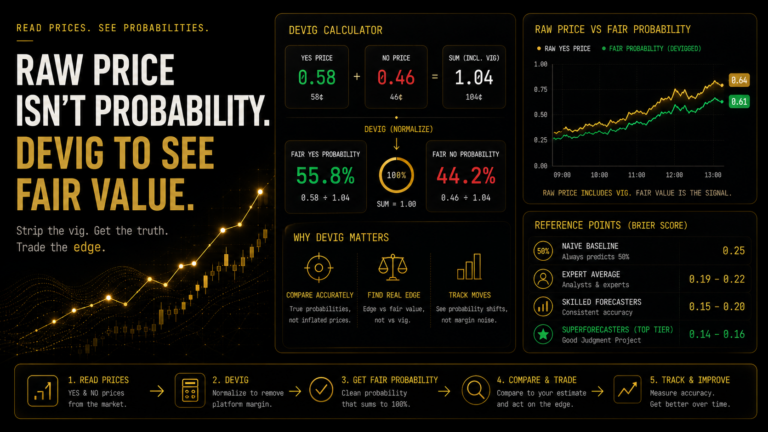
A market trading at 63 cents does not mean that team will probably win. It means the market thinks the probability is around 63%. That probability might be right. It might be wrong. A favourite can be significantly overpriced. An underdog can represent strong value. The odds are the starting point, not the conclusion.
A useful habit is to open the main moneyline first, not to trade it, but to read it. Where is the market’s confidence sitting? Which side is absorbing size? Use it as a compass before deciding which market to actually operate in.
Manchester City entering the 2024-25 Premier League season with their market trading at 48 cents to win the title is the best recent case for why this matters. On paper the price made sense. Four consecutive titles, Guardiola in the dugout, Haaland up front. What the market did not fully price in was Rodri’s ACL injury, the age of key players, and a squad that had been running at maximum capacity for four straight seasons. Liverpool were trading at 13 cents pre-season. City finished third. The traders who asked whether a 48 cents market actually reflected the real probability of a fifth consecutive title had a very different view of what was on offer.
The question is never “who is likely to win.” It is “what does the market think the probability is, and do I agree?”
Two
Line Movement Tells a Story
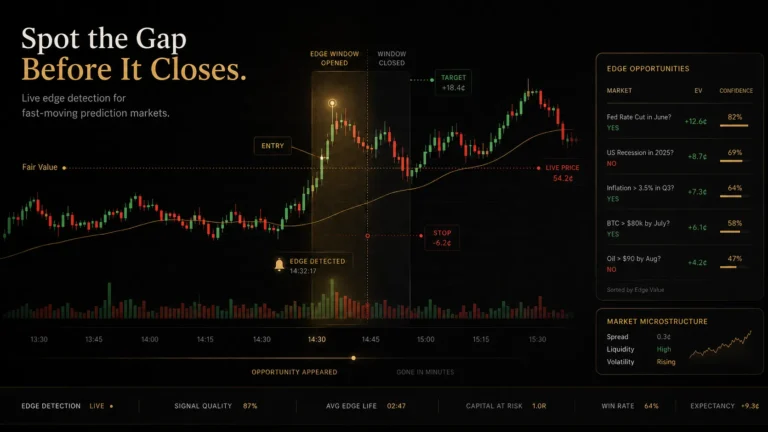
The market is not neutral, and the traders who treat it like it is are the ones funding everyone else’s positions. When odds move significantly in the hours before kick-off, something has changed. Either information has entered the market that was not public before, or sharp money has come in on one side, or both.
The direction of the move matters as much as the price itself. A market trading at 68 cents that drops to 40 cents by kick-off is not a buying opportunity by default. It’s a signal that someone who knows something has decided the original price was wrong.
The moment credible team news breaks, markets react within minutes. When Liverpool’s Virgil van Dijk has been flagged as a doubt before a fixture, the over 2.5 goals line tightens almost immediately, because the market understands what his absence means to Liverpool’s defensive structure before most traders have even read the headline.
Timing matters more than most traders realise. Opening a market more than 24 hours before kick-off, the early phase is reconnaissance. Prices are loose, positions are thin, and most of what you are seeing is noise. The real action happens closer to line closure, when informed money arrives with conviction and the price starts reflecting something closer to reality.
Three
Know Who Is Moving The Price
Traditional sports betting is a one-way window. You see the odds. You do not see who set them, who moved them, or what they know that you do not. Prediction markets are different. The information is there. Most traders never look for it.
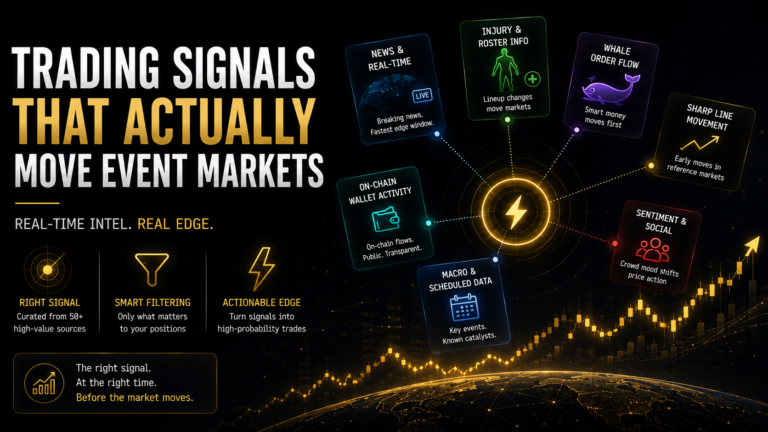
Every significant price movement has a source. Someone entered a large position. A whale doubled down. A cluster of profitable accounts aligned on one side before the broader market caught up. These are not random events, and unlike line movement alone, which tells you that something changed, holder analysis tells you who changed it and whether they are worth following.
The process starts with noise reduction. A market with hundreds of active positions contains maybe five to ten accounts worth paying attention to. Filter by liquidity, position size, and track record. Cut 80% of the activity and what remains is the part of the market that actually knows something.
The most important signal is convergence. When a large holder, a smart money account, and a sport-specific trader with a strong track record all land on the same side of a tight handicap market independently, that’s not consensus. That’s compression of separate signals. That is when a position starts to make sense.
Four
Know Which Market To Be In
Start here before anything else: which market on this fixture actually gives you room to be right?
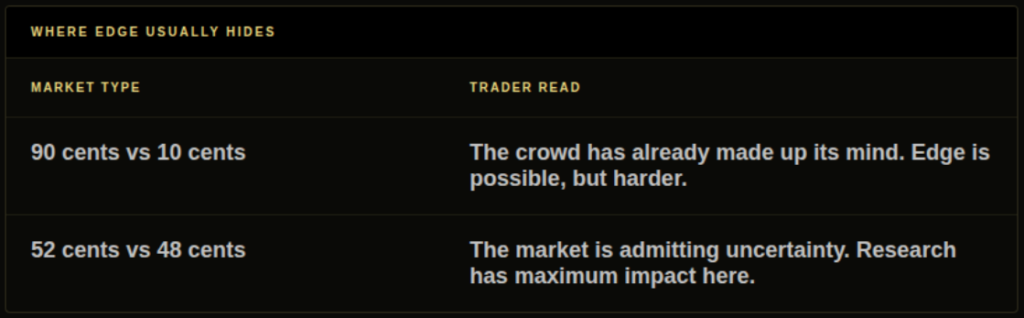
The main moneyline on a heavily favoured team tells you the outcome most people expect. It does not tell you much else. The price is high, the margin is thin, and the edge available to an informed trader is small. Everyone already knows the favourite is supposed to win.
The market worth operating in is the one that admits uncertainty. On a prediction market, that’s usually the handicap or spread equivalent, where both sides sit close to 50 cents. When a market is priced near even, it’s acknowledging that the outcome is genuinely unclear, and that uncertainty is exactly where information edge has maximum value.
Five
Injuries and Suspensions Are Not Equal
Losing a third-choice striker and losing the player who controls tempo from midfield are not the same event, and treating them like they are is one of the most common mistakes traders make.
Before placing a trade, map the absence to the function. Who covers that role? Has the team shown they can play without that profile? In the Premier League, losing a pressing forward might cost a team one chance per game. Losing the defensive midfielder might cost them the entire structure.
Suspensions matter more than most traders account for because they’re guaranteed. Injuries come with fitness percentages and late tests. A suspension is certain. A player missing a big match on accumulated yellows has zero chance of appearing. That certainty should be factored differently to an injury doubt.
Six
Motivation Is Invisible Until It Is Not
This one’s harder to pin down than the others, but it causes more losses than almost any variable that does show up in the data.
It comes in two forms. The first is situational motivation. A team that has already secured a top-four finish playing the final home game of the season against a side fighting relegation. A manager who has just been told he is leaving in the summer, away from home, in a game that does not matter for league position. A squad playing Thursday and Sunday in a month when three players are nursing knocks that won’t show up on the injury report.
The second is rivalry motivation. Some teams play completely different football when a specific opponent walks into the stadium. It has nothing to do with form, league position, or squad quality. It’s pure fuel.
Everton are the best example of this in English football. In 2024-25 they finished 15th, won 6 of their 24 non-derby league games, and were one of the worst teams in the division by almost every metric. Then Liverpool came to Goodison in February. Everton went 2-1 down deep into added time and scored twice in the final six minutes to draw 2-2, including a thunderous Tarkowski volley in the 98th minute.
Seven
Form Is Context, Not Conclusion
Form without opposition quality is decoration, and a five-game winning streak against bottom-half sides tells you almost nothing about what happens when the quality steps up.
Here is what happened before a recent Manchester United home fixture. Five wins on the bounce, crowd behind them, market had them as comfortable favourites. What the form table did not show was that all five wins came against teams in the bottom six, three of which were already relegated. The opponent that weekend was Arsenal, sitting second. United lost.
Always check who the results came against, not just what the results were. The question is not whether they’re in form. It’s whether they’re in form against this level of opponent.
Eight
Head to Head Means Less Than the Narrative Around It
Traders reach for H2H records early, often ranking them above current form, injuries, and squad depth when justifying a position. A record built across six years, three managers, and twelve different squads does not tell you much about Tuesday evening. It tells you about history. History and probability are not the same thing.
What the H2H does reveal, when used correctly, is psychological pattern. Some clubs underperform against certain opposition regardless of quality gaps. Some teams raise their level for specific rivals regardless of current form. That is worth examining. The scorelines from 2019 are not.
Look at the last two or three meetings with similar context. Same competition, similar stakes, roughly comparable squads. That small sample is more useful than ten years of noise.
Nine
Home and Away Splits Are a Different Sport
A surprising number of traders never separate home and away performance before placing a position. They look at the combined table, see a team sitting seventh, and price them accordingly, without ever asking whether that seventh place was built at home, away, or somewhere in between.
Winning an away match in football is like entering the Death Star and beating Darth Vader. It’s possible. It’s been done. But you had better know exactly what you’re walking into.
Some clubs build their entire identity around home crowds and turn their ground into something visiting teams genuinely fear. Others travel well because their game is built on defensive structure rather than attacking momentum. The venue doesn’t just influence results. It can define them.
Ten
Weather and Surface Are Not Afterthoughts
Bournemouth at the Vitality Stadium. The south coast ground carries one of the highest average rainfall figures of any top-flight venue in England. Under Iraola, Bournemouth play a high-intensity pressing game that thrives in difficult conditions. Visiting sides built on technical passing and quick combination play have struggled there in wet and windy weather, not because they’re worse teams on paper, but because the conditions stripped them of the tools they rely on.
Weather and surface are the two variables traders dismiss most and pay for most quietly. Neither appears in any form table. Neither shows up in a head-to-head record. Heavy rain or strong wind favours lower-scoring, more direct football. An artificial pitch can neutralise the home advantage of a well-drilled side overnight, flattening the very qualities that made them difficult to play against on their own ground.
Check the forecast. Check the pitch type. If either is unusual for the fixture, adjust.
The Bottom Line Football will always produce results nobody saw coming. That’s not a flaw. That’s the sport. But there’s a difference between a result that was unforeseeable and one that was unforeseeable to you because you didn’t do the work. These ten things are your pre-trade ritual. Run them before a single position gets opened. The traders who do won’t win every trade. But they’ll stop losing for the wrong reasons. Finding the right markets, analysing every variable, executing with a disciplined playbook so the edge doesn’t leak between decisions. That’s what DG3 is built for. An intelligent prediction market terminal for traders who treat this as a business.
Also read:
Trading Signals That Actually Move Event Markets
Line Movement in Prediction Markets: Reading Sharp Moves
Sharp Money vs Public Money
Sign up now – DG3 Terminal