What $1.2 Billion in Trades Says About Who Wins the 2026 World Cup
Who the smart money is backing, who has been faded, and the wildcards worth watching.
The 2026 FIFA World Cup is the largest football tournament in history. Expanded to 48 teams and spread across the United States, Canada, and Mexico, it opened winner contracts for all 60 competing nations on July 2, 2025.
The early prices were, in some cases, laughably off. Morocco opened at 48%, Switzerland and Croatia at 50%. The informed money arrived fast and corrected all of it. What remains after that price discovery is a market with over $1.2 billion in trades placed, and a clear signal on who traders actually believe can go all the way.
The edge is not in knowing the odds. It is in reading who is moving them and why.
Table of Contents
Live Standoff
The France wall is the market right now
Two weeks before the 2026 FIFA World Cup kicks off, there is a live fight happening inside the prediction market.
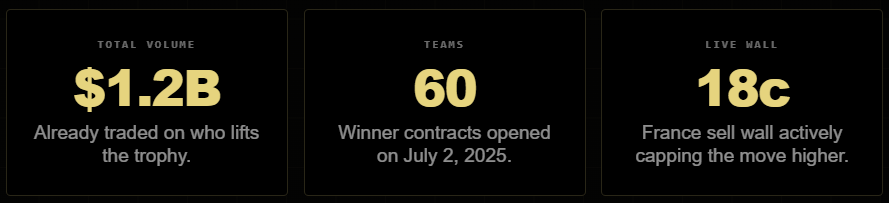
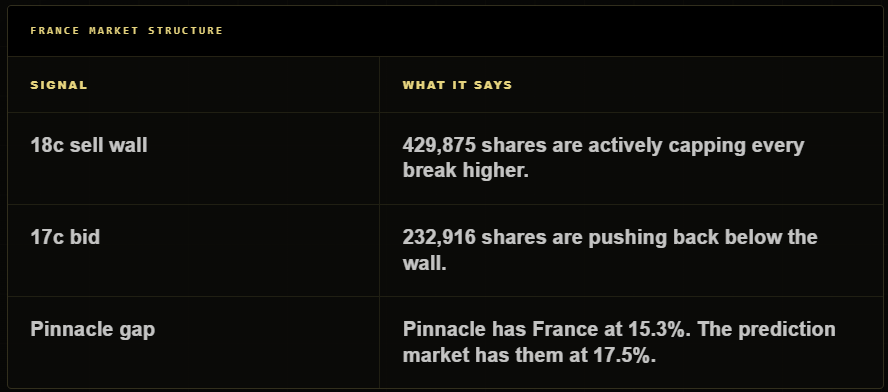
A large buyer has been accumulating France since late March, pushing the price from 10% to 17.5%. A large seller is sitting on 429,875 shares at exactly 18c, actively capping every attempt to break higher. Below them, 232,916 shares are bidding at 17c, refusing to back down.
These are not automated market maker orders – those sit in the deep book below 5c in round numbers like 555,555 and 1,000,000. These are two human actors with opposing convictions, fighting over a specific price level on France specifically, with $1.2 billion in total market volume behind them and seventeen days until the opening whistle.
That standoff is what this market looks like right now. To understand why it exists, you need to read the whole market.4
Co-Favourites
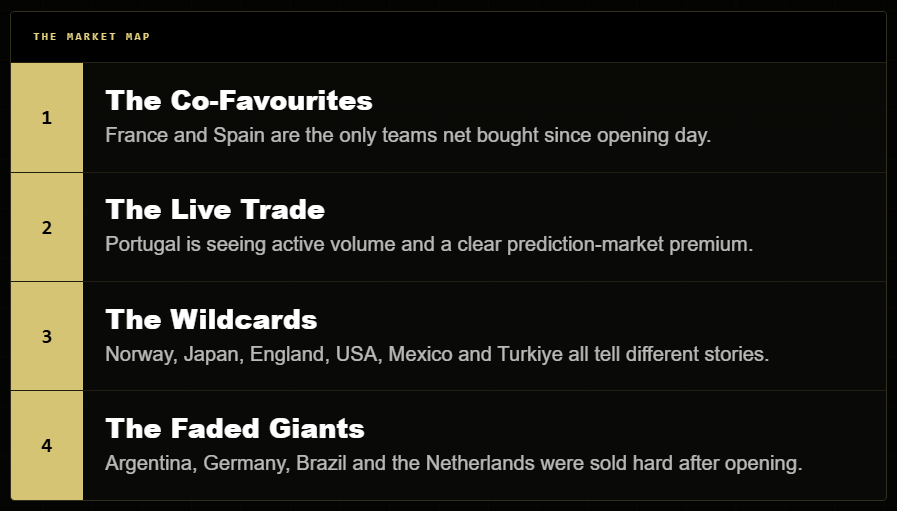
France and Spain are the only net-bought teams
France and Spain are the only two teams in this market that have been net bought since opening day. France opened at 16%, Spain at 15%. Both sit higher today. That sounds straightforward until you look at what happened in between.
Within hours of the market opening, France was hit with a single -8.5c dump at 05:00 UTC on July 3, crashing from 17.5% to 9% in one hour. Eight hours later, a counter position came in and pushed it back up +11.5c to 21%.
It is the most violent whale-versus-whale exchange in this entire market. Someone opened aggressively short, someone else bought the entire dip. The buyer won. France has never revisited that 9% level since.
The longer-term drift tells its own story. France bled quietly from around 20% down to 12% between July and November 2025, a period that maps directly onto a string of simultaneous injuries to Mbappé, Dembélé, Doué, Barcola, and Thuram during World Cup qualifying. The market noticed. What it did next is harder to explain.
From mid-March 2026, France began climbing from 10.2% to its current 17.5%, a +7c move in under ten weeks, touching 18.2% at its weekly high.
The Ekitike Achilles rupture came in April. Camavinga was dropped from the squad in May. Both are unambiguously negative news for France. The price went up through both of them.
The price chart for this period does not look like a market. It looks like a position. France was dead flat at 11-13% for seven months, actively ignored while Spain was being traded in both directions the entire time. Then in late March someone made a specific decision about France specifically and started buying.
Spain by contrast has been steadier and more distributed, supported by a dominant qualifying campaign in which they won five of six games and conceded just twice. One anomaly stands out: Spain saw a mid-October spike and reversal, a round trip with no news attached. It looks like a large position entered and exited quickly. The money did not stay.
Cross-referencing against Pinnacle sharpens the picture. Pinnacle has France and Spain both at 15.3% after vig removal. The prediction market has them at 17.5% and 17.4% respectively, a premium of roughly 2 percentage points on each.
Portugal
The live trade
Portugal does not belong in the same sentence as Norway and Japan. By volume, by Pinnacle divergence, and by the speed of recent price movement, it is a co-equal story to what is happening at the top of this market.
They opened at 12.5%, spent most of the year ranging between 7.5% and 12%, with an all-time high of 12.5% in October 2025. They drifted down to 6.6% in February before climbing back to their current 10%.
The chart looks nothing like France. Where France shows seven months of flatness followed by one clean unidirectional move, Portugal has been actively volatile the entire time – two-way flow, multiple spikes and reversals, a market with genuine participant disagreement throughout.
The fundamentals support why. Portugal won the 2025 Nations League, beating Spain on penalties in the final. Their squad announced May 19 is full strength: Ronaldo for his sixth World Cup at 41, Bruno Fernandes arriving after breaking the Premier League assist record, Joao Neves and Vitinha anchoring the midfield, Bernardo Silva and Rafael Leao in attack.
The market signal reinforces it. Their roughly $720K in 24h volume is the highest of any non-host team, running at levels you would expect from a team priced three times higher. Pinnacle has Portugal at 7.6%. The prediction market has them at 10%, a 2.5 percentage point gap.
Wildcards
Norway, Japan, England, USA, Mexico and Turkiye
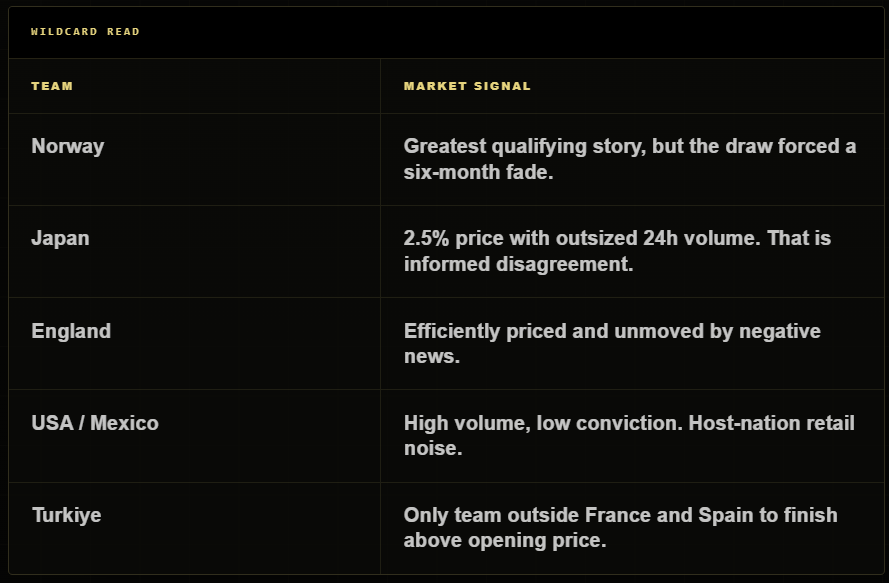
Norway’s story is the most compelling in the entire field and the market has spent six months slowly giving up on it. They ran a perfect qualifying campaign: 8 wins from 8, 37 goals, Haaland top scorer in Europe with 16 goals, twice the next closest player.
On September 9, they beat Moldova 11-1, Haaland scored five. On November 16, they qualified beating Italy 4-1, their first World Cup since 1998. The price peaked at 8.2% the following day.
What happened next is visible in the chart. Not a crash, not a single exit – a perfectly smooth linear decline from 8% to 2.5% over six months. No bounces, no accumulation. This is distributed selling, many participants gradually reassessing, not one actor changing their mind.
Japan at 2.5% is the volume anomaly of this market. Their roughly $500K in 24h volume is higher than Brazil, Argentina, Germany, and the Netherlands. For a team priced at 2.5%, that level of active trading suggests informed disagreement about the number.
England at 11.2% is the most efficiently priced contract in this section. Pinnacle has them at 11.0%, a gap of 0.2%. The squad announcement on May 22 was widely described as a surprise by pundits: Foden dropped, Cole Palmer dropped, Trent Alexander-Arnold out. The price did not move.
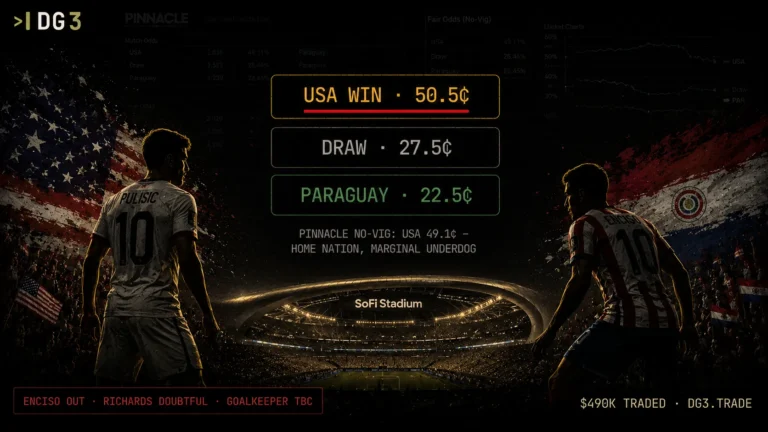
The two host nations tell the same story in different fonts. USA has the highest total volume in the entire market. Mexico peaked at 14.7% in the first hours of trading, the most inflated opening price of any team. Both sit at approximately 1.1% today, frozen for months.
Faded Giants
Argentina, Germany, Brazil and the Netherlands were sold
Argentina, Germany, Brazil, and the Netherlands all opened with prices the informed money immediately rejected. The selling was fast, sustained, and in most cases eventually justified by events.
Argentina is the starkest case. They opened at 20% as defending champions and have been sold down to 8.2%, the largest absolute fade in the market. The correction began within hours of launch. September 2025 brought a 1-0 qualifying loss to Ecuador. October brought public uncertainty about whether Messi would even compete. The price kept grinding lower.
Then on May 24, Messi was substituted in the 73rd minute against Philadelphia Union clutching his left thigh and walked straight down the tunnel. His coach called it fatigue. No official medical report has been released. Argentina’s first game is June 16.
The prediction market has not moved a single cent in response. That non-movement is the most interesting data point in this entire article.
Either the market is saying Messi fitness risk was already fully priced at 8.2%, or it is saying Argentina’s probability does not hinge on Messi the way most people think it does.
Germany is the most brutal chart in this entire market. Near-vertical drop from 20% to 8% in the opening weeks, then a perfectly smooth ramp from 8% down to 5% over ten months. No meaningful bounces.
Brazil opened at 16% and now sit at 9%, a fade driven almost entirely by injury. Rodrygo tore his ACL and meniscus on March 3, 2026, ruled out for the rest of the year. Estevao suffered a hamstring tear severe enough that Chelsea wanted immediate surgery, confirmed out in May. Eder Militao is also absent.
The Netherlands opened at 13% and sit at 3.5%. The opening price was almost certainly wrong and the early weeks were violent price discovery. By December the market found a floor at 3.4-3.5% and locked there.
Cross-referencing against Pinnacle confirms the faded giants have been efficiently priced. Argentina, Germany, Brazil, Netherlands, and England are all within half a percentage point of their Pinnacle implied probabilities. The sportsbook market and the prediction market are in complete agreement on every single faded team.
What Moves First
Three catalysts are live right now
The France order book is the highest single-event volatility in this market. That 429,875 share sell wall at 18c breaks or holds on a single match result. France versus Norway on June 26 is the specific trigger.
A Norway win sends France from 17.5% toward 12% in hours and Norway from 2.5% toward double digits. A France win reinforces the buyer’s thesis, blows through the seller’s wall, and France sees 20%+ for the first time since July 2025.
Portugal is the second catalyst, and it is already moving. The roughly $720K daily volume is the market telling you that active participants are forming views right now, not waiting for the tournament. The first Portugal group game on June 17 against DR Congo is the next hard data point.
Argentina and Messi is the third. The non-reaction to the May 24 injury scare has a 72-hour clock on it. If an official medical report confirms a minor strain, 8.2% holds. If Messi is ruled doubtful, a market that has already priced in everything finds out whether it actually priced in everything.
The Bottom Line
The market has priced the tournament. The tournament has not yet priced back.
$1.2 billion placed. The edge is not in knowing the odds. It is in reading who is moving them and why.
Also read:
Five World Cup Matches That Made Billions of People Forget Everything Else
Seven Days In. The Market Has Sorted the Contenders.
Sharp Money vs Public Money
Sign up now – DG3 Terminal