What Is a Prediction Market? The Complete Guide for 2026
Markets that turn collective belief into prices.
There is a market where you can trade the probability that a specific event will happen – not the event itself, but the probability. If you believe something is more likely than the current price reflects, you buy. If you believe it is less likely, you sell. You profit if you were right and the event resolves accordingly.
That is a prediction market. Simple in concept, surprisingly complex in practice, and increasingly important as a tool for understanding what the collective intelligence of traders believes about future events.
This guide explains how prediction markets work from first principles – no assumed knowledge, with real examples throughout.
Table of Contents
Quick Answer
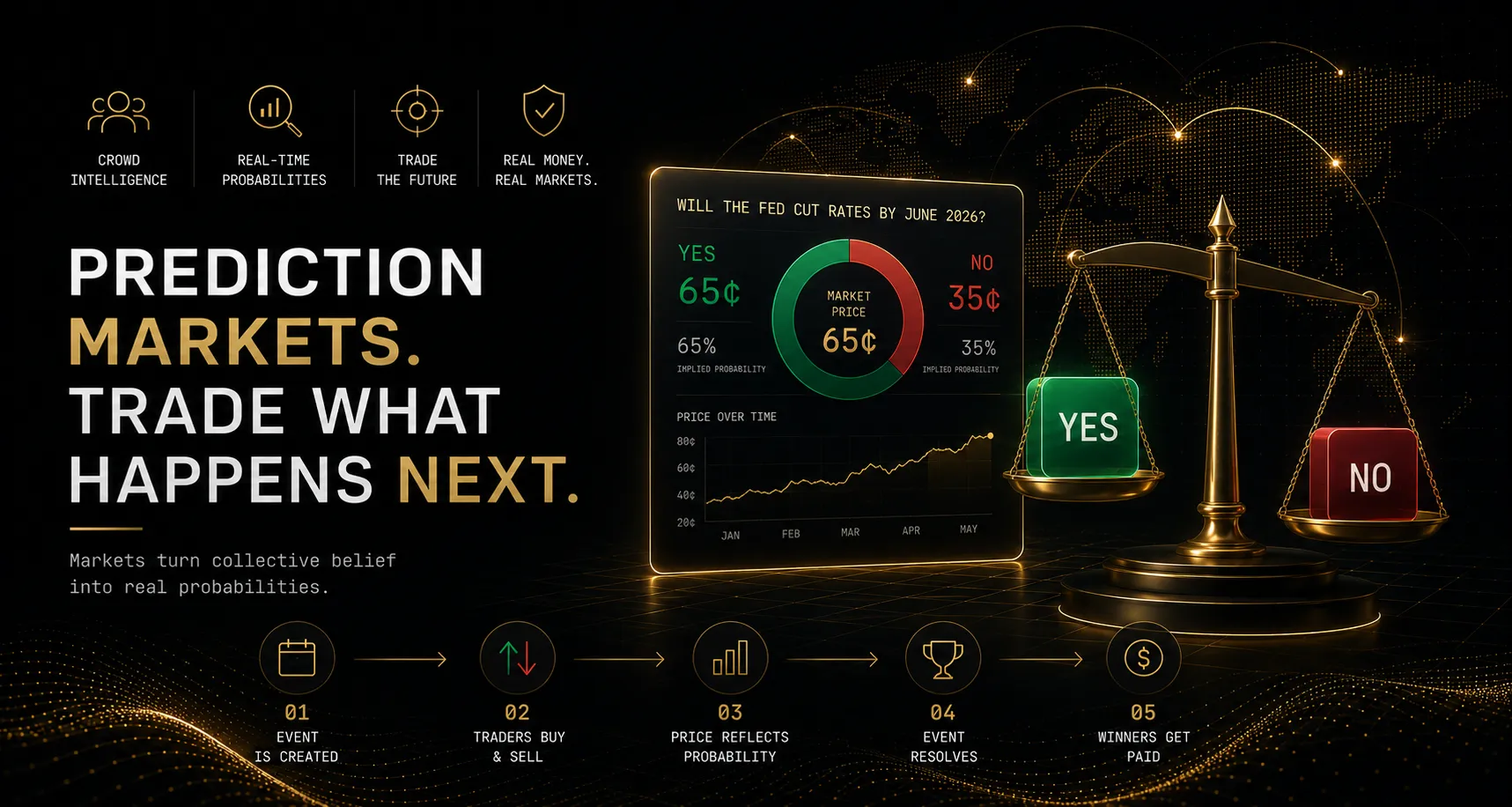
A prediction market is a financial exchange where participants trade contracts tied to the outcome of future events. Each contract pays a fixed amount if the event occurs and zero if it does not. The current trading price represents the market’s collective estimate of the probability that the event will happen. Prediction markets aggregate information from many participants to produce crowd-sourced probability estimates, often more accurate than polling or expert opinion for near-term events.
Why Prediction Markets Matter
Understanding prediction markets matters for three distinct groups of people.
Traders and investors – prediction markets offer event-driven trading opportunities where the edge is information and probability calibration rather than technical analysis or macroeconomic forecasting.
Researchers and forecasters – prediction market prices provide a real-time, financially incentivized measure of collective belief about future events, making them a powerful complement to traditional forecasting methods.
Anyone who follows news and current events – prediction market prices on elections, economic data releases, and major news events are increasingly treated as primary signals by journalists, analysts, and policy observers. Reading those prices and understanding what they mean has become a form of financial literacy.
Key Takeaways
- A prediction market contract pays 100 cents if an event occurs and 0 cents if it does not – the current price is the market’s implied probability as a percentage
- Prices are set by traders buying and selling based on their beliefs about probability – more buyers push prices up, more sellers push prices down
- Prediction markets aggregate information from many participants, creating crowd-sourced probability estimates that often outperform individual expert forecasts
- Implied probability and percentage probability are the same thing expressed differently: a 65-cent contract implies 65% probability
- The main prediction markets in 2026 are Polymarket (global, crypto-native) and Kalshi (US-regulated, USD)
- Prediction markets are not sports betting – they are financial instruments with different mechanics, different audiences, and different regulatory frameworks
- The primary skill for new prediction market traders is probability calibration: estimating the true likelihood of an event more accurately than the current market price
How Prediction Markets Work: The Mechanics
Every prediction market is built on a simple contract structure.
A market is created for a specific event with a specific resolution criterion. For example: “Will Brazil win the 2026 FIFA World Cup?” The resolution criterion is clear – YES if the Fed cuts rates at that meeting, NO if it holds or raises.
The contract economics:
- If you buy YES at 60 cents and the Fed cuts rates, your contract pays 100 cents. You profit 40 cents per contract.
- If you buy YES at 60 cents and the Fed does not cut rates, your contract pays 0 cents. You lose your 60-cent investment.
- If you buy NO at 40 cents (the inverse) and the Fed holds rates, your contract pays 100 cents. You profit 60 cents per contract.
YES and NO prices always sum to approximately 100 cents (the small difference is the platform fee). If YES is trading at 63 cents, NO is available at around 37 cents.
How prices move: Prices move based on supply and demand among traders. If many traders believe the Fed is more likely to cut rates than the current 60-cent price reflects, they buy YES contracts. That buying pressure pushes the price up – say to 65 cents. If news arrives that the Fed is considering holding rates, sellers push the price back down. The price is continuously updating as new information enters the market.
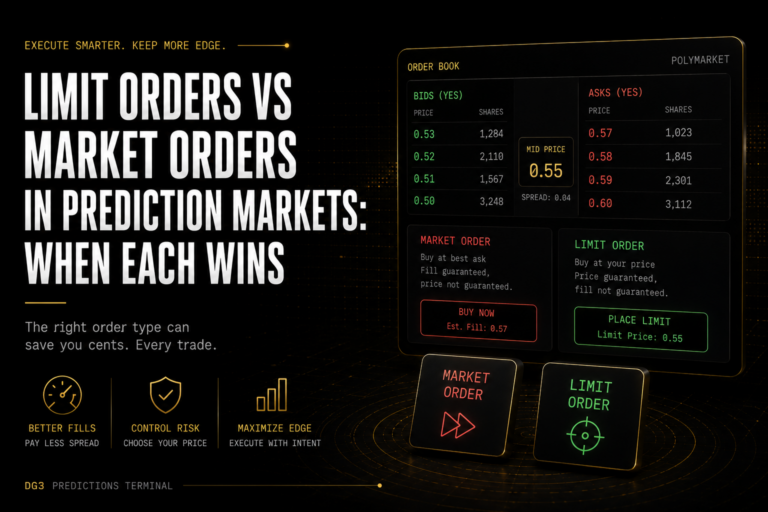
The order book: Like a stock exchange, prediction markets operate with an order book where buyers and sellers place orders at specific prices. The current market price is where the most recent transaction occurred. You can place a limit order at a specific price or take the current market price with a market order.
What Is Implied Probability?
Implied probability is the probability of an event occurring as implied by the current market price.
If a YES contract is trading at 72 cents, the implied probability of the event occurring is 72%. If it is trading at 31 cents, the implied probability is 31%.
The term “implied” is important. The market is not stating the true probability – it is reflecting the aggregate belief of the current set of buyers and sellers. Those beliefs may be well-calibrated (close to the true probability) or poorly calibrated (significantly off). The opportunity for traders is in identifying markets where the implied probability is significantly different from their estimate of the true probability – the gap between market price and fair value.
A worked example: A market asks whether a major tech company will announce a specific product by a given date. The market is trading at 45 cents YES. You have followed this company closely and believe, based on reliable public reporting and past announcement patterns, that there is a 60% chance of the announcement happening. The gap between the market’s 45% and your 60% estimate is your potential edge. If your estimate is correct, you have positive expected value buying YES at 45 cents.
The edge calculation: Expected value = (probability of winning × profit per unit) – (probability of losing × loss per unit). At 45-cent entry with 60% true probability: (0.60 × 55 cents) – (0.40 × 45 cents) = 33 cents – 18 cents = 15 cents of positive expected value per dollar of position.
This is the fundamental calculation behind prediction market trading. Every position is a bet on your probability estimate versus the market’s implied probability, and it is worth understanding expected value in full before sizing real money.
Real Examples: How Major Events Trade
The 2024 US Presidential Election: The US presidential election market on Polymarket was one of the most-watched prediction markets in history. In early 2024, the Republican candidate was trading around 40 cents – reflecting roughly equal probability between the two major candidates. Over the course of the year, as the political environment shifted and new information arrived, the price moved significantly. By late October 2024, the Republican candidate was trading in the high 60s on some platforms. The Republican candidate won. Prediction markets were tracking information that had not fully shown up in polling averages.
Sports outrights: Before major tournaments, prediction markets develop deep winner markets with continuous repricing as results arrive. The 2026 FIFA World Cup winner market on Polymarket reached over $2.6 billion in total trading volume, with team probabilities updating in real time after every group stage result.
Crypto price milestones: Polymarket regularly lists markets on whether specific cryptocurrencies will reach price milestones by specific dates – “Will Bitcoin exceed $100,000 by December 31?” These markets can swing dramatically as prices move, creating fast-moving trading opportunities that attract both crypto traders and prediction market specialists.
Prediction Markets vs Sports Betting: The Actual Differences
Prediction markets and sports betting both involve placing money on uncertain outcomes. The differences between them are structural and significant.
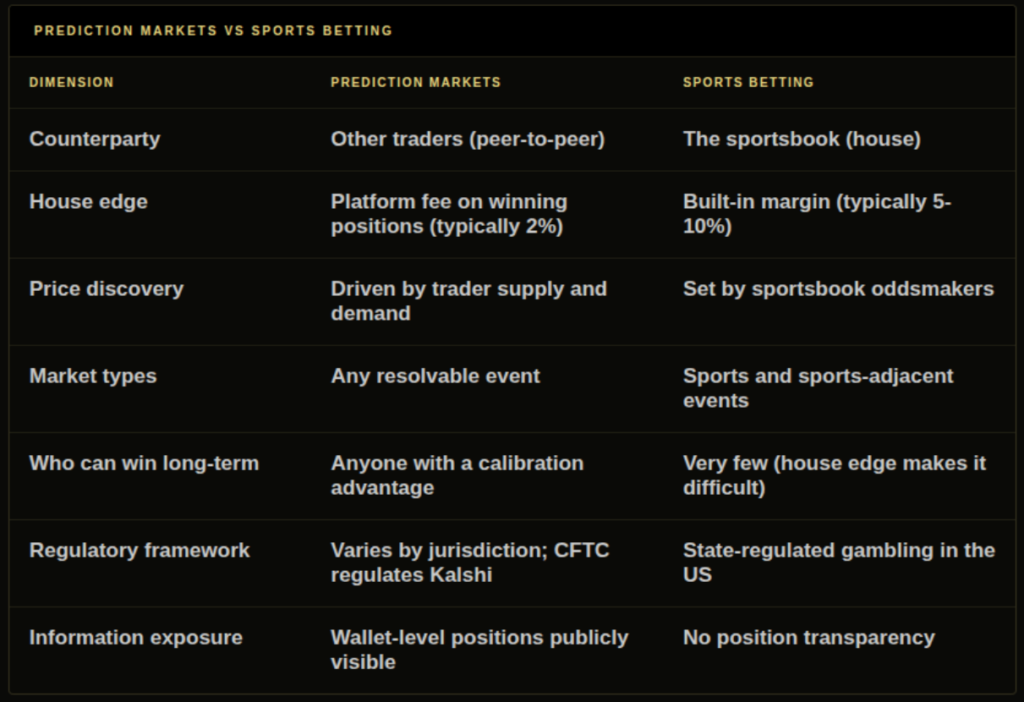
The most important difference is the counterparty. In sports betting, you are always trading against the house, which has a built-in margin that makes long-term profitability mathematically difficult for most participants. In prediction markets, you are trading against other participants. The platform takes a small fee, but the prices are set by supply and demand among traders rather than by an oddsmaker with a built-in advantage.
This means that prediction market traders with better information, better probability calibration, or better tools than the average participant can consistently extract positive expected value. The sportsbook analogy breaks down at exactly this point – we cover it in depth in our breakdown of sports betting versus prediction markets.
Who Trades Prediction Markets?
The prediction market participant base in 2026 is diverse and stratified.
Retail traders and enthusiasts: People who follow politics, economics, sports, or technology closely and trade based on their domain knowledge. This is the largest participant group by number but trades smaller sizes.
Sharp traders and quantitative analysts: Participants with systematic approaches to probability estimation and position sizing. These traders often have backgrounds in statistics, finance, or trading and treat prediction markets as a professional activity.
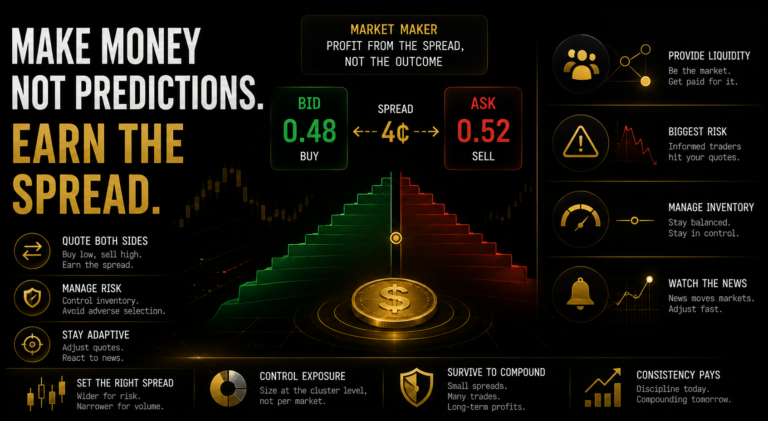
Arbitrageurs: Participants who monitor multiple venues simultaneously and trade when the same event is priced differently across platforms. Their activity helps price discovery by closing gaps between venues.
Institutional participants: Hedge funds, trading firms, and financial institutions that have identified prediction markets as a source of returns or a hedge against related risk. This participation has grown significantly since Kalshi’s regulatory approval.
Information traders: Participants who trade based on specific information advantages – being an industry expert in a specific domain, having access to data that is publicly available but not yet priced into markets, or following developments in a niche event category with unusual depth.
Are Prediction Markets Accurate?
Prediction markets have a well-documented track record of producing probability estimates that outperform individual expert forecasters and, in many cases, polling averages for near-term events.
The mechanism is the Efficient Market Hypothesis applied to event probabilities: when participants with different information sets trade against each other, the resulting price aggregates their collective knowledge more efficiently than any single forecast.
Where prediction markets perform well:
- Near-term events with clear resolution criteria and active liquidity
- Events where domain experts are trading – financial data, tech milestones, electoral outcomes in well-studied districts
- Events with strong base rates from historical data
Where prediction markets can be wrong:
- Thin-liquidity markets with few participants
- Events influenced by factors that are impossible to quantify (major surprise events, “black swans”)
- Markets prone to herd behavior when a prominent participant takes a large visible position
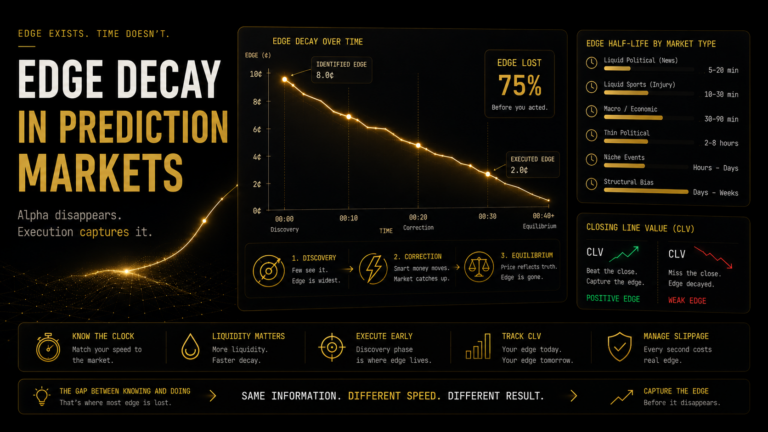
The practical takeaway: prediction market prices on major, liquid events are among the most reliable probabilistic indicators available. They are not infallible. They are prices – which means they are wrong sometimes, and the degree to which they are wrong is itself an edge opportunity.
How to Start Trading Prediction Markets
Common Mistakes for New Traders
Treating prediction markets as a place to express opinions. Prediction markets are not polls. Putting money on the outcome you want to happen is not trading – it is spending. The question is always whether the current price reflects the true probability accurately.
Ignoring liquidity. A 20-cent edge in a market with $500 in total liquidity means you might be able to take a $50 position before the price moves against you. Always check liquidity depth before sizing a position.
Over-concentrating in correlated positions. Major political events, in particular, affect many related markets simultaneously. A trader with YES positions on five Republican Senate races, Republican Senate control, and Republican House control has one large correlated position – not seven independent ones.
Confusing short-run P&L with long-run edge. Winning a few trades does not confirm positive expected value. Losing a few does not negate it. The only reliable measure is whether your probability estimates are systematically better than market prices over a large enough sample.
Starting with complex markets before mastering the basics. Markets on obscure events, novel market types, or thin-liquidity venues are harder to analyze and easier to get wrong. Build calibration in well-studied, liquid markets first.
Beyond the Native Interface
For traders who have moved past the basics and want to operate at a higher level, raw platform access is not enough. DG3 is a prediction market intelligence terminal built to give traders the data layer that native interfaces do not provide: real-time order flow, whale and sharp wallet monitoring, edge detection across markets, and signal aggregation in one workspace.
The gap between trading with native platform access and trading with a full intelligence terminal is the same gap that exists between reading earnings reports manually and using a Bloomberg Terminal. The underlying data is the same. The speed, organization, and signal-to-noise ratio are different.
Frequently Asked Questions
What is a prediction market in simple terms? A prediction market is an exchange where people trade contracts that pay out if a specific event happens and expire worthless if it does not. The current price of a contract represents the collective probability estimate of the crowd – how likely they think the event is. Prices move as new information arrives and traders update their views.
How do prediction markets make money for traders? Traders profit when they correctly identify markets where the current price (implied probability) is higher or lower than the true probability of the event occurring. If you buy a contract at 40 cents and it resolves at 100 cents, you profit 60 cents per contract. The edge is calibration – estimating probability more accurately than the market.
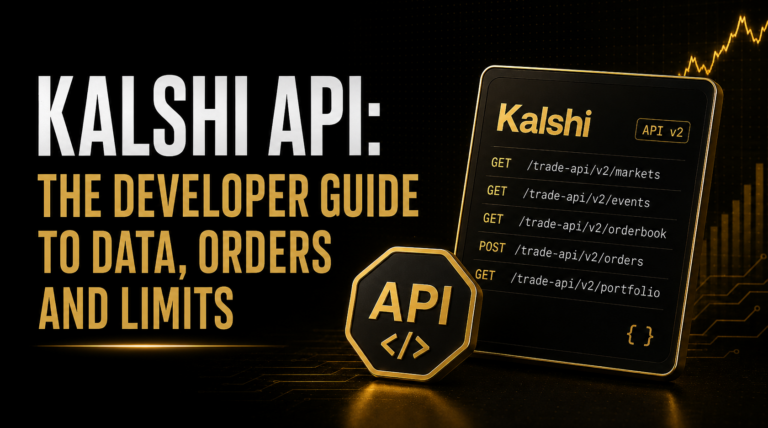
Are prediction markets legal in the US? Kalshi is a CFTC-regulated designated contract market that is legally accessible to US residents. Polymarket is not regulated by US authorities and is not legally accessible to US residents. The legal landscape has evolved significantly since 2023 and continues to develop.
What is the difference between prediction markets and sports betting? In sports betting, you trade against the house, which builds a margin into every price. In prediction markets, you trade against other participants in a peer-to-peer market. Platforms charge a small fee on winning positions (typically around 2%), but prices are set by supply and demand rather than by oddsmakers. This makes long-term profitability structurally more accessible for skilled traders.
What is implied probability in prediction markets? Implied probability is the probability of an event occurring as expressed by the current market price. A contract trading at 68 cents implies 68% probability of the event occurring. It is called “implied” because the market is reflecting the collective belief of traders, which may or may not accurately represent the true probability.
Are prediction markets accurate? Research consistently shows that liquid prediction markets with many active participants produce probability estimates that outperform individual expert forecasters and polling averages on near-term events. Thin-liquidity markets with few participants are less reliable. The 2024 US presidential election was a widely cited example of prediction markets moving earlier and more accurately than polling models.
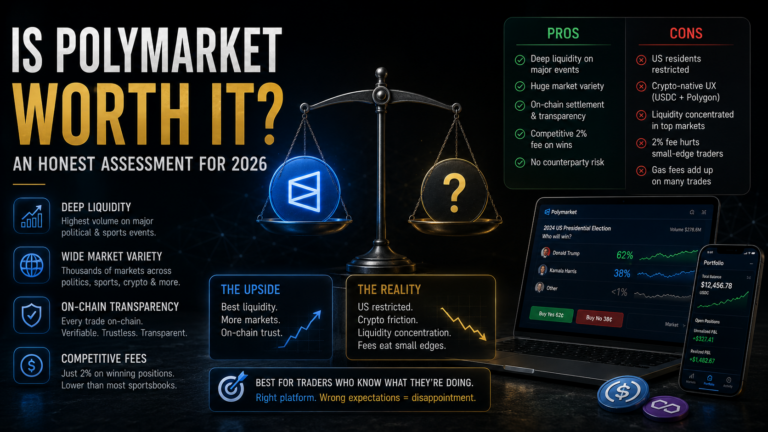
What is Polymarket? Polymarket is the world’s largest prediction market by trading volume, operating on the Polygon blockchain and settling positions in USDC. It offers markets on politics, crypto, economics, sports, and entertainment events. The platform is not available to US residents under its terms of service.
How much money do I need to start trading prediction markets? Both Polymarket and Kalshi allow trading with small amounts. Most serious traders start with $100 to $500 to learn the mechanics before scaling. The more important resource than capital is time – building a track record of calibrated probability estimates takes many positions over many months.
What is DG3 and how does it relate to prediction markets? DG3 is a prediction market intelligence terminal – the data infrastructure layer for prediction market traders. It provides real-time order flow, whale tracking, edge detection, and market intelligence across Polymarket markets in one workspace, positioned as the Bloomberg Terminal equivalent for the prediction market space.
Final Thoughts
Prediction markets are one of the most interesting developments in financial markets of the last decade. They take the abstract concept of probability and make it tradeable, creating a system where the crowd’s collective intelligence is continuously updated, financially incentivized, and publicly visible. Understanding them is increasingly a form of literacy for anyone who follows world events closely. Trading them well is a distinct skill set that rewards patience, calibration, and the willingness to measure yourself honestly against the market’s aggregate estimate. Start with what you know. Size conservatively. Track your accuracy relentlessly. The markets will teach you the rest.
Author note
Written by the DG3 research desk. We build tools for traders who treat probability as a number to beat, not a line to accept. We track market microstructure, order flow, and pricing across prediction markets every day. Nothing here is investment advice – it is a guide to how these markets work.
Trade what happens next When you have outgrown the native interface, DG3 gives you order flow, whale tracking, and edge detection in one workspace. Sign up now – DG3 Terminal
Also read:
What Is a Prediction Market Terminal? (And Why Traders Outgrow Raw Polymarket)
DGPredict to DG3 Terminal | Here’s what led us here
Sports Betting vs Prediction Markets