Why Rule-Followers Beat Gut Traders
The terminal built for traders who run rules, not vibes.
Every experienced trader has a version of this story.
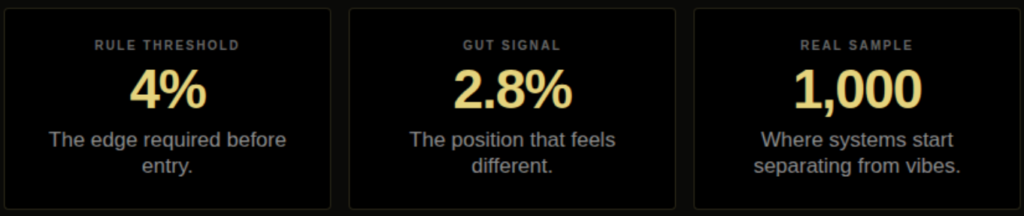
You have a rule. The rule says don’t enter a position unless the EV is above 4%. The market opens. The signal is 2.8%. You know the signal is 2.8%. But something – some combination of recent form, vibes, and pattern recognition that you would struggle to articulate – tells you this one is different.
You enter.
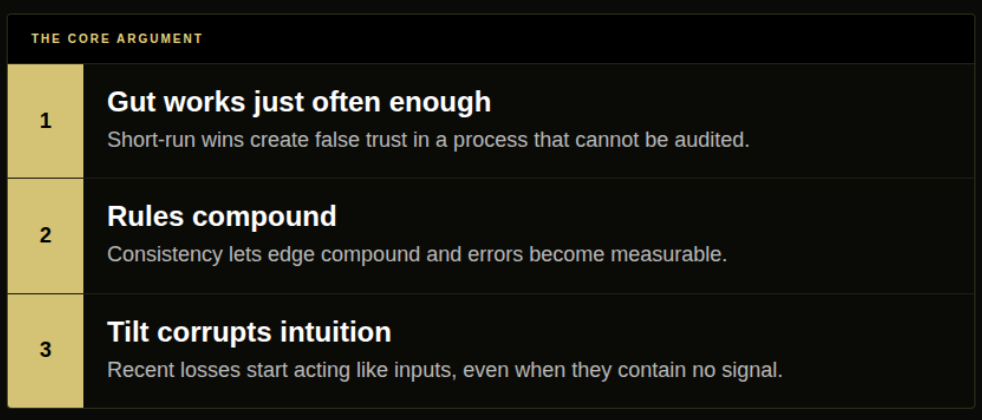
Sometimes you’re right. Often enough to keep trusting the feeling. And that’s exactly the problem.
Table of Contents
The sample size illusion
Your gut isn’t wrong because it’s stupid. It’s wrong because it’s operating on too small a sample to generate a reliable signal, and it has no mechanism to flag this limitation.
The human brain is built to find patterns. It will find them in randomness if randomness is all it has. It will construct a coherent narrative out of 12 positions and present that narrative with the same confidence it would present one derived from 1,200.
Gut traders aren’t worse people than rule-followers. They’re people who have been deceived by the same cognitive architecture that makes humans exceptional at learning from experience – applied to a domain where the feedback loops are too noisy, too slow, and too variable for that architecture to work correctly.
What data actually shows
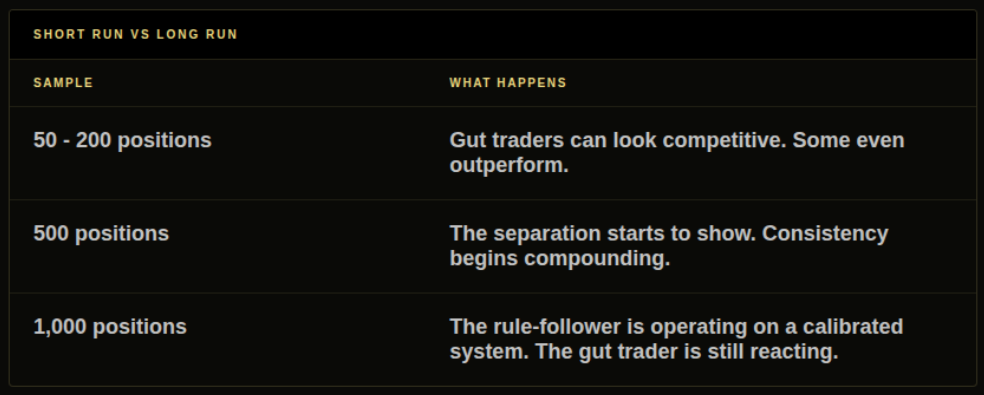
The research on systematic vs discretionary trading across prediction markets and sports betting converges on a consistent finding: the gap between the two cohorts is not large in the short run. Over 50 positions, 100 positions, even 200 positions, gut traders can perform comparably to rule-followers. Some outperform.
Extend the sample to 500 positions and the picture starts to shift. Extend it to 1,000 and the separation becomes stark.
Rule-followers don’t outperform because they’re smarter. They outperform because they’re consistent. Consistency means the edge, where it exists, compounds. It also means the errors are systematic – which means they can be identified and fixed.
A gut trader’s errors are diffuse. They shift with mood, with recent results, with sleep quality. They can’t be isolated, diagnosed, or corrected.
The gut trader at position 1,000 is not materially better than the gut trader at position 50. The rule-follower at position 1,000 is operating on a calibrated system that has been refined by 950 data points.
The tilt problem
There’s a second mechanism at work that compounds the first.
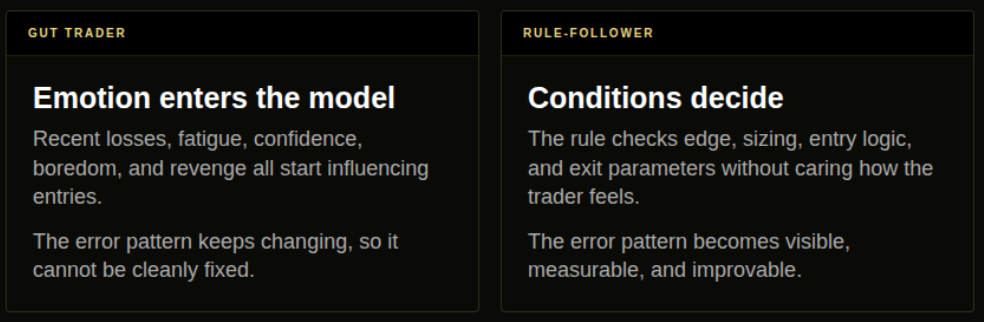
Gut trading is sensitive to emotional state in a way that rule-following is not. After a bad run, the gut adjusts – usually in exactly the wrong direction. Loss aversion kicks in. The trader gets conservative when they should be neutral, or aggressive when they should be pulling back.
The positions start to carry the weight of the last three positions, which is not information. It’s noise.
Tilt is not a character flaw. It’s a predictable output of a system that uses recent emotional experience as an input to decision-making.
Rules break the feedback loop. If the rule says enter at 4% edge, the rule doesn’t know about the loss you took on Tuesday. It doesn’t know you’re tired. It doesn’t know you’ve been watching the market for three hours and your pattern recognition is starting to generate false positives.
It just checks the edge, checks the conditions, and fires or doesn’t fire.
The rule is indifferent to context in exactly the way you cannot be.
What discipline actually means
There’s a version of discipline that means white-knuckling your way through a decision you don’t trust. That’s not what we’re talking about.
Real discipline in trading is structural. It means building the rules before you sit down at the market, not in the moment when a position looks interesting. It means specifying your entry conditions, your sizing logic, your exit parameters – in advance, in writing, without the pressure of a live market.
And then running them.
The long run is the only run that matters
One more thing the data shows: gut traders tend to have better highlight reels.
The best single trade in a gut trader’s record is often better than the best single trade in a rule-follower’s record. Intuition can find edges that rules miss. It can read the room in ways that a model can’t.
But you don’t bank highlight reels. You bank PnL.
Over 1,000 positions, the trader with the better system wins. Not the trader who made the best call in position 47. Not the trader who trusted their gut on a 2.8% edge and got away with it.
The trader who was right more often, lost less when they were wrong, sized correctly throughout, and never let Tuesday’s loss influence Wednesday’s entry.
That trader had rules.
The Bottom Line The terminal built for traders who run rules, not vibes. Rule-followers win because their process can survive a bad day, a hot streak, a false pattern, and a thousand positions. Gut traders can be right. Rule-followers can get better.
Also read:
Cognitive Load in Fast Markets
Tilt Management
Calibration in Prediction Markets: How to Measure Forecast Accuracy
Sign up now – DG3 Terminal