World Cup Final Odds: The Complete 1-0 Spain Breakdown
You had Spain at 59 cents on Sunday morning. By the 90th minute you still had Spain at 59 cents, because nothing had happened. No goal, no red card that mattered yet, no reason to move. Then Enzo Fernandez picked up a second yellow in the third minute of stoppage time and the world cup final odds still barely blinked. That is the part nobody tells you about world cup final odds. Sometimes the market is right about the outcome and completely wrong about how boring the road there is going to be.
Table of Contents
Quick Answer
World cup final odds had Spain favored at roughly 59 percent on Polymarket and Kalshi entering Sunday’s match against Argentina, with sportsbooks pricing Spain near plus 125. The world cup final odds barely moved through 90 scoreless minutes and Fernandez’s red card. Ferran Torres settled it in the 106th minute of extra time, and the close matched the number, even though the match itself did not look like a 59-41 game until the final whistle.
Key Takeaways
- Spain closed as roughly a 59 percent favorite in the world cup final odds across both Polymarket and Kalshi, a number that held steady from Saturday night through kickoff with almost no drift, which is unusual for a final with this much retail attention.
- More total dollars flowed to Argentina than to Spain on Polymarket’s dedicated matchup contract, even though Spain carried the higher implied probability in the world cup final odds, a classic split between where the smart price sits and where the public money piles up.
- Argentina played the entire 30 minutes of extra time a man down after Fernandez’s second yellow, yet the world cup final odds for Spain moved less than you would expect for a team facing 10 men for a third of the remaining match.
- Spain outshot Argentina 20 to 3, a gap that dwarfs the 18-point spread implied by the closing world cup final odds, which tells you shot volume and market price are measuring two different things.
- Ferran Torres came on in the 62nd minute as a substitute and scored the only goal of the match in the 106th minute, becoming just the second substitute ever to score a World Cup final winner.
- Emiliano Martinez turned in one of the great goalkeeping performances in final history, and his save count is the single biggest reason the scoreline stayed close to the number for as long as it did.
- World cup final odds that close correctly are not the same as a market that told you the story. Spain at 59 cents predicted the winner. It did not predict a shutout, a red card, or 20 shots against 3.
How World Cup Final Odds Actually Moved
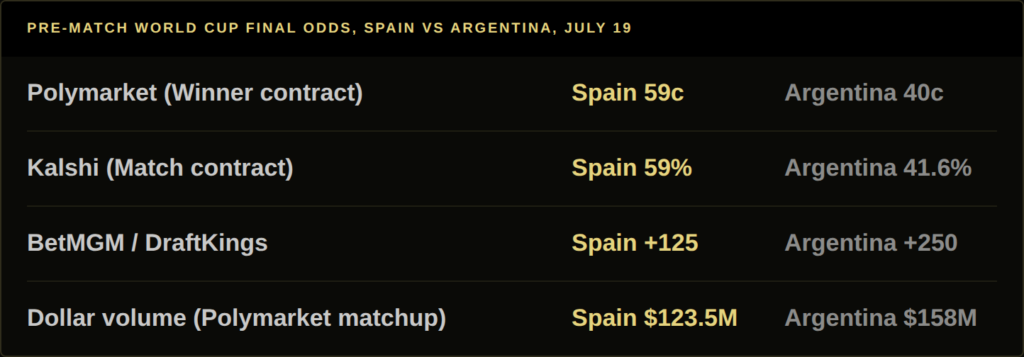
The number people quote is almost always the closing price, and the closing world cup final odds on “World Cup Winner” over on Polymarket showed Spain at 59 cents against Argentina’s 40, on a contract that had pulled in more than 4.28 billion dollars since it opened the previous July. Kalshi’s separate Spain versus Argentina contract landed in the same neighborhood, Spain at 59 percent and Argentina at 41.6, which meant two of the largest prediction market platforms for sports were showing near-identical world cup final odds heading into kickoff.
Sportsbooks told the same story from a different angle. BetMGM and DraftKings priced Spain at plus 125 to lift the trophy, with the draw at plus 200 and Argentina out to the 250 to 260 range in the regulation-plus-normal-time markets. Three separate venues, three nearly identical numbers. That kind of agreement across a prediction market platform, a crypto-native exchange, and a legacy sportsbook, with no arbitrage gap worth chasing, is rare, and it usually means the crowd has actually converged on something real rather than three books guessing independently.
Here is the part that gets left out of every recap. Polymarket’s dedicated Spain versus Argentina matchup contract traded 47 million dollars in total volume, and inside that number, traders had committed 123.5 million combined to Spain’s side against 158 million to Argentina. Read that again. Argentina pulled more raw dollars even while sitting at a lower implied probability inside the world cup final odds. That gap between price and dollar flow is the single most useful signal in the whole match, and it is the one almost nobody wrote about. It is also exactly the kind of divergence a sports prediction market terminal is built to surface the moment it opens, instead of days later in a recap.
What The Red Card Should Have Done To The World Cup Final Odds
Fernandez picked up his second yellow in the third minute of stoppage time at the end of regulation, meaning Argentina walked into extra time already down a man for the full 30 minutes that followed. In most matches, losing a starter for an entire extra period against a team that had just outshot you 20 to 3 through 90 minutes should crater your win probability. A team down a man against a possession-dominant opponent is a team running out the clock on hope.
The world cup final odds barely reacted. Part of that is structural. Spain was already priced as the heavy favorite, so there was not much room left to move. Part of it is that Martinez had already saved everything Spain had thrown at him for 90 minutes, and the market had started pricing him as a wall rather than a goalkeeper. You do not discount a team’s chances much further in a live prediction market when their keeper has already stopped a double-digit shot count.
This is the uncomfortable truth about world cup final odds in a match like this one. The price is not a live measurement of what is happening on the pitch. It is a slow-moving consensus that updates only when something changes the actual probability of the outcome, and a red card in the 93rd minute of a scoreless game moves that probability less than intuition tells you it should, because the team already down a goal or a man was never the team you were pricing to win in the first place.
The Gap Between Shots And The World Cup Final Odds Is The Real Story
Twenty shots to two. That is the shot count Spain built over 90 minutes plus extra time, and it is a wider gap than almost anything else in this final. A 59-41 closing price on the world cup final odds implies a competitive match with a moderate lean. Twenty shots to three implies one team dominated territory and chances almost completely.
So which one do you trust. Neither on its own. The price told you who was more likely to win. The shot count told you how the match was actually being played. Martinez is the bridge between those two numbers. His save total, widely reported as the most by any goalkeeper in a men’s World Cup final, is the reason a 20-2 shot differential produced a nervy 1-0 scoreline instead of a blowout that would have pushed Spain’s world cup final odds into the 80s by halftime.
If you only watch the price, you miss the game. If you only watch the shot count, you miss Martinez. The traders who made money on this match were the ones tracking both on a real prediction market dashboard, watching for the moment Spain’s expected goals from open play started diverging hard from the scoreboard, because that gap is exactly where a well-priced in-play edge lives.
Expected goals divergence: The difference between a team’s shot-based expected goal total and its actual goals scored. When that gap widens fast in a scoreless match, it usually means a goalkeeper is outperforming the price rather than the world cup final odds being wrong about who is better.
Ferran Torres And The Substitute The World Cup Final Odds Never Priced
Torres entered in the 62nd minute. He had a header saved by Martinez in the 66th. He did not score until the 106th, in the opening minute of the second period of extra time, converting off a bouncing ball inside the box with his left foot. It was his first goal of the tournament, and it made him just the second substitute in history to score a World Cup final winner.
Nobody was pricing Torres specifically before kickoff. Anytime goalscorer markets on a bench player rarely carry meaningful liquidity, and that is exactly why they can offer real value when a manager’s substitution pattern is predictable. Spain’s coaching staff had used fresh legs late in every knockout match this tournament, bringing on a forward between the 60th and 70th minute in each of the last three rounds to attack tired legs in the opposing back line.
That pattern was sitting in plain view for anyone tracking Spain’s substitution log on a prediction market screener rather than just the pre-match headline world cup final odds. A trader who built a simple rule, watch which forward warms up first once the game passes the hour mark, had a real edge over someone reading only the outright winner contract. The lesson generalizes past this one final. Bench-player props are thin exactly because most of the market ignores them, and the traders who do the unglamorous work of tracking a coach’s late-game pattern across an entire tournament get first access to the mispricing before the crowd catches up. That is the whole case for treating a prediction market terminal as infrastructure rather than a novelty, the signal was there in the data well before the world cup final odds on Torres moved at all.
Common Mistakes Traders Make Reading World Cup Final Odds Like These
Treating the closing price as a prediction of the game’s style. A 59-41 close on the world cup final odds tells you who wins more often in the long run. It tells you nothing about whether the match will be a shootout or a defensive standoff. Traders who assumed a closer price meant a more open match got caught flat-footed by 90 minutes of almost nothing happening. A terminal that ranks markets by edge rather than by headline probability would have flagged how little the shot-based signal matched the quoted price well before halftime.
Ignoring the volume-versus-price split. More dollars went to Argentina than to Spain despite Spain’s higher price. That split usually means retail sentiment and public narrative, Messi’s farewell run among them, was pulling money toward the underdog even while the sharper side of the book kept Spain favored inside the world cup final odds. Missing that divergence means missing where the real information is.
Assuming a red card automatically crashes a price. It moves the number, but only in proportion to the room the price had left to move. Late red cards in already lopsided matches produce smaller swings than red cards in tight, evenly priced games.
Fading the goalkeeper entirely from a shots-based model. A 20-2 shot count with a scoreless result for 105 minutes should have raised a flag that the goalkeeper, not the price, was the load-bearing variable in that match.
Skipping bench player markets because the pre-match price looks thin. Torres traded almost no volume before kickoff. The trader who tracked Spain’s late-substitution pattern across the tournament, using a workspace built for comparing multiple markets side by side, had information the closing world cup final odds never captured.
Frequently Asked Questions
What were the world cup final odds for Spain vs Argentina? Spain closed around 59 percent to win on both Polymarket and Kalshi, with sportsbooks pricing Spain near plus 125 and Argentina in the plus 250 range.
Did the world cup final odds move after Enzo Fernandez’s red card? Only marginally. Spain was already the heavy favorite, and the market had limited room to shift further given Martinez’s performance had already been priced in as exceptional.
Who scored the winning goal in the World Cup final? Ferran Torres, a 62nd-minute substitute, scored in the 106th minute of extra time, becoming the second substitute in history to score a World Cup final winning goal.
How much money traded on the Spain vs Argentina Polymarket contract? The dedicated matchup contract traded roughly 47 million dollars, with 158 million combined across both sides once you include cross-market positions tied to the outright winner contract.
Why did more dollars go to Argentina if the world cup final odds favored Spain? Higher implied probability does not always mean more raw dollar volume. Underdog narratives, including Messi’s expected final World Cup appearance, tend to pull retail money even when the sharper price sits elsewhere.
Was Emiliano Martinez’s save count actually a record? Reports place his total among the highest ever recorded by a goalkeeper in a men’s World Cup final, a major reason the scoreline stayed close despite Spain’s shot dominance.
Is a shot count more useful than the closing world cup final odds for live trading? Neither alone. The price reflects win probability. The shot count reflects style and territorial dominance. The traders who track both on a real-time prediction market dashboard catch divergences the price alone will not show you.
Did Polymarket and Kalshi agree on the same world cup final odds? Yes, both closed within a point of each other, Spain at 59 percent, which is a strong signal that the crowd had genuinely converged rather than three books independently guessing.
What is a prediction market prop like an anytime goalscorer contract? It is a market on a specific outcome inside the larger event, such as whether a named player scores at any point in the match, and these markets often carry thinner liquidity and bigger informational edges than the headline outright winner contract.
Why do finals like this matter for prediction market data quality? High-volume, high-attention events like a World Cup final produce some of the cleanest price discovery of the year, since liquidity is deep enough that the closing world cup final odds reflect real informed positioning rather than a handful of thin trades.
Final Thoughts
Spain at 59 cents got the outcome right. It did not warn you about a scoreless 90 minutes, a red card that barely moved the needle, or a substitute nobody was pricing who ended up lifting the trophy on his own. The number and the match were two different stories that happened to agree at the finish line. Next time the world cup final odds sit still for 90 minutes, that stillness is not nothing. It is the market telling you the story is happening somewhere the headline number cannot see, and the traders who go looking for it, on a terminal built to rank edge instead of just displaying a headline price, are the ones who get paid before the rest of the room notices. DG3 exists for exactly that gap.
Sign up now – DG3 Terminal
Also read –
Sharp Money vs Public Money
Closing Line Value
Trading Signals That Actually Move Event Markets