The +EV Edge Hiding in Every 1-1 Football Contract
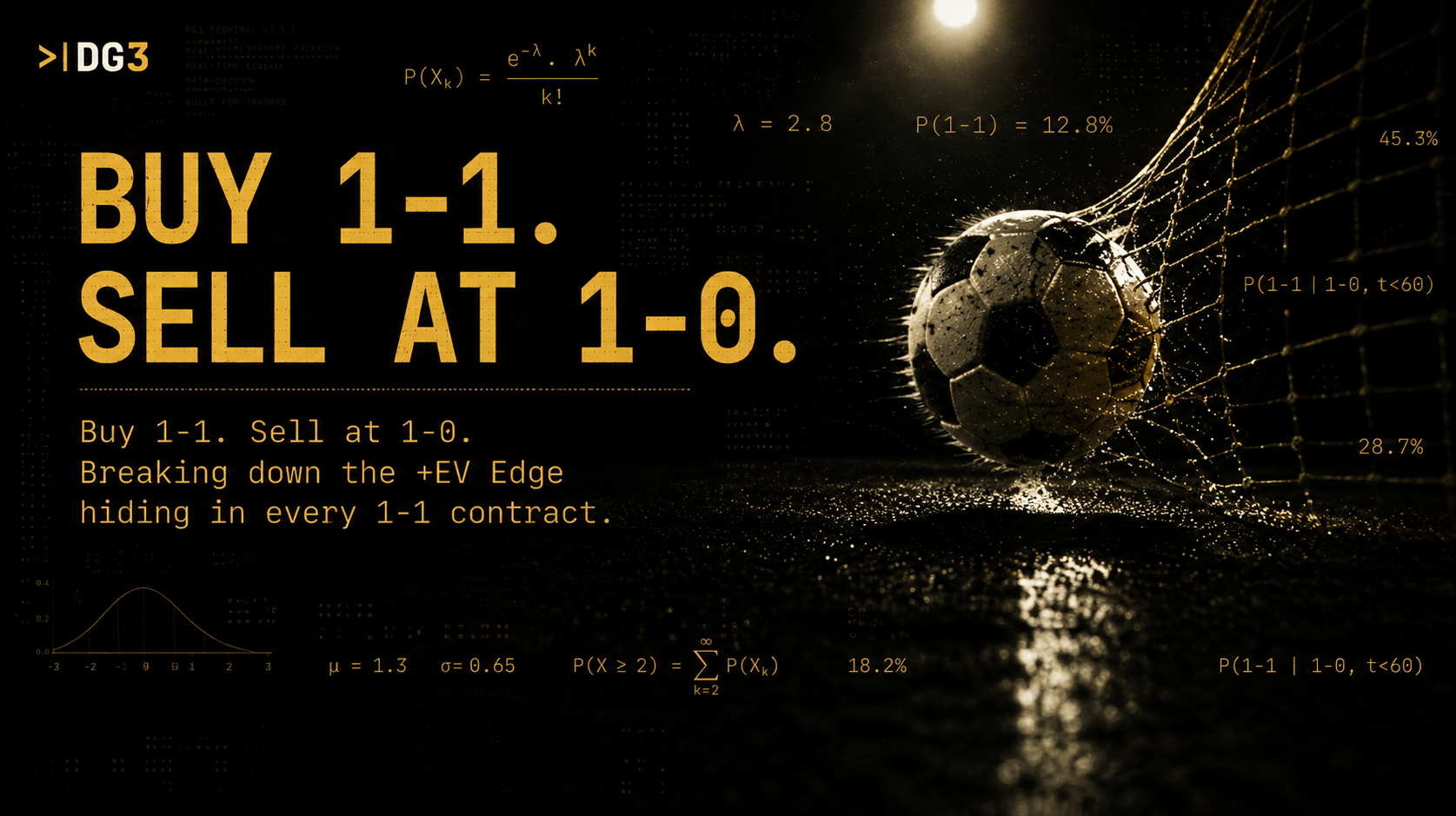
Buy a 1-1 contract. Exit when it’s 1-0. There’s a genuine EV edge hiding in that sequence — and here’s the full math behind why it’s not as insane as it sounds.
TL;DR: Buy a 1-1 exact score contract before kickoff on a match where both teams are evenly matched. The moment the first goal goes in and the score hits 1-0, sell. Don’t wait for 1-1 to actually happen.
Why does that work? Because the probability of a 1-1 final score is actually higher from a 1-0 state than it was before the match started, at least in the right window of the game. The market knows this and reprices the contract upward the second that first goal lands. You’re not betting on the scoreline. You’re trading the repricing event that the scoreline creates.
Three rules hold it together. Both teams need to be evenly matched. Exit at 1-0, not at 1-1. If it’s still 0-0 past the 45-50 minute mark, start cutting. A goalless game bleeds your position quietly from around minute 21 onward.
The rest of this piece is the full mathematical proof of why each of those rules holds.
Table of Contents
The Paradox You’re About to Trade
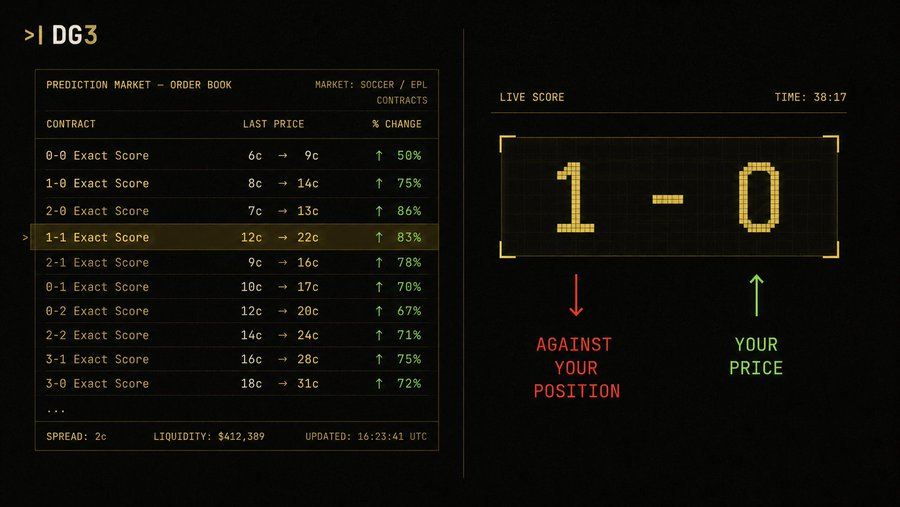
A goal goes in. It’s 1-0. Your 1-1 exact score contract just moved against the final result you need. And yet, if you structured this trade correctly, that goal is your exit signal, not your kill shot. You’re about to close the position at a profit.
You buy a 1-1 contract pre-match on an evenly contested fixture. You hold while it’s goalless. The moment the first goal lands, conditional probability of a 1-1 final jumps, the market reprices upward, and you sell into that repricing. You never wait for the actual 1-1. You’re not predicting the score. You’re trading the event that makes the market believe it’s more likely.
The difference between gambling and trading is right there.
Why Poisson, and What It Actually Tells You
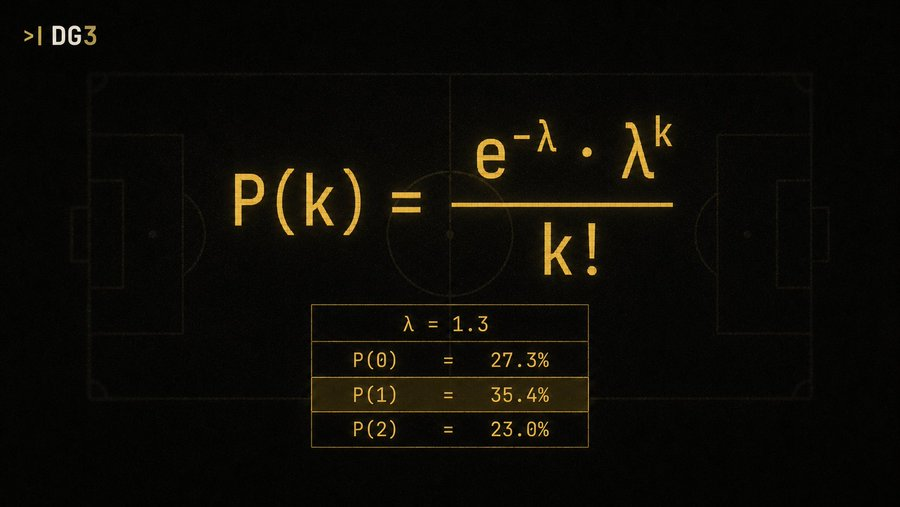
The Poisson distribution counts rare independent events that happen at a roughly constant rate. Football goals fit well enough to be useful. The formula:
P(k goals) = (e^-λ × λ^k) / k!
λ is the expected number of goals a team will score. k is the number you’re asking about. Feed in lambda, get a probability.
For a team with λ = 1.3, the probability of scoring exactly 1 goal works out to about 35.4%. Scoring exactly 0 is 27.3%. Because each team scores independently in the model, the probability of any specific scoreline is just the two individual probabilities multiplied. P(1-1) = P(home scores 1) × P(away scores 1). For equal teams both at λ = 1.3: 0.354 × 0.354 = roughly 12.5%. Pre-match fair value on the 1-1 contract: around 12-13 cents.
That’s your entry benchmark. Buy at 12 cents or under. Above 13 cents and the edge hasn’t started yet.
The Conditional Shift: What 1-0 Does to the Math
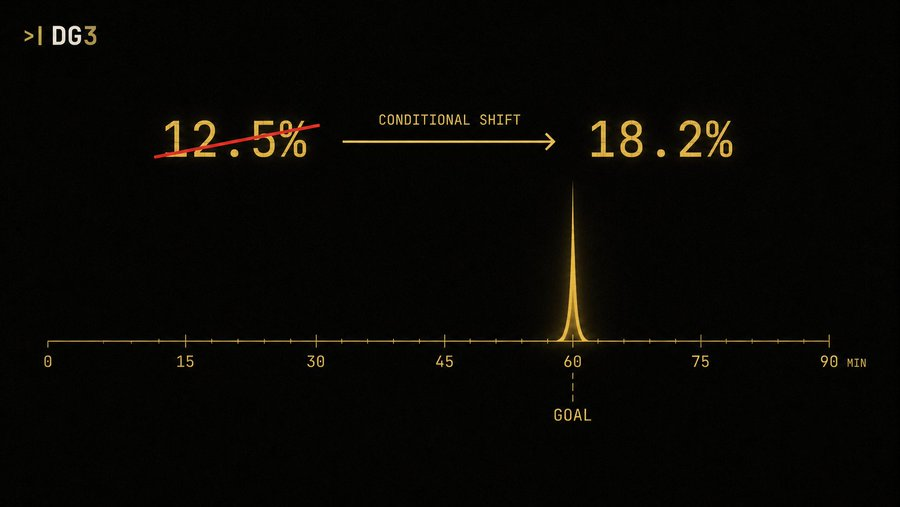
When the score hits 1-0, the market’s question changes. It’s no longer “will this match end 1-1?” It’s “given it’s 1-0 with X minutes left, what’s the probability of a 1-1 final?” That’s a conditional probability, and it’s a different number.
You scale lambda down proportionally to the time remaining. A goal at minute 30 leaves 60 minutes, two-thirds of the match. Remaining lambda per team: 1.3 × (60/90) = 0.867. For the score to finish 1-1 from here, the home team needs exactly zero more goals and the away team exactly one.
P(home adds 0) = e^-0.867 = 42.0% P(away adds exactly 1) = e^-0.867 × 0.867 = 36.4% Multiply: 15.3%
Up from 12.5% pre-match. The contract just moved from ~12 cents to ~15 cents fair value because a goal went in.
The lift isn’t uniform though. A goal at minute 15 produces almost no lift, conditional P(1-1) barely reaches 12.4%. Too much game left. A goal between minutes 45 and 65 is the sweet spot. A 1-0 at minute 60 pushes conditional P(1-1) to 18.2%, a 1.45x lift. The away team has just enough time to score once but not enough for the match to spiral into 2-1 or 3-0 territory.
Goal rates aren’t uniform across 90 minutes either. The final 15 minutes run about 25% hotter than average due to fatigue and desperation. A 1-0 at minute 60 leaves two of the highest-rate phases still to play, so the true conditional probability sits slightly higher than flat Poisson suggests.
None of this is why you exit at 1-0 though. The market usually reprices to 20-25 cents on the first goal, well above what Poisson alone justifies. In-play traders rush into “equaliser likely” positions the moment a goal lands. They’re buying emotion. You’re selling maths.
The 0-0 Problem: When You Have to Cut
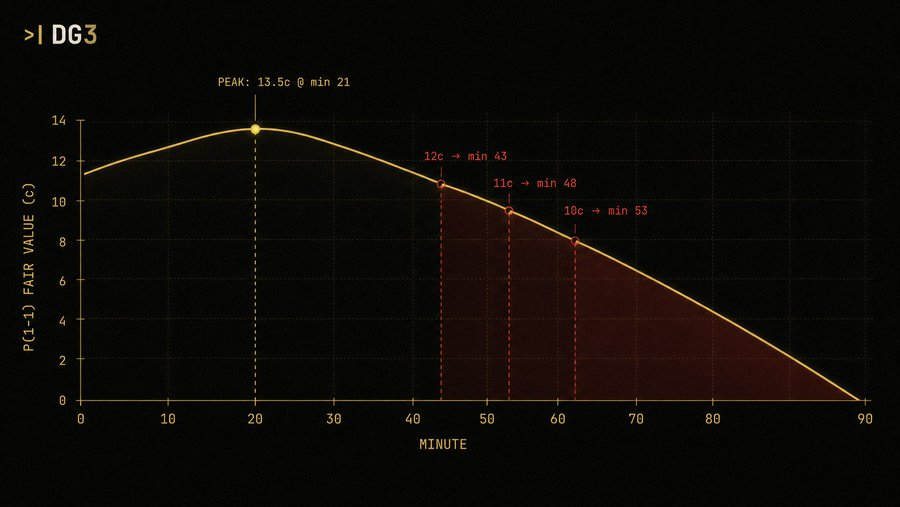
A match that stays goalless isn’t neutral for your position. It’s a slow bleed.
P(1-1) isn’t flat at 0-0. It peaks around minute 21 at roughly 13.5 cents, then declines continuously. P(exactly 1 goal) per team is maximised when lambda equals 1.0. With each team starting at λ = 1.3, remaining lambda hits 1.0 at approximately minute 21. After that it shrinks below 1.0 and the probability of exactly one more goal from each team starts falling. By halftime at 0-0, fair value is already near your entry price. By minute 60 it’s 7.9 cents. At minute 75 it’s 3.0 cents.
The mathematical cut points:
| Entry price | Cut by |
|---|---|
| Bought at 10 cents | Minute 53 |
| Bought at 11 cents | Minute 48 |
| Bought at 12 cents | Minute 43 |
Past those minutes you’re holding negative expected value and it’s accelerating.
The practical exit is before the Poisson crossover, not at it. Late in a goalless match, retail traders hold the market price above fair value on narrative. At 0-0 minute 60, your contract is mathematically worth 7.9 cents but the market may still show 11-12 cents. That’s your exit. Sell into the narrative premium before the market catches up.
Minute 48 is your line in the sand at 11 cents entry. Before that, you’re fine. After that, you’re hoping.
Building Your Lambda: What a Trader Actually Does
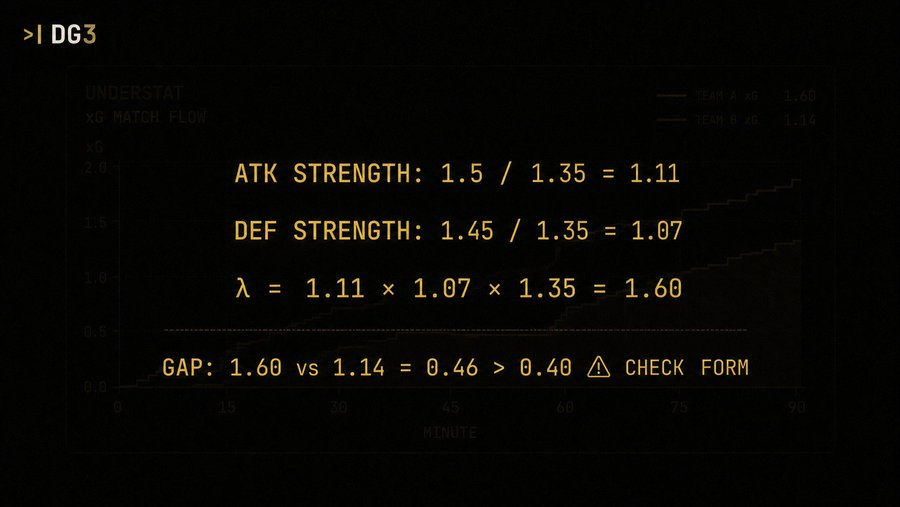
Lambda isn’t a number you look up. You build it for each match.
Start with league average xG per team per match. In the Premier League this runs around 1.35-1.4. Call it L. Then for each team: attack strength = their average xG scored divided by L. Defence strength = their average xGA conceded divided by L.
Lambda for Team A vs Team B = Attack strength of A × Defence strength of B × L.
Example. Team A averages 1.5 xG, league average is 1.35. Attack strength: 1.5/1.35 = 1.11. Team B concedes 1.45 xGA average. Defence strength: 1.45/1.35 = 1.07. Lambda A: 1.11 × 1.07 × 1.35 = 1.60. Team B averages 1.2 xG, Team A concedes 1.3 xGA. Lambda B: (1.2/1.35) × (1.3/1.35) × 1.35 = 1.14. Gap of 0.46, just outside the 0.4 threshold. Check recent form before entering.
Lambda is not the same as xG. xG is the raw material, lambda is the processed input. A single-match xG of 2.4 doesn’t mean lambda is 2.4. It’s derived from an average across 10+ matches adjusted for the specific opponent.
Use xG averages, not actual goals. Actual goals over a 10-game sample are noisy. xG smooths that out. If xG and actual goals diverge by more than 0.2 per match, take a weighted average leaning toward xG. If they’re within 0.2, use xG directly.
Understat has per-match xG and xGA going back years. Sofascore updates live xG during matches. Five minutes per match before kickoff.
The Full Checklist
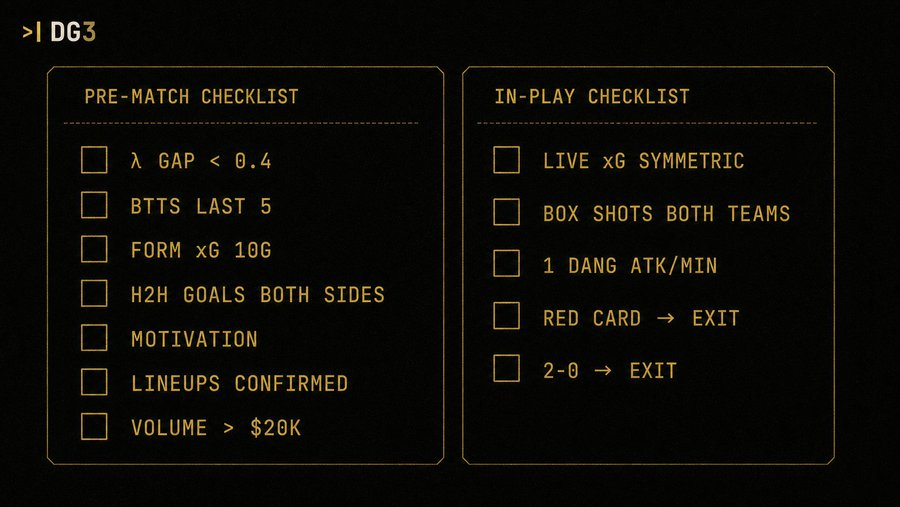
Pre-match:
Lambda balance is the gate. Gap wider than 0.4, don’t enter. From 1-0 in a mismatched match, conditional P(1-1) can actually fall while P(2-0) climbs. You’d be buying into a contracting probability.
Check BTTS in the last five for both teams. Fewer than two of five and one side isn’t creating or conceding. Check season xG and xGA, then cross-check last 10 games. A team whose season xG is 1.4 but last 10 average 0.8 is not a 1.4 team right now.
Look at scorelines, not just results. A five-game winning run of 1-0s with low xG is a different animal to 2-1, 3-2, 2-1. Clean sheet streaks kill this trade. Check home and away form separately. A team that goes quiet away from home has a different lambda on the road and that won’t show in the headline average.
Head to head. Three of the last five meetings producing at least one goal from each side is the baseline. Fixtures that historically end 0-0 or 2-0 are telling you something averages miss.
Match context. Dead rubbers, cup ties where extra time is acceptable, late-season fixtures with nothing at stake, all compress attacking intent regardless of the numbers. You need both teams genuinely trying to score. Check motivation.
Confirm lineups before entering. The lambda you calculated is for the starting striker, not whoever’s covering for a knock. Market volume on the 1-1 contract should be above $20,000. Below that, spreads eat you on both ends.
In-play:
Live xG is your primary read. Both teams accumulating xG symmetrically at 0-0 is what you want. Combined live xG above 0.8 before minute 30 with no goals means chances are being created, just not converted. Hold.
Shots from inside the box signal genuine threat. Long-range efforts don’t. One dangerous attack per minute per team is the rough benchmark for a hot match. Below that on either side and the game is tactically dead for your purposes.
Red card: exit immediately. Score goes 2-0: near-worthless, get out at whatever’s showing. Combined live xG near zero at minute 40: sell into whatever narrative premium exists and close it.
The Error Bands: What the Model Gets Wrong
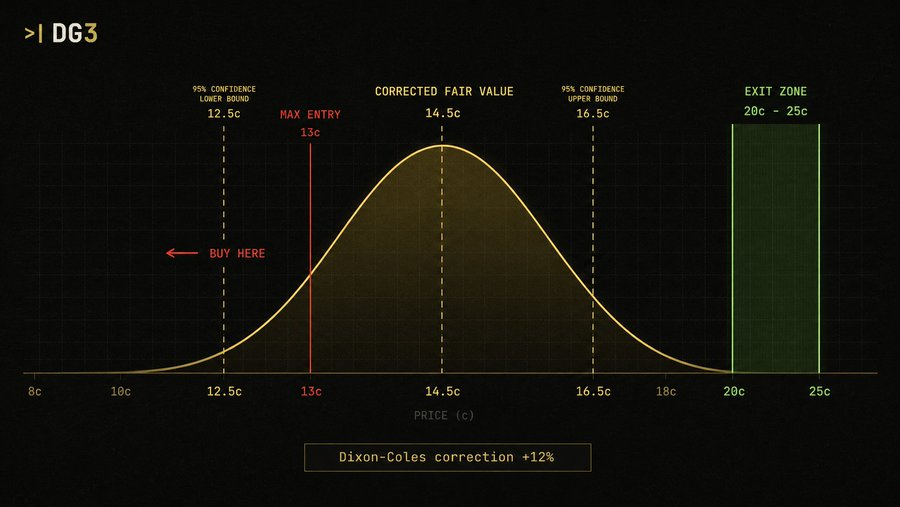
Poisson is not a crystal ball.
Lambda estimation: on a 10-game sample, the 95% confidence interval around λ = 1.3 runs from 0.59 to 2.01. Wide. Use at least 10 games and cross-check against the season average.
Draw inflation: pure Poisson treats both teams as independent scorers. They’re not. A team that goes behind pushes forward, inflating draw probability. The academic correction adds roughly 8-12% relative probability to the 1-1 scoreline. Poisson gives you 12.5 cents but true corrected fair value is closer to 14-15 cents.
Non-uniform goal rates: goals cluster late. The final 15 minutes run about 25% hotter than average. A 1-0 at minute 60 sits in elevated-rate territory. Small correction, in your favour.
Combined error band: roughly plus or minus 2 cents around any Poisson estimate. The entry rule, buy at 12 cents or below, gives you 3 cents of buffer below corrected fair value. Even if your lambda is off by a standard deviation, you’re still entering at or below true fair value. Above 13 cents and you’re paying fair value with no buffer.
On the exit side, the error bands don’t matter. Corrected conditional fair value at 1-0 around minute 60 is roughly 20 cents. The market reprices to 20-25 cents. You’re selling above the entire confidence range. Entry discipline is where the error bites. The exit takes care of itself.
What This Strategy Actually Is
It’s not a scoreline prediction. It’s a repricing trade built on conditional probability and the gap between what the market should price and what it actually prices in the seconds after a goal lands.
Entry is mechanical: equal teams, lambda gap within 0.4, buy at 12 cents or below. Exit trigger is binary: first goal, sell. Stop-loss is a clock: still 0-0 past your breakeven minute, cut into whatever narrative premium remains.
No chasing scores. No holding through 2-0 on a prayer. No gut feel. The math sets the entry, the goal sets the exit, the clock sets the stop.
Run your lambdas on DG3 Terminal before the next evenly matched fixture and see what the market is pricing the 1-1 at.
Frequently Asked Questions
Q: What is the 1-1 contract trading strategy in prediction markets? A: It’s a repricing trade, not a scoreline prediction. You buy a 1-1 exact score contract pre-match on evenly matched teams at 12 cents or below. When the first goal lands and the score hits 1-0, you sell into the market repricing that follows. You never wait for the 1-1 to actually happen. The edge comes from the conditional probability jump that occurs at 1-0 and the emotional in-play repricing that overshoots what the math justifies.
Q: Why does the 1-1 contract price go up when the score hits 1-0? A: Because the conditional probability of a 1-1 final is higher from a 1-0 state in the right game window than it was before the match. With 30 minutes left and the score at 1-0, the away team needs exactly one more goal – achievable. The home team needs exactly zero – also achievable. The combined probability often exceeds the pre-match probability of 1-1. In-play traders rush into “equaliser likely” positions and push the price to 20-25 cents, above what Poisson alone justifies. You’re selling into that emotional repricing.
Q: What is lambda and how do you calculate it for a football match? A: Lambda is the expected number of goals a team will score in a specific match, accounting for their attack strength, the opponent’s defensive strength, and the league average. It’s derived from xG averages across 10+ matches, not from a single game. Formula: Lambda for Team A = (Team A attack xG / league average) × (Team B defensive xGA / league average) × league average. Lambda is not the same as raw xG from a single match.
Q: When should you cut a 1-1 contract if the match stays 0-0? A: The cut points depend on your entry price. At 10 cents entry, cut by minute 53. At 11 cents, cut by minute 48. At 12 cents, cut by minute 43. After these points the contract is in negative expected value territory and the loss accelerates. Don’t wait for the Poisson crossover – sell into whatever narrative premium the market still holds before it catches up to fair value.
Q: What is the maximum lambda gap for this strategy to work? A: 0.4. If the gap between the two teams’ lambdas exceeds 0.4, don’t enter. In a mismatched match, when the stronger team scores first to make it 1-0, the conditional probability of a 1-1 can actually fall rather than rise because P(2-0) climbs faster than P(1-1). The equal-teams requirement is not a preference – it’s a mathematical gate.
Q: What market volume is needed to trade the 1-1 contract? A: At least $20,000 in market volume on the 1-1 contract. Below that, spreads eat you on both entry and exit. The entry-exit round trip needs enough liquidity to execute at prices close to what the market shows, which requires genuine two-sided participation.
Also read: Positive EV Trading: A Practical Framework for Prediction Markets
How to Find Mispriced Markets on Polymarket
Line Movement in Prediction Markets: Reading Sharp Moves Before They Finish