
Bankroll Management in Prediction Markets: The Fuel Tank Every Trader Needs
Your bankroll is a fuel tank. Most prediction market traders drive with the accelerator pinned.
Bankroll management, sizing each prediction market position as a fixed percentage of your total capital, is the single practice that separates traders who survive variance from those who blow up mid-season. Not the sharpest model. Not the fastest execution. Not the best information sources. This one thing.
This guide covers why fixed percentage staking works, what happens when you ignore it, and the tier structure that keeps you on the road when the inevitable losing run arrives.
Table of Contents
Every Position Burns Fuel
The question isn’t how much you want to win. It’s how long you can stay on the road before you run dry.
Every position you take depletes something. When that position loses, and losing positions are not optional, they come for every trader eventually, your remaining capital is smaller. The next position is entered from a weaker position than the last. If your stake sizes don’t account for this, you’re not managing a bankroll. You’re managing a countdown.
The maths of ruin is not complicated. As Pinnacle’s trading strategy resources note, a 50% drawdown requires a 100% return just to get back to where you started. A 70% drawdown requires 233%. Most traders don’t think about this when they’re sizing a position. They think about how confident they are. Confidence is not a bankroll management system.
What makes bankroll management in prediction markets different from other trading contexts: positions resolve at $0 or $1.00. There’s no partial loss, the contract either pays out or it doesn’t. This binary resolution means a run of losing positions creates a sequence of complete write-offs, each one from a smaller capital base. Without a fixed percentage system, a losing run doesn’t just hurt. It compounds.
The Marcus Breakdown
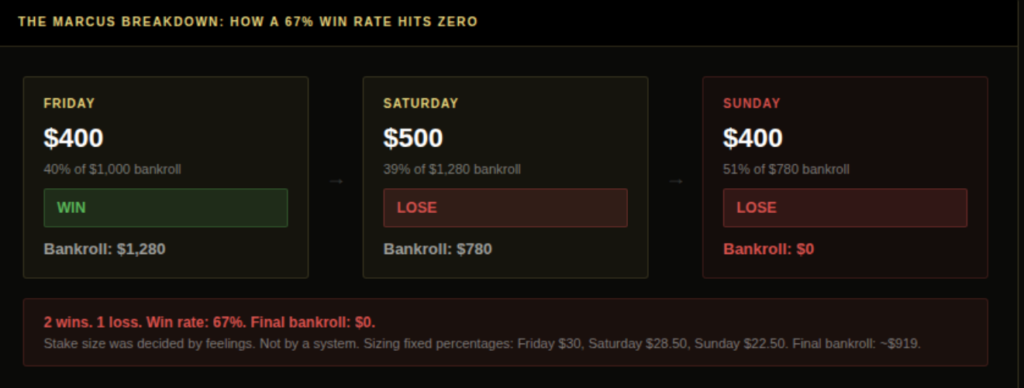
Friday night. Man City at home. He’s confident. Puts $400 on them. City win, he’s up to $1,280. He feels untouchable.
Saturday. Same confidence. Goes $500 on the next one. Loses. Down to $780. He’s chasing now, though he wouldn’t call it that.
Sunday. Puts $400 in to claw it back. Loses again. Zero.
Three positions. Two wins. One loss. Bankroll: gone.
That’s what happens when your stake size is decided by your feelings rather than a system. Marcus won two of three positions. In any reasonable model of prediction market skill, winning 67% of your positions should grow a bankroll, not eliminate it. But his sizing decisions, $400, $500, $400 on a $1,000 bankroll, turned a positive win rate into a zero balance.
The problem isn’t that he lost a position. The problem is that he sized his positions based on confidence rather than capital. On Friday, 40% of his bankroll on one contract. On Saturday, after the win, nearly 40% again. After the loss, he was down to $780 and still putting 51% of his remaining capital into a single position.
No system. No rules set in advance. Just feelings.
Prediction market bankroll management isn’t about being pessimistic. It’s about having a plan that works even when you’re wrong. Marcus had no plan for being wrong. Most traders don’t.
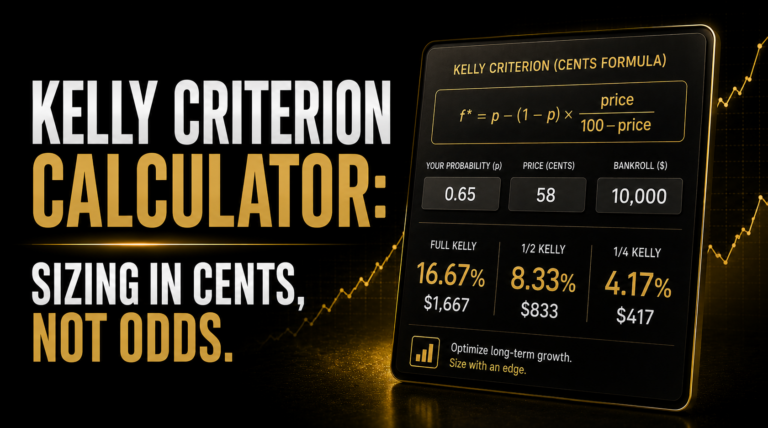
Also read: Kelly Criterion for Prediction Markets: Sizing Positions When Odds Move
Stop Sizing Fixed Amounts. Start Sizing Fixed Percentages.
This one change is the difference between a prediction market trader who’s still active in December and one who’s blown up by October.
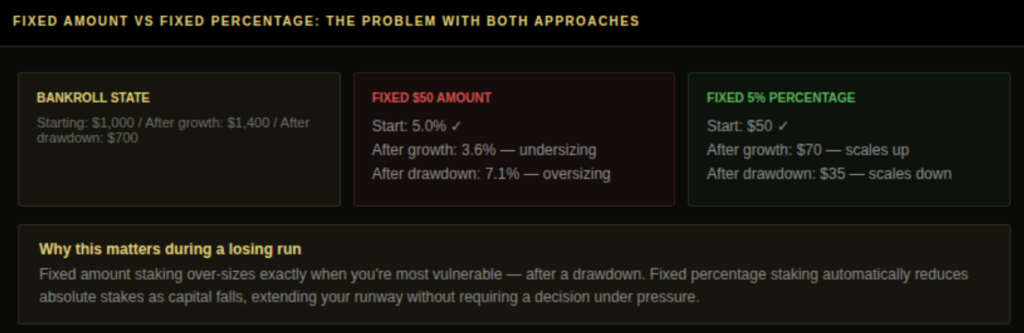
Fixed amount staking, $50 per position regardless of bankroll size, feels disciplined. It isn’t. When your bankroll grows from $1,000 to $1,400, $50 is now 3.6% of capital instead of 5%. You’re effectively under-sizing. When it falls to $700 after a losing run, $50 is 7.1% of capital. You’re over-sizing exactly when you’re most vulnerable.
Fixed percentage staking solves both problems simultaneously. As your bankroll grows, your absolute stake sizes grow proportionally. As it shrinks, your stakes shrink too, automatically extending your runway through losing runs without you having to make a decision under pressure. The bankroll manages itself. You just have to follow the tiers.
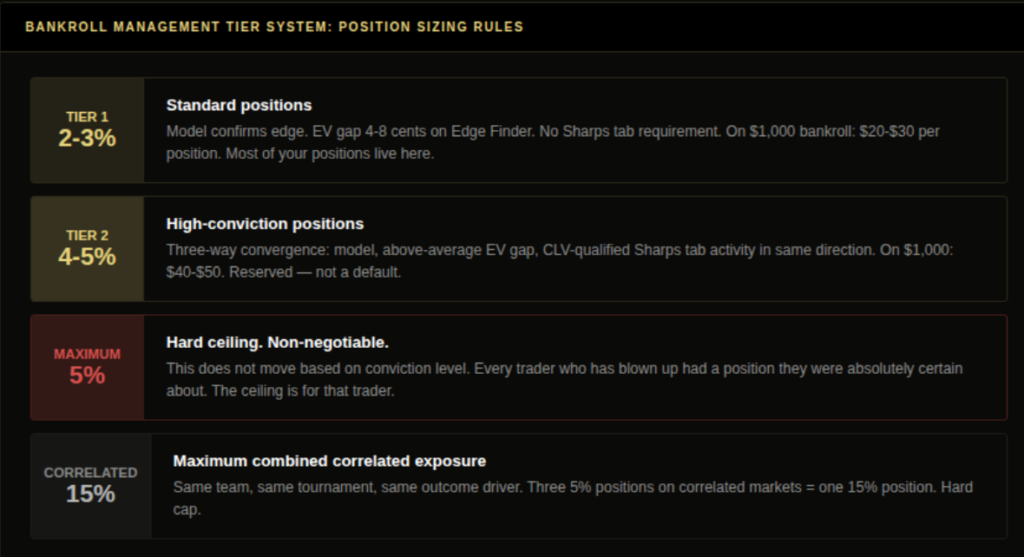
The practical tier structure for prediction market bankroll management:
Tier 1, Standard positions: 2-3% of current bankroll. These are your bread-and-butter trades. You’ve run the model, the edge is clear but not exceptional, the EV gap is in the 4-8 cent range. Most of your positions live here. On a $1,000 bankroll, that’s $20-$30 per position.
Tier 2, Higher conviction positions: 4-5% of current bankroll. Three-way convergence: your model agrees with the direction, DG3’s Edge Finder shows an above-average EV gap, and the Sharps tab has CLV-qualified wallet activity in your direction. Reserved for the setups that genuinely check all three boxes. On a $1,000 bankroll, that’s $40-$50.
Tier 3, Maximum positions: no more than 5% of current bankroll. This is the ceiling. It doesn’t move based on how certain you feel. The highest conviction you’ve ever had about a prediction market position is not sufficient justification to breach 5%. Every trader who has blown up had a position they were absolutely certain about.
One additional rule: no more than 15% of total bankroll across correlated positions at any one time. A CS2 match winner and a tournament outright involving the same team are correlated. Two World Cup matches where the same team’s result affects both are correlated. Treat them as a combined position for bankroll management purposes.
A Tale of Two Traders
Two prediction market traders. $1,000 each. Ten losing positions in a row, which happens to everyone eventually, regardless of model quality, because variance is real.
Trader A uses 5% fixed percentage staking.
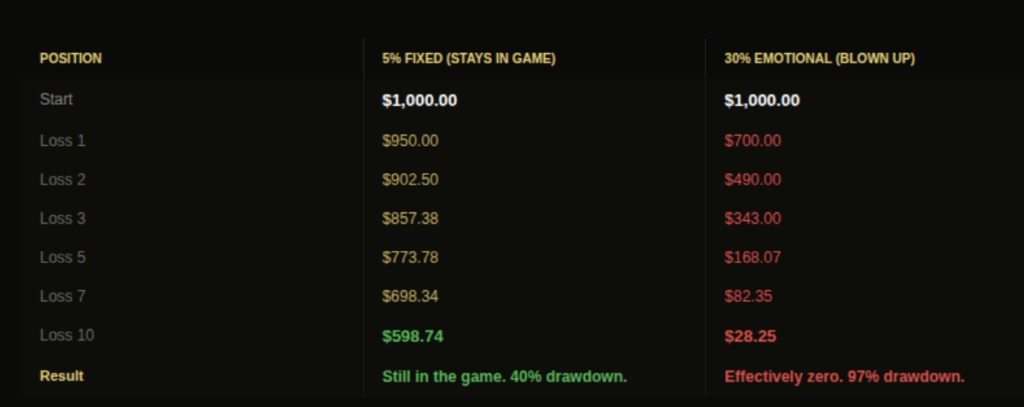
Position 1: $50 stake. Loses. Bankroll: $950. Position 2: $47.50 stake. Loses. Bankroll: $902.50. …continuing through ten consecutive losses… After position 10: $598.74 remaining.
Still in the game. Still able to enter position 11. The losing run hurt, but it didn’t end anything.
Trader B sizes emotionally at 30% per position.
Position 1: $300 stake. Loses. Bankroll: $700. Position 2: $210 stake. Loses. Bankroll: $490. Position 3: $147 stake. Loses. Bankroll: $343. …continuing through ten consecutive losses… After position 10: $28.25 remaining.
Effectively zero. One more position at any reasonable stake size and it’s over.
Same ten-loss sequence. Same starting capital. Trader A is sitting at 60% of starting capital, annoyed but functional. Trader B is at 2.8% of starting capital, unable to participate meaningfully in the next opportunity regardless of how good it is.
The losing run didn’t discriminate. The bankroll management system decided the outcome.
Why Bankroll Management Is a System Design Problem, Not a Willpower Problem
Most bankroll management advice treats sizing discipline as a willpower issue. It isn’t. It’s a system design issue. If your sizing decision happens in the moment you’re about to enter a position, you’re relying on willpower at exactly the point when emotion is highest. That’s the worst possible architecture.
The fix: make sizing decisions before you open any prediction market. Before a tournament. Before a match day. Define your tier thresholds in advance and write them down. Know that your standard position is 2-3%, your high-conviction tier is 4-5%, and 5% is absolute maximum. By the time you’ve identified a position to enter, the sizing decision has already been made by your pre-session rules, not by how you feel about this specific trade.
DG3 supports this workflow directly. The Edge Finder shows EV gaps in real time, you can see in advance whether a market is at the 4-8 cent range that warrants Tier 1 sizing or the above-average gap that warrants Tier 2 consideration. The Sharps tab tells you whether CLV-qualified wallets are in your direction before you enter. You can form a complete sizing decision, including tier classification, before committing a single cent.
The correlated markets framework matters here too. Running five positions simultaneously that all resolve the same way if one team wins isn’t five independent 3% positions. It’s one 15% position with extra steps. Map your correlation exposure before each session, not after.
The Compound Effect Works Both Ways
The compound ruin problem has a property most traders underestimate until they’ve lived it. When you lose 40% of your bankroll, the loss feels painful but bounded. When you lose 97%, it feels like the same kind of event, just bigger. It isn’t. The 97% loss removes you from the game. The 40% loss leaves you in it.
This asymmetry is why experienced prediction market traders treat bankroll management as a constraint, not a goal. You don’t manage your bankroll to maximise returns. You manage it to stay in the game long enough for your returns to materialise. Survival first. Compounding second.
Every trader knows compound growth is powerful. Fewer think carefully about compound loss.
A 5% stake on a $1,000 bankroll is $50. Ten losses later you’re at $599, a 40% drawdown that requires a 67% recovery to get back. Painful, but survivable with disciplined staking from this point.
A 30% stake on a $1,000 bankroll is $300. Ten losses later you’re at $28, a 97% drawdown that requires a 3,471% recovery. That’s not a recovery. That’s starting over, if you can even muster the capital to do it.
The asymmetry is brutal. Oversizing by 6x doesn’t produce 6x more damage. It produces complete ruin versus meaningful but recoverable setback. This is why the ceiling is not negotiable. The maximum is 5% not because 6% is modestly riskier, it’s because the non-linear ruin function means the difference between 5% and uncontrolled sizing is the difference between staying in the game and leaving it.
The half Kelly and quarter Kelly frameworks exist for exactly this reason. Full Kelly maximises expected logarithmic growth but produces variance that most traders can’t emotionally sustain, a finding well-documented in behavioural finance research at SSRN, leading to the kind of sizing drift that wrecked Marcus. Quarter Kelly produces lower expected growth but a loss sequence that doesn’t trigger the emotional responses that destroy systems. Most serious prediction market traders operate closer to quarter Kelly than full, for exactly this reason.
The Bottom Line
The sharpest prediction market traders aren’t the ones who pick the most winners. They’re the ones still standing when everyone else has gone home.
Variance will come for you. A run of ten losing positions on genuinely positive-EV trades is not a sign that your model is broken, it’s a sign that prediction markets are probabilistic and short-run outcomes are noisy. The only question is whether you’re structurally set up to survive that run and come out the other side with enough capital to let your edge compound.
Size small. Stay consistent. The fuel tank outlasts the ones with the accelerator pinned.
One Session Bankroll Management Rule That Changes Everything
There’s a practical habit that translates the tier system from theory into execution: the pre-session bankroll calculation.
Before every match day or tournament window, open a note or spreadsheet and do three things. First, record your current bankroll total. Second, calculate your tier thresholds: Tier 1 minimum, Tier 1 maximum, Tier 2 minimum, Tier 2 maximum, and the absolute 5% ceiling. Third, calculate your correlated exposure cap at 15%.
These five numbers are the only bankroll management information you need during the session. When you identify a position to enter, you already know what tier it sits in based on your pre-session model assessment. You look up the corresponding dollar range. You enter that amount. No decision under pressure. No negotiation with yourself about whether this one warrants an exception.
The pre-session calculation takes three minutes. What it buys is the removal of bankroll sizing from the list of things you’re deciding in real time while a position window is closing. Marcus was making three separate sizing decisions under emotional conditions, one after a win, one after a win, one while chasing. The pre-session rule makes those decisions zero times under emotional conditions. The rules are already set. The only thing left is whether the position meets your entry criteria.
DG3’s Edge Finder and Sharps tab handle the entry criteria check. Your pre-session bankroll rules handle the sizing. Session structure handles the sequencing. That’s the complete system.
Frequently Asked Questions
Q: What is bankroll management in prediction markets? A: Bankroll management in prediction markets means sizing each position as a fixed percentage of your current total capital rather than a fixed dollar amount. The standard approach is 2-5% per position, with correlated positions capped at 15% combined exposure. Fixed percentage staking automatically reduces absolute stake sizes during drawdowns and increases them during growth, extending your runway through losing runs without requiring active decisions under pressure.
Q: What percentage of bankroll should I stake on each prediction market position? A: Standard positions: 2-3% of current bankroll. High-conviction positions with three-way convergence (model, EV gap, Sharps tab): 4-5%. Hard ceiling: 5% on any single position, regardless of conviction level. The 5% ceiling is non-negotiable because the ruin function is non-linear, oversizing doesn’t produce proportionally more damage, it produces exponentially more damage.
Q: How many losing positions in a row can a 5% staker absorb? A: Using 5% fixed percentage staking from a $1,000 starting bankroll, ten consecutive losing positions leaves $598.74, approximately 60% of starting capital. Survival is intact and recovery is realistic. The same ten-loss sequence with 30% emotional sizing leaves $28.25, effectively zero. The same losing run. The bankroll management system determined the outcome, not the losses themselves.
Q: What is the difference between fixed amount and fixed percentage staking? A: Fixed amount staking ($50 per position regardless of bankroll) creates a problem in both directions. As your bankroll grows, $50 becomes a smaller percentage and you’re under-sizing. As it shrinks during a losing run, $50 becomes a larger percentage and you’re over-sizing precisely when you’re most vulnerable. Fixed percentage staking solves both problems: it grows your absolute stakes as capital grows and shrinks them automatically during drawdowns.
Q: How does bankroll management connect to the Kelly Criterion? A: The Kelly Criterion calculates the theoretically optimal stake size given your edge and the payout structure of a position. Full Kelly maximises expected logarithmic growth but produces volatility that most traders can’t emotionally sustain, a finding well-documented in behavioural finance research at SSRN. Quarter Kelly produces lower absolute growth but a loss sequence that doesn’t trigger emotional sizing drift. The 2-5% tier system is roughly consistent with quarter to half Kelly across typical prediction market edge sizes of 4-12 cents per position.
Also read: Kelly Criterion for Prediction Markets: Sizing Positions When Odds Move
Half Kelly, Quarter Kelly, Full Kelly: Choosing Your Fraction
Correlated Markets in Prediction Markets: Managing Portfolio Risk