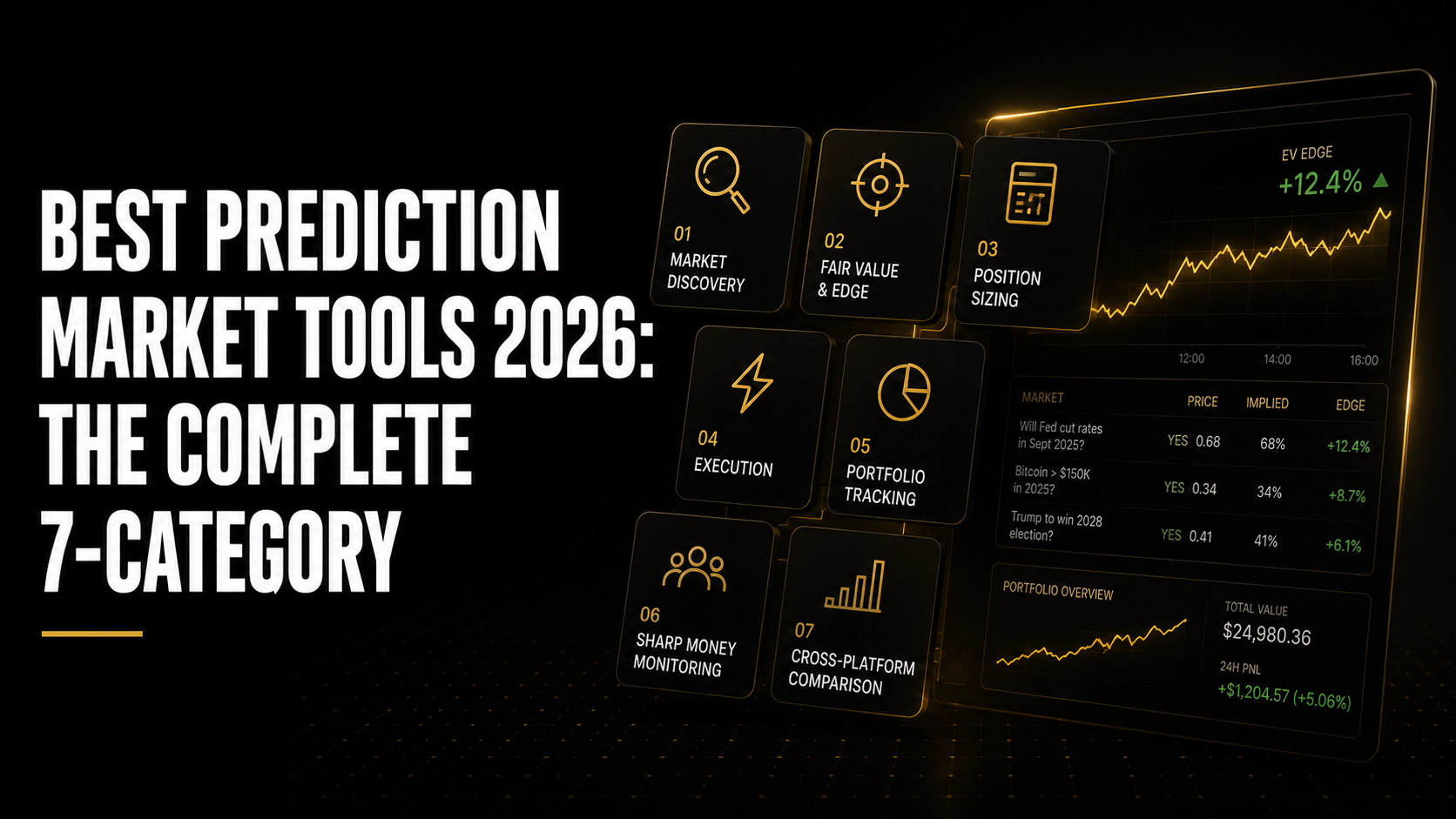
Best Prediction Market Tools in 2026 (Ranked by What They Actually Do)
Seven tabs open. Three of them are doing the same job. You are cross-referencing a Polymarket price in one tab, a devigged fair value in another, and a whale tracker in a third, and you still have not placed the trade because the market has moved 4 cents since you started.
This is not a research problem. It is a tooling problem. And it has a direct cost: the edge you calculated no longer exists at the price you need.
Table of Contents
Quick Answer
The best prediction market tools in 2026 fall into seven categories: edge detection and fair value, order book and execution, signal and order flow tracking, portfolio and P&L tracking, data feeds and APIs, research and backtesting, and terminal infrastructure. The most serious traders in 2026 are consolidating all seven into a single terminal workflow rather than stitching together free tools across multiple browser tabs.
Key Takeaways
- The seven tool categories map directly to the seven stages of a trade: find a market with edge, assess liquidity, identify who is driving the price, size correctly against your bankroll, execute cleanly, track what it cost you, and review your calibration over time. A gap in any one category costs money at exactly the moment it is hardest to recover.
- Free tools handle approximately 60% of the workflow. The 40% gap is almost always in the integration layer: no tool connects fair value to order book depth to execution in a single view without manual tab-switching between them.
- Whale trackers are the most misused tool category in prediction markets. Tracking dollar amounts without tracking wallet quality produces the illusion of signal. A $50,000 order from an unclassified wallet and a $50,000 order from a wallet with a 90-day positive CLV track record are not equivalent information, the dollar amount tells you one thing, the wallet context tells you the other.
- The best prediction market tools in 2026 are not the ones with the most features. They are the ones that eliminate the friction between spotting an edge and acting on it before the market closes the gap.
- Most traders build their stack around the tools that are easiest to find, not the tools that cover the most critical parts of the workflow. The result is a stack that is overbuilt on research and underbuilt on execution speed and P&L tracking.
- Data feed tools and terminal tools are not the same category. A raw API feed gives you data. A terminal gives you data plus interpretation plus execution in a single workflow. At the point where your research is strong enough to generate consistent edge, the speed gap between a feed and a terminal is where most of that edge leaks.
- Trade Desks are systematically underused at the casual level and systematically overused without calibration at the serious level. The output of a Kelly calculator is only as good as the probability estimate going in. A Kelly calculator fed a bad fair value estimate produces a confidently wrong position size.
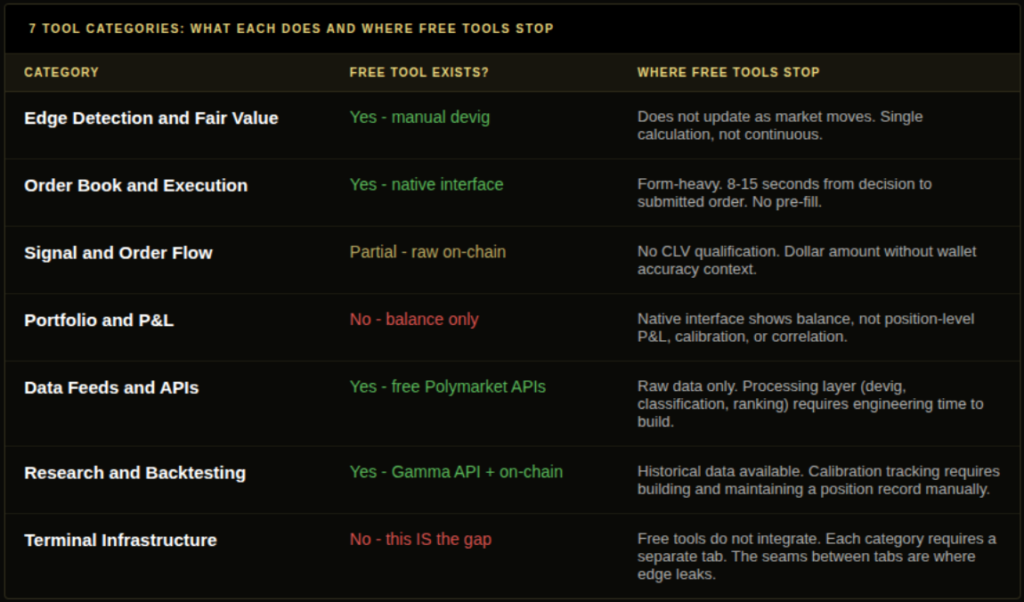
The 7 Tool Categories Every Serious Prediction Market Trader Needs
Category 1: Edge Detection and Fair Value
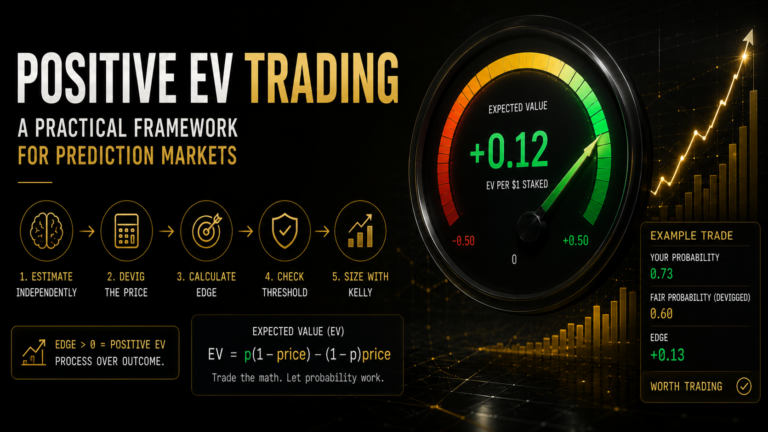
Fair value in prediction markets: The devigged probability for an outcome, the market’s raw price stripped of the platform’s implied margin. On Polymarket, raw prices sum to slightly above 1.00 across all outcomes. Fair value normalises each price so they sum to exactly 1.00, giving you the honest market-implied probability rather than the margin-inflated price.
Without fair value, you are comparing your probability estimate against a distorted number. You think the market is offering 0.62 on an outcome you believe is 0.70. The true devigged price might be 0.64. The edge is real but smaller than it looks.
The tools that handle this range from manual spreadsheets (precise but slow) to automated fair value engines that update as market prices move. The meaningful difference is whether the devig calculation happens once when you open a position or continuously as the market reprices.
Also read: Fair Value in Prediction Markets
Category 2: Order Book and Execution Tools
The order book tells you three things before you touch a position: how much liquidity is available at your target price, what the spread is (and therefore what your entry and exit slippage will cost), and whether the depth holds under a position of your intended size.
Most traders check the order book after they have decided to trade. By then, the book is a constraint on a decision already made rather than an input to it. The correct sequence is book check before decision, not after.
Execution tools range from the native Polymarket interface (functional but form-heavy) to Trade Desk implementations with pre-filled orders, limit GTC/GTD order types, and 1-Click Trade modes that reduce a multi-step form to a single tap. On a market moving at 0.5 cents per second, the difference between 8 seconds and 1.5 seconds of form friction is measurable in entry price.
Also read: Slippage in Prediction Markets: What Your Fill Actually Cost You
Category 3: Signal and Order Flow Tracking
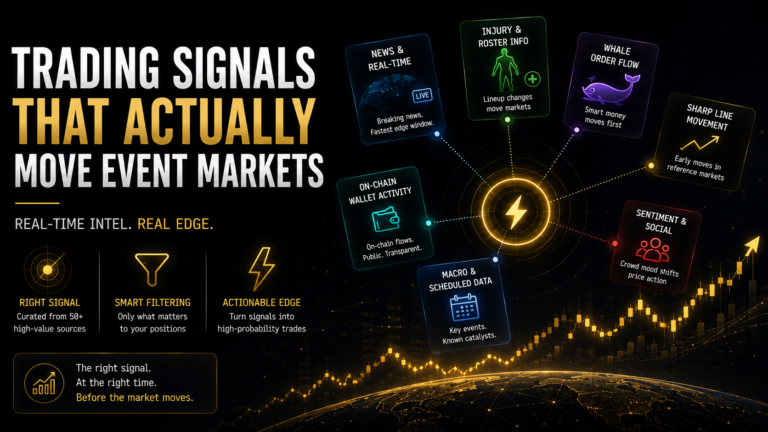
Signal tracking is where most free tools reach their limit. The data is on-chain and publicly available, every trade on Polymarket is a verifiable Polygon transaction. The problem is classification. Raw wallet addresses tell you nothing about the quality of the capital behind them.
Serious signal tracking tools do two things: they surface large wallet entries in real time, and they provide context on those wallets’ historical accuracy. The combination answers the question that raw order flow cannot: is this informed capital or is this size without skill?
The correct qualifier for a sharp is not a dollar threshold. It is a track record. A wallet with 50+ resolved trades in the last 90 days and a positive rolling Closing Line Value is demonstrably beating the market on a consistent basis. The same number of trades without a positive CLV is noise at scale.
Category 4: Portfolio and P&L Tracking
This is the most neglected category for traders who have been active for 6-12 months. The native Polymarket interface shows balance. It does not show entry-price-vs-resolved-price across positions, calibration by market type, or the correlation between positions that are individually sized correctly but collectively overweight on the same event driver.
A portfolio tracker that shows open exposure by category, Sports, Politics, Crypto, Macro, makes correlation visible before it becomes a loss. A single tournament with four correlated positions across match winner, outright, player prop, and group stage looks diversified until the key player is injured 10 minutes before kickoff and all four move against you simultaneously.
Also read: Correlated Markets in Prediction Markets: Managing Portfolio Risk
Category 5: Data Feeds and APIs
For traders who build their own tools, probability models, automated position monitors, backtesting frameworks, the Polymarket CLOB API and Gamma API are free, publicly documented, and sufficient for most research use cases. WebSocket feeds from the CLOB API provide sub-second price updates for execution-speed-sensitive applications.
The gap between free API access and processed data products is the engineering time required to build the processing layer. Devigging, fair value calculation, market categorisation, and signal classification are all work that happens above the raw feed. Traders who build this themselves own it. Traders who need it immediately use a terminal that has already built it.
Category 6: Research and Backtesting Tools
Historical Polymarket data is available on-chain and through the Gamma API for structured queries. The practical use cases for backtesting in prediction markets are more constrained than in traditional financial markets because the market depth, participant composition, and event types have all changed meaningfully over the last three years.
The most defensible backtesting use case is calibration tracking: were your entry prices systematically above or below the closing price across a specific market type? A calibration record built across 100+ positions separates systematic edge from variance in a way that win/loss records cannot.
Also read: Calibration in Prediction Markets: How to Measure Forecast Accuracy
Category 7: Terminal Infrastructure
A terminal is not a tool category in the same sense as the six above. It is the integration layer that connects them. The meaningful question is not whether a terminal has more features than free tools, most of them do. The meaningful question is whether the integration eliminates the friction between spotting an edge and acting on it.
The 5-tab stack works. Traders with enough discipline to maintain it consistently and enough speed to navigate between tabs without losing the market have used it to generate real returns on Polymarket since 2021. The cost is always the same: time between decision and execution, and attention split across multiple interfaces.
A terminal that puts fair value, order book depth, wallet signal context, and execution in the same three-column view eliminates that cost. Not because the underlying data is different. Because it removes the tab-switching latency that compounds every time the market is moving.
Also read: What Is a Prediction Market Terminal? (And Why Traders Outgrow Raw Polymarket)
Free vs Terminal: Where the Stack Breaks Down
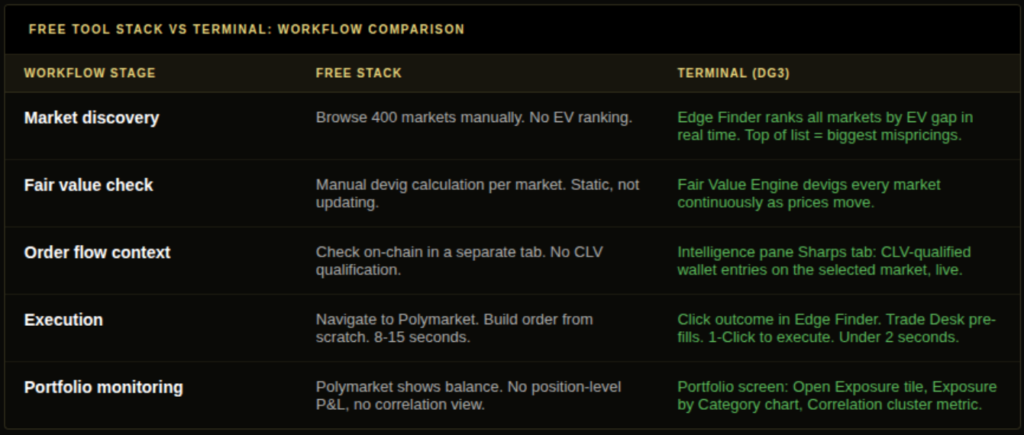
Free tools cover the research layer thoroughly. Historical data, devig calculators, Kelly sizing spreadsheets, and API access to Polymarket’s CLOB are all available without cost. The stack breaks down at the integration layer, specifically at the moment when research is complete and execution needs to happen.
The specific failure mode looks like this: you have done the research, formed the probability estimate, devigged the current price, calculated your edge, sized the position correctly via Kelly calculator, and are ready to execute. The market is moving. You navigate to Polymarket’s native interface, build the order from scratch, and by the time you confirm, the entry price you targeted is no longer available.
This happens because each tool in a free stack is optimised for its own function, not for the handoff to the next function. A Kelly calculator does not know what the current Polymarket price is. A whale tracker does not know what you are about to execute. A devig spreadsheet does not update as the market moves. Each tool is excellent in isolation. The combination has seams.
At lower trade frequency and in stable, slow-moving markets, the seams are manageable. In fast-moving markets around news events, injury reports, or team sheet drops, they are not.
Common Mistakes
Mistake 1: Building the stack around research tools and underinvesting in execution tools. Traders spend hours on probability models and 60 seconds on order execution. The time allocation is exactly inverted relative to where edge actually leaks. A trader with a mediocre model and fast, friction-free execution will outperform a trader with an excellent model and a slow form-heavy execution path, in any market that moves faster than 3 minutes from signal to fill.
Mistake 2: Using whale trackers without CLV filtering. Raw on-chain transaction size tells you capital committed. It does not tell you whether that capital has a track record of being right. A $40,000 entry from an unclassified first-time wallet and a $40,000 entry from a wallet with 73 resolved trades and a positive 90-day CLV are two completely different signals. Most freely available whale trackers show you the dollar amount without the qualification context.
Mistake 3: Treating the Kelly calculator as a sizing tool rather than a calibration input. Kelly gives you the mathematically optimal position size given your edge estimate. If your edge estimate is wrong, because your probability model is miscalibrated or because you are comparing your estimate against a raw price rather than a devigged fair value, Kelly outputs a confidently wrong number. The tool works. The input is the problem. Most traders who blame Kelly for blowups were feeding it bad inputs.
Mistake 4: Never reviewing P&L at the position level. Balance tracking tells you whether you are making money. Position-level P&L tells you which market types are generating edge and which are leaking it. A trader who wins overall but tracks only net balance will never know that they are systematically losing on player prop markets while winning on match winners, and therefore will keep allocating to both equally rather than concentrating on what works.
Mistake 5: Adding more research tools when the real gap is in execution speed. The marginal value of a better probability model declines as calibration improves. The marginal value of faster execution never declines in fast-moving markets. If you have spent more than 3 hours this month improving your research process and zero hours improving your execution infrastructure, the allocation is probably wrong.
Frequently Asked Questions
Q: What are the 7 tool categories every serious prediction market trader needs? A: Edge detection and fair value, order book and execution, signal and order flow tracking, portfolio and P&L tracking, data feeds and APIs, research and backtesting, and terminal infrastructure. Each category covers a distinct stage of the trade workflow. A gap in any one stage costs money.
Q: What free tools exist for prediction market research? A: Polymarket’s native interface for browsing markets and checking prices. The Gamma API and CLOB API for structured data access and WebSocket price feeds. Manual devig calculators (spreadsheet-based) for fair value estimation. Kelly criterion spreadsheet templates for position sizing. On-chain data on Polygon for wallet tracking and trade verification.
Q: At what point does a trader need a terminal instead of free tools? A: When the gap between spotting an edge and acting on it has a measurable cost. In practice, this shows up in one of three ways: a trade where the intended entry price was no longer available by the time the order was built. a position sized incorrectly because the Kelly input was based on a stale price rather than the current devigged fair value. or a whale signal that was visible in one tab while execution was happening in another with no connection between them.
Q: How does DG3 cover all 7 tool categories in one interface? A: DG3’s Edge Finder handles category 1 (fair value and EV ranking). The Intelligence pane’s Book tab and Trade Desk handle category 2 (order book and execution). The Intelligence pane’s Sharps tab handles category 3 (signal and order flow, with CLV-qualified wallets). The Portfolio screen handles category 4 (open exposure, P&L, and correlation tracking). The terminal connects to Polymarket’s CLOB and Gamma APIs for category 5. Categories 6 and 7 are addressed through the calibration record built in position history and the integrated three-column workflow.
Q: What do the best prediction market traders actually use? A: An edge detection layer for fair value, live order book depth before every execution, wallet quality context on large orders (not just transaction size), position-level P&L tracking, and a way to get from decision to executed order in under 2 seconds. The specific tools vary. The workflow requirements do not.
Q: How do whale trackers work and what makes a good one? A: A whale tracker shows large wallet entries in the Polymarket order book, on-chain transaction addresses, direction, size, and timestamp. A good whale tracker adds CLV qualification: is this wallet historically accurate as measured by its entry prices relative to closing line values? Without qualification, you are watching large orders from wallets that may have no edge whatsoever. A poor tracker optimised only for size misses what the signal actually means.
Q: What is the difference between a prediction market screener and a full terminal? A: A screener shows markets that match criteria: minimum liquidity, minimum spread, minimum EV gap. It answers the question “which markets are worth looking at?” A full terminal answers that question and then connects the answer to a live order book, a signal feed, and an Trade Desk in the same view. A screener narrows the search. A terminal completes the workflow.
Q: How is prediction market tooling different from sportsbook tooling? A: Sportsbooks have closed systems. You bet into the house at a fixed margin. Prediction markets have open CLOBs. You trade against other participants at a transparent price. This means order book depth, wallet quality, and execution speed matter in prediction markets in ways they simply do not in sportsbooks. Sportsbook tools are built around odds comparison and value finding. Prediction market tools need to add order flow tracking and execution infrastructure on top of that foundation.
Final Thoughts
The right stack for 2026 is not the most expensive stack. It is the stack with the fewest seams between decision and execution.
Every tool category in this guide addresses a real part of the workflow. Every gap between them has a real cost. The cost compounds with trade frequency: at 5 positions per month, a slow execution workflow costs a few cents here and there. At 50 positions per month, it costs a meaningful fraction of your total edge.
The uncomfortable truth is that most traders who are not making consistent money on Polymarket are not losing because their probability models are wrong. They are losing because their tooling has enough friction that the edge from correct probability models does not fully translate into the fills they need.
Fix the seams.
Also read: Inside Edge Finder
Also read: The Best Polymarket Tools in 2026: What Serious Traders Are Actually Using What Is a Prediction Market Terminal? (And Why Traders Outgrow Raw Polymarket)
Kalshi vs Polymarket: Fees, Liquidity, Markets, and Who Should Trade Where