What Is a Prediction Market Terminal? (And Why Traders Outgrow Raw Polymarket)
The venue gave you a steering wheel. A terminal gives you a cockpit.
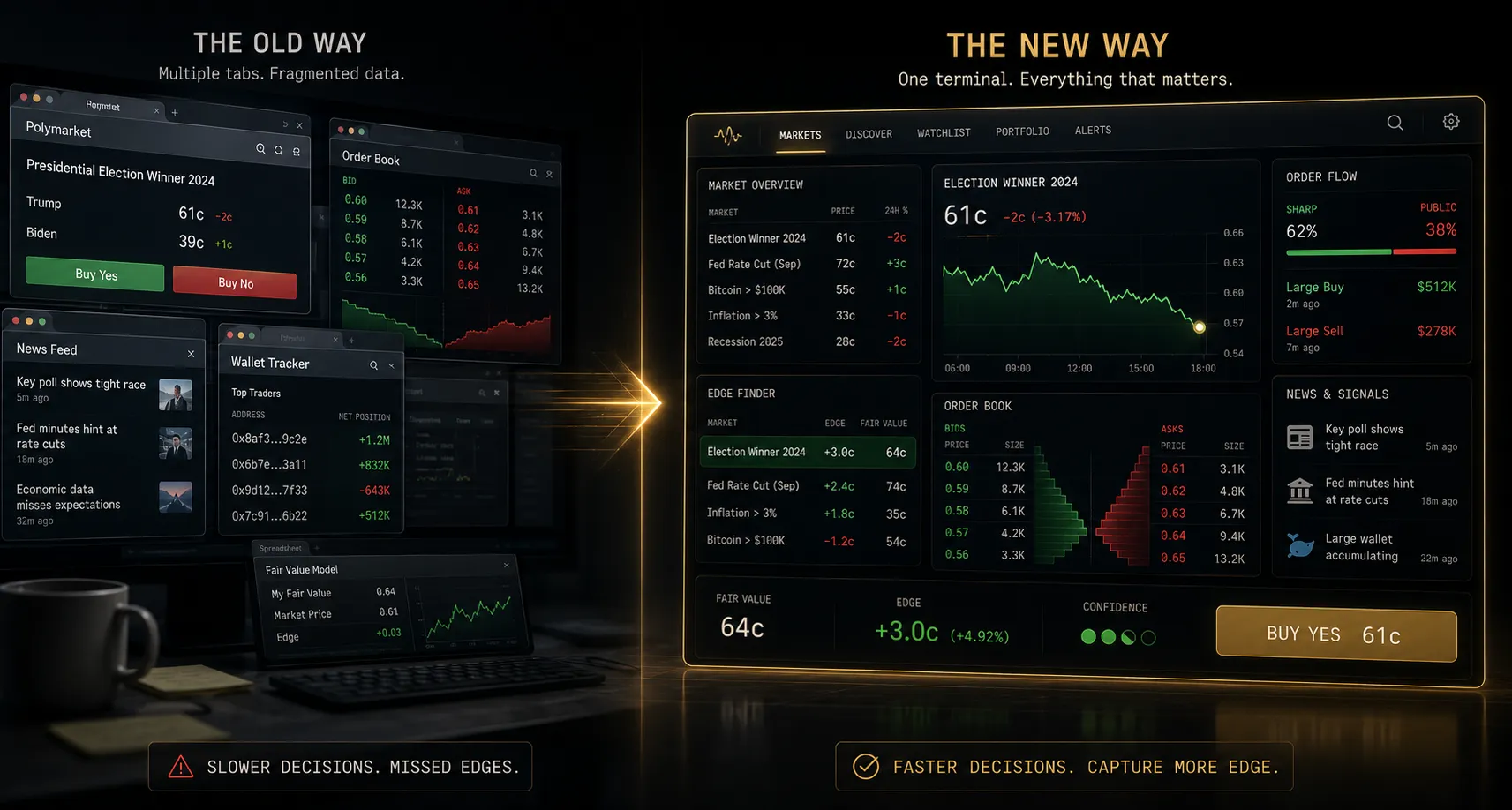
You start on Polymarket. Everyone does. The odds are right there, the markets are deep, and for your first few trades it feels like enough. Then you get serious. You open a second tab for the order book. A third for news. A fourth to track a wallet. A fifth for your own spreadsheet. Somewhere around tab six, you realize the platform was built to place a trade, not to find one. That gap is what a terminal fills.
Table of Contents
What is a prediction market terminal?
A prediction market terminal is a single interface that pulls market data, order flow, news, and analytics into one screen, so a trader can find an edge and act on it without switching between tools.
What does a terminal actually do that the raw market doesn’t?
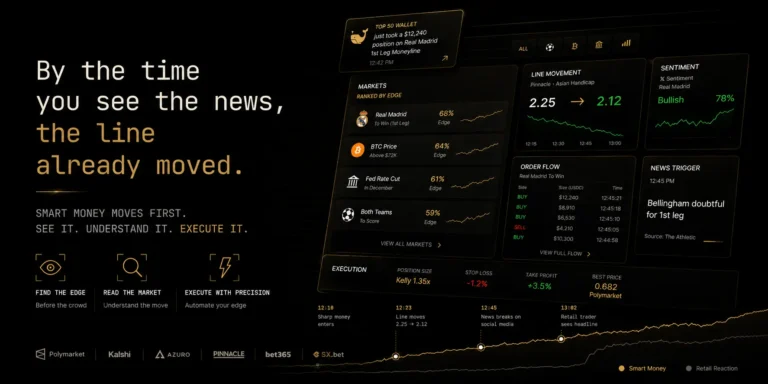
It turns scattered data into one workflow. Raw Polymarket shows you the price and lets you trade it. A terminal shows you the price, the order book, who is trading, what just moved the market, and where the edge sits, all in one place, so the time between spotting an opportunity and taking it collapses.
That is the whole pitch. Same underlying markets. A completely different way of working them.
The problem: raw markets are built to bet, not to trade
Here is the thing nobody tells you when you start. A prediction market exchange is a venue. Its job is to host markets and settle trades. It does that well. What it does not do is help you decide what to trade.
So serious traders build their own setup out of tabs. One for the market. One for the order book depth. One for a news feed. One for an on-chain tracker to watch big wallets. One for the spreadsheet where they calculate fair value and size positions. We wrote about this before. We called it the 5-Tab Problem, and the name stuck because every trader recognized it instantly.
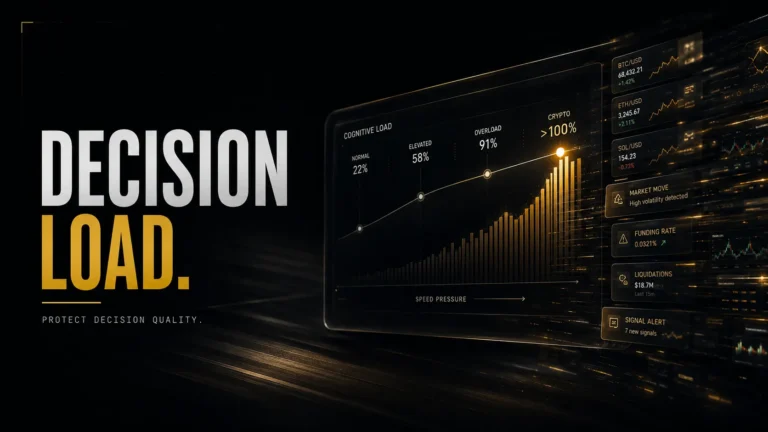
The cost is not just annoyance. It is real money. While you are alt-tabbing to check whether that price move was driven by a sharp or a headline, the edge is closing. Information has a half-life in these markets, and a fragmented workflow burns through it. You see the opportunity a beat late, you act a beat slower, and the price you wanted is gone.
This is what traders mean when they say they outgrew the raw market. Nothing wrong with the venue. They just need a cockpit, and the venue only gave them a steering wheel.
What lives inside a terminal
A real terminal is not a prettier version of the exchange. It is a different category of tool. These are the pieces that define one.
A unified market view. Price, last trades, and the full order book on one screen. No clicking into each market to see its depth. You read liquidity and price together, the way they actually move.
An edge finder. The hard part of trading is not placing the order. It is finding the mispriced market in the first place. A terminal scans across markets and surfaces where price and fair value diverge, so you spend your time on decisions instead of hunting.
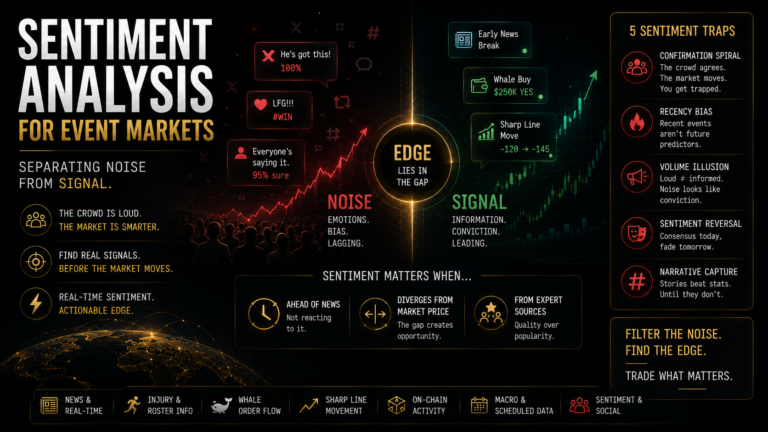
An intelligence layer. The context behind the price. What just moved this market. Whether sharp money or public money is driving the flow. Recent large trades. Relevant news. This is the difference between seeing a price tick and understanding why.
Fast execution. Once you have decided, the gap between decision and trade should be near zero. One click, not a five-step flow across tabs. Speed of execution is part of the edge, not a footnote to it.
Order flow and participant signal. Who is trading and how. Reading whether the smart money agrees with you, before you commit, is information the raw price will never hand you directly.
Put those together and the workflow inverts. Instead of you hunting through the market for an edge, the terminal brings the edge to you.
Exchange vs terminal: the real difference
People conflate these two, so let us draw the line clearly.
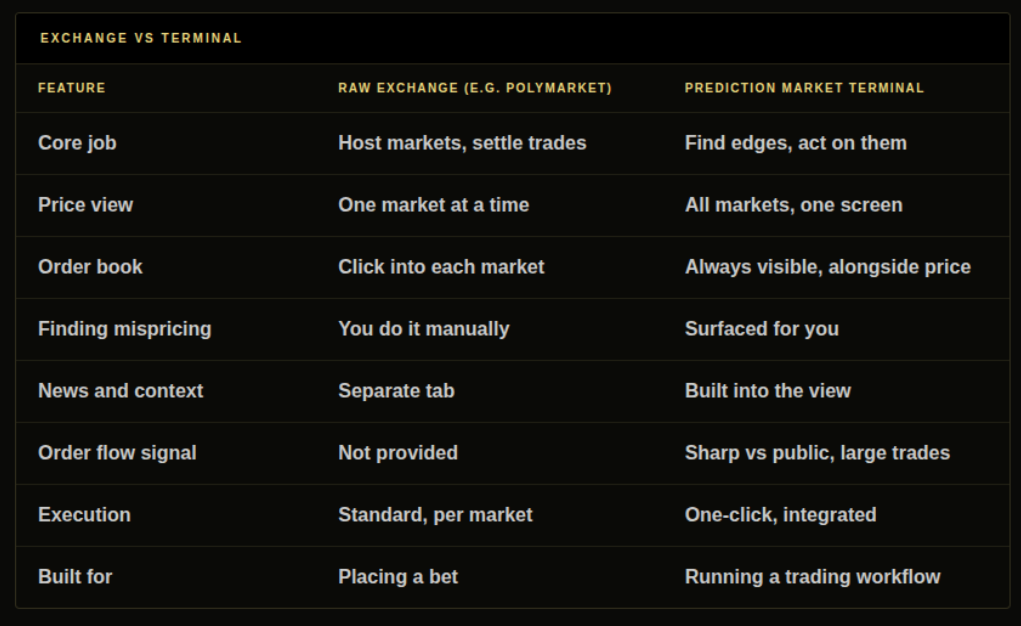
The exchange is where the trade settles. The terminal is where the trade gets decided. You still need the venue. You just stop living inside it.
A worked example
Two traders. Same market. A contract on a political outcome, sitting at 61 cents.
Trader A is on raw Polymarket. They notice the price looks low against their read. To confirm, they open the order book in a new tab. They check a news site in another. They pull up a wallet tracker to see if anyone big is moving. They tab back to their spreadsheet to recompute fair value at 64. By the time they decide to buy, four minutes have passed, the market has caught the same news, and the contract is at 63. Their two cent edge is now barely worth taking.
Trader B is on a terminal. The edge finder already flagged the 61 contract as trading below a 64 fair value. The same screen shows a large buy order just hit, and the flow is reading sharp. They see the divergence, the confirmation, and the context in one glance. One click, filled at 61. Three cents of edge, captured before the market moved.
Same information was available to both. The difference was the workflow. That is the entire value of a terminal in one scene.
Why this category is appearing now
Prediction markets used to be too small and too thin to justify serious tooling. That changed fast. Polymarket cleared more than 14 billion dollars in trading volume in 2024, driven largely by the US election cycle, and the trader base grew with it. When real money and real volume show up, professional tools follow. It happened in equities with Bloomberg. It happened in crypto with on-chain analytics platforms. Prediction markets are simply hitting that same maturity point now.
The pattern repeats every time a market grows up. First the venue. Then the volume. Then the terminal.
FAQ
Is a prediction market terminal the same as Polymarket? No. Polymarket is an exchange where markets are hosted and trades settle. A terminal sits on top of market data and adds the order book, news, order flow, and edge detection in one view. You trade the same markets, but you work them through a different interface.
Do I still need a Polymarket account if I use a terminal? Generally yes. The terminal is where you find and decide on trades. The exchange is still the venue where they execute and settle. Think of the terminal as the cockpit and the exchange as the engine.
Who actually needs a terminal? Anyone who has outgrown placing the occasional bet and started trading seriously. If you find yourself running multiple tabs to check the book, the news, and the flow before every trade, you have already outgrown the raw market.
What is the 5-Tab Problem? It is the name for the messy workflow serious traders fall into on raw markets: separate tabs for the market, the order book, news, an on-chain tracker, and a spreadsheet. A terminal exists to collapse those five tabs into one screen.
How does a terminal help me find an edge? It scans across markets and flags where the price diverges from fair value, then shows the order flow and context behind the move. Instead of hunting market by market, you get the mispricing surfaced and the confirmation alongside it.
Key takeaways
- A prediction market terminal pulls market data, order flow, news, and analytics into one screen, so you find edges and act on them without tab-switching.
- Raw exchanges like Polymarket are built to host and settle trades, not to help you decide what to trade.
- Serious traders outgrow the raw market and end up juggling tabs, the 5-Tab Problem, which costs them time and edge.
- A terminal inverts the workflow. Instead of hunting for an edge, the edge gets surfaced to you, with context and one-click execution.
- The category is emerging now because prediction markets finally have the volume to justify professional tooling, the same path equities and crypto took.
Related reading
For the workflow pain this solves, read the 5-Tab Problem and why prediction market platforms have failed both casual and pro traders. For the broader frame, see Bloomberg for equities, Nansen for crypto, and what comes next for prediction markets. To understand the edge a terminal helps you find, read fair value in prediction markets. See it all on one screen at the DG3 terminal.
Author note
Written by the DG3 research desk. We build tools for traders who treat probability as a number to beat, not a line to accept. We track market microstructure, order flow, and pricing across prediction markets every day.
See the live edge The price, the book, the flow, and the edge on one screen. See it all at the DG3 terminal, Sign up now – DG3 Terminal
Also read:
The 5-Tab Problem
Prediction Market Platforms Have Failed Both Casual & Pro Traders
Bloomberg for Equities. Nansen for Crypto. 7 tabs for Prediction Markets. Until Now.