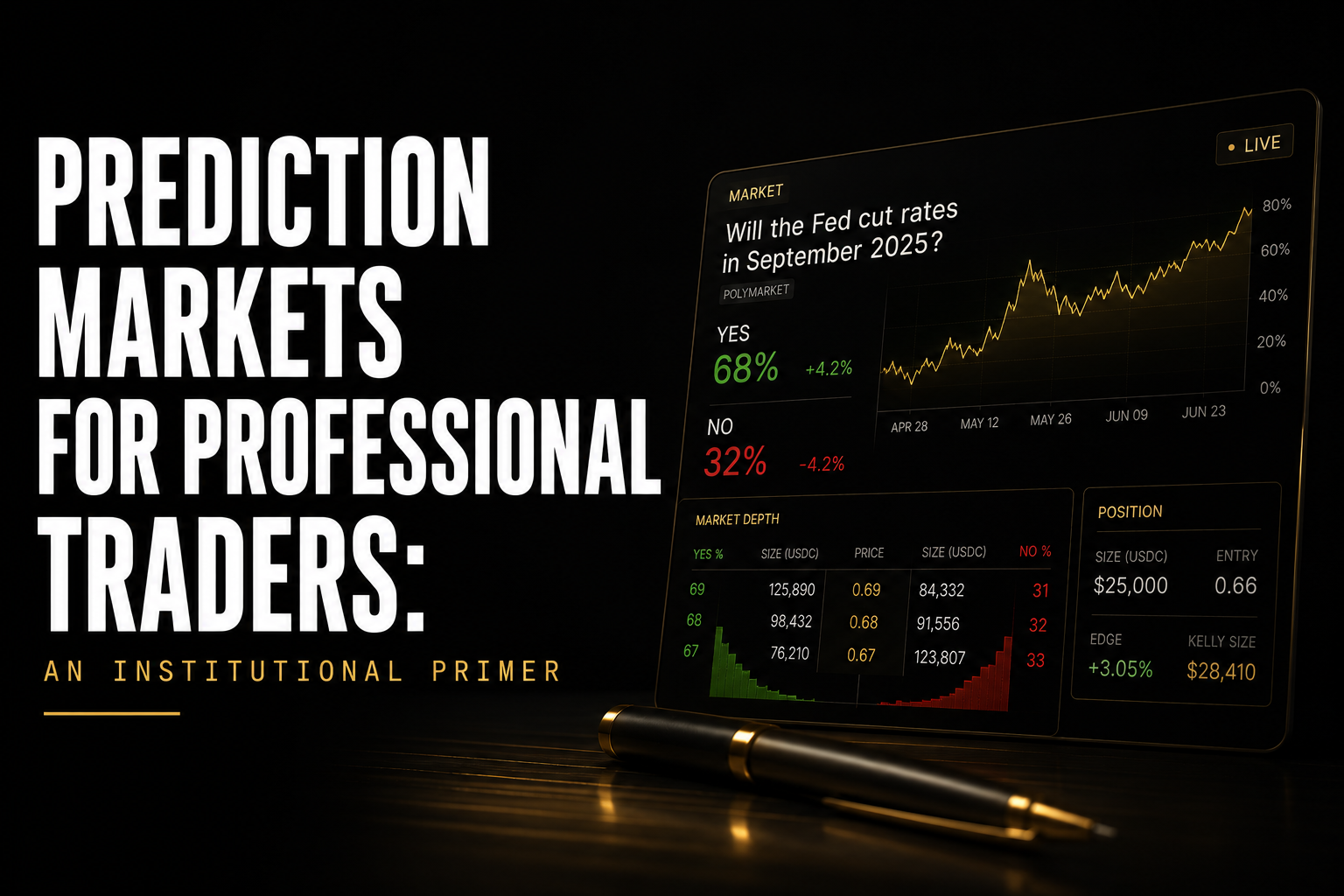
Prediction Markets for Professional Traders: An Institutional Primer
The question serious traders ask about Polymarket is not whether it is legitimate. It is whether the market depth is sufficient to absorb the kind of position sizing that makes it worth the infrastructure investment.
The answer is: it depends on how you define sufficient. $44 billion traded on Polymarket in 2025. The FIFA World Cup 2026 winner market exceeded $2.6 billion in total volume. The most liquid sports markets on Polymarket now support five-figure positions without meaningful market impact. That is not institutional scale by traditional financial market standards. It is well past the threshold for professional-grade retail and emerging quant strategies.
Table of Contents
Quick Answer
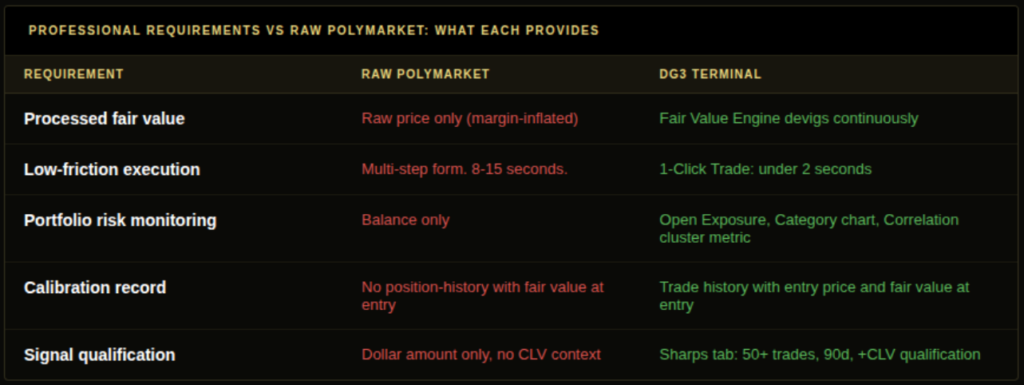
Professional traders in 2026 are approaching prediction markets as a serious trading venue rather than a novelty. The five infrastructure requirements that separate professional-grade participation from casual trading are: processed fair value data above the raw API, execution infrastructure that minimises form friction, portfolio-level risk monitoring across correlated positions, a calibration record that separates edge from variance, and signal classification that qualifies order flow rather than just measuring its size.
Key Takeaways
- Professional prediction market trading is not an extension of sportsbook betting. It is structurally closer to options market-making or event-driven equity trading: you are taking a probability view on a binary outcome in a two-sided, transparent CLOB, against a participant pool that includes both retail noise and sharp, well-calibrated capital.
- The most exploitable inefficiency in prediction markets in 2026 is not mispriced outright probabilities. It is speed of interpretation: how quickly informed capital reads a news event, injury report, or roster change and acts on the probability implication before the rest of the market catches up. This is an infrastructure and workflow problem, not just a research problem.
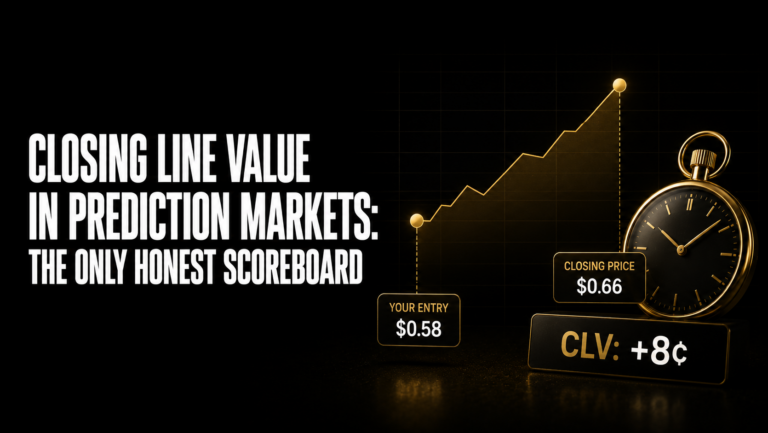
- Serious prediction market trading requires a calibration record. Not a win/loss record. The difference: a win/loss record measures outcomes, which are partially variance. A calibration record measures whether your entry prices consistently beat the closing price across 100+ resolved positions. That is the metric that tells you whether you have a process that generates edge.
- Position-level correlation is the most undermanaged risk in professional prediction market portfolios. Three positions sized correctly at 5% each can collectively represent 15% exposure to the same team’s tournament result. The Kelly fraction is applied per position. The correlation risk is invisible unless you are tracking exposure by underlying event driver.
- The raw Polymarket interface was not built for professional use. It was built for accessibility. That is a deliberate design choice, not a failing. The implication for professional traders is that the native interface is a starting point for accessing the market, not the workflow they will use to trade it at scale.
- Closing Line Value is the professional standard for measuring whether a prediction market strategy is generating genuine edge. Entry price relative to the pre-event closing price, adjusted for direction, is the most honest measure of whether you were ahead of the market’s final consensus across a large sample.
- The gap between the smartest casual Polymarket trader and a serious professional participant is not probability model quality. Both groups can develop strong models. The gap is in execution infrastructure, position-level tracking, and the discipline to have a calibration record that holds up after 300 positions, not 30.
What Does Professional Prediction Market Trading Actually Look Like?
A professional prediction market setup is not a faster version of the casual workflow. It is a different workflow.
The casual workflow looks like this: spot a market, check the price, form a rough view, place a trade, check back at resolution. The process is research-light and infrastructure-light. It works for entertainment. It produces inconsistent returns over large samples because it has no mechanism for distinguishing edge from luck.
The professional workflow looks like this: maintain a probability model for specific market types where domain expertise is deepest. Generate probability estimates independently before looking at market prices. Devig the current market price to compare against the honest benchmark. Calculate edge. Size the position using a fraction of Kelly against current bankroll. Execute with minimal form friction. Record entry price, fair value at entry, and outcome. Review calibration monthly.
Every step after “generate probability estimates” is an infrastructure problem. And every step that is slow, manual, or disconnected from the others creates a point where edge leaks.
Also read: The Best Polymarket Tools in 2026: What Serious Traders Are Actually Using
The 5 Things Professionals Need That Raw Polymarket Does Not Provide
1. Processed Fair Value Above the Raw Price
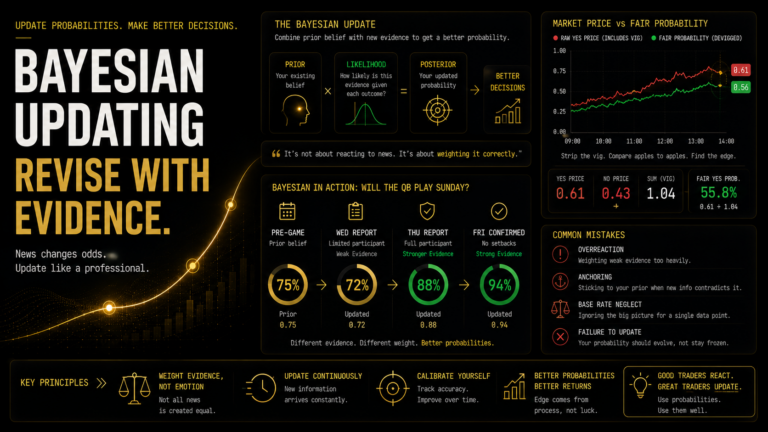
Raw Polymarket prices include the platform’s implied margin. On a binary market with YES at 0.62 and NO at 0.42, the sum of 1.04 means the raw prices are each inflated by approximately 2%. The honest fair value for YES is closer to 0.596. For NO, closer to 0.404.
A trader comparing their probability estimate against the raw price is benchmarking against a distorted number. At small edge thresholds (3-5 cents), the 2% distortion matters. Processed fair value tools strip this out continuously as prices move.
2. Execution Infrastructure That Minimises Form Friction
The native Polymarket interface requires: selecting an outcome, entering a dollar amount, selecting order type, reviewing the form, and confirming. In a market moving at 0.5 cents per second, a 12-second form completion means a potential 6-cent slippage on entry price before the order is submitted.
Professional execution infrastructure pre-fills the order form from the outcome selection. In 1-Click mode, the full sequence from outcome click to submitted order takes under 2 seconds. The difference compounds across 50 positions in a month: each position where the entry price was 3 cents worse than intended due to form friction represents cumulative edge loss that has nothing to do with the quality of the probability model.
3. Portfolio-Level Risk Monitoring
A professional portfolio in prediction markets might have 12-20 open positions simultaneously. Each position is sized individually using Kelly against the full bankroll. But Kelly applied per position does not account for correlation between positions.
Portfolio-level monitoring tracks total bankroll deployment as a percentage, exposure by event category (Sports, Politics, Crypto, Macro), and correlation clusters, situations where multiple positions are effectively betting on the same underlying result. The Portfolio screen that shows this as a live view prevents a trader from holding what looks like 5 independent 5% positions but is actually 25% concentrated in the same tournament.
Also read: Exposure Management: How to Stop One Event From Sinking Your Book
4. A Calibration Record Built on Entry Price vs Closing Price
A win/loss record tells you outcomes. A calibration record tells you whether your entry prices consistently beat the market’s final assessment of the probability. These are different measurements, and only one of them is useful for assessing process quality.
Calibration tracking requires recording entry price (your implied probability at the time of the trade), the closing price for each resolved market (the last-traded price before the event resolves), and whether you were on the right or wrong side of that closing price across 100+ positions. A trader whose entry prices average 4 cents better than the closing price across 200 positions has documented edge. A trader whose entry prices track the closing price without meaningful divergence has no documented edge, regardless of their win/loss record.
5. Signal Classification That Qualifies Order Flow
Large orders on Polymarket are on-chain and publicly visible. The raw data is free. The interpretation is the hard part.
A $60,000 YES order tells you that someone committed $60,000 to a position. It does not tell you whether that someone has a track record of being right. Professional signal classification adds the context that makes the order meaningful: does this wallet have 50+ resolved trades in the last 90 days with a positive rolling CLV? If yes, this is informed capital from a historically accurate participant. If not, this is a size-weighted noise event.
The difference between acting on every large order and acting only on CLV-qualified large orders is the difference between following noise at scale and following genuine sharp flow.
Also read: Reading Sharp Money Signals on DG3
How Is the Market Evolving Toward Institutional Participation?
The 2025-2026 period has seen three structural shifts that make prediction markets more viable as a professional trading venue.
The first is depth. Total volume on Polymarket grew from $1.7 billion in 2023 to $44 billion in 2025. The most liquid markets now support five-figure positions without meaningful market impact. This is still thin compared to regulated futures markets, but it is no longer an obstacle for the position sizes that characterise emerging professional participants.
The second is regulatory clarity. Kalshi’s CFTC registration and the growing distinction between regulated US-facing platforms and offshore CLOB prediction markets has created a clearer operating environment for professional participants. Regulatory ambiguity was a meaningful barrier for institutional capital in 2022-2023. It has receded.
The third is infrastructure maturation. The tooling gap between raw platform access and professional-grade workflow is being closed by terminal products that wrap Polymarket’s API in processed fair value, signal classification, and portfolio monitoring. The gap still exists. It is narrowing.
Common Mistakes
Mistake 1: Treating a large sample of wins as evidence of edge. 100 winning positions in 3 months feels like proof. It may be. It may also be a period of good variance in markets that were correctly directional but not correctly priced. Calibration is the check: are your entry prices consistently better than the closing price? If yes, the wins are evidence of edge. If your entry prices are approximately equal to the closing price, the wins are variance.
Mistake 2: Sizing positions using Kelly without a calibrated probability model. Kelly sizing requires an accurate edge estimate. Edge is the difference between your probability estimate and the market’s devigged fair value. If your probability estimate is not built on a model that has been tested across 100+ resolved positions, the edge estimate is a guess. Kelly applied to a guess produces a confidently wrong position size. This is how professional-scale ambition produces amateur-scale losses.
Mistake 3: Treating Polymarket as a sportsbook with a different interface. The structural difference matters. On a sportsbook, the house sets the line and maintains a margin. You bet against a fixed price. On Polymarket, you trade against a two-sided order book populated by other participants. The edge source is different. Probability model accuracy is still essential. But order book timing, market impact, and execution speed are also alpha variables. Treating execution as an afterthought is a sportsbook habit. It does not transfer.
Mistake 4: Not tracking position-level P&L by market type. Net balance tells you the result. Position-level P&L by market category tells you the source. A trader who is profitable on sports outrights but systematically negative on player props will never discover this from balance tracking alone. Without market-type P&L, you are flying blind on where to concentrate and where to cut.
Mistake 5: Acting on large order flow without CLV qualification. Dollar amounts in the order book are visible and easy to process. CLV track records are not automatically visible, they require a qualification layer built on top of on-chain data. Professional traders who have built this layer treat unqualified large orders as noise until proven otherwise. Traders without this layer are routing through every large order as if it were sharp money. Most of it is not.
Frequently Asked Questions
Q: Can professionals make consistent money on prediction markets? A: Yes, with documented edge. The requirement is a calibration record showing entry prices consistently beating closing prices across 100+ resolved positions in specific market categories. “Consistent” here means over a 6-12 month window with at least that sample size. Below that threshold, the evidence is inconclusive regardless of the headline returns.
Q: What does professional trading infrastructure look like for prediction markets? A: Fair value processing above the raw API, a 1-Click or equivalent low-friction execution path, portfolio-level tracking of open exposure and correlation, a position-history record for calibration review, and CLV-qualified signal classification for order flow. These five elements are the standard. Any one missing creates a gap where edge leaks.
Q: What are the 5 things professionals need that raw Polymarket does not provide? A: Processed fair value (the raw price is margin-inflated), low-friction execution (the native interface is form-heavy), portfolio risk monitoring across correlated positions, a calibration record built on entry price vs closing price, and signal classification that qualifies wallet accuracy rather than just measuring order size.
Q: How is the market evolving toward institutional participation? A: Three shifts: depth ($44 billion traded in 2025 vs $1.7 billion in 2023), regulatory clarity (Kalshi’s CFTC registration and clearer offshore platform distinctions), and infrastructure maturation (terminal products closing the gap between raw API access and professional-grade workflow).
Q: How is DG3 built for professional traders? A: DG3’s Edge Finder processes raw Polymarket prices through the Fair Value Engine and ranks markets by EV gap continuously. The Trade Desk supports 1-Click mode for sub-2-second execution from decision to submitted order. The Portfolio screen tracks open exposure by category and the correlation cluster metric. The Sharps tab in the Intelligence pane qualifies wallet order flow using 50+ resolved trades and positive 90-day CLV as the threshold. Together these address the five professional requirements without requiring separate tools for each.
Final Thoughts
Prediction markets in 2026 are not yet institutional-scale in the traditional finance sense. The liquidity is not there for nine-figure position sizes. The regulatory environment is not yet settled across all major jurisdictions. The data history is shorter than most systematic strategies require for rigorous backtesting.
What they are is a serious, liquid, transparent, two-sided market with a documented 2.5-year track record of growing volume, improving market depth, and increasing participation from sophisticated capital.
The traders who will have built the largest and most defensible edge positions in 2028 are the ones building calibration records right now. Process quality compounds over time. A trader with 18 months of calibration data showing consistent positive CLV across a specific market category has something that cannot be replicated by a new entrant with a better probability model.
Start the record before you think you need it.
Also read:
Bloomberg for Equities. Nansen for Crypto. 7 tabs for Prediction Markets. Until Now. What Is a Prediction Market Terminal? (And Why Traders Outgrow Raw Polymarket) Best Prediction Market Tools in 2026 (Ranked by What They Actually Do)