Edge Decay in Prediction Markets: Why Alpha Disappears
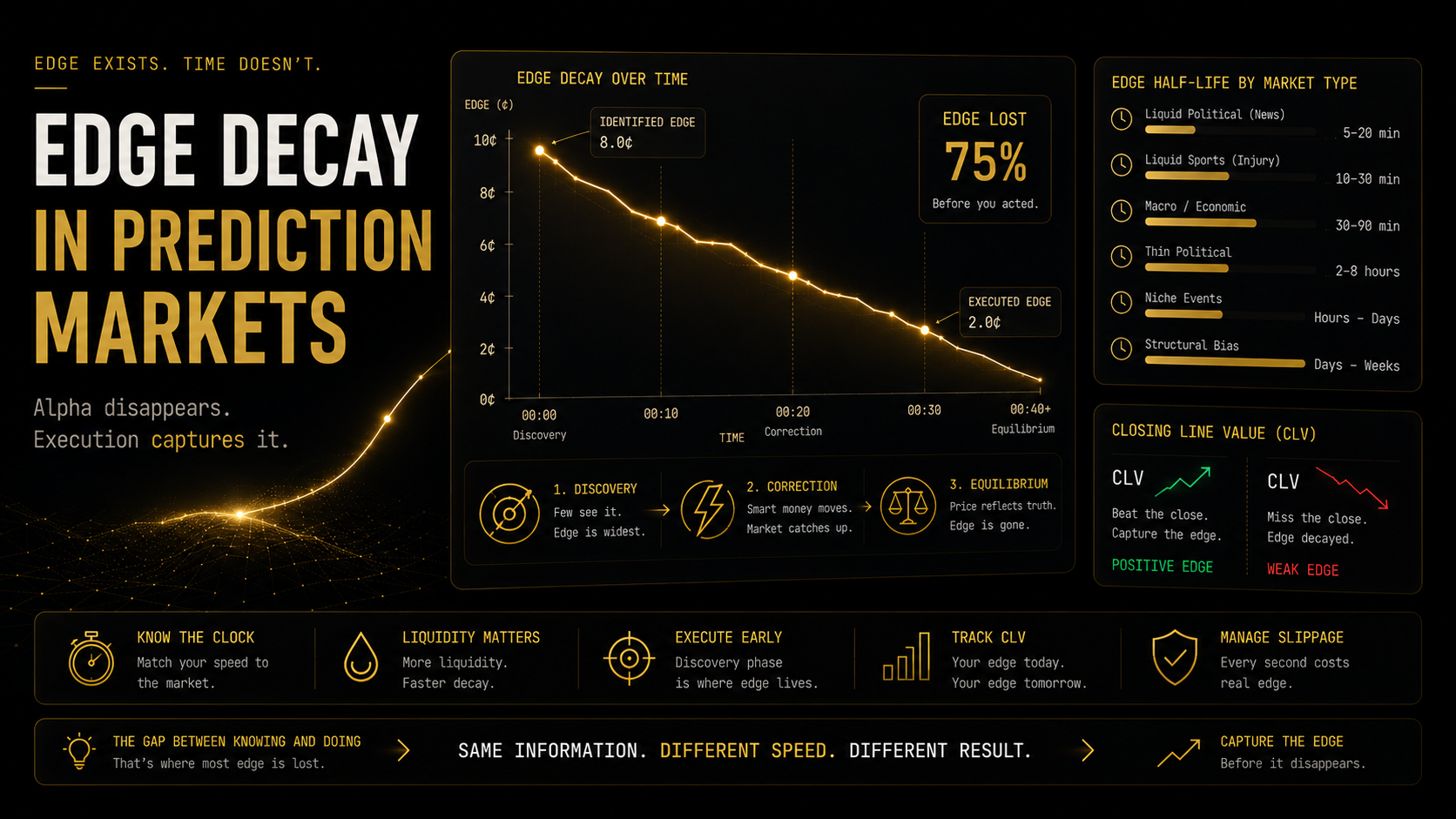
You found the mispricing. You were right about the direction. You still lost money, because by the time your order filled, the eight cents of edge you identified had shrunk to two, and two cents was not enough to cover the risk you took getting there.
That is edge decay, and it is the reason being right about a market is not the same as making money from being right about it.
Table of Contents
Quick Answer
Edge decay is the rate at which a trading edge in prediction markets closes as other participants notice and correct the same mispricing. Decay speed depends heavily on market liquidity and the type of catalyst driving the edge, ranging from 5 to 20 minutes on liquid political markets reacting to breaking news, to days or weeks for structural biases like the favourite-longshot effect that persist without a specific triggering event. The faster the expected decay, the more execution speed matters relative to analytical depth.
What Is Edge Decay?
Edge decay describes the shrinking gap between a mispriced probability and true probability as the market absorbs new information and corrects itself. An edge does not sit still waiting for you to act on it. From the moment a mispricing exists, a clock starts, and every other participant capable of noticing the same thing is a countdown you cannot see.
The concept matters because it reframes what “having an edge” actually means. Identifying a mispricing is necessary but not sufficient. The edge you identified at the moment of analysis is rarely the edge you actually capture at the moment of execution, and the difference between those two numbers is decay.
The 3 Phases of Edge Decay
Every edge, regardless of source, tends to move through the same three phases, though the speed varies enormously by market type.
Phase 1: Discovery. A small number of well-positioned or well-informed participants identify the mispricing first. The price has not moved yet. This phase can last seconds on a liquid, heavily-watched market or hours on a niche one.
Phase 2: Correction. Informed participants begin trading, their activity moves the price, and the visible price movement itself becomes a signal that draws in more participants. This is usually the fastest phase and the one where most of the edge closes.
Phase 3: Equilibrium. The price settles near the corrected fair value, and the remaining gap, if any, reflects genuine remaining uncertainty rather than an exploitable mispricing. Trading against the price at this stage is closer to speculation than edge capture.
Understanding which phase a specific mispricing sits in tells you how much time you realistically have left, which should directly inform how aggressively you prioritize execution over further analysis.
Edge Half-Life: How Fast Does Alpha Decay?
Edge half-life is not a formally standardized metric. It is a practical way to think about how long a specific type of edge typically survives in a specific market environment before roughly half of it has closed.
| Market Type | Catalyst | Typical Edge Half-Life |
| Liquid political market (top 10% by volume) | Breaking news | 5-20 minutes |
| Liquid sports market | Game-day injury confirmation | 10-30 minutes |
| Thin political market | Same breaking news | 2-8 hours |
| Liquid sports market (in-match) | Live game event (red card, injury) | 5-15 minutes |
| Niche event market | Domain-specific information | Hours to days |
| Structural bias (favourite-longshot) | No catalyst, persistent | Days to weeks |
The half-life framework implies a clear operating rule: the faster a market type typically corrects, the earlier your entry needs to happen relative to the information event. On liquid markets with news-driven edges, execution infrastructure matters more than additional analysis. On thin or niche markets, the opposite holds. You have more time, but you need stronger conviction that the edge is genuinely real before committing capital, since the cost of being wrong sits in the position longer.
Worked example. A Polymarket contract on a tournament outright trades at 0.36. A trader with a well-calibrated model on this sport estimates true probability at 0.54 based on squad depth and draw analysis not yet reflected in the market. This specific read is not aggregated anywhere the broader market has processed.
On a thin market with roughly $20,000 in liquidity, this edge might persist for two to three days, giving the trader time to build a position carefully without moving the price meaningfully against themselves. On a liquid market with $500,000 in depth, the same read, once a single well-positioned trader acts on it, would likely price in within an hour. The window is execution-dependent in the liquid case and analysis-dependent in the thin one. The trader’s actual edge capture depends more on market depth than on the quality of their underlying research.
Closing Line Value as the Proxy for Edge Decay Rate
Closing line value, the difference between the price you entered at and the final price right before resolution, is the standard way serious traders measure whether their edge was real and how fast it decayed.
Consistently beating the closing line, meaning your entry price was better than where the market eventually settled, is strong evidence that your original read was correct and that you captured genuine edge before it closed. Consistently entering at or worse than the closing line, even on positions that ultimately won, suggests you were not actually ahead of the market. You got lucky on direction without ever holding real informational edge.
Tracking closing line value over enough positions also gives you a rough empirical read on your own personal edge decay rate. A trader who consistently beats the close by 8 to 10 cents on liquid markets is likely acting fast enough relative to their information source. A trader who only beats the close by 1 to 2 cents, even while winning, is closer to the equilibrium phase than the discovery phase, and their process has less room for error than it might feel like.
Common Mistakes
Treating identified mispricing as guaranteed profit. It isn’t. Every second between identification and execution is decay eating your number.
Applying the same urgency everywhere. A thin niche market and a liquid flagship market decay at completely different speeds. Match your pace to the market, not the other way around.
Skipping closing line value. No feedback loop means no way to tell a real edge from a lucky win.
Confusing structural bias with a fast-decaying edge. The favourite-longshot bias persists for weeks because there is no single triggering event to correct. Rushing it is the wrong instinct. The real risk with structural edges is holding them too long past fair value, not missing a narrow window.
Ignoring your own footprint. Large orders on thin markets accelerate the correction phase. The act of capturing edge shortens how much of it is left for the size you still want to build.
Reading Decay Speed Before You Enter
Knowing how fast a specific edge is likely to decay requires reading liquidity, catalyst type, and how recently the information has become public – all at once and quickly. DG3’s Edge Finder surfaces live liquidity depth alongside EV gap for every market, which is the single biggest input into estimating decay speed.
The Edge Finder updates the gap between fair value and current market price continuously, so you can see in real time whether the mispricing you identified is still open or has already started closing. Your position history tracks entry price against final resolution on every closed trade, giving you an ongoing read on whether your process is capturing edge before decay closes it or arriving closer to equilibrium than you think.
Frequently Asked Questions
Q: What is edge decay? A: It is the rate at which a trading edge shrinks as other market participants notice and correct the same mispricing. The speed of decay depends heavily on market liquidity and the type of information driving the edge.
Q: How fast do prediction market edges close? A: It varies widely, from 5 to 20 minutes on liquid political markets reacting to breaking news, to hours on macro or economic markets, to days or weeks for structural biases without a specific triggering event.
Q: What is edge half-life in prediction markets? A: It is a practical framework, not a formal metric, for estimating how long a given edge type typically takes to lose roughly half its value in a specific market environment, based on liquidity and catalyst type.
Q: How does closing line value relate to edge decay? A: Consistently beating the closing line indicates your entries captured genuine edge before it decayed. Entering at or near the eventual close, even while winning positions, suggests weaker real edge than the outcome alone would suggest.
Q: When should I trade before an edge disappears? A: As early in the discovery phase as your conviction allows, particularly on liquid markets where correction happens fast. On thin markets, you generally have more time, but should prioritize confirming the edge is genuine before committing size.
Q: Why does market efficiency change over time on Polymarket? A: Because information continuously enters the market and gets absorbed at different speeds depending on liquidity and attention. A market can be relatively inefficient right after news breaks and rapidly become efficient again as participants react.
Q: What causes alpha decay in prediction markets? A: Other participants noticing and trading on the same mispricing you identified. The more visible and liquid the market, the faster other traders tend to notice, and the faster the edge decays.
Q: Why does my Polymarket edge disappear before I can act on it? A: Most commonly because the market you are trading is liquid enough that other participants correct the mispricing within minutes, or because execution delay between identifying the edge and placing the order gave the market time to move.
Final Thoughts
Edge decay is the uncomfortable variable that separates analysis from profit. Being right about a mispricing is the easy part. Capturing enough of it before the market corrects is where most of the actual difficulty in trading prediction markets lives.
The traders who consistently profit are not necessarily the ones with the sharpest analysis. They are the ones who correctly estimate how fast a specific edge will decay given its liquidity and catalyst, and who match their execution speed to that estimate instead of applying the same pace to every position regardless of how much time they actually have.
Track Closing Line Value alongside your entries to see exactly how much of your identified edge you are actually capturing before it closes.
Also read:
Market Efficiency in Prediction Markets: Are They Really Smarter Than the Crowd?
Closing Line Value
Information Asymmetry: Who Knows What, and When, in Event Markets