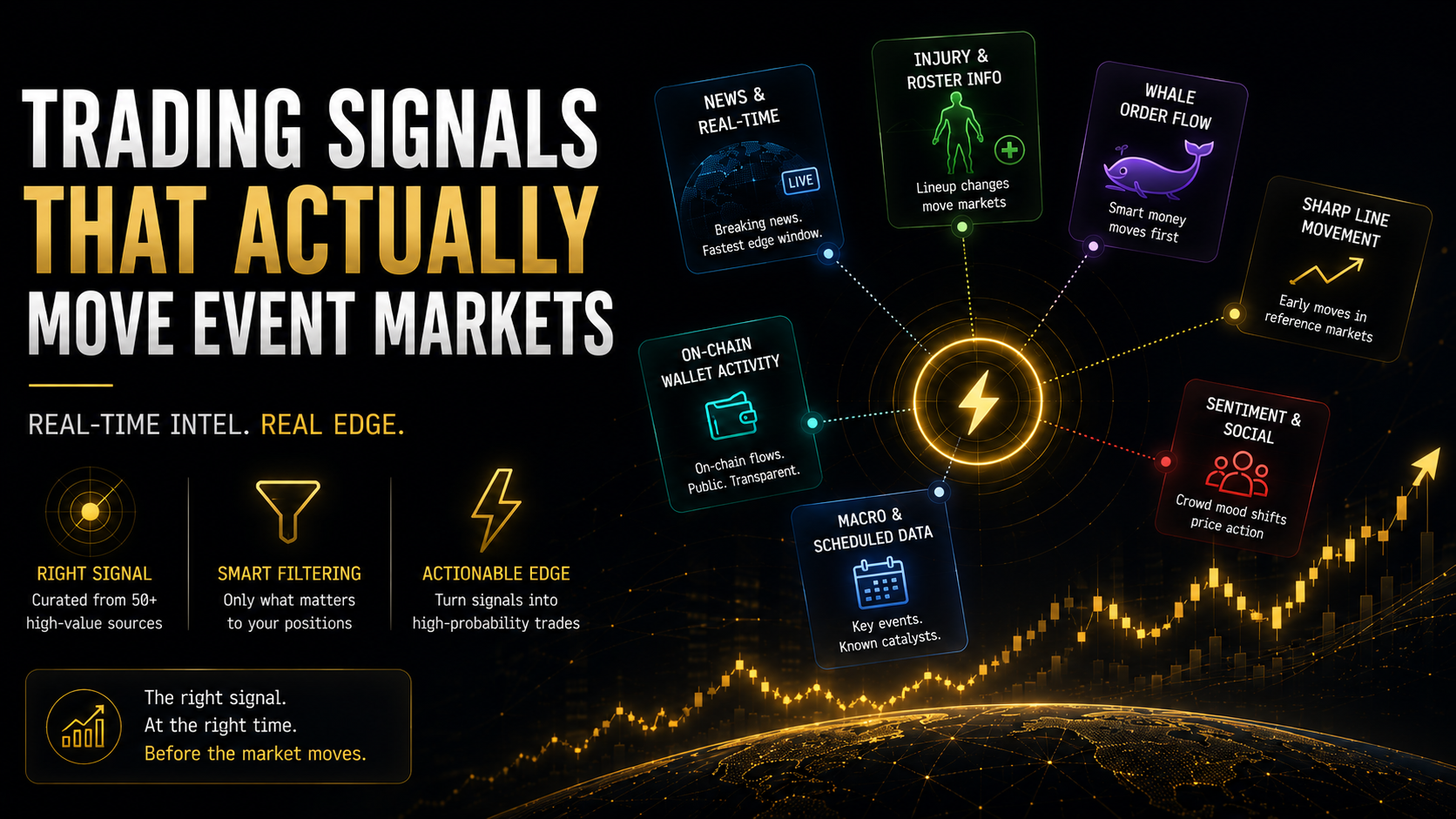
Trading Signals That Actually Move Event Markets
The injury confirmation dropped at 2:14 PM. By 2:17 PM the Polymarket price had moved 9 cents. By 2:19 PM it had moved another 4. The traders who were in before 2:14 did not know the injury was coming. They were watching different signals entirely.
This is the thing most signal guides miss: the question is not “what signals exist” but “which signals move prices before you can act, and which still have an open window.” Get that distinction wrong and every signal you follow is already priced.
Table of Contents
Quick Answer
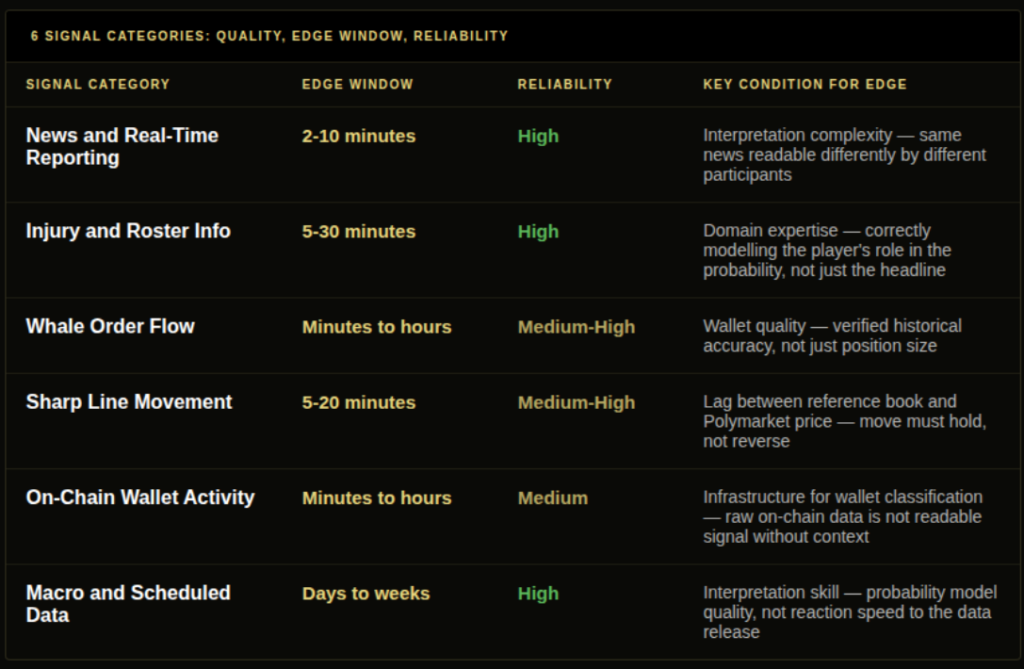
Trading signals that move event markets fall into six categories: news and real-time reporting, injury and roster information, whale order flow, sharp line movement, on-chain wallet activity, and macro or scheduled data releases. Each category has a different typical edge window, a different reliability profile, and a different relationship to price. Pulling them into one view, ranked by recency and market linkage, is what DG3’s Signal Layer is built for.
Key Takeaways
- Not all signals are equal, and treating them as such is how you end up chasing price movements that have already closed the edge. Signal quality, timing window, and noise ratio vary dramatically by category.
- News signals are the highest-value and fastest-decaying category. On liquid Polymarket markets, a major news event prices in within 2-5 minutes. The edge belongs to whoever processes and acts first.
- Whale order flow is the most underused signal by retail traders and the most monitored by professionals. A large wallet entering a position before public news is not coincidence on a consistently accurate wallet. It is information.
- Sharp line movement from reference books (sportsbooks, other prediction markets) is a leading indicator on Polymarket. When a sharp-money book moves a line before Polymarket does, the lag between those two prices is a tradeable gap that typically closes within minutes.
- On-chain signals are publicly visible on Polygon. This creates a paradox: the information is free and fully transparent, but most traders do not know which wallets matter or how to interpret the context around a large trade. Raw visibility is not the same as readable signal.
- Social media and crowd sentiment are the lowest-reliability category in this list, with the narrowest set of conditions under which they have genuine predictive power. They are discussed separately in the sentiment analysis guide because the traps are extensive.
- DG3’s Intelligence pane scopes signal categories to your open Polymarket positions in real time, removing the need to monitor each source independently across separate tabs.
The 6 Signal Categories That Move Event Markets
1. News and Real-Time Reporting
News is the primary driver of prediction market price movements on liquid markets. An official team announcement, a central bank statement, a court ruling, an election result, a transfer confirmation from a verified source: each of these is a direct probability update for every market tied to that event.
The speed problem is well-documented. On a major Polymarket market with millions in liquidity, informed traders monitoring primary sources can act within seconds of a news event. By the time a retail trader reads the headline, the price has often already moved most of the way to its new equilibrium.
Where news signals still have a window: thin markets (where fewer traders are actively monitoring), scheduled events where the news content is uncertain (Fed meeting statements, injury report releases), and interpretation-heavy events where the same information can be read differently by different market participants. A central bank statement that is technically a hold but contains language signalling a future cut is not a simple YES/NO signal. The interpretation layer is where the edge persists after the headline has priced.
2. Injury and Roster Information
Sports prediction markets are among the most information-asymmetric markets on Polymarket. An injury to a key player has a direct, calculable effect on a team’s win probability. A manager’s press conference revealing a surprise formation change moves the probability on both sides of a match winner market.
The edge hierarchy in injury signals:
Primary sources (team medical staff, official club communications) move prices immediately when public. Secondary sources (journalists with club access, player tracking data) create a window between their signal and public confirmation. Tertiary signals (social media rumours, early training ground footage) carry a lot of noise and require confirmation before acting.
Fabrizio Romano’s football transfer confirmations are the canonical example of how a single verified source can become the market-moving event for player-linked prediction markets. The “here we go” confirmation has moved prices on transfer markets multiple times before official club announcements followed.
3. Whale Order Flow
Whale order flow signal: A large position entry on Polymarket from a wallet with a documented history of accurate positioning, entering before a corresponding price movement or news event becomes public.
This is not the same as any large trade. A large trade from an unknown wallet with no performance history is noise. A large trade from a wallet that has correctly positioned on 70% of its directional calls over the last 90 days is a different signal entirely.
The Polymarket structure on Polygon makes this observable. Every transaction is on-chain and public. The analytical work is in identifying which wallets have edge, building their historical track records, and then monitoring their new positions as they appear. DG3’s Whale Tracker does this by classifying wallets by tier and verified win rate, so the signal arrives with context rather than as raw transaction data.
The timing dimension matters critically. A whale entry from 8 minutes ago in a fast-moving market and a whale entry from 3 hours ago in a stable market represent completely different opportunities. The Edge Decay guide covers how fast different edge types close.
4. Sharp Line Movement
Sharp line movement is the prediction market equivalent of the closing line movement signal in professional sports betting. When a sharp-money sportsbook (Pinnacle, Betcris, or similar) moves its line sharply before a corresponding Polymarket move, it is typically because informed capital has entered the reference book first.
On correlated markets, this creates a lag that is a tradeable gap. A football match winner market on Polymarket that is trading 3-4 cents wider than the current Pinnacle devigged probability has a discrepancy that arbitrage and smart traders will close. The direction of the Pinnacle move is the signal. The Polymarket lag is the entry window.
Sharp line movement signals require context. A 2-cent move on a reference book with high volume at the new price is different from a 2-cent move that immediately reversed. The direction, the magnitude, and whether the move held are all part of reading the signal correctly.
5. On-Chain and Wallet Activity
On-chain signals extend beyond whale wallet tracking. The aggregate order flow into a specific Polymarket market, the timing distribution of large trades relative to each other, and the relationship between order flow and price movement all provide information about whether a market is being moved by informed participants or by noise.
Order flow toxicity (the proportion of trading activity from informed versus uninformed participants in a given window) is elevated in the period before large price moves on well-monitored markets. When this metric rises on a market you are watching, it is a signal that informed capital is entering and that the current price may not reflect the full information set.
The practical challenge: reading on-chain signals in raw form requires infrastructure. Polygonscan provides the data but not the interpretation. DG3’s Intelligence Layer processes on-chain data into readable signal formats: wallet tier classifications, position size relative to market liquidity, and timing relative to subsequent price moves.
6. Tournament Draw and Scheduled Sports Signals
The most predictable signal category. Tournament draws, squad announcements, injury report windows, and match scheduling all have known timing. The prediction market edge in scheduled data signals is in probability estimation before the release, not in reaction speed after it.
A trader who has built a model of how tournament draw outcomes track against squad depth and recent form can position before the draw announcement with a genuine probability edge over the market’s consensus. The signal is not the release itself. The signal is the discrepancy between what your model says the data implies and what the current market price implies.
This category has the most durable edges of the six because interpretation skill compounds over time. A trader who has traded 50 Fed decision markets has calibration data on their own model that a trader who has traded 5 does not.
Signal Timing: When to Act on Each Category
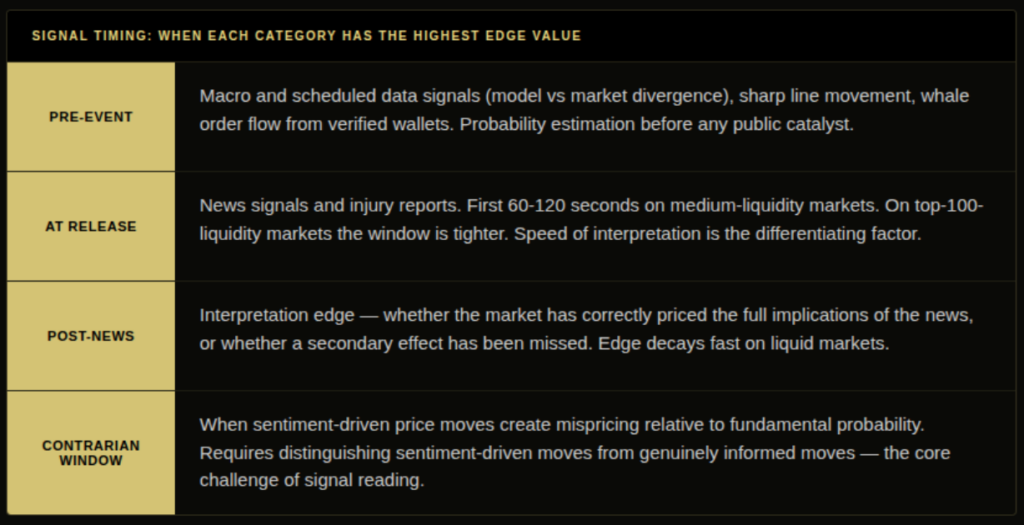
Signal timing is as important as signal quality. The same signal has different value at different points in the edge lifecycle.
Before the event (pre-event positioning): Macro and scheduled data signals, sharp line movement, and whale order flow from historically accurate wallets all carry edge in the pre-event window. The probability interpretation happens before any public catalyst, and the position enters before the information becomes widely priced.
At the moment of information release: News signals and injury reports have their highest value at the moment of first public confirmation. The trader who acts in the first 60-120 seconds of a news event on a medium-liquidity Polymarket market can still capture meaningful edge. On top-100-liquidity markets, that window is tighter.
After public confirmation: Most news signals are effectively priced within 5-10 minutes on liquid markets. The value at this point is in interpretation: whether the market has correctly priced the full implications of the news, or whether a secondary effect has been missed. Information Asymmetry in event markets is covered in depth at Information Asymmetry: Who Knows What, and When.
Contrarian signal window: When a crowd signal (social media, public sentiment) pushes a price away from fundamental probability, the contrarian window opens. This requires distinguishing between sentiment-driven price moves and genuinely informed price moves, which is the core challenge covered in the sentiment analysis article.
Signal Filtering: The Noise Problem
Most traders underperform not because they have bad signals but because they act on too many signals without filtering. Every signal category above generates false positives. The discipline is in knowing which signals to weight and which to discard.
Four practical filters:
Source verification. Who generated the signal? An official club injury report and an anonymous Twitter account claiming the same thing are not equivalent. Weight by source quality before acting.
Market liquidity context. A signal that moves a thin market 8 cents may represent $5,000 of informed capital entering a $30,000 market. The same dollar amount on a $2,000,000 market is background noise.
Recency. How old is the signal? A whale entry from 3 minutes ago on an active market is different from one from 40 minutes ago. Check timestamps before acting on any order flow signal.
Convergence. When two or more independent signal categories point the same direction simultaneously (whale entry plus sharp line move plus relevant news in the same 10-minute window), the signal quality is substantially higher than any single category alone. Multi-signal convergence is the setup worth prioritising.
Common Mistakes
Size alone is not a signal, and the most expensive version of this mistake is treating all large order flow as informed. A $50,000 position from a wallet with no history, entering a market that does not subsequently move, tells you nothing. The signal is size combined with wallet quality, timing, and subsequent price action. The second version of the same error is acting on news signals after the liquid market has already corrected. On a major Polymarket market with $500,000+ in liquidity, public news prices within minutes. Entering 20 minutes after a headline broke is buying momentum that has already expressed itself. Check when the signal first hit the market before deciding whether an edge still exists.
Mistake 3: Conflating social media volume with signal quality. High Twitter volume around a prediction market topic is frequently the opposite of a tradeable signal. The highest social media volume periods are often exactly when retail sentiment is most disconnected from underlying probability. Volume is attention. Attention is not information.
Mistake 3: Monitoring signals without linking them to specific open positions. Watching a global feed of Polymarket price movements and signal events is overwhelming and analytically useless unless each signal is connected to a position you hold or are considering. Signal value is position-specific. A whale buying YES on a market you are not in is irrelevant. DG3’s Signal Layer filters to your open positions by design.
Mistake 4: Ignoring the timing dimension on whale signals. A whale entry that is 6 hours old on a market that has since moved 15 cents in their direction is not an open edge. The edge has been expressed. The signal is historical context now, not a live trading opportunity. Every order flow signal needs a timestamp check before you act on it.
How DG3 Helps
Monitoring six signal categories across hundreds of active Polymarket markets simultaneously is not possible without infrastructure. The volume of noise in each category alone would consume a full trading session before any signal reached the execution stage.
DG3’s Intelligence pane aggregates signal categories in real time, scoped to the specific Polymarket markets you have open or are monitoring. Whale activity appears through the Sharps tab. Order flow through the Book tab. Breaking news through the News tab. All scoped to the market you are in, not a global feed.
When multiple signal categories converge on the same market simultaneously, the combination of Sharps activity, News, and Edge Finder EV gap visible in one view makes the highest-quality setups identifiable before they require manual cross-referencing.
Frequently Asked Questions
Q: What signals actually move prediction market prices? A: Six categories drive the majority of prediction market price movements: verified news events, injury and roster information for sports markets, whale order flow from wallets with documented accuracy, sharp line movement from reference books, on-chain wallet activity in aggregate, and macro and scheduled data releases. Each has a different edge window and reliability profile. News and whale flow are the highest-value categories for traders who can access them with appropriate speed.
Q: Which signal types are most reliable for event market trading? A: Reliability depends on how it is measured. For sheer probability of producing a genuine price move, verified news from primary sources is the most reliable. For durability of edge (how long the window stays open after the signal appears), macro and scheduled data signals are most durable because interpretation skill is the differentiating factor rather than reaction speed. Whale order flow is most reliable as a leading indicator when the wallet quality rating is high and the position entry precedes a price move.
Q: How do you filter signal noise in event markets? A: Four practical filters: source verification (weight by who generated the signal), market liquidity context (relative position size to total market depth), recency (how old is the signal timestamp), and convergence (are multiple independent signal categories pointing the same direction simultaneously). Multi-signal convergence is the highest-quality setup. Single signals without context are frequently noise.
Q: When does a whale trade signal a genuine edge? A: When three conditions are met: the wallet has a documented history of accurate positioning (not just any large wallet), the entry precedes rather than follows a price move, and the position size is material relative to the market’s liquidity. A large entry from a historically accurate wallet, in a market with sufficient depth to absorb it, entering before public news, is the highest-confidence whale signal.
Q: How does DG3 filter signals to your open positions? A: DG3’s Intelligence pane monitors signal categories in real time scoped to the specific market you have open – Sharps tab for wallet activity, News tab for breaking developments, Book tab for order flow depth. Each is filtered to the market in view rather than a global broadcast.
Q: What is the best signal for sports prediction markets on Polymarket? A: Injury and roster information is the highest-edge signal category for sports markets because it has the clearest direct probability implication and the largest interpretation gap between participants. A confirmed starter absence affects expected goals, win probability, and over/under markets simultaneously. The trader who correctly models the probability impact of the specific player’s role (not just “key player is out”) has an edge over the market’s first-reaction price.
Q: How do sharp line movements signal edge on Polymarket? A: When a sharp-money reference book (Pinnacle or similar) moves its line before Polymarket does, it typically reflects informed capital entering the reference book first. The lag between the reference book’s new price and Polymarket’s current price is a gap that arbitrage and systematic traders will close. The reference book move sets the direction. The gap between its new price and Polymarket’s current price is where you enter.
Q: What is signal convergence and why does it matter? A: Signal convergence occurs when two or more independent signal categories point in the same direction on the same Polymarket market within a short time window. For example: a whale wallet enters YES, a sharp reference book moves toward the same outcome, and a relevant news event confirms the direction. Each signal alone has false positive risk. All three pointing the same direction simultaneously substantially increases the probability that the signal is genuine and that the edge has not yet fully priced.
Final Thoughts
The prediction market traders who use signals well are not the ones with access to the most signals. They are the ones who have built a clear model of which signals they can act on quickly enough to matter, which require interpretation skill rather than speed, and which to ignore entirely.
Most retail traders are in the third category without knowing it. They watch a busy feed of market movements and news events and mistake activity for opportunity. The discipline is narrower: identify the two or three signal types where you have a genuine edge in quality or timing, ignore everything else, and build the infrastructure to act on those quickly.
The Sharp Money vs Public Money article covers the professional side of signal reading in depth.
Sign up now – DG3 Terminal
Also read:
How to Read Polymarket Signals: A Field Guide
Information Asymmetry: Who Knows What, and When, in Event Markets
Edge Decay in Prediction Markets: Why Alpha Disappears