Market Efficiency in Prediction Markets: Are They Really Smarter Than the Crowd?
The 2024 US presidential market on Polymarket carried more than a billion dollars in volume before a single vote was counted. That is a lot of money betting that a market price can outthink a newsroom, a pollster, and a pundit at the same time. Most of the time it did. Not always.
Prediction markets get sold as a kind of oracle, a place where the wisdom of the crowd distills into a single clean number. The truth is closer and more useful than that story. Prediction markets are efficient in aggregate and mispriced in specific, identifiable ways, and knowing where those ways live is the actual edge.
Table of Contents
Quick Answer
Prediction markets are broadly efficient at aggregating dispersed information into prices, often outperforming individual experts and polling averages on near-term events. They are not perfectly efficient. Mispricing shows up in thin-liquidity markets, in the favourite-longshot bias where longshots trade above true probability and favourites trade below it, and in the lag between an information event and full price adjustment. The gap between broad accuracy and specific mispricing is where trader edge actually lives.
Why This Question Matters
Whether prediction markets are accurate is not an abstract debate. It decides how much weight you should put on a market price versus your own research, and it decides where the actual opportunities sit for anyone trying to trade against the crowd rather than just follow it.
If markets were perfectly efficient, there would be no edge to find anywhere, ever, and every trader would be wasting their time doing anything beyond passive index-style exposure. If markets were consistently wrong, they would be worthless as a signal and nobody serious would reference them. Neither extreme is true. The real answer sits in the specific mechanics of where and why efficiency breaks down.
What Does Market Efficiency Mean for Prediction Markets?
Market efficiency, borrowed loosely from the efficient market hypothesis in finance, means prices reflect all available public information at any given moment. In a fully efficient market, no trader could consistently beat the price using only public information, because the price would already contain everything relevant.
Prediction markets test this idea more cleanly than stock markets do, because prediction market contracts resolve to a known binary outcome on a known date. That resolution gives you a ground truth to check the price against, which is something stock markets never really offer.
The honest answer is that prediction markets sit somewhere between fully efficient and consistently wrong. On liquid, high-volume markets covering well-known events, prices track true probability closely most of the time. On thin markets, or in the minutes right after breaking news, the price can be meaningfully off, and that gap is exactly what an informed trader is trying to capture before the crowd catches up.
Where Prediction Markets Get It Right
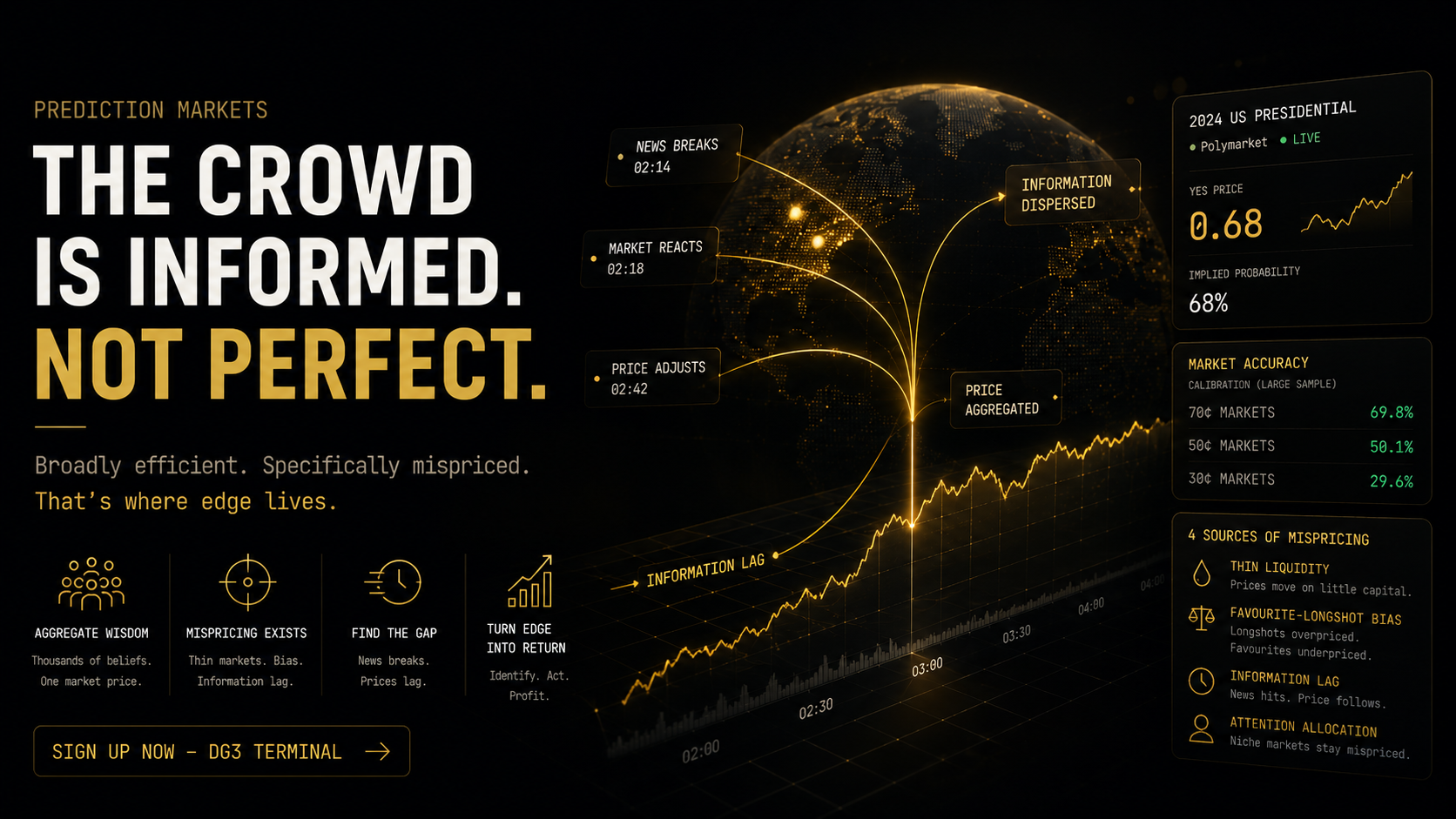
The clearest evidence for prediction market efficiency comes from comparing market-implied probabilities against realised outcomes across large samples of resolved markets. Markets that traded consistently near 70 cents resolved YES close to 70% of the time, and markets near 30 cents resolved YES close to 30% of the time. That kind of calibration at scale is not an accident. It is what information aggregation actually looks like when it works.
The 2024 presidential election is the reference case most people already know. Polymarket’s price moved meaningfully through October as new information entered, and by late in the cycle the market had priced in developments that had not yet fully shown up in polling averages. That is the aggregation mechanism doing its job: thousands of participants, each holding a small piece of information or a specific read on a demographic trend, combining into a single number faster than any one polling operation could update.
Sports market repricing shows the same pattern on a shorter timeline. Ahead of major fixtures, prediction markets on match outcomes move continuously as injury reports, team sheets, and sharp sportsbook line movements land, often adjusting within minutes of a confirmed team news update, well ahead of slower-moving casual participant reaction.
4 Sources of Mispricing in Prediction Markets
Efficiency is not uniform. It concentrates in liquid, well-covered markets and breaks down in four specific, recurring ways.
Thin liquidity distorts prices mechanically. A market with only a few thousand dollars of depth can be moved several cents by a single position, regardless of whether that position reflects real information. The price in a thin market is partly signal and partly noise from whoever happened to trade last.
The favourite-longshot bias shows up consistently. Longshot outcomes, priced under roughly 10 cents, tend to trade above their true resolved frequency, while heavy favourites, priced above 90 cents, tend to trade slightly below theirs. This pattern appears across sports betting research and shows up in prediction markets too, likely driven by a mix of overconfidence in rare outcomes and the appeal of a large payout on a small stake.
Information lag creates a real window. Between a news event breaking and the market fully repricing, there is a gap, sometimes minutes, sometimes hours depending on market liquidity, where the old price is stale and the new information has not been fully absorbed.
Attention allocation skews coverage. Popular, heavily-traded markets like a presidential race get more eyes, more capital, and faster correction. Niche markets, an obscure legislative vote or a regional election, get less attention and can sit mispriced for longer simply because fewer people are looking.
Do Prediction Markets Beat Polls?
For elections specifically, this comparison gets asked constantly, and the honest answer sits in the middle rather than a clean yes or no.
Polls measure stated voting intention at a point in time, sampled from a subset of the population, with known and unknown sources of error. Prediction markets aggregate the beliefs of people who are financially motivated to be right, including people who have access to polling data, private research, and their own read of momentum, all filtered through the discipline of having money on the line.
In practice, prediction markets tend to react faster to new information than polling averages, since market prices update continuously while polls are conducted periodically. Markets can also incorporate information that is hard to poll directly, like enthusiasm gaps or late-breaking events close to an election date. Polls, meanwhile, have the advantage of methodological transparency and large, structured sample sizes that a market price simply does not provide.
Neither replaces the other cleanly. The more useful framing is that markets and polls are different aggregation mechanisms for the same underlying question, and divergence between them is itself informative. When a market price sits well outside where polling suggests it should be, that gap deserves scrutiny rather than automatic trust in either source.
Common Mistakes
Mistake 1: Treating market price as certain truth. A price of 70 cents means 70% probability, not a guarantee. Traders who forget the probabilistic nature of the number end up shocked when the 30% outcome happens, even though it was always meant to happen roughly three times in ten.
Mistake 2: Assuming all markets are equally efficient. A flagship election market with millions in volume and a niche regional referendum market with a few thousand dollars of liquidity do not deserve the same level of price trust. Check liquidity depth before treating any price as reliable.
Mistake 3: Ignoring the favourite-longshot bias. Longshots trade above true probability. Size for that or don’t buy them.
Mistake 4: Confusing market movement with market accuracy. A price that moves sharply on news is reacting, not necessarily correcting to the right number. Sometimes markets overreact to a headline and then partially revert once the full picture settles.
Mistake 5: Assuming efficiency means no edge exists anywhere. This is the mistake that undoes everything else in this article if you let it. Broad efficiency at the market level, the kind backed by large resolved samples and calibration data that tracks closely with reality, does not mean every individual market is efficiently priced at every single moment in its life. Thin markets stay mispriced for hours. Longshots carry a structural bias that persists for as long as the pattern itself persists. News takes real, measurable time to fully absorb into a price, even on liquid markets. The gaps described above are not theoretical edge cases sitting at the margins of an otherwise perfect system. They are specific, identifiable, and exploitable by traders who know where to look, and treating the broad efficiency finding as a reason to stop looking for them is how a genuinely useful insight gets turned into an excuse for laziness.
Reading Efficiency at the Market Level
Reading whether a specific market is likely efficient or likely mispriced requires more than glancing at the current price. It requires liquidity context, a devigged fair value read, and a sense of how recently the price has moved relative to news flow.
DG3’s Edge Finder surfaces liquidity depth alongside EV gap for every market, so you can distinguish a thin market prone to noise from a liquid one where the price carries real informational weight. The Fair Value Engine strips platform vig out of the raw price, giving a cleaner number to compare against your own read. The Intelligence pane’s Signals tab shows live order flow, helping you spot the gap between a stale price and a market that has not yet caught up to new information.
Frequently Asked Questions
Q: Are prediction markets more accurate than forecasters? A: On average, yes, for near-term events with clear resolution criteria, since markets aggregate the beliefs of many financially motivated participants rather than relying on any single expert’s judgment. Individual superforecasters can still outperform markets on specific questions, but market aggregation tends to beat the average individual forecaster.
Q: Why do prediction markets sometimes get it wrong? A: Mispricing concentrates in thin-liquidity markets, in the favourite-longshot bias, and in the lag between breaking news and full price adjustment. These are identifiable patterns rather than random noise, which is why they persist.
Q: What makes a prediction market inefficient? A: Low liquidity, low participant attention, and a short window since the last major information event all reduce efficiency. A niche market with a handful of traders reacting to news minutes ago is far less efficient than a flagship market with continuous deep liquidity.
Q: Do prediction markets beat polls? A: They react faster to new information and incorporate a wider range of inputs than polling alone, but polls offer methodological transparency that markets do not. The two are complementary aggregation methods rather than direct competitors.
Q: How does liquidity affect prediction market accuracy? A: Higher liquidity means more capital and more participants are needed to move the price, which filters out noise and makes the resulting price a stronger signal. Thin markets can be moved meaningfully by a single position with no real informational content.
Q: What is the favourite-longshot bias in prediction markets? A: It is the tendency for longshot outcomes, typically priced under 10 cents, to trade above their true resolved frequency, while heavy favourites trade slightly below theirs. It shows up consistently enough across markets that it factors into serious expected value calculations.
Q: How accurate are Polymarket prices? A: On liquid, high-volume markets, Polymarket prices have tracked resolved outcome frequencies closely across large samples, which is the practical definition of good calibration. Accuracy drops on thin or niche markets with less capital and attention behind the price.
Q: What is the efficient market hypothesis applied to prediction markets? A: It is the idea that a prediction market price reflects all available public information at any given moment, making it difficult to consistently beat using only public information. Prediction markets approximate this on liquid markets but deviate from it in specific, well-documented ways.
Q: Are prediction markets more accurate than polls for elections? A: They tend to update faster and incorporate a broader information set, but polls provide structured methodology that markets lack. The most reliable approach treats significant divergence between the two as a signal worth investigating rather than picking one source as always correct.
Final Thoughts
Prediction markets are not an oracle and they are not noise. They are a genuinely effective aggregation mechanism that works especially well on liquid, well-covered markets and works less well exactly where you would expect: thin liquidity, longshot pricing, and the narrow window right after news breaks.
That specificity is the actual takeaway. Broad market efficiency is real, which is why the price is worth paying attention to at all. Specific, recurring inefficiency is also real, which is why paying attention to price alone is not enough.
The traders who do well are not the ones who trust the market blindly or distrust it reflexively. They are the ones who know which of the four gaps above they are looking at on any given position.
See how Sharp Money vs Public Money diverges from prediction market prices, and where that divergence tends to resolve.
Also read:
Calibration in Prediction Markets: How to Measure Forecast Accuracy
Information Asymmetry: Who Knows What, and When, in Event Markets
Edge Decay in Prediction Markets: Why Alpha Disappears