Information Asymmetry: Who Knows What, and When, in Event Markets
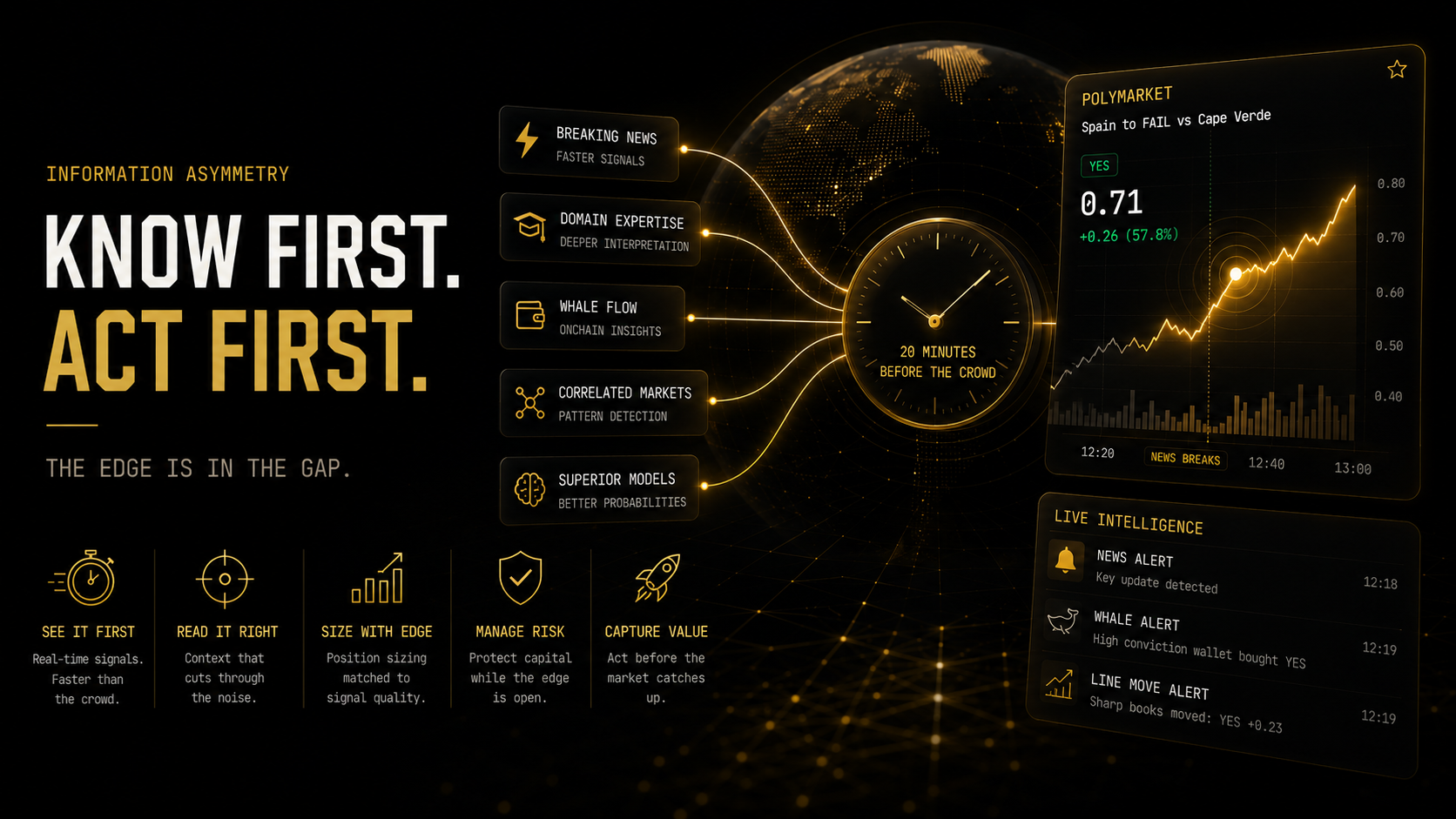
A wallet on Polymarket opened a large YES position on Spain failing to beat Cape Verde roughly twenty minutes before the news everyone else was watching for actually broke. It was not insider information. It was someone who read the same public signal faster and more precisely than the rest of the market, and that twenty-minute window was worth a position size most traders never build up the conviction to take.
That is what information asymmetry actually looks like in prediction markets. Not a secret. A speed and interpretation gap that closes fast and rewards whoever gets there first.
Table of Contents
Quick Answer
Information asymmetry in prediction markets is the gap between what one participant knows and what the broader market has priced in, and it is the primary source of trading edge on Polymarket. It comes from five main sources: faster news receipt, domain expertise, on-chain whale flow monitoring, correlated market signal reading, and superior probability modeling. Each type has a different durability, ranging from minutes for news timing edges to weeks for structural biases, and durability should directly shape how you size and execute against it.
What Is Information Asymmetry in Event Markets?
Information asymmetry exists whenever one side of a trade knows something relevant that the other side does not yet know, or has not yet fully processed. In prediction markets specifically, this shows up as the gap between a market’s current price and the true probability of the outcome, given everything currently knowable.
The distinction that actually matters is between edges that come from genuinely new information and edges that come from faster or better interpretation of information everyone already had access to. Insider information, someone with direct non-public knowledge of an outcome, is rare, often illegal depending on jurisdiction and market type, and not the primary source of edge for most serious prediction market traders.
The far more common and far more sustainable edge comes from interpretation speed and depth. Two traders can read the exact same injury confirmation on a team’s official website, and one extracts a clearer probability implication in ninety seconds while the other takes twenty minutes to process what it means for the match winner market. That gap, repeated across hundreds of events, is where real, defensible edge accumulates.
How Breaking News Moves Polymarket Prices
The mechanism is straightforward once you have watched it happen a few times. News breaks, a small number of fast, well-positioned traders act on it immediately, their trades move the price, slower participants see the price move and follow, and the market settles into a new equilibrium that reflects the information.
The speed of that whole sequence depends heavily on liquidity. On a liquid, high-volume market, the first informed trades might move price only fractionally before a wave of followers closes the gap within minutes. On a thin market, a single well-timed position can move price several cents and then sit there for hours before enough attention arrives to correct it.
This creates a specific, repeatable pattern: the edge from being first is largest and most fragile on liquid markets, where the correction happens fast, and smaller per-minute but more durable on thin markets, where correction takes longer simply because fewer people are watching.
5 Types of Information Edge in Prediction Markets
| Edge Type | Source | Durability | Example |
|---|---|---|---|
| News timing | Faster information receipt | Minutes | Transfer confirmed before public announcement |
| Domain expertise | Specialist knowledge | Days to weeks | Medical professional evaluating injury severity |
| Whale flow monitoring | On-chain order data | Minutes to hours | Large accurate wallet entering YES position |
| Correlated market signals | Cross-market pattern reading | Hours | Senate market lagging behind presidential market |
| Model accuracy | Superior probability estimation | Ongoing | Calibrated forecaster vs naive base rate user |
News timing edges are the highest value per minute and the hardest to systematically capture, since they require being positioned and paying attention at the exact moment information lands, which is closer to infrastructure than analysis. Domain expertise edges are more durable. A sports specialist’s read on injury severity does not decay in minutes the way a news timing edge does, because the specialized knowledge behind it took years to build and is not something the broader market can catch up to instantly. Whale flow monitoring sits in between: visible to anyone with on-chain access, but genuinely useful only to someone who can interpret which wallets and which position sizes actually mean something.
Order Flow Toxicity in Prediction Markets
Order flow toxicity describes how dangerous a given piece of trading activity is to whoever is on the other side of it, specifically to market makers and liquidity providers who accept orders without knowing whether the counterparty holds superior information.
A market maker quoting both sides of a thin political market has no way to distinguish a retail trader placing a small directional bet from a well-informed trader who just read a leaked internal poll. Every filled order carries some probability of being “toxic,” meaning it reflects real information the market maker did not have, and that risk is exactly why spreads widen on markets where informed trading is more likely.
For directional traders, understanding order flow toxicity matters because it explains market maker behavior. When you see spreads widen suddenly on a market with no obvious news catalyst, that widening itself can be a signal that someone with better information than the visible order book has started trading, and the market makers have noticed before you have.
Common Mistakes
Mistake 1: Confusing information asymmetry with insider trading. Most real edge in prediction markets comes from faster or deeper interpretation of public information, not access to secrets. Chasing “insider” angles is both a poor use of time and, in many cases, a legal risk not worth taking.
Mistake 2: Treating all large positions as informed. A large onchain position can reflect genuine information, or it can reflect a wallet parking capital, hedging elsewhere, or simply having a high risk tolerance. Size alone does not tell you which.
Mistake 3: Acting on stale information as if it were fresh. A whale entry from thirty minutes ago in a fast-moving live event is historical context, not a current signal. Timestamp discipline matters as much as the information itself.
Mistake 4: Ignoring market liquidity when estimating how long an edge will last. The same piece of information persists far longer as tradeable edge in a thin market than in a liquid one, and sizing your urgency to the wrong liquidity profile means either overpaying for speed you did not need or missing a window that closed faster than expected.
Mistake 5: Assuming domain expertise translates automatically into trading edge. Knowing a sport, a legislative process, or an industry deeply is necessary but not sufficient. That knowledge has to translate into a specific probability estimate that differs meaningfully from the market price, or it is just expertise without an edge attached.
Closing the Gap Between Signal and Action
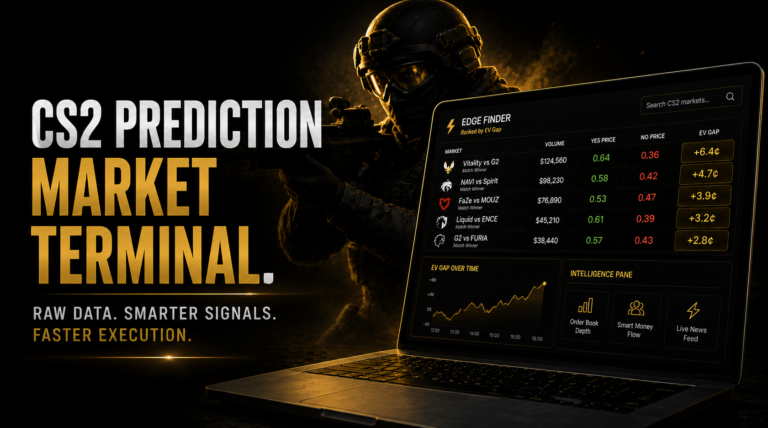
Information asymmetry is only useful if you can act on it before the gap closes, and closing speed depends on knowing what other participants are doing in real time. DG3’s Intelligence pane surfaces order flow through the Signals tab and Sharps tab, scoped to the specific market you have open rather than a generic global feed. The News tab shows breaking developments alongside the market price they affect.
That scoping matters more than it sounds. A trader watching a general transaction feed has to manually filter for relevance. A trader with a market-scoped view sees only what matters for the position in front of them, cutting the interpretation time that determines whether an information edge is still open or has already closed.
Frequently Asked Questions
Q: What is an information edge in prediction markets? A: It is the gap between what you know or have correctly interpreted and what the current market price reflects. It can come from faster news receipt, deeper domain expertise, on-chain flow monitoring, cross-market signal reading, or superior probability modeling.
Q: How does breaking news affect prediction market prices? A: Fast, well-positioned traders act on new information first, their trades move the price, and slower participants follow that movement until the market reaches a new equilibrium. The speed of this process depends heavily on the market’s liquidity.
Q: Can insiders profit from prediction markets? A: In principle yes, but genuine insider information is rare and often carries legal risk depending on jurisdiction and market type. The far more common and sustainable edge comes from faster or better interpretation of public information, not secret knowledge.
Q: How do you trade before information is priced in on Polymarket? A: By monitoring the specific channels where information tends to surface first for your area of focus, whether that is breaking news feeds, onchain whale activity, or correlated markets that tend to move first, and acting quickly once a genuine signal appears.
Q: What is order flow toxicity in prediction markets? A: It describes the risk that a given trade reflects superior information the market maker does not have. Widening spreads on a market without an obvious news catalyst can itself be a signal that informed trading has started.
Q: How durable are different types of information edges? A: News timing edges typically last minutes. Domain expertise edges can persist days to weeks. Whale flow monitoring edges last minutes to hours depending on how quickly the broader market notices and reacts to the same activity.
Q: Why do some traders track wallet activity on Polymarket? A: Because every position is onchain and publicly visible, tracking well-performing wallets can surface informed activity before it is broadly recognized, though the data requires interpretation since not every large position reflects real information.
Q: What is domain expertise edge in prediction markets? A: It is the advantage that comes from deep, specialized knowledge in a specific area, such as a medical professional assessing injury severity or a policy analyst reading legislative dynamics, applied to translate that knowledge into a probability estimate that diverges from the market price.
Final Thoughts
Information asymmetry is not about knowing secrets. It is about reading the same public information everyone else has access to, faster and more precisely, and having the infrastructure to act on that read before the gap closes.
The traders who build a durable edge are not chasing rumors. They are building repeatable processes around one or two of the five edge types above, whether that is domain specialization, flow monitoring, or cross-market pattern reading, and getting good enough at execution that the edge survives contact with a market that is trying to close it in real time.
That gap between knowing and acting is where most of the value gets lost. Closing it is the actual skill.
Learn how Sharp Money vs Public Money reveals which side of a market actually holds the information edge.
Also read:
Trading Signals That Actually Move Event Markets
Edge Decay in Prediction Markets: Why Alpha Disappears
Sharp Money vs Public Money