Reading Sharp Money Signals on DG3
Everyone can see the trade. Almost nobody reads it right.
Every position opened through Polymarket is onchain. Every wallet is public. The data costs nothing. This creates a comfortable illusion – that because the information is open, the edge is democratic.
That assumption is wrong.
Watching a large wallet buy YES and following it in is not a strategy. It is the most expensive way to learn that size is not signal.
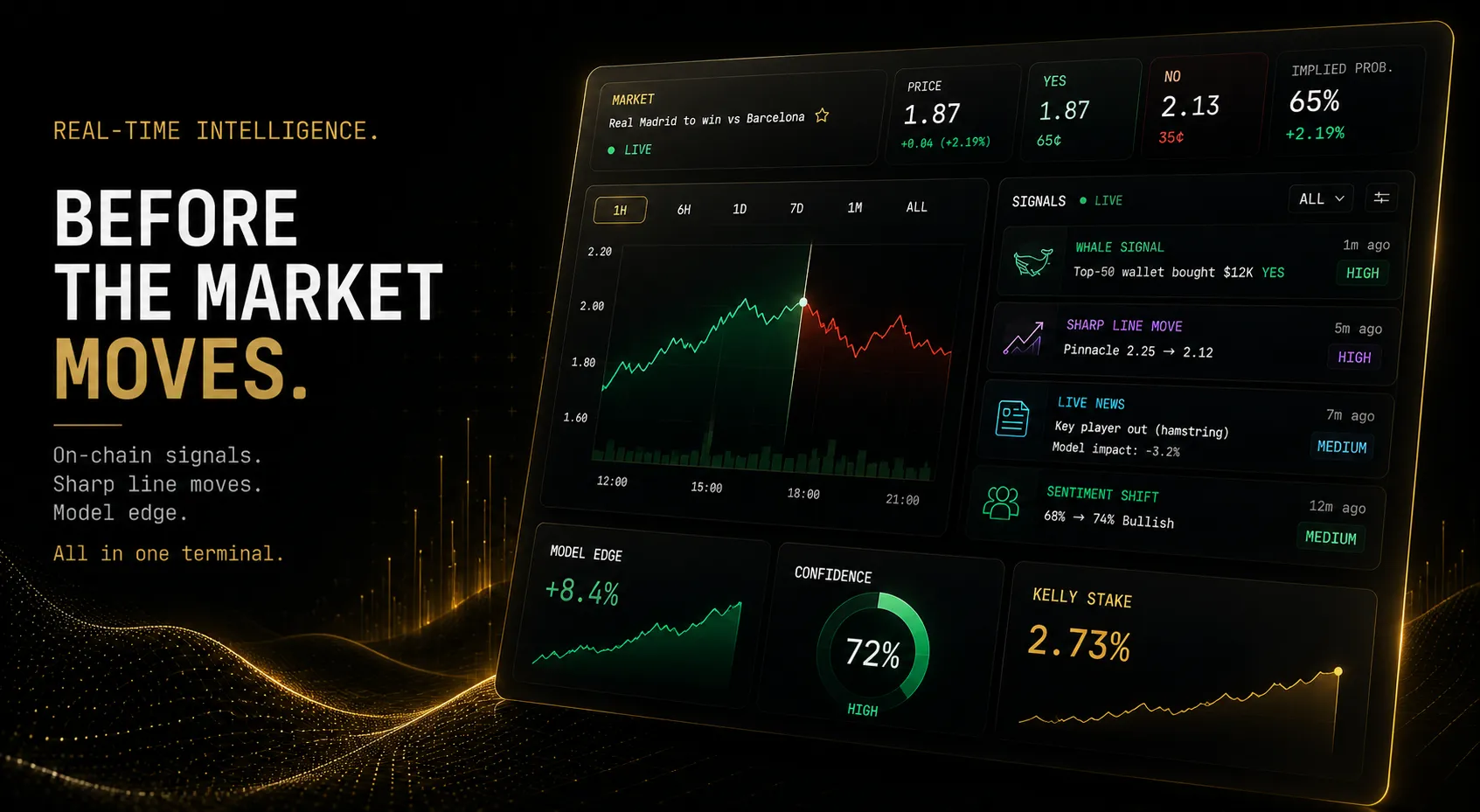
Reading sharp money on DG3 means using the Signals feed inside the Intelligence Pane – a filtered, real-time view of onchain whale activity, sharp line moves from reference books, and live news with model impact scores, all scoped to the specific market you have open. DG3 shows which wallets are moving size, whether sharp lines are confirming direction, and how all of it sits against the model’s fair value read. The goal is to catch genuine conviction before it is fully priced in.
Table of Contents
Why Prediction Markets Make This Different
In most financial markets, institutional order flow is hidden. Equity dark pools, futures block trades, smart money positioning in FX – these move in places retail participants cannot see. Prediction markets built on public blockchains invert this completely.
Every large onchain position is visible. The wallet that built a $427,000 position on Spain failing to beat Cape Verde at the 2026 World Cup – one of the most profitable single trades of the tournament, paying out over $4.7 million – did it in full public view on Polygon. Wallet address, entry timing, position size, market: all onchain, readable by anyone.
That is the opportunity. It is also the trap.
Because visible data and actionable signal are entirely different things. The trader who built that Spain position was not following a large wallet. They were building a probability view that the market had mispriced – deeply, at 6 cents on the dollar for a result that eventually happened. Copying that trade at 6 cents required independent conviction the market was wrong. Copying it at 60 cents, after the position had already moved the market, would have been the opposite of smart.
Sharp Money Signal, defined: onchain or line-movement data indicating informed, high-conviction positioning by wallets or reference books with a verified track record. On DG3, sharp signals are classified, timestamped, and scoped to the specific market you have open – not a generic broadcast of large trades.
Key Takeaways
- DG3’s Signals feed is market-scoped: every signal is filtered to the specific position you are analysing, not a global stream
- Three signal types run simultaneously: onchain whale activity (with wallet tier and win rate), sharp line moves from reference books, and live news with model impact
- Whale signals include classification – wallet tier and verified win rate – not just transaction size
- The Spain vs Cape Verde market at the 2026 World Cup is the clearest example: a wallet accumulated positions when the market priced a Spain non-win at 6 cents, generating a $4.7 million payout – the signal was onchain the entire time, but without context it was invisible to most traders
- Signal timing is the most underread data point in any feed – a whale entry from 8 minutes ago in a live match and the same entry from 2 hours ago require completely different responses
- Multi-signal convergence – whale activity, sharp line move, and news model impact all pointing the same direction – is the highest-confidence state in the terminal
- DG3’s Trade Desk shows Kelly-sized presets in the execution panel, updated as the market price moves, so the sizing decision is anchored to a number rather than a feeling.
Not Every Large Position Is a Sharp Signal
This is where most traders go wrong first.
A large onchain position is a data point. It is not automatically a signal. On Polymarket’s CLOB, a $30,000 to $50,000 position in a mid-liquidity market shifts the best available price by 2 to 6 cents. That movement is real. But movement is not the same as information.
Some large positions are structural. A wallet accumulating shares at 97 cents on a near-certainty is parking capital for yield. It moves capital but tells you nothing about the outcome.
The Iran peace deal case is the cleaner lesson. A wallet opened YES positions when the market priced the deal at 6 cents – days before any public confirmation of a tentative agreement. The size was large enough to register. But at 6 cents on an event considered near-impossible by the market, most traders scanning the feed saw noise. The traders who read it as signal had a framework for asking: what kind of wallet is this, what is their track record, and does this position reflect structural accumulation or directional conviction?
DG3’s Signals feed does this filtering before the data reaches you. It classifies activity by wallet tier and win rate, not just transaction size. A top-ranked wallet with a verified directional record entering a position reads differently in the feed than an anonymous large position with no history.
Inside the Terminal: Where Sharp Money Lives
Open any market on DG3 and the Intelligence Pane surfaces three signal types at once, scoped to that market:
Sharps tab – onchain position entries from tracked wallets, classified by wallet tier and win rate. The signal shows position size, market, wallet tier, verified win rate, and onchain confirmation status. Timestamp tells you exactly how fresh the activity is.
Sharp line moves – Shifts from reference books, showing the book, timeframe, magnitude, and whether sharp money has been confirmed on that move. The confirmed tag is what separates an informed line move from a liquidity shift or public money reaction.
Live news with model impact – Breaking developments from verified sources, automatically scored for model impact on the current market. This contextualises the other signals – if whale activity and news are coherent, the signal is stronger. If they conflict, that conflict is itself information.
All three run at once, scoped to the market you have open. You are not scrolling a global transaction feed. You are reading intelligence assembled specifically for the position in front of you.
The Four Data Points That Make a Whale Signal Actionable
Not all whale activity in the feed carries equal weight. The classification data attached to each signal is what determines whether it is worth acting on.
Wallet tier – A top-ranked wallet with a verified directional record entering at an edge price is a fundamentally different signal from an anonymous large transaction. The tier classification does the filtering work before the signal surfaces.
Position size relative to market liquidity – A large position in a market with thin liquidity is a real directional statement. The same position in a deep market with many times that liquidity is background noise. Always read size in the context of the market it is entering.
onchain confirmed tag – This means the position has been verified directly on the blockchain, not inferred from secondary line movement. It distinguishes a confirmed entry from a pattern match.
Signal timestamp – The most underread data point in any prediction market signal feed. A whale entry from 8 minutes ago in a live match market is actionable. The same entry from 90 minutes ago in a live match is historical context at best. The timestamp determines whether an edge still exists at the current price, which brings us to the next point.
The Price Problem Nobody Talks About
You identify a sharp signal. A top-ranked wallet has entered a large position on a market you have been watching, at a price where your own analysis agrees there is genuine edge. The signal looks clean.
Then you check the current price.
The whale entered at 52 cents. The market is now at 61 cents. Their entry moved the price. Other traders reacted to what the whale had done. The edge they found at 52 cents does not exist at 61 cents. You are not acting on their signal – you are acting on the price their signal created. This is how traders lose money on correct reads.
The check is simple: look at the current mid before doing anything else. If the market has already moved 6 to 8 cents in the direction of the whale entry, the window has closed. The signal is real. Your entry price is not the signal price.
DG3’s Edge Finder runs alongside the Signals feed for exactly this reason. When a signal fires, the Edge Finder shows the current fair value versus the current market mid. If positive EV still exists at the current price, the signal is still actionable. If the gap has closed, the Edge Finder tells you that before you execute.
Multi-Signal Convergence: The Setup Worth Waiting For
The World Cup has produced the clearest examples of multi-signal convergence this year.
The Spain vs Cape Verde market on June 15 is the most documented case. Spain were overwhelming favourites. The market priced Cape Verde failing to win at roughly 94 cents. But in the hours before the match, onchain data showed a single wallet building a large position on a Spain non-win – not a small test position, but a committed entry at a price that implied very high conviction that the market had this wrong.
The signal was onchain the entire time. Most traders scanning raw transaction data saw a large contrarian position and assumed noise. The trader who built the position turned $427,000 into $4.7 million.
What multi-signal convergence looks like on DG3: a top-ranked wallet enters a position in a direction that contradicts the current market consensus. A reference book line moves in the same direction with sharp money confirmed. A news signal surfaces with a model impact score pointing the same way. All three are independent sources reaching the same conclusion.
Any one of those signals alone is interesting. All three pointing the same direction is a setup – not a guarantee, but a substantially higher-confidence state than any single data point provides.
Sharp Signals During the FIFA World Cup
The 2026 FIFA World Cup has become the largest sports prediction market event ever run. Over $1.2 billion in trading on the winner market, $280 million in live liquidity, and daily volumes approaching $30 million across 370 active markets (Polymarket data).
The Spain vs Cape Verde result is the tournament’s most prominent sharp signal case, but it is not the only one. The pattern repeats across group-stage markets: wallets with verified track records taking positions that contradict the consensus, at prices the market has mispriced, before the information that explains the position becomes public.
At this volume and with this concentration of sophisticated capital, signal density in live World Cup markets is higher than almost any other period on Polymarket. More of the onchain activity reflects genuine informational edge rather than casual retail participation. The sharp line moves compress faster – a move that takes 6 hours to propagate in a quiet political market can move in under 45 minutes during a live World Cup fixture, because more sharp participants are watching and moving at the same time.
For traders using DG3 during the tournament, this means timestamps matter more than usual. The entry window on a live World Cup sharp signal is shorter than in almost any other market context.
Five Ways Traders Get This Wrong
Treating a whale entry as a copy signal. A signal tells you where informed money is positioned. It cannot tell you what your entry price should be, how much of your bankroll to commit, or whether the edge that existed when the whale entered still exists when you execute. Flow is an input, not an instruction.
Acting on alerts without checking the current price. If the market has already moved 6 to 8 cents toward the whale’s position since they entered, the edge they found is gone. Check the current mid against the Edge Finder before doing anything.
Ignoring wallet tier. A large position from an unclassified wallet is not a sharp signal – it is a large position. The Spain vs Cape Verde trade is instructive precisely because the wallet that built it had a track record of well-timed contrarian positions. Size without history means nothing.
Reading signals without the Edge Finder. Sharp flow without fair value context leads to entries at prices where the edge has already been priced in. Both need to be in the same view before you execute.
Treating a 2-hour-old signal in a live match the same as a 2-hour-old signal in a 30-day political market. Decay rate is a function of market type and time to resolution, not clock time. In a live match at minute 70, a 2-hour-old whale entry is ancient history. In a market resolving in three weeks, the same signal may still be highly relevant.
What the Terminal Actually Does
Most traders trying to assemble sharp money intelligence are running separate tools in separate tabs: a blockchain explorer for onchain data, an odds tracker for line movement, a news feed, and a Kelly calculator. By the time they assemble the picture across all four, the edge window in a live market has often already closed.
DG3 collapses that into one view – which sounds straightforward until you have actually tried to do it across five tabs in a live World Cup match. Whale signals, sharp line moves, live news, model edge, and Kelly sizing all run simultaneously, scoped to the specific market you have open. The execution panel pre-fills your recommended stake from Kelly before you decide to trade, and updates live as the market mid moves.
When signal, fair value, and sizing are in the same pane, you are reading a complete picture. The Spain vs Cape Verde trade illustrates the cost of assembling that picture too slowly – or not at all.
Frequently Asked Questions
What is a sharp money signal in prediction markets? A sharp money signal is onchain or line-movement data indicating informed, high-conviction positioning by wallets or reference books with a verified performance track record. On DG3, sharp signals are classified by wallet tier and win rate for onchain activity, and by book source, magnitude, and confirmation status for line moves – all scoped to the market you are currently analysing.
How does DG3 display sharp money and whale flow? Through the Signals feed and Sharps tab inside the Intelligence Pane. Each sharp signal shows position size, market, wallet tier, verified win rate, onchain confirmation status, and timestamp. Sharp line move signals show the reference book, timeframe, percentage shift, and a sharp money confirmed tag. All signals are filtered to the market you have open, not broadcast as a global feed.
What does “onchain confirmed” mean on a whale signal? It means the position has been verified directly on the blockchain, not inferred from secondary line movement. It distinguishes a confirmed large entry from a pattern match or estimate.
How do I know if a signal is still actionable? Check the timestamp first, then check whether the market price has already moved in the signal’s direction. If a whale entered 8 minutes ago and the market has moved 6 to 8 cents toward their position, the edge they found may no longer exist at the current price. DG3’s Edge Finder shows current fair value versus current mid in real time – cross-check it before executing.
Is acting on DG3 signals the same as copy trading? No. DG3 surfaces where informed money is positioned – it does not replicate positions mechanically. Sharp signals are one input into a decision that also involves checking current EV, market liquidity, and your Kelly-sized stake. The terminal is built for traders making their own decisions with better information, not for automatically following positions.
What makes the DG3 Signals feed different from a raw whale alert tool? The distinction comes down to three things. First, every signal is scoped to the market you have open, not a global broadcast. Second, whale signals include wallet tier and win rate classification, not just transaction size. Third, the feed runs alongside the Edge Finder, order book, and Kelly panel in the same view, so signal, fair value, and sizing are visible at the same time.
Why does signal timing matter more in live match markets? The information cycle in a live match compresses to minutes. A whale entry from 8 minutes ago and the same entry from 90 minutes ago in a live match carry completely different levels of actionability. DG3 timestamps every signal precisely so you can make that call before acting.
What is multi-signal convergence? Multi-signal convergence is when whale activity, a sharp line move, and a news model impact score all point in the same direction independently for the same market. Because these sources are independent, convergence substantially increases signal confidence. The Spain vs Cape Verde World Cup market is a recent example where onchain positioning preceded a result the broader market had severely mispriced.
Final Thoughts
Sharp money signals are the most valuable information in prediction markets. They are also the most misread.
The data is public. The wallets are visible. The positions are onchain. But public data without a classification framework is just a transaction log – and traders who treat it that way end up chasing prices that large wallets already created, not the edges those wallets found.
The Spain vs Cape Verde trade was onchain the entire time. The $4.7 million payout went to the trader who had the framework to read it. Not the traders watching the same blockchain and seeing noise.
DG3’s Intelligence Pane is that framework. Signals, Edge Finder, order book, live news, Kelly sizing – scoped to the market you are in, in one view.
Not just a signal – a complete picture of what the market is actually saying.
Sign up now – DG3 Terminal
Also read:
The Gap Closes Before Most Traders See It.
Trading Signals That Actually Move Event Markets
How to Read Polymarket Signals: A Field Guide