The Gap Closes Before Most Traders See It.
Edge surfaces before it’s priced. The question is whether you’re set up to see it.
There’s a version of prediction market trading that looks like this: open 15 tabs, scroll through markets, try to remember what the line was an hour ago, check a news site, come back, and find the price you wanted is already gone.
Most people trade that way. They’re reacting, not detecting.
Edge doesn’t wait for you to find it. It opens, attracts capital, and closes – often in minutes. The traders who catch it consistently aren’t smarter or more informed. They’ve just built a system that surfaces the gap before it disappears.
This is what edge detection actually means. And if you’re serious about prediction markets, it’s the skill that separates active traders from people who occasionally get lucky.
Table of Contents
What Edge Is (And What It Isn’t)
Edge is not a feeling about a market. It’s not “I think this is going higher.” That’s a directional view, which is a different thing entirely.
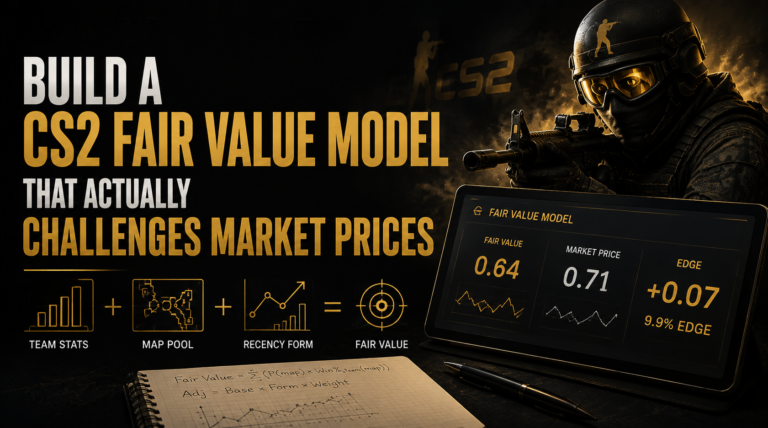
Edge, in the precise sense, is the gap between a market’s current price and its fair value – the probability the outcome actually deserves based on all available information.
If a Polymarket contract is pricing a team’s win at 38 cents and the correct probability, accounting for recent form, injuries, and line movement, is closer to 44%, that 6-point gap is edge. It has a direction (you’re buying), a magnitude (6 cents on the dollar), and an implied expected value you can calculate before you put capital in.
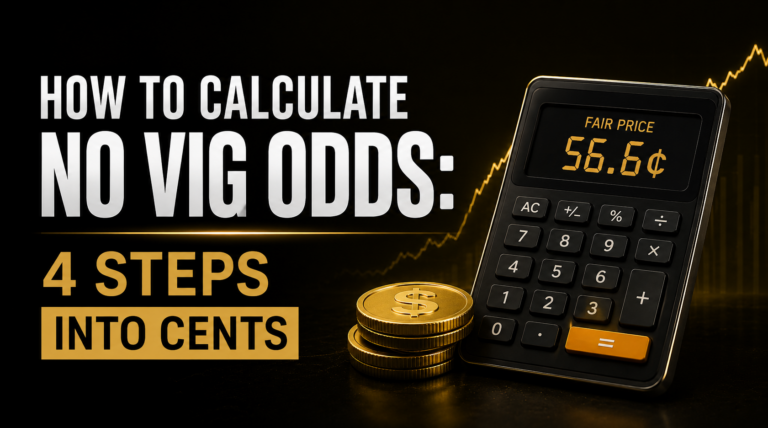
This is the practical extension of fair value estimation. Once you know how to compute what a market should price, edge is just the delta between that number and what the market is actually showing.
When the delta is large enough, and your fair value estimate is reliable enough, you have a trade.
Why Edge Exists at All
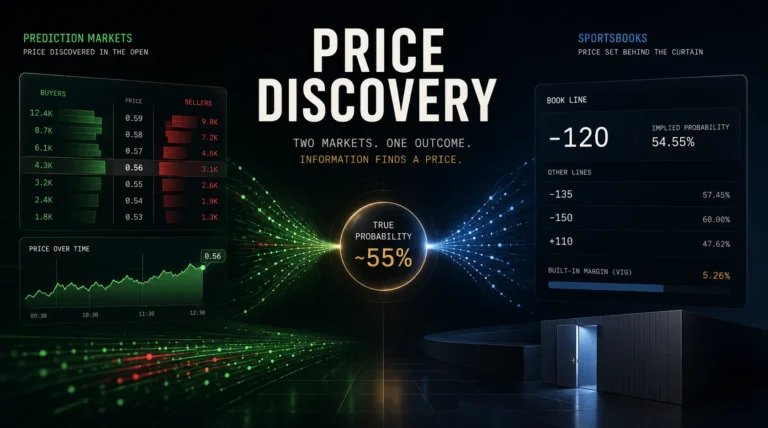
Prediction markets are information aggregation machines. Prices move toward truth as capital flows in from people who know things. In theory, a large, liquid, well-followed market should be efficient – hard to beat.
But in practice, inefficiencies are real and recurring. They come from a few specific places.
Public money creates the most obvious ones. Recreational bettors skew toward popular outcomes, household names, and narratively satisfying results. That pressure moves prices away from probabilities and toward sentiment. A high-profile political candidate might be overpriced by 4-6 points just because people want them to win and are betting accordingly.
Thin markets are another source. A low-volume contract on a niche political or economic event might have a spread wide enough to park a truck through. The line exists because someone set it, not because the market has priced it efficiently. These gaps can be large and they can sit for a while.
Breaking news creates the third category. New information drops and the market takes time to catch up, sometimes seconds, sometimes minutes. For that window, the old price is wrong and anyone still trading it is trading stale. These gaps close fast once sharp money finds them.
The traders closing those gaps are sharp money (systematic, probability-driven, and quick). When you see a line move hard and fast without obvious news, it usually means a sharp player found the inefficiency before you did.
The question is whether you’re positioned to find it first.
The Scale Problem
Here’s the practical issue: On any given day, Polymarket alone has thousands of active markets. Elections, sports, crypto, geopolitics. The edge you’re looking for might exist in 2 or 3 of those markets at any moment
Manual scanning doesn’t work. You can’t hold fair value estimates in your head for hundreds of markets simultaneously, update them as new information arrives, compare them to live prices, and flag the discrepancies – all before the gap closes.
This is where the trading terminal layer matters. Not as a nice-to-have, but as a structural requirement. DG3 Terminal built for serious traders does this computation continuously – tracking live prices across all active markets, running live fair value estimates, and surfacing the gaps that meet a meaningful threshold.
Without that infrastructure, you’re not edge-hunting. You’re just scrolling through markets hoping something catches your eye.
How Edge Gets Ranked: EV and Confidence
Not all edge is equal. Finding a 3-point gap on a 90% market is very different from finding a 3-point gap on a 12% longshot. The numbers look similar; the implied trades are not.
Two variables determine whether a detected gap is worth acting on.
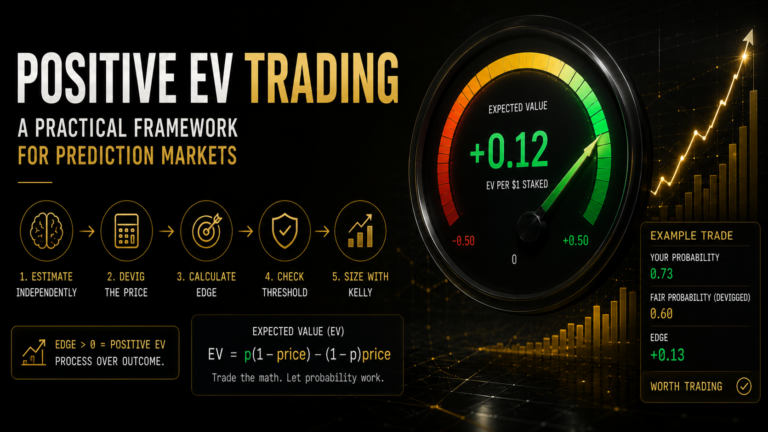
Expected Value (EV) is the core metric. It’s roughly: size of the edge gap, weighted by the implied probability of the outcome. A market pricing Yes at 68 cents when fair value is 74 cents gives you 6 cents of edge on a position that, by your estimate, hits nearly 3 in 4 times. That’s a high-EV trade. A 6-point gap on a 10% market means you’re right once every ten times – the math still needs to work before you act.
Confidence is the second variable. How robust is the fair value estimate behind the detected gap? An edge signal derived from multiple sharp-money indicators and recent high-quality data is a different quality of signal than one based on a thin model with stale inputs. High confidence + high EV is a signal. High EV + shaky confidence is a hypothesis, not a trade.
A well-built edge scanner ranks detected opportunities along both axes. The best traders don’t see a list of every gap across every market. They see a ranked, filtered view – highest EV, highest confidence, ordered by urgency. The signal is processed before it reaches them.
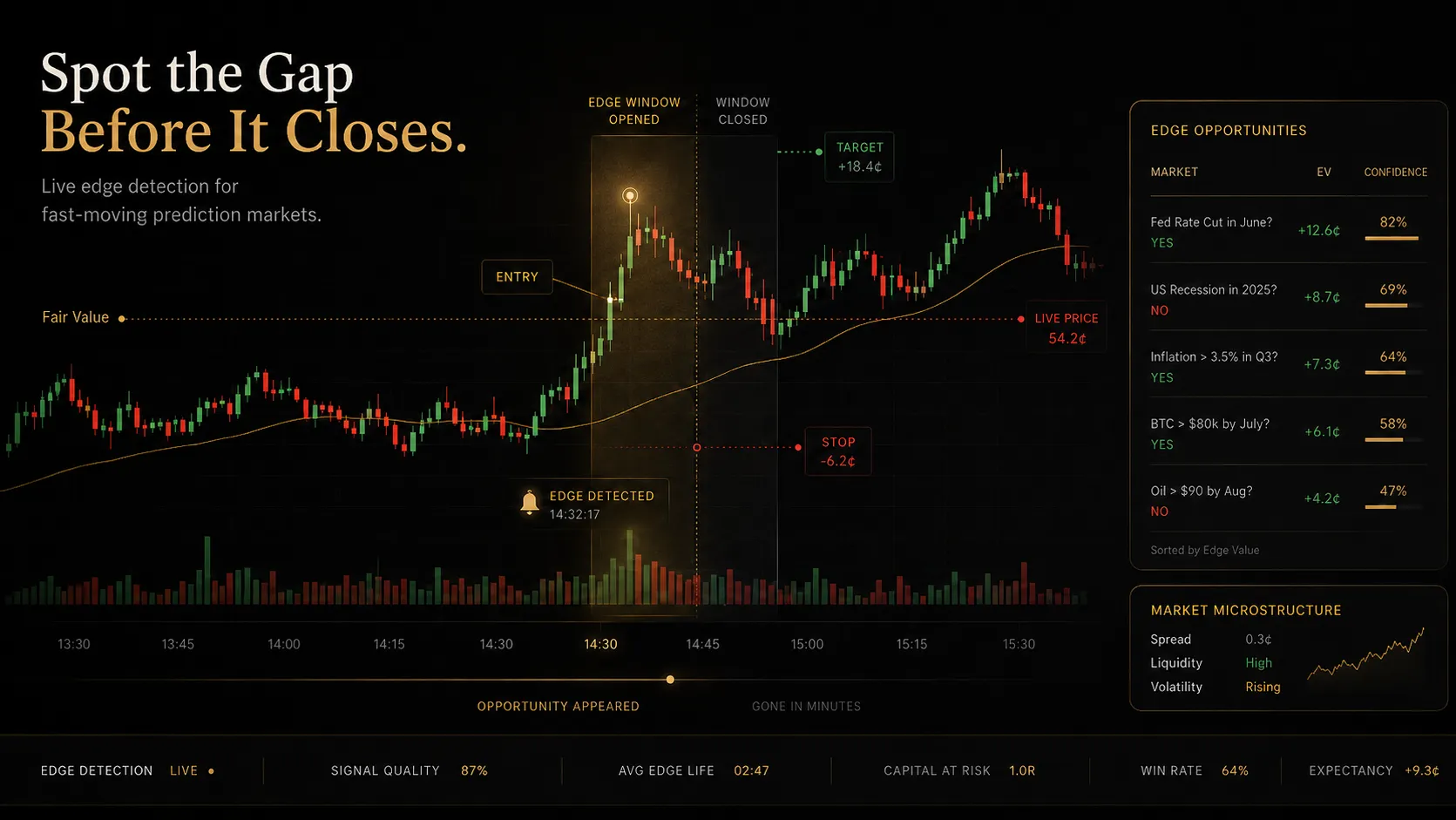
DG3’s Edge Finder pulls up exactly this: ranked edge opportunities on Polymarket, ordered by EV and confidence, updated live. The terminal does the scanning. You do the judgment call.
Speed Is Part of the Edge
Finding an edge opportunity is not the same as capturing it.
An edge window has a natural lifespan. Public information spreads fast. Other traders with similar tools are looking at the same markets. The moment a gap becomes visible, capital starts flowing toward it, correcting the price and closing the gap.
This means execution speed is part of the return. A trader who identifies the opportunity 10 seconds after it opens but takes 45 seconds to size and execute the trade is capturing a fraction of the edge that existed at the moment of detection. In some cases, they’re trading into a market that’s already halfway repriced.
This is why sharp-focused terminals build for speed at the execution layer, not just the detection layer. Real-time alerts. 1-click execution. No switching between platforms. No copying numbers between tabs. The workflow is designed so that the gap between “I see it” and “I’m in” is as small as possible.
Detection without fast execution is still leaving money on the table.
What an Edge Detection Workflow Actually Looks Like
Operationally, a real edge detection workflow has five stages:
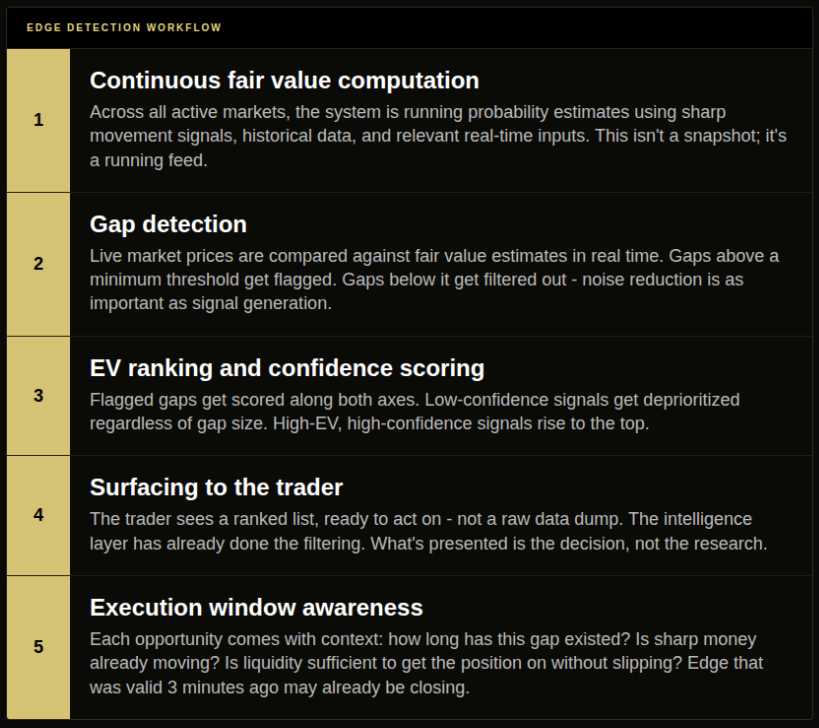
The workflow compresses what would take an analyst hours of screen-watching into something that surfaces in seconds.
The Shift That Matters
Consistently profitable prediction market trading is not about having stronger opinions than everyone else. Most markets, most of the time, are priced closer to right than they look.
What changes outcomes is information advantage – finding the moments when the market is wrong, being confident enough in that assessment to act, and being fast enough to capture the return before the gap closes.
Edge detection is the systematic version of that. Not guessing more boldly. Not watching more screens. Building or using a process that identifies the gap, ranks it by quality, and puts you in position to act before the market reprices.
That’s what the trading terminal layer is actually for. Not just organizing markets in one place, but computing where the price is wrong and showing you before it fixes itself.
Edge surfaces before it’s priced. The question is whether you’re set up to see it.
Ready to see the live edge? Sign up now – DG3 Terminal
Also read:
Trading Signals That Actually Move Event Markets
Edge Decay in Prediction Markets: Why Alpha Disappears
Market Efficiency in Prediction Markets: Are They Really Smarter Than the Crowd?