2030 World Cup Odds: The Complete Early Favorites List
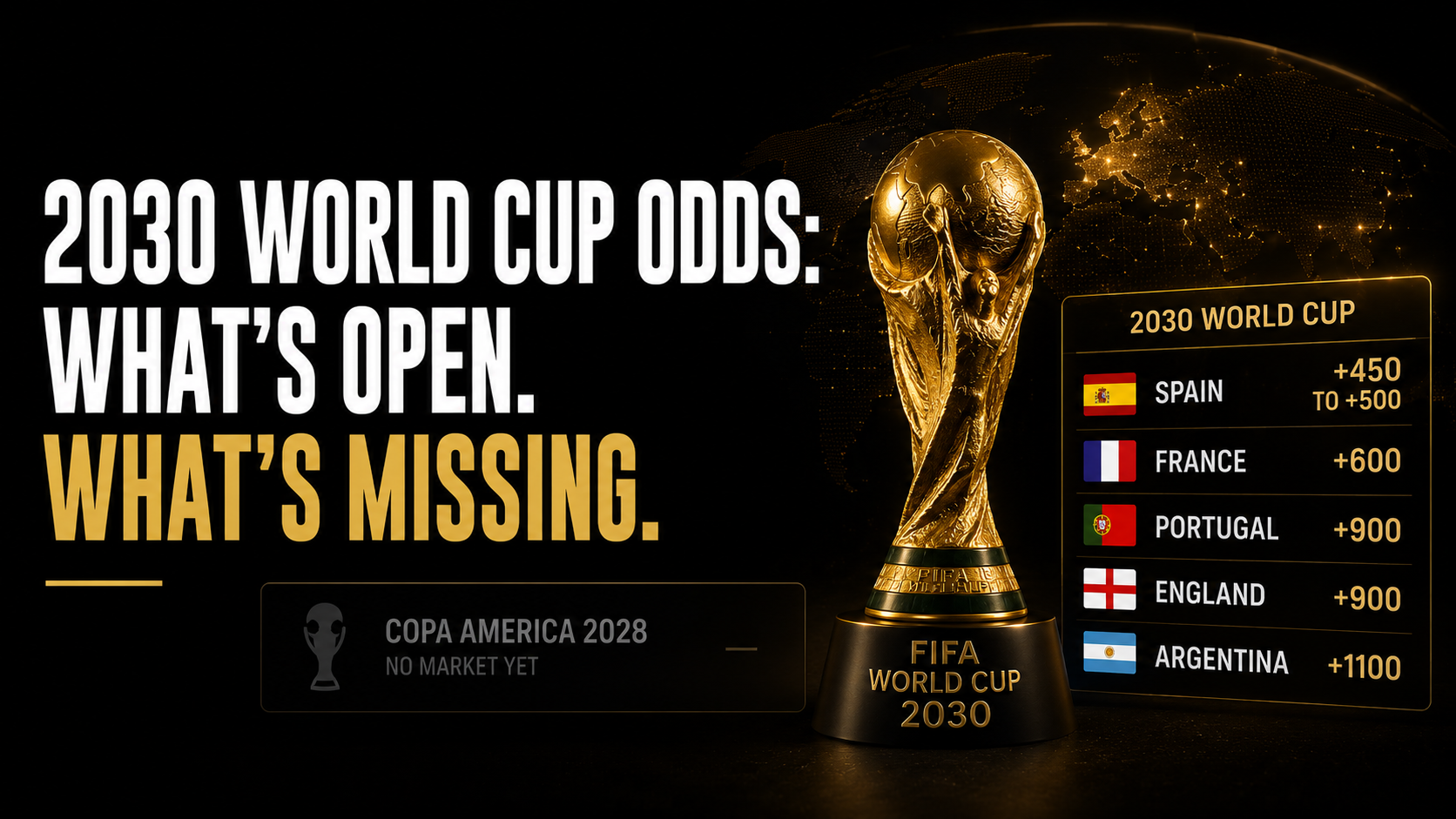
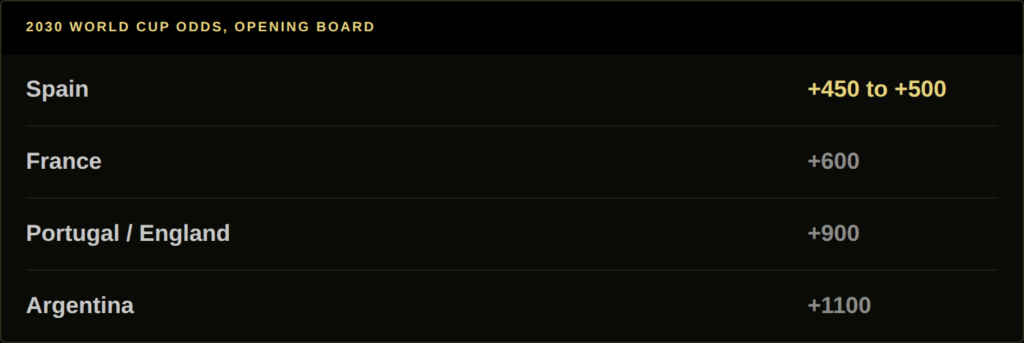
Within hours of Ferran Torres’ extra-time winner, sportsbooks had already posted 2030 World Cup odds. Spain opened as the favorite to defend its title, at plus 450 to plus 500 depending on the book. That is not unusual, tournament futures reopen fast. What is more interesting is what has not opened yet. The 2030 World Cup odds are live. A Copa America 2028 market, the next major event on the calendar for half of Sunday’s finalists, is still sitting empty, because nobody has even confirmed where or when it will happen.
Table of Contents
Quick Answer
2030 World Cup odds opened within hours of the 2026 final, with Spain installed as the favorite at roughly plus 450 to plus 500 across major sportsbooks, ahead of France, Portugal, and Brazil. No Copa America 2028 futures market exists yet on any platform, since neither the host nation nor the tournament dates have been confirmed. The gap between how fast one futures market reopens and how long the other stays dark says a lot about what prediction markets actually need before they can price an event.
Key Takeaways
- Spain opened as the 2030 World Cup favorite at roughly plus 450 to plus 500 on major sportsbooks, immediately after winning the 2026 title, with France next at plus 600 and Portugal and England tied near plus 900.
- The speed of the 2030 World Cup odds reopening, within hours of the final whistle, reflects a simple truth about futures pricing: as soon as the host nations and format are known, a market can post a number, even four years out.
- Morocco, Portugal, and Spain will co-host the 2030 tournament, with three centennial matches played in Uruguay, Argentina, and Paraguay, a detail that already factors into early pricing for host-nation bumps.
- No Copa America 2028 futures market exists as of this writing, because the host country and exact dates for that tournament have not yet been finalized by CONMEBOL, unlike the 2030 World Cup, whose hosts were confirmed back in 2023.
- Argentina, the two-time defending Copa America champion, will likely open as a market favorite whenever pricing does appear, but there is currently nothing to trade, an unusual gap for a major international tournament this close to its expected window.
- The contrast between these two futures markets is itself the lesson. A prediction market cannot price genuine uncertainty about an outcome until the structural facts, the host, the format, the dates, are locked in. Uncertainty about the facts is a different kind of unknown than uncertainty about who wins.
- Spain’s short price to repeat is historically rare. No team has won consecutive World Cups since Brazil in 1958 and 1962, which makes the current favorite’s number as much a bet on history not repeating a specific pattern as it is a bet on Spain’s roster.
Why 2030 World Cup Odds Were Live Before The Trophy Was Even Presented
Sportsbooks moved fast because the hard part of pricing 2030 was already done years ago. Morocco, Portugal, and Spain were confirmed as co-hosts back in October 2023, ratified by the FIFA Congress in December 2024, with three commemorative opening matches set for Uruguay, Argentina, and Paraguay to mark the World Cup’s centennial. Once the structural facts are locked in, a sportsbook only needs current form and roster outlook to post a number, and that is exactly what happened. DraftKings had Spain at plus 500, France at plus 600, and Portugal and England tied at plus 900 within a day of the final. Bet365 had a nearly identical board, Spain at 9/2, France at 6/1, Portugal at 7/1.
Spain’s case is straightforward on paper. A young core, Pau Cubarsi, Pedri, Gavi, and Lamine Yamal chief among them, gives bookmakers a roster outlook that should still be near its peak in four years, and Spain becomes the fourth pre-tournament favorite to actually win the trophy since 1974, which reinforces rather than complicates the number. But history cuts the other way too. No country has won back-to-back World Cups since Brazil in 1958 and 1962, and that drought is part of what any 2030 World Cup odds position is actually betting against.
Why Copa America 2028 Has No Market At All
Contrast that with the Copa America. Argentina is the two-time defending champion, having won in both 2021 and 2024, and is the most successful nation in the tournament’s history with 16 titles. Brazil sits close behind with 9. Any sportsbook would happily post odds on that field today if it could. It cannot, because CONMEBOL has not yet confirmed a host nation or a date window for the 2028 edition. Reporting has floated Ecuador or the United States as possibilities, and the tournament is expected to fall somewhere in the June-to-July window that has become standard, but none of that is locked in the way the 2030 World Cup’s structure already is.
This is not a market inefficiency. It is the correct behavior for a well-functioning prediction market. You cannot meaningfully price who wins a tournament until you know which teams qualify, where it is played, and how home advantage and travel will factor into form, and none of those structural questions have answers yet for Copa America 2028. The absence of a market here is itself informative: it tells you exactly which unknowns are still unresolved, rather than pretending a number would be more useful than no number at all.
Watching for the moment that changes is itself a useful habit. The first credible reporting that names a Copa America 2028 host, even before any federation makes it official, is usually the earliest signal a futures market is about to open, and traders who track that kind of structural news alongside live contracts, rather than only checking back once a market has already appeared, get first access to positioning before the crowd shows up. A terminal built around tracking markets that do not exist yet, alongside the ones that do, on the same screen as your active World Cup positions, is exactly the workflow that catches a new listing the day it opens rather than the week after. DG3 is built around exactly that kind of watch list.
How Early Futures Pricing Actually Gets Built
It is worth understanding what a sportsbook is actually doing when it posts a number four years ahead of an event. There is no live betting data to lean on yet, no in-tournament form to react to. Early futures pricing is built almost entirely from three inputs: recent major-tournament results, roster age curves projected forward, and host-nation or scheduling advantages that are already known. Spain’s plus 450 to plus 500 opening number is a direct product of all three, a fresh trophy, a core of players in their early twenties who should be entering their prime by 2030, and no host-nation bump since Spain is one of the co-hosts itself.
That last point matters more than it might seem. Co-host status has historically produced a real, measurable edge at World Cups, shorter travel, home crowds, and no need to adapt to an unfamiliar climate or altitude. Morocco, as a first-time host alongside Spain and Portugal, will likely see its own long-shot price shortened somewhat purely on that basis once oddsmakers start factoring it in more explicitly, separate from any judgment about the current strength of its playing squad.
What Happens Once A Copa America Host Is Actually Confirmed
The moment CONMEBOL names a host and dates for 2028, expect the same rapid-listing behavior this piece opened with. Sportsbooks moved on 2030 World Cup odds within hours because the structural questions were already answered. A confirmed Copa America host removes the single biggest blocker to a market appearing, and once it happens, expect Argentina and Brazil to open as the two clear favorites almost immediately, mirroring the same recency-plus-pedigree formula that put Spain atop the 2030 board this week.
The Real Distinction: Structural Uncertainty vs Outcome Uncertainty
This is the piece worth carrying forward past this one football cycle. There are two fundamentally different kinds of not-knowing that show up in prediction markets, and they get treated very differently by traders and platforms alike.
Outcome uncertainty is what a live World Cup Winner contract prices, the kind that moved Spain from 13.8% to 59% over five weeks as results came in. The structure of the question never changed, only the answer’s probability did. Structural uncertainty is what a nonexistent Copa America 2028 market represents, where the question itself, who is even eligible to answer it and under what conditions, has not been defined yet. Markets can price the first kind constantly and well. They cannot meaningfully price the second kind at all, and the correct response to structural uncertainty is not a wide, sloppy number. There is no market yet.
Traders who understand this distinction stop wasting time looking for an edge in a field that has not been set, and instead put that attention toward markets where the structure is locked and only the outcome is genuinely alive, which is where a real, tradable edge actually exists.
This distinction shows up constantly outside soccer too, in any tournament or election where qualification, format, or participants are not yet settled. A market on a primary election with an undeclared field, or a playoff bracket before seeding is finalized, carries the same structural uncertainty problem as Copa America 2028 does right now. The correct trader behavior in every one of those cases is the same: wait for the structural facts to lock, then move fast once they do, rather than trying to force a probability estimate onto a question that has not actually been asked yet in a form the market can answer.
How The 2030 World Cup Odds Will Actually Move From Here
The current 2030 World Cup odds board is the roughest version of the number that will ever exist for this event, and it is worth understanding why. Between now and kickoff in 2030, qualifying campaigns across six confederations will run for roughly three years, each one generating new form, new injuries, and new squad-building data that will repeatedly reprice every team on the board. Spain’s current plus 450 to plus 500 favorite tag is a starting point, not a forecast, built on a roster that will age four years before it plays a competitive minute at the actual tournament. Watch for the first real inflection points to land around each confederation’s qualifying draw, then again once qualification itself concludes roughly a year out, the same way this year’s Spain and France co-favorite tag at 16% shifted hard once actual group-stage results started coming in. A four-year-out number tells you almost nothing about form. A number six months out, once qualifying has actually happened, tells you a great deal more, and that is the point in the cycle where the 2030 World Cup odds will genuinely start to mean something closer to what people assume they already mean today.
Common Mistakes When Reading Early Futures Markets
Treating a four-year-out favorite’s price as a serious probability estimate. Spain’s 2030 number reflects current roster outlook and recent history, not a rigorous four-year forecast. A lot can change before a single qualifying match is played.
Assuming every major tournament gets a futures market on the same timeline. The 2030 World Cup and the 2028 Copa America are on almost identical calendars, four years and two years out respectively, yet one has a live market and the other has none, because their structural questions are at completely different stages.
Confusing the absence of a market with a lack of interest. Argentina and Brazil will draw plenty of Copa America betting interest the moment a host and date are confirmed. The current silence is about missing structure, not missing demand.
Overweighting recent tournament success in a long-horizon future. Spain’s back-to-back drought history matters as much as its current roster strength, and pricing that leans too hard on the most recent trophy risks ignoring how rare repeat titles actually are.
Ignoring host-nation and travel effects in early pricing. Morocco, Portugal, and Spain’s co-host status, plus the centennial matches in South America, will shape 2030 in ways a same-quality roster from a non-host nation will not experience.
Frequently Asked Questions
Who is favored to win the 2030 World Cup?
Spain, at roughly plus 450 to plus 500 across major sportsbooks, opened as the favorite within hours of winning the 2026 title.
When and where is the 2030 World Cup? Co-hosted by Morocco, Portugal, and Spain, running June to July 2030, with three centennial matches played in Uruguay, Argentina, and Paraguay to mark 100 years since the first World Cup.
Is there a Copa America 2028 odds market yet? No. CONMEBOL has not confirmed a host nation or exact dates for the 2028 tournament, so no sportsbook or prediction market platform has posted futures odds.
Has any team won back-to-back World Cups recently? No. The last team to do it was Brazil, in 1958 and 1962. Every World Cup winner since has failed to repeat.
Why did Spain’s title odds drop after the group stage in 2026 but its 2030 odds open high right away? Different contexts. The 2026 in-tournament drop reflected an underwhelming opening result. The 2030 opening price reflects a fresh trophy, a young core, and no actual matches yet to move the number.
Where will the 2028 Copa America likely be held? Reporting has floated Ecuador or the United States as possible hosts, though nothing has been officially confirmed as of this writing.
What is the difference between structural uncertainty and outcome uncertainty in a prediction market? Structural uncertainty is not knowing the basic facts of an event, like its host or date. Outcome uncertainty is not knowing who wins an event whose structure is already fixed. Markets can price the second kind well. They generally cannot price the first kind at all.
Final Thoughts
Two futures markets, two completely different states, four hours after the same final whistle. One reopened almost instantly because the structural questions were answered years ago and only the outcome was ever really in doubt. The other remains dark because the structural questions themselves are still unanswered, no host, no date, nothing yet to price. That gap is not a flaw in either sportsbooks or prediction market platforms. It is the correct, disciplined response to two very different kinds of not-knowing, and recognizing which kind you are looking at is the first real skill in reading any futures board.
Sign up now – DG3 Terminal
Also read –
What $1.2 Billion in Trades Says About Who Wins the 2026 World Cup
Fair Value Prediction Markets
Information Asymmetry: Who Knows What, and When, in Event Markets