
Kalshi and Polymarket: 3 Execution Gaps That Cost You Time
You’ve decided to run both, Kalshi and Polymarket. Kalshi for the regulated US access, Polymarket for the liquidity and catalog. The comparison that got you here is settled. What nobody mentions is that funding and moving money between them doesn’t work the same way at all.
Kalshi wants a bank account and a Social Security number before you deposit a dollar. Polymarket, on its main international product, wants a wallet address and nothing else. Withdrawal timing isn’t the same either, and neither is what counts as “your money is actually available to trade.”
This is the operational half of running both accounts, the part that shows up after you’ve already decided both platforms are worth having.
Table of Contents
Quick Answer
Kalshi requires full identity verification, government ID and Social Security number, before any deposit or trade, funded through ACH, debit card, wire, or crypto. Polymarket’s international wallet-based product requires no identity verification at all; you connect a wallet and deposit USDC directly. A separate, CFTC-registered product gives US residents legal access with a KYC process closer to Kalshi’s. Withdrawal timing differs by method on both platforms more than it differs between the platforms themselves.
Key Takeaways
- Kalshi requires KYC, government ID, SSN, and a US address, before you can deposit or trade at all. This isn’t optional and isn’t tied to withdrawal size.
- Polymarket’s international, wallet-based product has no KYC requirement for the deposit-and-trade flow itself. You connect a wallet and fund it directly.
- A separate CFTC-registered product built on QCEX gives US residents a legal path to Polymarket-style markets, with a verification process closer to a regulated broker than the wallet-based product.
- Kalshi’s fastest funding method is ACH, generally free, but full clearing before withdrawal can take several business days even though the funds are tradeable sooner.
- Polymarket has no platform-side withdrawal fee or holding period on the wallet-based product, since you’re moving your own USDC. The cost and speed depend entirely on which route you take to turn it back into spendable cash.
- Sending USDC on the wrong network, Ethereum instead of Polygon, is the single most common way people lose time or money moving funds into Polymarket.
- Funds tied up in open positions aren’t withdrawable on either platform until the position closes or the market settles.
Funding Each Platform
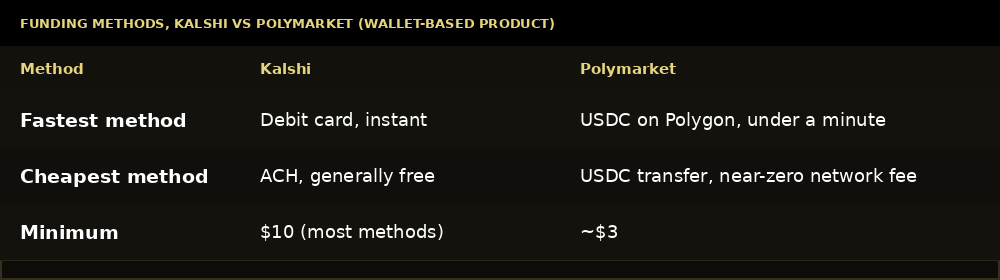
Kalshi funding methods: ACH bank transfer is free and the standard method, with a $10 minimum. Debit card deposits are typically instant but carry a processing fee around 2 percent. Wire transfer works for larger amounts, generally same-day, with a higher minimum around $1,000. Crypto deposits are also supported. Every method requires identity verification to complete first; Kalshi doesn’t let you fund an unverified account by any route.
Polymarket funding methods (wallet-based, international product): Direct USDC deposit on the Polygon network is the cheapest and fastest route, with a minimum around $3 and confirmation typically under a minute. A built-in card on-ramp lets you buy USDC without leaving the platform, usually completing in minutes, at a materially higher cost, commonly 3 to 5 percent, than moving USDC you already hold. Sending USDC on the wrong network, Ethereum mainnet is the classic mistake, doesn’t lose the funds but adds a bridging step and extra cost to recover them.
KYC: The Bigger Structural Difference
Kalshi: Full identity verification is mandatory before your first deposit. Expect to provide your legal name, date of birth, address, government-issued photo ID, and Social Security number. This is a function of Kalshi’s status as a CFTC-regulated exchange, not a platform choice it could opt out of.
Polymarket (international, wallet-based): No identity verification for the standard deposit-and-trade flow. You connect a wallet, fund it with USDC, and start trading. Verification can still be triggered afterward in specific cases, unusual deposit patterns or withdrawal activity flagged by chain analytics, but it isn’t a precondition for using the platform.
Polymarket (US-accessible product): A separate product built on a CFTC-registered exchange gives US residents a legal path to Polymarket-style markets, and its verification requirements resemble Kalshi’s more than the international product’s wallet-first flow. If you’re a US resident specifically weighing legal access, this distinction matters more than which product you happened to read about first, and it’s worth confirming current details directly rather than assuming the wallet-based product’s rules apply.
Withdrawal Timing: Where the Real Difference Shows Up
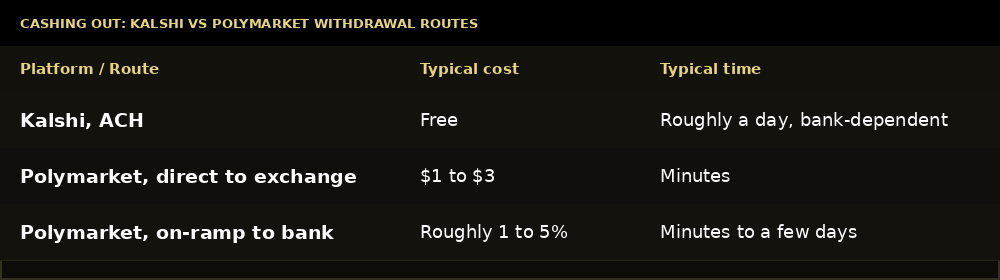
Kalshi withdrawals: Route back through the method you used to fund, generally. ACH withdrawals commonly take somewhere around a day to reach your bank, though your bank’s own processing adds variability outside Kalshi’s control. Large or unusual withdrawals can trigger an additional security review. Funds tied up in open positions aren’t available until the position closes.
Polymarket withdrawals (wallet-based product): There’s no platform-side withdrawal fee or holding period, because you’re not withdrawing from a Polymarket-controlled balance. You’re moving USDC that was already in your own wallet. What takes time and money is turning that USDC into spendable cash afterward: sending it directly to a centralized exchange is cheapest, an on-ramp service is most convenient but carries a real percentage fee, and bridging to a different network is the slowest and most expensive route.
Common Mistakes Running Both Accounts
Sending USDC on the wrong network. Polygon is the network Polymarket expects. Sending on Ethereum mainnet doesn’t lose the funds, but it means a bridging step, extra time, and extra cost to get them where they need to be.
Assuming Kalshi ACH is instant because the funds show as tradeable right away. Tradeable and withdrawable aren’t the same status. A deposit can be usable for trading within minutes while still being held from withdrawal for several days.
Expecting the same name-matching rules on every method. Some funding and withdrawal methods require the destination account to match your verified legal name exactly. A payment method under a spouse’s or family member’s name will get rejected even if the money is functionally yours.
Forgetting open positions lock the funds underneath them. Neither platform lets you withdraw money that’s actively sitting in an open position. It has to close or settle first, regardless of which platform or how urgently you want it out.
Treating tax reporting the same way on both platforms. Reporting practices differ by platform and can change; this isn’t the place to get specific tax guidance, and a tax professional familiar with both platforms is worth the conversation before assuming either one handles reporting for you.
Frequently Asked Questions
Q: Does Kalshi require KYC before you can deposit? A: Yes. Full identity verification, government ID, SSN, and address, is required before any deposit or trade, with no exceptions based on amount.
Q: Does Polymarket require KYC? A: The international, wallet-based product generally doesn’t for standard use, though specific deposit or withdrawal patterns can trigger verification afterward. A separate, CFTC-registered product for US residents has its own verification requirements, closer to a regulated exchange.
Q: How long does a Kalshi withdrawal take? A: ACH withdrawals commonly take roughly a day to reach your bank, though your bank’s own processing time adds variability Kalshi doesn’t control. Large or unusual withdrawals can trigger an additional review.
Q: How long does it take to withdraw from Polymarket? A: There’s no platform-side delay on the wallet-based product, since you already hold the USDC. How long it takes to convert to spendable cash depends entirely on the route: minutes for a direct exchange transfer, minutes to a few days for an on-ramp to your bank.
Q: Can you use the same bank account for both Kalshi and Polymarket? A: For Kalshi, yes, directly, since it’s a USD-funded account. For Polymarket’s wallet-based product, your bank connects indirectly, through a card on-ramp or an exchange you use to acquire USDC, rather than a direct bank link to Polymarket itself.
Q: Which platform is faster to fund? A: For someone who already holds USDC, Polymarket’s direct deposit is close to instant. For someone starting from a bank account with no crypto, Kalshi’s ACH or debit card path usually involves fewer total steps than acquiring USDC first.
Final Thoughts
None of this changes which platform makes sense for a given trade; that’s a fees, liquidity, and legality question this piece deliberately leaves to the fuller Kalshi vs Polymarket comparison. What changes here is how much friction sits between deciding to run both accounts and actually having usable balances on each.
Kalshi’s KYC-first model and Polymarket’s wallet-first model aren’t a ranking of which is better. They’re just different starting assumptions about who’s on the other end of the account, and knowing which mistake to avoid on which platform saves more time than picking the theoretically faster method and hoping it behaves the way the other platform’s version does.