A No Vig Calculator That Fixes the Margin for You
The line was -142 on the favorite and +122 on the dog. You did the quick math in your head and called it a 59 percent chance. Polymarket was asking 54 cents on the same outcome, so you booked it as a five cent edge and clicked confirm.
The real number was 2.6 cents.
Almost half of what you thought you had was never there. That number felt like information. It was the sportsbook’s margin, and nobody points that out until after you’ve already sized the trade.
Closing that gap, between what a line says and what it actually means, is the entire job of a no vig calculator.
Table of Contents
Quick Answer
A no vig calculator strips a sportsbook’s built-in margin out of a line and returns the fair probability of each outcome. Convert every price to implied probability, total them, then divide each one by that total. On Polymarket the output reads straight off as cents, so a fair probability of 56.6 percent is a fair price near 57 cents.
Key Takeaways
- Sportsbook odds never sum to 100 percent. A standard -110 on both sides sums to 104.76 percent, and that extra 4.76 percent is the vig you are paying for the privilege of a quote.
- A no vig calculator runs one operation on two-way and three-way markets alike. Total the implied probabilities. Divide each outcome by that total. That is how you remove the juice from odds and land on numbers that sum to 100 percent.
- Which book you devig matters more than which method you use. Pinnacle runs margins a fraction of what retail books charge. Devig FanDuel or DraftKings instead and your fair price carries whatever the public was doing that week.
- A fair probability of 56.57 percent is not the same as a tradeable price. That is your break-even probability. Pay above it and you are negative before a single fee lands.
- Proportional devigging quietly assumes the margin sits evenly across outcomes, which is false on lopsided markets. The multiplicative, power, additive and Shin methods exist because the favorite-longshot bias taxes the two sides differently.
- Compare your fair price to the ask you can actually hit, not the midpoint on screen. Polymarket displays the midpoint of the bid-ask spread. A 2.6 cent edge against the mid can be 0.6 cents against real liquidity.
- Devigging one book gives you a data point. Devigging two independent sharp sources and watching them agree gives you a price you can size against.
What a No Vig Calculator Actually Does
A no vig calculator takes the odds a book is showing you and converts each outcome into its implied probability. Then it rescales those probabilities to sum to exactly 100 percent instead of 104 or 107.
The bookmaker margin comes out. Nothing else moves.
What comes back is the fair price, sometimes called no vig fair odds. It’s the closest thing to a market consensus estimate you can reach without paying the margin baked into a line.
Here’s the part most people skip. A book that quotes both sides of a coin flip at -110 is telling you this:
Favorite: 52.38%
Underdog: 52.38%
Total: 104.76%
Two 52.38s cannot both be true. That extra 4.76 percent is the bookmaker’s cut, priced into the quote before you ever click. It is not a fee you pay at settlement. It’s a distortion sitting inside the number you’re reading.
When you compare a raw sportsbook line to a Polymarket price in cents, you compare two different prices. One includes a margin and the other does not. The comparison means nothing until you remove the margin from one of them. Run the line through a no vig calculator first and you are at least comparing like with like.
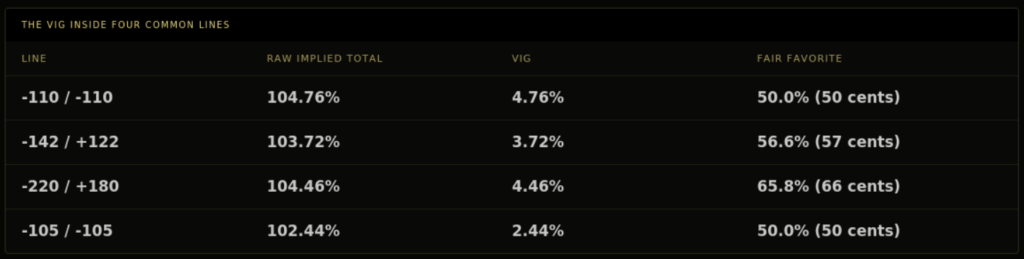
Look at the first and last rows. Same fair price, two different costs of asking. A trader moving 10,000 dollars a month treats the choice of reference book as a pricing decision, not a preference.
How to Calculate No Vig Odds on a Two Way Market
A no vig calculator does this in a keystroke. Doing it by hand a few times is how you learn to trust the output, and the arithmetic is three steps with no shortcuts.
- Calculate the implied probability for each side. To convert American odds, a negative price becomes its own value divided by itself plus 100. A positive price becomes 100 divided by itself plus 100. For decimal odds, it is 1 divided by the odds.
- Add the two implied probabilities together. Whatever you get above 100 percent is the vig. Write it down, because it tells you how much you can trust the line.
- Divide each side by that total. The two results now sum to 100 percent, and each one is the fair probability of that outcome. Those are your no vig odds.
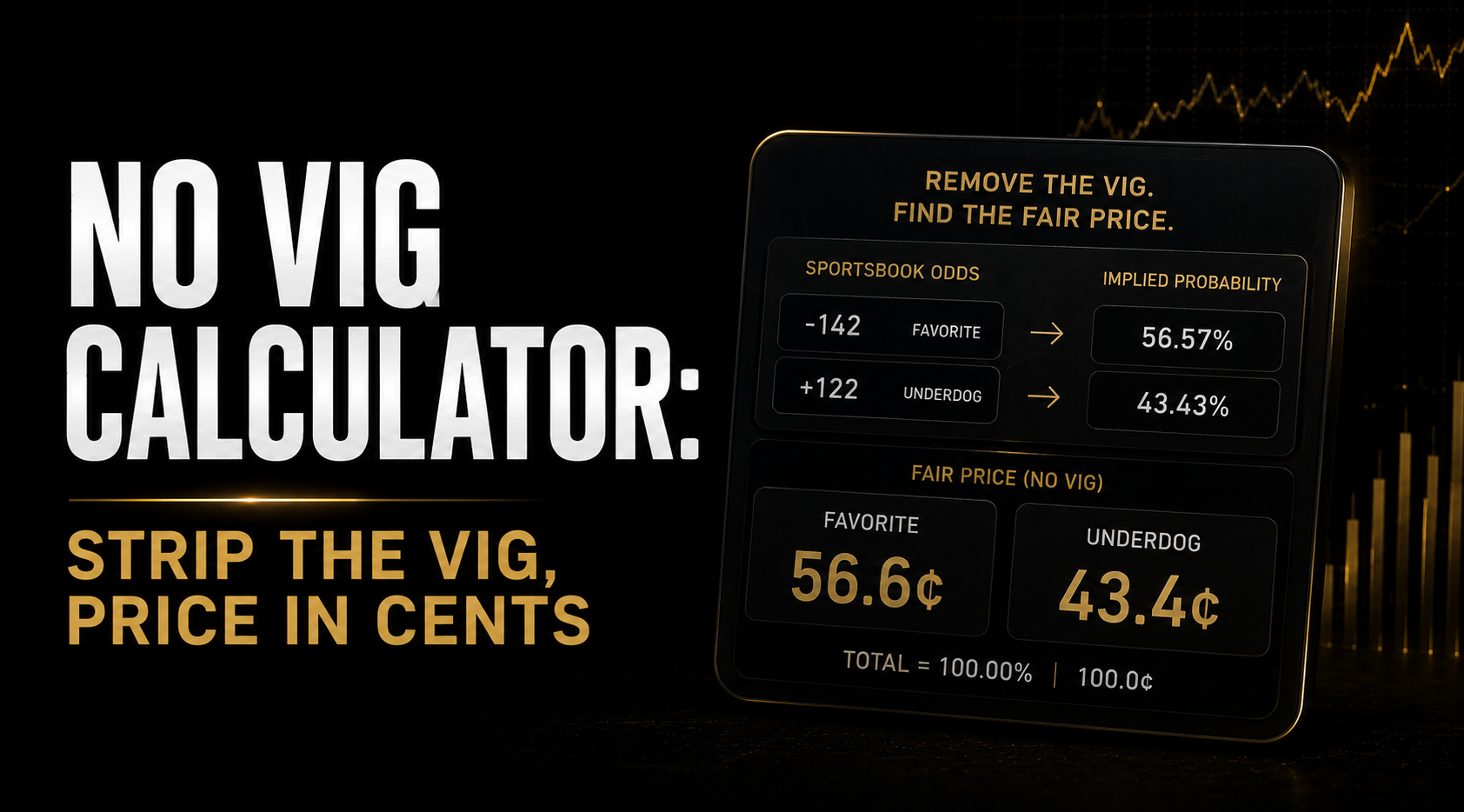
Run the line from the opening scene. The -142 favorite implies 142 divided by 242, or 58.68 percent. The +122 dog implies 100 divided by 222, or 45.05 percent. Together they sum to 103.72 percent.
Divide each by 103.72 and the fair probabilities land at 56.57 percent and 43.43 percent. Read that first number as a price and you get 57 cents.
The book was quoting you 58.7. The market’s real read was 56.6. Two full points of what looked like a signal was just the house charging rent.
That is the whole trick behind converting a line into a probability you can act on. A no vig calculator is the least glamorous tool in a serious workflow and one of the most used. Anyone still checking how their fill compares to the price they saw already knows the feeling of arithmetic that arrives 30 seconds too late.
Three Way Markets: Where the Draw Changes Everything
A three-way market has three outcomes and the same rule applies, with one condition that traders violate constantly. Every outcome belongs in the total. Miss one and the answer is not slightly off, it is wrong by a margin that will bankrupt a strategy.
Take a football 1X2 line of 1.72 on the home side, 4.00 on the draw and 4.80 away.
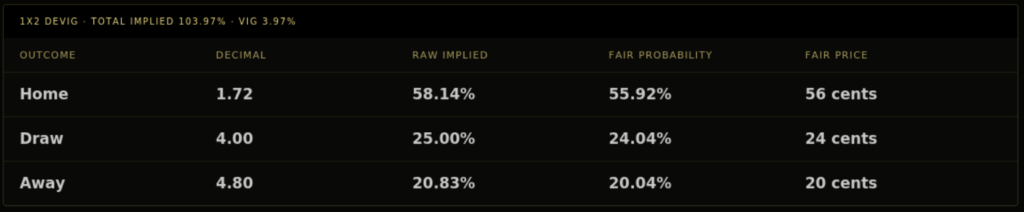
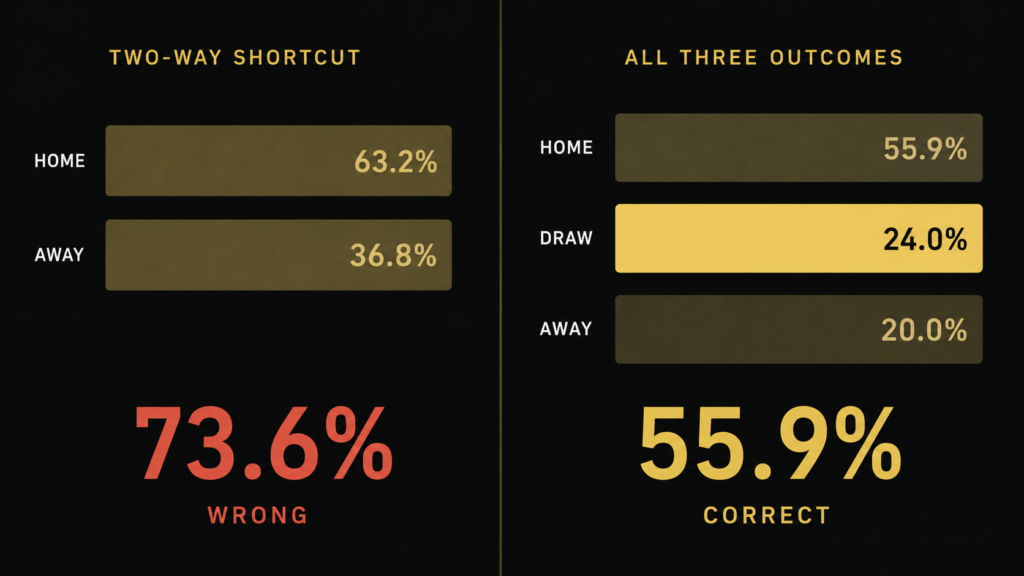
Now the failure mode. Drop the draw and devig home against away only, the way a two-way habit trains you to, and the home side comes back at 73.6 percent. The correct answer was 55.9 percent.
You would be sitting there thinking a 60 cent Polymarket price was a gift when it was already 4 cents rich. A no vig calculator built for three outcomes will not let you make that error. That is most of the argument for using one.
Fair odds in decimal, if that is the format you think in, is just 1 divided by the fair probability. Home at 55.92 percent becomes 1.79. A vig free odds calculator that only accepts two inputs cannot do this at all. Worth checking before you trust one on a Saturday morning slate.
No Vig Calculator: Run Your Line Through It
Do the arithmetic by hand twice so you understand it, then stop doing it by hand. The calculator takes your prices and returns the fair probability plus the fair price in cents. That leaves your attention for the part that pays, which is deciding whether the number in front of you is tradeable.
Two notes on using it well. Feed it the sharpest line you have access to rather than the most convenient one. Enter every outcome the market contains, including the draw, the tie and the push-adjacent option if one exists. A no-vig calculator is only as honest as the prices you hand it.
From Fair Odds to a Price in Cents
Prediction market pricing does something sportsbook pricing refuses to do, which is show you the probability directly. Every share on Polymarket carries a price between zero and one dollar, and that price is the market’s read on the probability of the outcome.
Shares settle at a dollar if the outcome happens and nothing if it does not. So 56 cents means 56 percent. Your devigged fair probability already sits in the same unit as the market you are trading.
This is the moment a no vig calculator stops being a betting curiosity and becomes an execution tool. You are no longer comparing a book price to a market price across two different scales. You are comparing 56.57 to 54, in cents, on the same line.
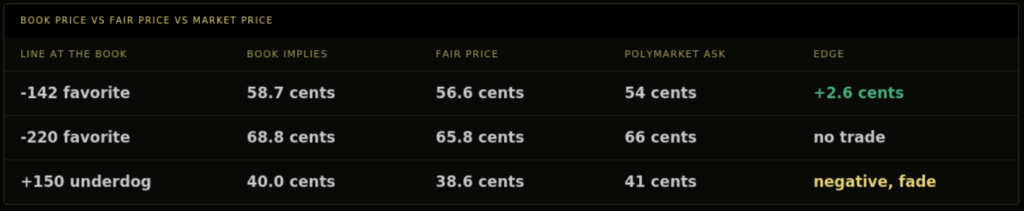
The middle row is the one worth sitting with. A three cent difference between what the book implies and what the market asks looked like a trade, and the fair price says there is nothing there. Most betting opportunities die at exactly this step. Learning to read rows two and three as wins is most of the discipline in this workflow.
Size it and the numbers get concrete. A 5,000 dollar entry at 54 cents buys 9,259 shares. At 2.57 cents of edge per share, that position carries roughly 238 dollars of expected value at entry. It either survives fees and slippage or it does not.
Fees and slippage are the last inputs before you know if that 238 dollars survives. Price them in before you confirm, not after.
Where the Simple Formula Breaks Down
Proportional devigging assumes the book spread its margin evenly across the outcomes. That assumption is convenient and often wrong. Real books tax favorites and longshots differently. The pattern has a name, the favorite-longshot bias, and on a lopsided market it pulls the proportional answer away from the truth.
Four methods exist because of it. Multiplicative spreads the vig in proportion to each outcome’s implied probability. Additive removes an equal share from each.
Power solves for an exponent that forces the probabilities to sum to one. It holds up better when the market prices one side at 90 cents. Shin runs an iterative model that treats part of the margin as protection against informed money. On three-way football that is usually the pick.
You do not need to hand-roll any of them mid-session. You do need three things. Know the simple method is an approximation, know which direction it errs, and stop treating one devigged number as fact.
Our longer piece on fair value in prediction markets works through the convergence test. That habit is what separates a fair odds calculator from an actual pricing process.
One more sharp edge, and it belongs to prediction markets alone. Polymarket shows the midpoint of the bid-ask spread. When that spread runs wider than 10 cents it shows the last traded price instead.
Buy and sell prices sit on either side of that midpoint, and only one of them is yours. Your 2.6 cent edge against a 54 cent midpoint might be 0.6 cents against a 56 cent ask. In a thin market it might be nothing at all. Devigging tells you what the price should be, and the order book tells you what you can get.
The Four Step Workflow to Run Before Every Entry
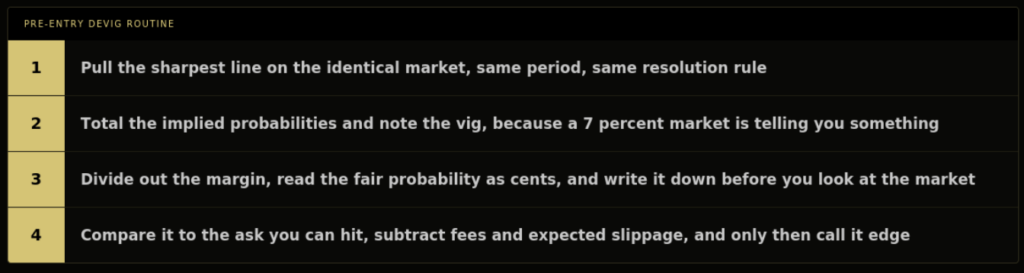
Step three has a hidden benefit. Write the fair price down before you look at the market. It stops you anchoring on the market price, then reverse-engineering a fair value that justifies the trade you already wanted.
Every trader does this. Almost nobody admits it.
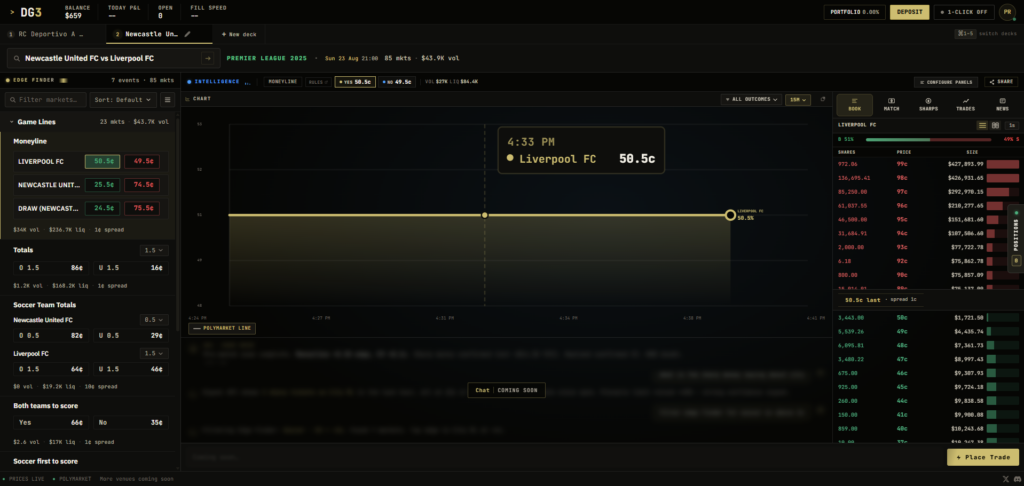
Step one is where most of the time goes, and it is the step a terminal removes. A no vig calculator answers one line at a time, on request.
A terminal that runs the same devig continuously turns this from a lookup you do one line at a time into a standing check across every market you’re watching.
Common Mistakes
You already know devigging removes the margin. What’s less obvious is how easy it is to devig correctly and still walk away with the wrong number. Here’s where that happens.
Devigging the wrong book. A no vig calculator cannot repair a bad input. Pull a retail price from FanDuel or DraftKings, devig it, and you get a fair price with public bias baked in.
Pinnacle publishes its own margins against the industry average because that gap is the product. Sharp lines are the reference point for a reason. Devig a soft book instead and you can lose money for months while believing you hold an edge.
Comparing the fair price to the midpoint. The mid is not a price you can transact at. Against a real ask, a 2.6 cent edge routinely shrinks to under a cent, and in thin markets the depth runs out before your size does.
Using the two-way formula on a three-way market. The draw is not a rounding error. Forget it and a 55.9 percent home side reads as 73.6 percent, as it did above. That kind of mistake feels like genius right up until settlement.
Treating one devigged number as truth. No vig odds are an estimate derived from one venue’s opinion. Two independent sharp sources landing within a cent of each other is a signal. One source is a starting point.
Ignoring the cost of getting in. Fees and slippage come out of the same 2.6 cents you are chasing, not out of some other budget. Every entry pays it. A trader running 10,000 dollars of monthly volume feels that compounding early.
Frequently Asked Questions
Q: What is a no vig calculator?
A: It is a tool that removes a bookmaker’s margin from a set of odds and returns the fair probability of each outcome. You enter the price for every outcome. The tool rescales those implied probabilities so they sum to 100 percent. The output is the fair price, which on a prediction market reads directly as cents.
Q: How do you calculate no vig odds?
A: Convert each outcome to implied probability, add them together, then divide each outcome by that total. A -110 pair gives 52.38 and 52.38 for a total of 104.76 percent. Divide each by 104.76 and you get 50 percent apiece. The same three steps hold whether you convert American odds, decimal or fractional, and whether the market has two outcomes or three.
Q: What does no vig mean in betting?
A: It means the price with the bookmaker’s cut taken out. A no vig price is what the market thinks the probability is. The quoted price is that number with the book’s margin added on top. Traders also call it fair odds, devigged odds, or the true price, though true price is a loose term.
Q: Why do sportsbook odds add up to more than 100 percent?
A: The surplus is how the book pays itself. Balanced action on a market priced at 104.76 percent leaves the book holding roughly 4.76 percent regardless of the result. Odds that add up to 100 percent would leave it nothing. That overround is why raw odds cannot stand in for probabilities until you devig them.
Q: Is a no-vig price the same as the true probability?
A: No, though it is the best available estimate of it. Nobody can observe true probability. A devigged price is one venue’s consensus with the margin removed, so it inherits whatever that venue got wrong. Sharp books produce estimates close enough to be useful, retail books frequently do not.
Q: Is there a free no vig calculator worth using?
A: Plenty of free ones handle the two-way case correctly. OddsJam, Unabated and BettorEdge sit in the paid tier with wider coverage, and those are the betting tools most serious sports bettors end up paying for. The question is not price, it is whether the tool accepts every outcome in the market and tells you which devig method it ran. A free no vig calculator that hides its method is guessing on your behalf.
Q: Does a no vig calculator work with decimal odds?
A: Yes, every method here works in decimal. Implied probability from decimal odds is 1 divided by the odds, so 1.72 becomes 58.14 percent. Everything after that is identical. For fair odds back in decimal, divide 1 by the fair probability, which turns 55.92 percent into 1.79.
Q: Which no vig sportsbook should I use as the reference?
A: The one with the lowest margin you can actually see, which for most markets means Pinnacle. Pinnacle does not take customers in the United States, though the prices remain visible and that is all a devig needs. Circa and a handful of Asian books serve the same purpose on specific sports. The point of a low-margin reference is that less of the number you are devigging is noise you have to model away.
Q: Do prediction markets have vig?
A: Not in the bookmaker sense, no. Polymarket and Kalshi run order books. Prices in these betting markets come from buyers and sellers meeting directly, with no book setting a line, so the two sides of a binary market sum to a dollar rather than 104 percent.
Your cost is the spread, the fees and the slippage. Different structure, usually a cheaper one. A no vig calculator belongs on the sportsbook side of that comparison, not the market side.
Q: Can I use a no vig calculator on three-way soccer markets?
A: Yes, and you have to include all three outcomes. Home, draw and away go in together, you divide out the total, and the results sum to 100 percent. Shin is usually the better method on three-way football. It handles the favorite-longshot skew that proportional devigging ignores.
Q: How much edge is worth trading after fees?
A: It depends on your size and the depth in front of you. Many active traders set a floor instead of trading everything positive, a minimum edge below which a signal is not worth acting on once fees and slippage are priced in.
Final Thoughts
Learning to devig changes what a line looks like. You stop seeing 58.7 percent and start seeing 56.6 with rent attached, and once that switch flips you cannot unsee it. It also makes you pass on more trades, which feels like doing less and is usually doing better.
One study covered 14 seasons and 31,247 positive expected value plays priced off devigged Pinnacle lines. It returned 3.6 percent against an expected 3.8 percent. That is the bottom line on a small, honest edge over the long term, run thousands of times without drama. That’s it. That’s the whole trick.
Thousands of times is the part worth sitting with. One line, checked once, is a nice piece of arithmetic. A trading career is that same check run on every market you look at, for years, without skipping the ones that feel obvious.
That is where the formula stops being enough on its own. Not because the math changes, it doesn’t, but because nobody hand-devigs forty lines before lunch and still has the attention left to decide which of them are actually worth trading.
DG3 is built for that gap. It is a prediction market intelligence terminal on Polymarket data, and it surfaces fair-price comparisons across markets continuously, so the checking happens before you ever have to ask for it.
Glossary
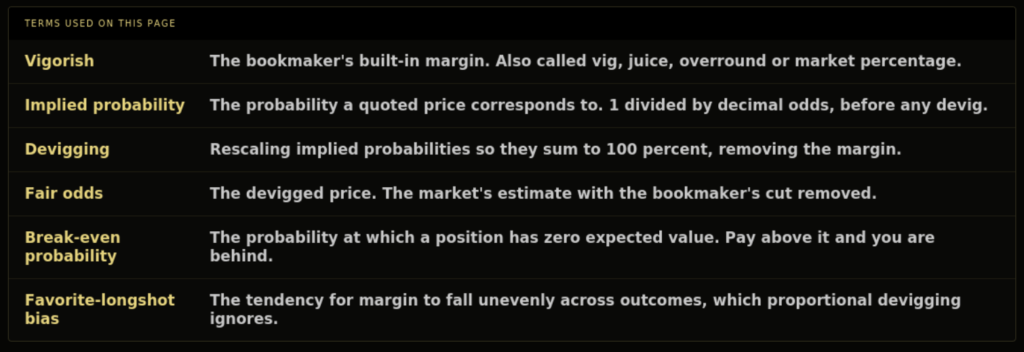
Further reading on the pricing side: how sharp money moves a market before the news lands and what a clean real-time feed costs.
On the margin formula itself, Pinnacle explains how it calculates its own margins and Polymarket documents prices and the order book.