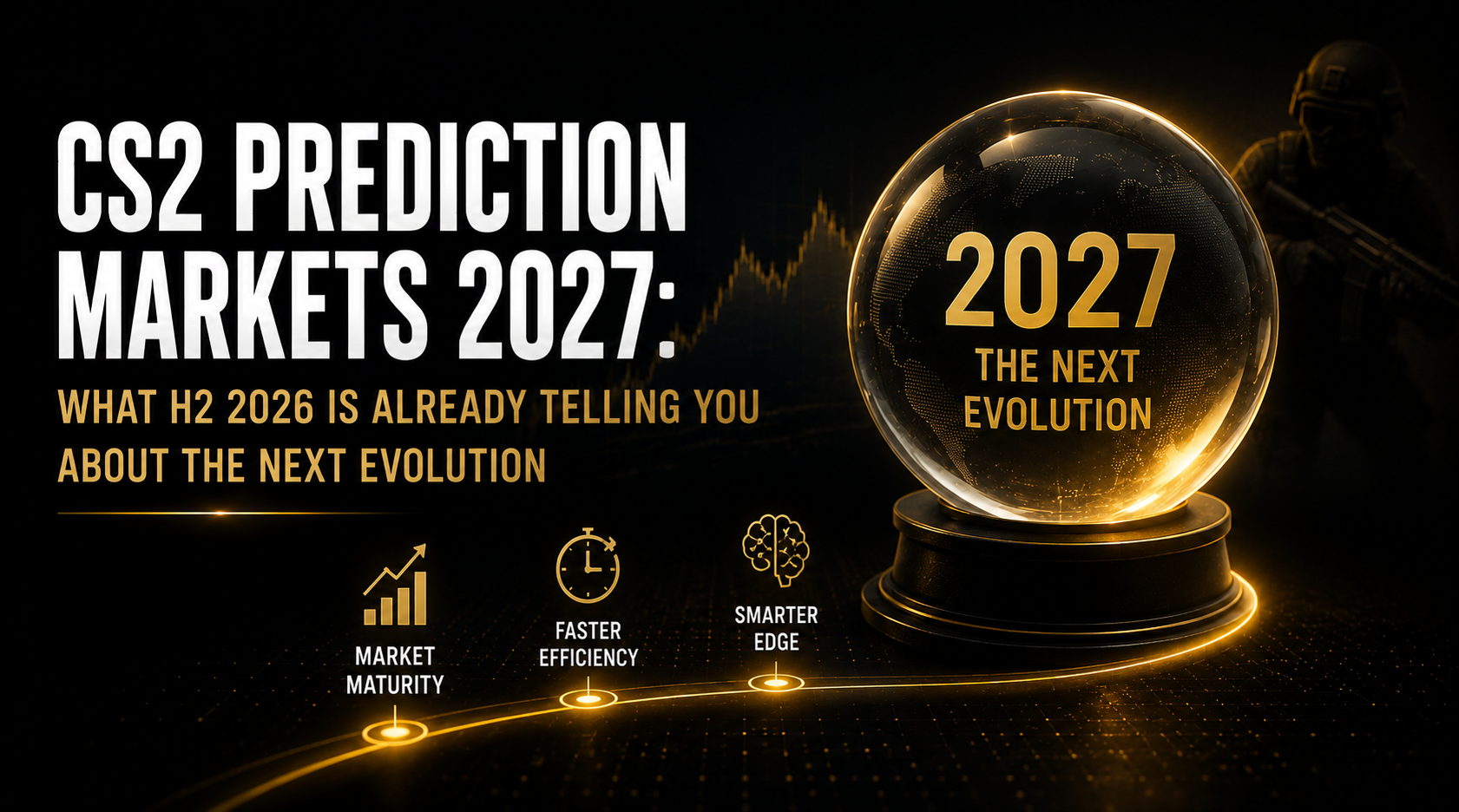
CS2 Prediction Markets 2027: What H2 2026 Is Already Telling You About the Next Evolution
H2 2026 is not the same market it was eighteen months ago.
The stand-in repricing window that averaged 19 minutes in 2024 is running at 12-14 minutes in H1 2026. The brand premium on historically dominant teams that averaged 4.2 cents in documented ESL Pro League S18 analysis has compressed to 2.8 cents across the same team set in H1 2026. T1 match winner market spreads have narrowed from 3.8-5.2 cents in 2023 to 2.2-3.1 cents in H1 2026.
The cs2 prediction markets 2027 evolution has already started. H2 2026 is where it becomes visible. Traders who are building their research infrastructure now, while the market is efficient enough to be worth trading seriously but inefficient enough to still reward genuine model depth, are entering the next phase with a structural advantage over those who wait.
Table of Contents
CS2 Prediction Markets 2027: What the Mid-2026 Data Already Shows
Before projecting forward, the current market state deserves precise characterisation.
Volume: CS2 Polymarket trading volume grew approximately 14x from 2022 to 2025. The H1 2026 run rate suggests full-year 2026 volume will exceed 2025 by 40-60%. The absolute numbers reflect a market that has matured from a niche category to one of Polymarket’s highest-volume esports verticals.
Field competitiveness: No team currently commands tournament outright probability above 0.22 on Polymarket upcoming major events on upcoming major events, compared to NaVi in 2021-2022 when s1mple-era tournament outrights regularly opened at 0.32-0.38. The compressed field means the systematic “fade the favourite” strategy that worked reliably in 2021-2023 now requires more precision, you’re not fading a dominant team, you’re identifying specific near-parity mismatches.
Spread compression at T1: Major match winner markets now run 2.2-3.1 cents spread during active events, down from 3.8-5.2 cents in 2023. Better for execution quality. Higher minimum viable edge threshold required for net-positive positions after fees.
Stand-in window compression: From 19 minutes average to 12-14 minutes average. Still a genuine edge window. Now requires a pre-built scenario library to act on reliably, the 10-minute research approach that worked in 2024 doesn’t fit inside the current window.
Brand premium compression: From 4.2 cents to 2.8 cents on historically dominant organisations at T1 fixtures. Still statistically present. Now requires tighter model precision to extract reliably, the rough “NaVi is probably overpriced” heuristic has been arbitraged away.
None of these trend lines are surprising. They’re what happens as a prediction market category matures and more sophisticated participants enter. The question is which edge sources are durable through this maturation and which are compressing to zero.
Which cs2 prediction markets 2027 Edge Sources Are Compressing Now
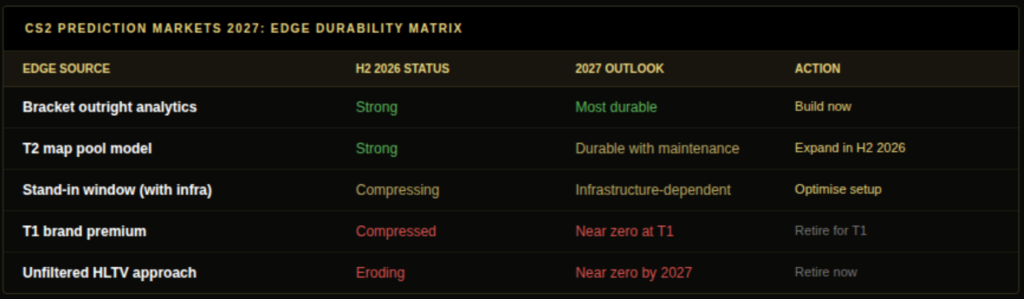
Simple brand premium exploitation at T1. The most casual version of this trade, entering YES on the underpriced opponent whenever a recognisable organisation is at 0.65+, has been the target of increasing systematic capital since 2025. The gap hasn’t disappeared, but it’s narrowed enough that undifferentiated execution of this thesis produces marginal returns at best. Precise model-driven identification of near-parity mismatches is now required.
Slow stand-in repricing without infrastructure. In 2024, a trader who saw a stand-in announcement 8 minutes after posting and entered within 18 minutes was still within a good portion of the edge window. In H2 2026, 8 minutes of detection delay plus 2-3 minutes of unstructured research leaves 1-4 minutes of remaining window. Without the X watchlist and scenario library, this edge is no longer accessible to most individual traders.
Unfiltered HLTV ratings as primary model inputs. As more CS2 prediction market participants apply basic HLTV filters, the price discovery function of that data improves. The three-filter approach (current roster, 90 days, T1 tier) is becoming more common. By 2027, the edge from applying these filters on T1 fixtures will likely be close to zero, though it may persist longer on T2 and regional fixtures.
Which cs2 prediction markets 2027 Edge Sources Have Staying Power
Tournament outright bracket analytics. Compound probability modelling across multi-match tournament sequences requires the most analytical infrastructure of any CS2 prediction market edge source. The participant pool capable of doing this accurately is small and grows slowly. The complexity barrier, correctly modelling six to eight sequential match probabilities with bracket path dependencies and Swiss seeding algorithms, keeps casual participants from doing it well. This edge source should remain durable through 2027.
The underlying research for this is Liquipedia format documentation, HLTV filtered stats per team, and probability-weighted bracket path modelling. Participants who build this infrastructure during H2 2026 are ahead of the eventual broader adoption curve.
Map pool model depth on T2 and regional fixtures. As T1 brand premiums compress and T1 stand-in windows shorten, the same inefficiency patterns that existed at T1 in 2022-2023 are present at T2 today. T2 CS2 prediction markets carry spreads of 8-15 cents and participant pools that skew even more heavily toward casual fans. A calibrated map pool model applied to T2 fixtures in H2 2026 likely produces similar edge to what the same model produced at T1 fixtures in 2022-2023.
The constraint: T2 markets typically carry $3,000-$15,000 in volume, limiting the position sizes that can be deployed without meaningful price impact. For traders operating at modest capital levels, this is actually fine, the edge is more accessible at smaller scale. For traders requiring large position sizes, T2 liquidity remains a genuine ceiling.
Execution speed advantage. As more systematic traders enter CS2 prediction markets in H2 2026 and 2027, the speed of post-announcement repricing will continue compressing. The stand-in window that’s currently 12-14 minutes may be 8-10 minutes by 2027. Traders who have the infrastructure to act in the first 2-3 minutes of any window maintain a structural advantage regardless of how fast the overall repricing becomes. This advantage is about infrastructure, not insight.
What H2 2026 Infrastructure Investment Looks Like
For traders building research and execution infrastructure during H2 2026, the investment priorities are clear from the durability analysis above.
Priority 1: Outright market bracket modelling. The most analytically demanding and most durable edge source. Building the compound probability infrastructure for CS2 outright markets, Swiss seeding simulation, bracket path probability, tournament format documentation, before the participant pool catches up to it is the highest-value investment for H2 2026. By 2027, the advantage from having built and calibrated this over a full major cycle is substantial.
Priority 2: Calibration record building. Every CS2 position you enter with a documented model estimate and entry price is adding to a calibration record. Traders preparing for cs2 prediction markets 2027 who start building this record now will have 100+ positions by mid-2027, the sample size needed to make meaningful model adjustments and demonstrate genuine edge to themselves and anyone they trade alongside. The calibration record is the research equivalent of compound interest: starting earlier produces a meaningfully larger dataset by any future benchmark date.
Priority 3: T2 fixture research expansion. If T1 efficiencies continue compressing, the highest-marginal-value research expansion in H2 2026 is building map pool models and scenario libraries for T2 events and teams. The research infrastructure is identical to T1, just applied to a different participant pool that’s currently less saturated with systematic traders.
Priority 4: Execution infrastructure optimisation. Ensure the three-layer monitoring system (X watchlist, API velocity polling, DG3 Edge Finder) is running reliably before every match window. As the stand-in window shortens, the cost of monitoring gaps increases. A missed notification that would have been recoverable in an 18-minute window may not be recoverable in a 10-minute window.
The Regulatory Landscape in H2 2026
Any cs2 prediction markets 2027 projection requires acknowledging the regulatory variable.
Kalshi’s CFTC-regulated framework for US traders has been the template for how prediction markets access the US retail market. Expansion of this framework, whether through the CLARITY Act, additional CFTC designations, or new entrants following Kalshi’s model, could rapidly increase the number of venues carrying CS2 prediction markets and the depth of liquidity at each.
More regulated venues means more competition for liquidity, faster price discovery, and potentially tighter spreads, all of which benefit execution quality while compressing specific edge sources further. The traders who build model depth now benefit from scale: deeper markets allow larger positions on the same edge, which improves absolute returns even as percentage returns on each trade compress.
A US regulatory expansion event in H2 2026 or H1 2027 would be the single largest structural change to the CS2 prediction market landscape since Polymarket established meaningful CS2 volume in 2022. It’s worth monitoring the CFTC docket and legislative calendar alongside your CS2 research.
Also read: CS2 Prediction Markets: The Complete Guide for Traders in 2026
The Honest Assessment of CS2 Prediction Markets Into 2027
This analysis isn’t optimistic or pessimistic about the category. It’s calibrated. The cs2 prediction markets 2027 picture is one where volume grows, efficiency improves at T1, and the distribution of who earns returns shifts toward participants with more complete research frameworks.
The cs2 prediction markets 2027 landscape will be harder for the median participant and more rewarding for the well-prepared one.
Harder for the median participant: the casual approaches that produced returns in 2022-2024, unfiltered HLTV checks, rough brand fade trades, slow stand-in entries, will produce smaller and smaller margins as more participants do the same things and the market prices them in faster.
More rewarding for the well-prepared: the absolute volume available in CS2 prediction markets in 2027 is substantially larger than 2024. The total expected value pool grows with the market even as each individual inefficiency compresses. Traders with bracket analytics, calibrated models, fast monitoring infrastructure, and genuine CLV track records are deploying the same edge across a deeper market with more opportunities.
H2 2026 is the preparation window. The traders doing the work now, building the calibration record, developing the bracket model, expanding into T2 research, running the monitoring system reliably, will be the best-positioned participants when the 2027 major cycle begins.
The market rewards preparation. Always has.
What H2 2026 Through 2027 Looks Like for Different Trader Types
The cs2 prediction markets 2027 landscape doesn’t affect all trader types equally. Understanding which segment you’re in determines where to focus.
Casual participants (under 20 positions per major): The efficiency improvements at T1 will most acutely affect casual traders who rely on intuition and unfiltered HLTV checks. The brand premium plays that worked reliably in 2022-2024 will produce inconsistent returns in 2027. The honest advice: invest more time in research before each position, or redirect toward less-efficiently-priced market categories.
Systematic traders with validated models (50+ calibrated positions): The improving market is actually positive for this segment. Deeper liquidity allows larger positions on the same edge. Better price discovery means the gaps that do appear are more reliable signals (less likely to be noise) than in a less efficient market. The challenge is maintaining edge as the methodology becomes more common. The response is going deeper into bracket analytics and T2 fixtures before the crowd follows.
Professional-scale participants (institutional capital, algorithmic execution): The infrastructure improvements in CS2 prediction markets in H2 2026, particularly the growing CLOB depth on T1 major fixtures, are enabling positions in the $5,000-$15,000 range with minimal market impact for the first time. This opens the category to a new set of professional participants who previously couldn’t trade at scale. Expect continued efficiency improvement at T1 as this capital enters, and continued relative inefficiency at T2 as it concentrates on higher-liquidity fixtures.
The cs2 prediction markets 2027 outlook is a stratifying market. The median participant experience gets harder. The well-prepared participant experience gets more scalable.
Building Calibration Records for the CS2 Prediction Markets 2027 Cycle
The specific habit that compounds most into cs2 prediction markets 2027 readiness is the calibration record, a log of every CS2 prediction market position taken, with model estimate, entry price, and closing price.
The calibration record reveals things about your trading that no other analysis produces. It shows which market types you consistently find genuine edge in versus which you think you do but don’t. It shows whether your model estimates are systematically overconfident or underconfident. It shows whether your stand-in signal trades produce the CLV your scenario library predicts, or whether the library needs recalibration.
Building it is simple. A spreadsheet with six columns: date, market, outcome traded, model estimate, entry price, closing price. After resolution, add the closing price and calculate CLV. Review the accumulated record once per major event cycle, not after every match.
A calibration record built across H2 2026 and reviewed entering 2027 will show you your actual edge distribution more honestly than any amount of theoretical model discussion. It will tell you which tournament formats your bracket model is best at, which teams you consistently overprice or underprice, and whether your stand-in scenario library is producing the performance impact estimates it predicts.
That information, accumulated over 40-80 positions across H2 2026, is worth more entering the cs2 prediction markets 2027 cycle than any individual trading idea. Start building it now.
Frequently Asked Questions
Q: What defines the cs2 prediction markets 2027 competitive landscape? A: The stand-in repricing window has compressed from 19 minutes (2024) to 12-14 minutes. T1 brand premiums have narrowed from 4.2 cents to 2.8 cents. Spreads on major match winner markets have tightened to 2.2-3.1 cents. Total volume is tracking 40-60% above 2025 levels on H1 2026 run rate. The market is more efficient at T1 than in 2022-2024 but still meaningfully less efficient than traditional financial markets.
Q: Which cs2 prediction markets 2027 edge sources are worth building for now? A: Tournament outright bracket analytics (most durable, requires compound probability modelling that most participants don’t do), map pool model depth on T2 fixtures (still underexploited by systematic traders), and execution speed advantage for stand-in windows (durable for traders with monitoring infrastructure). Brand premium exploitation at T1 and unfiltered HLTV approaches are compressing toward zero.
Q: How will CS2 esports prediction markets grow in 2027? A: Volume growth continues with the expanded CS2 tournament calendar. Any US regulatory expansion following the Kalshi CFTC model would notably increase both the number of venues and depth of available liquidity. Professional-scale position sizing ($2,000-$8,000 positions with minimal market impact) is increasingly viable on T1 major fixtures.
Q: What infrastructure should be built now for cs2 prediction markets 2027 readiness? A: Four priorities: outright bracket modelling infrastructure (compound probability across tournament formats), calibration record building (documenting every position for CLV tracking), T2 fixture research expansion (applying proven T1 research methods to less saturated markets), and execution infrastructure optimisation (monitoring system reliability before every match window).
Q: How is DG3 positioned for the cs2 prediction markets 2027 landscape? A: DG3’s Phase 2+ roadmap includes expansion beyond Polymarket to additional venues. For CS2, this would bring cross-platform EV comparison into the Edge Finder automatically, surfacing CS2 price discrepancies between Polymarket and other venues without manual Kalshi devig work. Phase 0’s Polymarket coverage handles the deepest current CS2 venue. Phase 2+ addresses the multi-venue landscape that H2 2026 through 2027 is building toward.
Also read: Best Prediction Market Tools in 2026 (Ranked by What They Actually Do)
CS2 Market Predictions 2026: What Skin Prices and Tournament Odds Are Telling You
Closing Line Value in Prediction Markets: The Only Honest Scoreboard