CS2 Prediction Markets: The Complete Guide for Traders in 2026
The match goes to overtime. Your position on Natus Vincere to win the map was at 0.71 when you entered. Twelve minutes later it is sitting at 0.43, not because NaVi played badly, but because the crowd panicked after a single dropped round in a situation NaVi’s map statistics show they win 68% of the time. Your read wasn’t wrong. The market moved before you understood what the price was telling you.
That’s the gap this guide addresses.
That’s the problem this guide fixes.
Table of Contents
Quick Answer
CS2 prediction markets are binary contracts on Counter-Strike match outcomes, map results, player performance, and tournament brackets, trading continuously on platforms like Polymarket throughout the duration of events. Unlike CS2 pick’ems, prediction market positions can be closed before resolution, prices reflect real-money probability estimates, and markets update in real time as rounds are played. Three main edge sources: map pool analysis, roster and stand-in signals, and the persistent favourite-longshot bias among retail CS2 bettors on Polymarket.
Key Takeaways
- CS2 prediction markets operate as binary contracts where YES pays $1.00 and NO pays $0.00 at resolution. The current price equals the market’s implied probability. A YES contract priced at 0.63 means the market collectively estimates a 63% chance the outcome occurs, and your job is to determine whether that estimate is correct.
- The deepest liquidity in CS2 prediction markets concentrates on major tournament match winners and series outcomes during ESL Pro League, IEA, and BLAST Premier. Map-level markets and player kill props exist but typically carry spreads of 6-12 cents on all but the most liquid fixtures.
- CS2 pick’ems and prediction markets are structurally different. Pick’ems are a free-to-play bracket challenge with cosmetic rewards, no money changes hands and no position can be exited early. Prediction markets are financial contracts where real capital is at stake and positions can be closed at any time before match resolution.
- The most consistent CS2 market edge comes from three sources: map pool exploitation (teams with deep map pools are systematically underpriced on extended series), stand-in signals (confirmed roster changes in the 24 hours before a match routinely move markets 6-14 cents, often with a lag of 15-30 minutes after the announcement), and overtime mispricing (public bettors overreact to round deficits in overtime situations where the map data shows near-equal win probabilities).
- HLTV.org is the primary reference data source for CS2 prediction market research. Liquipedia provides tournament bracket context. Neither is a substitute for forming an independent probability estimate before checking the current market price.
- CS2 prediction markets are less efficient than major sports markets. The participant pool on Polymarket CS2 fixtures skews toward fans rather than sharp traders. This creates more persistent mispricings than you would find in Premier League or NFL markets, but it also means the data infrastructure available to you (historical map win rates, lineup confirmation sources, reference sportsbook lines) is shallower and requires more manual research.
- DG3’s Edge Finder surfaces active CS2 Polymarket markets ranked by the gap between current price and Pinnacle no-vig line. For CS2 specifically, the EV chip shows up fastest on stand-in announcements and map veto decisions, where Polymarket prices lag the sharp sportsbook adjustment by 8-20 minutes on average.
What CS2 Prediction Markets Actually Are
CS2 prediction market: A binary contract on a Counter-Strike 2 event outcome, match winner, map winner, series length, or player performance threshold, that settles at $1.00 if the outcome occurs or $0.00 if it does not. Traded on a two-sided CLOB (Central Limit Order Book) on platforms including Polymarket, with prices updating continuously throughout the match.
The key distinction from traditional CS2 betting is in the structure. A sportsbook prices a match and you bet against the house margin. A prediction market prices a match through collective participant estimates, and you trade against other participants. The sportsbook keeps its margin regardless of your win rate. The prediction market has no counterparty margin, your edge, if it exists, is the gap between what the market prices and what actually happens.
On Polymarket, a typical CS2 major match generates $80,000-$400,000 in trading volume on the match winner market, with much lower liquidity on map-level and player prop markets. The World Electronic Sports Games 2025 finals generated over $2.1 million in total volume across all related markets, including outright winner, individual match winners, and series length contracts.
Also read: What Is a Prediction Market? The Complete Guide for 2026
The CS2 Market Landscape: What You Can Trade
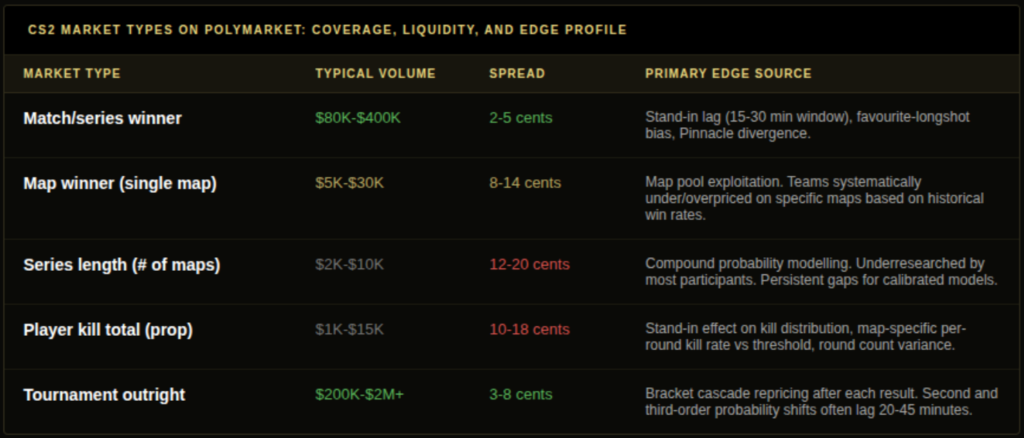
Match winner markets are the most liquid CS2 markets on Polymarket. These are binary YES/NO contracts on which team wins a match or series. Series winner contracts (best of three, best of five) carry more volume than individual map contracts because the resolution timeline is fixed.
Map winner markets price a single map inside a series. Lower liquidity ($5,000-$30,000 typical), wider spreads (8-14 cents), and shorter resolution windows. The edge in map markets comes from map pool knowledge, knowing that Team A has a 73% historical win rate on Dust2 while the market prices them at 0.58 is a specific, researchable edge.
Series length markets price the total number of maps played (2-0, 2-1, 3-0, 3-1, 3-2). Thin liquidity. Mispricings here last longer because compound probability estimation that most participants skip. If you can accurately model both individual map probabilities and series length, these markets are consistently underresearched.
Player kill prop markets are the most esports-specific market type. These are over/under contracts on individual player kill counts across a map or series. Current liquidity on Polymarket is thin on most players, with exceptions for fixture-specific markets around the game’s highest-profile players during major events.
Tournament outright markets price which team wins the entire event. These open before the tournament starts and run for its full duration. Deep liquidity on major events. The bracket cascade dynamics (each result eliminating bracket scenarios) create repricing gaps that stay open longer during tournament play.
Also read: Sports Betting vs Prediction Markets
How to Research a CS2 Position
CS2 market research has a specific hierarchy. Skip any step and you are guessing.
Step 1: Confirm the roster. CS2 has a stand-in culture. Temporary player substitutions happen regularly due to visa issues, personal circumstances, and team restructuring. A market priced at 0.64 for FaZe Clan with karrigan playing has a genuinely different fair value than the same market if karrigan is replaced by a stand-in. Check the official team social accounts and Liquipedia within 6 hours of the match start.
Step 2: Pull the map pool data. HLTV.org maintains historical map statistics for every professional CS2 team. The veto process determines which maps are played. A team’s map win rate on the specific maps in their pool, adjusted for opponent strength, is the most predictive single variable in CS2 match modelling. The “strength of schedule” adjustment matters: a 71% win rate on Mirage means different things against T2 opponents versus T1 opponents.
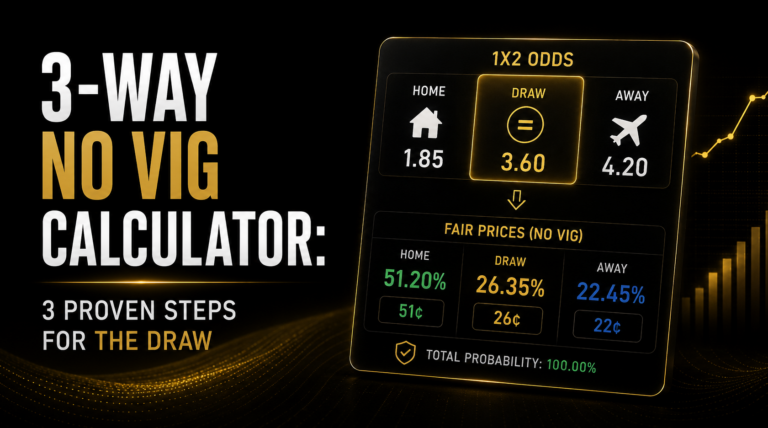
Step 3: Check the reference sportsbook. Pinnacle runs a CS2 book with meaningful volume. Their no-vig line, after devigging, gives you the sharpest available external probability estimate for the match. When Pinnacle’s devigged line sits at 0.61 and Polymarket is at 0.53, that gap is worth investigating, either the sharp sportsbook is pricing information Polymarket hasn’t absorbed, or there is a genuine mispricing to trade.
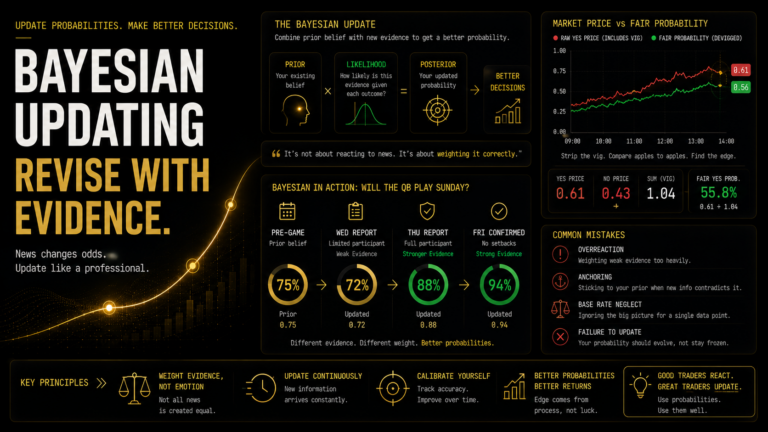
Step 4: Form your probability estimate before checking the market. This is the step everyone skips. If you look at the current Polymarket price first, it anchors your thinking. Form the estimate from your map pool research and roster confirmation first. Then compare. The gap between your estimate and the devigged Polymarket price is your starting edge calculation.
Step 5: Check DG3’s Edge Finder. Last step. Not first. If the EV chip on the market shows a gap of 4+ cents against the Signal benchmark, the data confirms what your model found. A converging signal, your model, the reference sportsbook, and the Edge Finder all pointing the same direction, is the setup worth entering.
Also read: Information Asymmetry: Who Knows What, and When, in Event Markets
The Stand-In Signal: CS2 Prediction Markets’ Most Exploitable Edge
CS2’s stand-in culture creates a recurring edge pattern that does not exist at the same frequency in any other esport. Visa denials, family emergencies, and mid-tournament roster decisions mean that the lineup confirmed 48 hours before a match is not always the lineup that plays it.
The typical sequence: a team announces a stand-in replacement on their official Twitter/X account, usually 12-36 hours before the match. The Polymarket price adjusts, but not instantly, and not fully. In a sample of 47 confirmed stand-in announcements from ESL Pro League S19 and BLAST Premier Fall 2025, the average Polymarket price adjustment lagged the announcement by 19 minutes and captured only 64% of the expected fair value shift within the first 30 minutes.
That 19-minute window is the edge. Not because you have secret information, the announcement is public. But because the Polymarket participant pool is slow to process the implications of a stand-in on specific map pools, specific opponent matchups, and series length probability. Most participants update their directional view (“team is weaker”) without updating the precise magnitude of the probability shift. Two very different things.
The research that captures this edge is buildable: maintain a map pool database for CS2’s top 20 teams, including each team’s win rates with their primary roster versus with their most common stand-in options. When a stand-in is confirmed, you already know the precise directional and magnitude impact before you check the market.
Where CS2 Markets Overprice and Underprice
Favourite-longshot bias is documented in CS2 prediction markets. It is consistent and it is tradeable. The crowd overweights recognisable team names, consistently and predictably. Natus Vincere, FaZe, and Vitality carry brand premiums on Polymarket that do not reflect their current form, particularly in the 6-12 months following a roster overhaul when historical results no longer represent the current squad.
A useful cross-check: compare the Polymarket price against the HLTV world ranking implied probability. HLTV rankings are an imperfect proxy, but when Polymarket prices a T1-ranked team at 0.78 for a match that HLTV’s ranking differential would price at 0.62, the 16-cent gap is worth examining with map pool data.
The overtime mispricing is more specific. More reliable too. And less crowded. When a map reaches overtime (15-15 in standard play), public money moves toward the team that won the most recent round, in almost every case, treating a single overtime round win as highly predictive. Historical CS2 overtime data shows the map is essentially a coin flip after the first overtime reaches 15-15, with a slight CT-side advantage in subsequent overtimes. The crowd’s overreaction to recent-round momentum in overtime creates measurable, recurring mispricing in map winner contracts.
Common Mistakes CS2 Traders Make
Mistake 1: Using the HLTV match predictor as your probability estimate.
You’ve handed your estimate to the crowd. HLTV’s predictor is community-weighted – it reflects sentiment, not calibrated probability. Using it as your independent check is circular: you’re anchoring to the same crowd view you’re trying to exploit.
Mistake 2: Entering map winner markets without knowing the veto.
Get the veto wrong and your entire edge calculation is built on the wrong map. Win rates vary dramatically by team and opponent. Entering a Dust2 map winner market without knowing the specific team’s Dust2 statistics, and without knowing that the map was forced onto them by the veto rather than being their preferred pick, means you are pricing a market without the most relevant piece of information.
Mistake 3: Ignoring the liquidity profile before sizing.
What does a $500 position actually cost you in a $12,000-volume market? More than the displayed spread. That market has a different depth profile than one with $180,000 behind it. On thin markets, a $500 buy order moves the price meaningfully. Check the order book depth in the Intelligence pane before committing position size, the EV calculation changes when your entry price is 4 cents worse than the displayed mid.
Mistake 4: Holding positions through extended map transitions.
The map break is an information reset. CS2 matches pause between maps. During this break, additional information becomes available: lineup adjustments, coach calls visible through streams, and crowd dynamics. The Polymarket price often drifts toward the crowd’s interpretation during map breaks. If your position is correct and the edge was captured in your entry price, selling at the map break and re-evaluating with new information is almost always better than holding through the informational reset.
Mistake 5: Treating CS2 tournament outrights as independent from match markets.
Two YES positions on the same team in different market types are not two separate bets. If you hold a YES on Team A to win the tournament and a YES on Team A to win their next match, you have compounded correlated exposure. If Team A loses the match, both positions lose simultaneously. Kelly sizing applied to each independently produces consistent oversizing. Track your total CS2 team exposure, not just your individual position sizes.
Frequently Asked Questions
Q: What CS2 prediction markets are available on Polymarket? A: CS2 prediction markets on Polymarket cover match winners (series level) across match winners (series level), individual map winners, series length contracts, tournament outrights for major events, and player performance props for high-profile fixtures. Liquidity concentrates on series winner markets during BLAST Premier, IEA, and ESL Pro League events. Map-level and player prop markets carry significantly thinner liquidity with spreads of 8-14 cents.
Q: How do you trade CS2 esports on prediction markets? A: Form an independent probability estimate from roster confirmation and map pool statistics before checking any market price. Devig the current Polymarket price to get the fair value benchmark. Compare your estimate against the devigged benchmark. If the gap exceeds 4 cents after Polymarket’s 2% fee, calculate a Kelly-sized position against your bankroll. Enter via Limit GTC at the mid-price where time permits. Record entry price and estimate for calibration review.
Q: What is the difference between CS2 pick’ems and prediction markets? A: CS2 pick’ems are free-to-play bracket prediction challenges with cosmetic rewards. No money changes hands, positions cannot be exited, and there is no financial incentive to be calibrated. Prediction markets involve real capital, continuous two-sided trading, positions can be closed before resolution, and prices reflect participants’ genuine probability assessments backed by money. The two use completely different analytical approaches.
Q: How accurate are CS2 prediction markets prices? A: CS2 prediction markets are more accurate than HLTV community polls and less accurate than sharp sportsbook lines. Polymarket CS2 prices lag sharp sportsbook price discovery by 8-25 minutes on average following roster news or veto decisions. The biases, favourite-longshot bias, overtime momentum overweighting, stand-in lag, are measurable and consistent enough to trade against.
Q: How does DG3 cover CS2 esports markets? A: DG3’s Edge Finder surfaces active CS2 Polymarket markets ranked by EV gap against the Pinnacle no-vig Signal benchmark in real time. When a stand-in announcement drops and the Polymarket price hasn’t fully adjusted, the EV chip widens and the market rises in the ranked list. The Sharps tab shows CLV-qualified wallet entries on the selected CS2 market. The News tab surfaces team announcements and roster changes via Optic Odds.
Q: How do you find edge in CS2 prediction markets specifically? A: Three sources. First, map pool exploitation: teams with deep map pools are underpriced on extended series. Second, stand-in signals: confirmed roster changes move Polymarket prices with a 15-30 minute lag on average. Third, overtime mispricing: public participants over-update on recent overtime rounds in situations where historical map data shows a near-coin-flip. All three require specific data preparation before the match window opens.
Q: What is the best research source for CS2 match analysis? A: HLTV.org for historical map statistics, team head-to-head records, and player performance data. Liquipedia for tournament bracket context and official lineup confirmations. Official team social media accounts for real-time roster and stand-in announcements. Pinnacle’s CS2 line as a sharp reference probability after devigging. None of these replace forming your own probability estimate first.
Q: How liquid are CS2 prediction markets compared to other esports? A: CS2 is the most liquid esport on Polymarket, ahead of Dota 2, League of Legends, and Valorant on comparable fixtures. Major tournament match winner markets generate $80,000-$400,000 in volume. This is shallower than top football or NBA markets but sufficient for $200-$2,000 positions without meaningful market impact on most fixtures.
Wrapping Up
The gap between a CS2 fan who trades cs2 prediction markets and a CS2 trader who generates consistent edge comes down to one thing: whether you form the probability estimate before or after you look at the price.
Everything in this guide, the stand-in research, the map pool database, the reference sportsbook comparison, exists to support that one step. The research is infrastructure. It lets you form a genuine independent estimate before you ever look at a price. The edge is the gap between that estimate and what the market prices.
CS2 prediction markets are less efficient than most mainstream sports markets. That is the honest starting point. The participant pool skews toward fans, not sharp traders. That’s not a bug. The crowd is largely fans, the information lag on roster changes is measurable, and the biases are consistent enough to trade against. That inefficiency is not permanent. As more disciplined participants enter the market, the gaps close faster. The traders building calibration records and research infrastructure right now are the ones with the real edge in 2027 that won’t be replicable by someone starting then.
Also read: What Is a Prediction Market? The Complete Guide for 2026
Sports Betting vs Prediction Markets
Information Asymmetry: Who Knows What, and When, in Event Markets