CS2 Skin Market vs Prediction Markets: Two Ways to Trade Counter-Strike
The AWP Dragon Lore peaked at $8,000 in 2021. By mid-2023 it was at $3,200. In the same window, a trader who correctly positioned on CS2 match winners during three ESL Pro League seasons compounded their bankroll at a rate that had nothing to do with skin prices. Two markets. Same underlying game. Completely different risk structures, time horizons, and research requirements.
If you’re in both, or deciding which deserves your attention, the comparison matters.
Table of Contents
Quick Answer
CS2 skin market and prediction markets are two structurally distinct ways to trade Counter-Strike. Skin markets involve buying and selling cosmetic item NFTs on Steam or third-party platforms, with returns driven by supply scarcity, case opening economics, and tournament correlation. CS2 prediction markets are binary event contracts on match and tournament outcomes. Skin markets are medium-to-long term with high item-specific variance. Prediction markets are event-duration with returns driven entirely by probability accuracy and edge against the market price.
Key Takeaways
- CS2 skin prices are driven by four independent variables: Valve’s case release and operation schedule, tournament correlation (major viewership drives case opening demand), float value scarcity within specific item tiers, and broader Steam marketplace liquidity. None of these variables appear in prediction market pricing.
- CS2 prediction markets are closed in a way skin markets aren’t. A prediction market position resolves within the duration of a match or tournament. A skin investment might take 6-18 months to return a meaningful gain. Capital deployment timelines are completely different.
- CS2 market cap data from 2022-2026 shows the skin market peaked during the CSGO-to-CS2 transition period (late 2023) and declined approximately 35-40% through mid-2025 as case opening rates normalised and CS2’s player base growth plateaued. Prediction market volume on the same CS2 events grew throughout this period, total Polymarket CS2 volume in 2025 was approximately 14x the 2022 figure.
- Skin markets have a liquidity ceiling based on item tier. A StatTrak AK-47 Factory New Redline might have $40,000-$80,000 in daily Steam marketplace liquidity during active periods. That’s insufficient for institutional-scale trading but adequate for most individual participants. Prediction markets on major CS2 matches run $80,000-$400,000 per match winner market.
- The correlation between CS2 tournament outcomes and skin prices is real but not tradeable as an arbitrage. Major tournament results affect case opening demand and, indirectly, skin prices over days to weeks, not in the minutes that a prediction market reprices. By the time the skin price moves, the prediction market edge is long gone.
- Skin trading has a structural tax that prediction markets don’t: Steam’s 15% marketplace fee (5% Steam cut + 10% game developer cut) on every transaction. On a skin purchased at $100 and sold at $120, your $20 gross gain becomes $3 after fees. The minimum viable return threshold for skin trading is much higher than the 2% Polymarket market order fee.
- Neither market is universally better. Skin markets suit participants with long time horizons, specific item knowledge, and tolerance for Steam fee structures. Prediction markets suit participants with short event-duration time horizons, probability research skills, and preference for position liquidity.
How the CS2 Skin Market Works
CS2 skin market: The secondary marketplace for Counter-Strike 2 cosmetic items (weapon finishes, knife skins, stickers, cases) traded on the Steam Community Market and third-party platforms including Skinport, CS.Money, and BitSkins. Item prices are denominated in Steam Wallet funds on the official marketplace or USD equivalents on third-party sites.
CS2 skins are cosmetic items with no impact on gameplay. Their value derives from scarcity (determined by float value and case drop rates), visual desirability, and demand cycles tied to tournament viewership and case opening activity.
The skin market’s price driver hierarchy, from most to least predictable: Valve operations and case releases, which create direct supply-side events. major tournament viewership peaks, which correlate with case opening volume. float value and exterior tier scarcity, which determines within-item price distribution. and broader Counter-Strike player count trends, which set the baseline demand floor.
The Dragon Lore example from the opening is representative of the 2021-2025 cycle. The peak coincided with peak global CS:GO/CS2 player counts and peak case opening rates. The decline tracked the normalisation of player growth after the initial CS2 launch surge. Neither move was tied to match results.
Third-party CS2 skin market tracking sites including PriceEmpire and CSGOStash maintain historical price data for most items. For pattern analysis on skin cycles around majors, these are the primary research tools.
Also read: CS2 Prediction Markets: The Complete Guide for Traders in 2026
How CS2 Prediction Markets Work
Unlike skin markets, which are asset markets, CS2 prediction markets are event markets. The mechanics are covered in depth in the CS2 prediction markets guide, for comparison purposes, the key structural points:
A prediction market contract pays $1.00 if the outcome occurs and $0.00 if it doesn’t. You buy the YES contract at the current price, which represents the market’s implied probability. Your profit is the difference between your entry price and the resolution price. You can exit before resolution by selling at the current market price.
The relevant comparison: in skin markets, you hold an asset whose price changes based on macroeconomic and supply factors largely outside your control. In prediction markets, you hold a contract whose resolution is determined by a single discrete event that occurs within a defined timeframe. The risk structure is fundamentally different.
Also read: What Is a Prediction Market? The Complete Guide for 2026
The Risk and Return Comparison
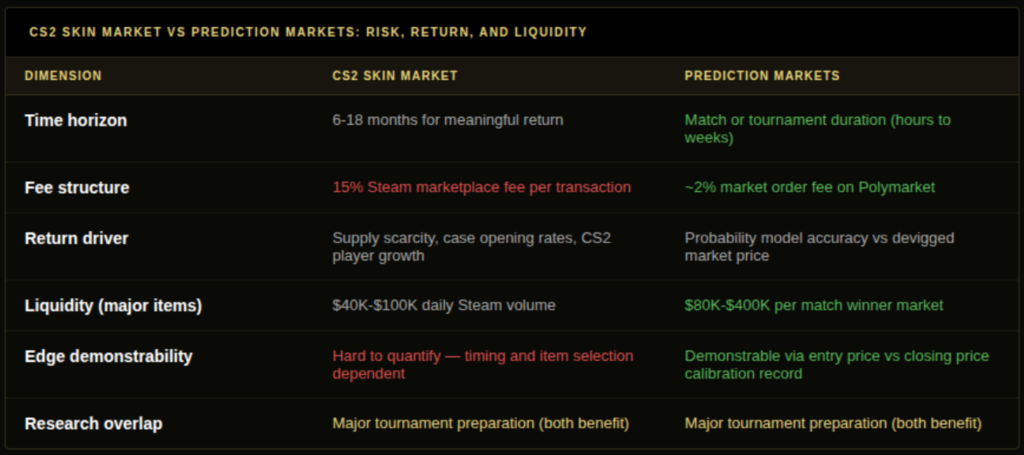
The comparison table tells part of the story. The rest is in the structure of returns.
Skin market returns are path-dependent. Whether you bought the Karambit Fade in January 2023 or September 2023 mattered enormously, the same item had a 40% price gap between those two points. Timing and item selection are the primary alpha sources. Neither is systematically predictable from public information.
Prediction market returns are accuracy-dependent. Whether your CS2 match probability model is better calibrated than the market’s is the only variable that matters across a large sample. Timing matters in a different sense, entry price quality determines edge per position, but the underlying return driver is the quality of your probability estimate relative to the devigged market price.
The practical implication: skin market edge is hard to define and harder to demonstrate. Prediction market edge is demonstrable through calibration records. A trader can prove their CS2 prediction market edge by showing that their entry prices consistently beat the pre-resolution closing price across 100+ positions. No equivalent proof standard exists for skin market returns.
CS2 Skin Prices and Tournament Correlation
The correlation that gets discussed most in CS2 trading communities: does winning a major affect a team’s player signature sticker prices? Yes, substantially. A player who wins the major typically sees their sticker price increase 200-600% in the first 48 hours after the event, as collectors buy the winning team’s stickers and capsule demand spikes.
That correlation isn’t tradeable as an arbitrage. By the time the final is played and the winner is known, the prediction market for the grand final has already resolved. The sticker price move happens after prediction market resolution. You can’t hold a prediction market position and simultaneously hold a skin position that benefits from the same outcome in a way that would be more efficient than either separately.
What the tournament-skin correlation does affect: major announcement windows. In the 2-4 weeks before a CS2 major, skin prices in the relevant player signature capsule series often rise on speculative demand. Traders who correctly anticipate finalist-caliber team performance in advance of the major can position in skin markets with a longer horizon. This is a different skill set from prediction market trading and requires a different research approach.
Common Mistakes When Comparing the CS2 Skin Market to Prediction Markets
Mistake 1: Treating skin ROI and prediction market ROI as comparable without adjusting for Steam fees. Steam charges 15% on every marketplace transaction. A skin that goes from $100 to $120 returns $3 net after fees, not $20. A Polymarket position that generates $0.08 per share on a $0.60 entry costs approximately 2% in fees. The fee structures make headline return comparisons misleading.
Mistake 2: Assuming tournament outcomes directly move skin prices in tradeable timeframes.
The correlation between tournament outcomes and skin prices is documented but operates on a 48-hour to 2-week lag. Prediction markets resolve in real time. There is no position that captures both the prediction market payout and the subsequent skin price move simultaneously on the same event in a way that’s more efficient than taking each separately.
Mistake 3: Applying prediction market research frameworks to skin market decisions.
Probability modelling of match outcomes is not the right framework for skin valuation. Skin prices follow supply-side economics more than match result probabilities. Analysts who are good at prediction markets often underperform in skin markets because the research skill doesn’t transfer.
Mistake 4: Ignoring the CS2 market cap data as a trend signal.
The CS2 market cap decline from its 2023 peak wasn’t invisible. Case opening volume data (trackable via third-party tools), CS2 player count trends (available via Steam Charts), and Valve’s operation release cadence all gave leading indicators. Traders who ignored the macro trend and held high-value skins through the 2024 downturn paid the equivalent of a notable negative return.
Frequently Asked Questions
Q: Is CS2 skin trading or prediction market trading more profitable? A: Neither is universally more profitable. Skin market returns depend on item selection, timing, and tolerance for Steam’s 15% transaction fees. Prediction market returns depend on probability model quality and edge against devigged market prices. A skilled predictor with calibrated CS2 match models will consistently outperform skin speculation. A skilled skin trader with deep item knowledge may outperform CS2 prediction market participants who lack a structured model.
Q: How do skin markets and prediction markets compare in liquidity? A: For major items, skin market daily liquidity on Steam ($40,000-$100,000 for top-tier items) is comparable to mid-tier CS2 prediction market volumes. Major match winner markets on Polymarket exceed $80,000-$400,000 per match. Tournament outright markets on major events run meaningfully higher.
Q: What caused the CS2 skin market crash? A: The 2023-2024 decline in high-value skin prices followed a period of peak speculation during the CS:GO-to-CS2 transition. Contributing factors included normalisation of case opening rates, plateauing CS2 player count growth after the initial launch surge, and broader Steam marketplace volume softening. No single event caused the decline.
Q: How do CS2 skin prices correlate with tournament outcomes? A: Player signature sticker prices increase substantially (200-600%) in the 48 hours following a major win for that player’s team. Broader capsule prices for the winning team’s associated drops follow a similar pattern. Match results during a major also drive case opening demand generally, major viewership peaks correlate with case opening volume spikes within the same 48-hour window.
Q: Which is more liquid: CS2 skins or CS2 prediction markets? A: For major items during active tournament periods, they’re comparable in the $50,000-$150,000 daily volume range. For prediction market positions that need to be exited quickly, Polymarket match winner markets during live events offer more reliable exit liquidity than Steam marketplace listings, which can take hours to fill at target price.
Q: How does DG3 fit into CS2 trading? A: DG3 covers the prediction market side, not the skin market side. DG3’s Edge Finder surfaces CS2 Polymarket markets ranked by EV gap in real time. The Intelligence pane shows order book depth, CLV-qualified wallet entries, and match news for open CS2 markets. Skin market research requires separate tools (PriceEmpire, CSGOStash, Steam Charts).
Final Thoughts
The CS2 skin market and CS2 prediction markets aren’t competitors for the same trader’s attention. They serve different time horizons, require different research skills, and reward different analytical capabilities.
Skin trading at its best is supply-and-demand analysis applied to a closed digital item economy. Prediction market trading at its best is probability estimation applied to a transparent two-sided event market. The overlap between the two skill sets is smaller than the CS2 branding suggests.
Where they do intersect: tournament preparation. If you’re doing the full match probability model work to trade a CS2 major on Polymarket, you have the underlying analytical infrastructure to make informed skin positioning decisions around the same event. The research compounds. Most traders use it for one and ignore the other.
Also read: CS2 Prediction Markets: The Complete Guide for Traders in 2026
What Is a Prediction Market? The Complete Guide for 2026
Market Efficiency in Prediction Markets: Are They Really Smarter Than the Crowd?