Bloomberg, Nansen, DG3: The DG3 Bloomberg Alternative Explained
The DG3 Bloomberg alternative question is really about function, not scale. Here is what each terminal actually solved, and what prediction markets still need.
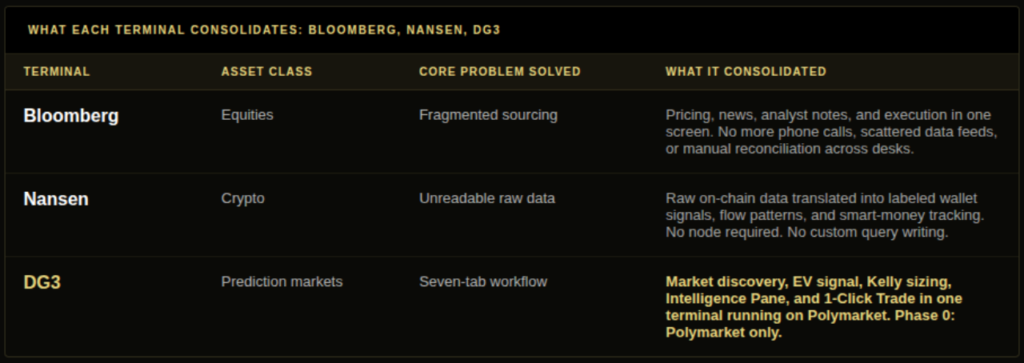
Bloomberg built a terminal because equities traders needed one screen instead of ten phone calls. Simple enough idea. Nansen built one because crypto traders needed on-chain flows translated into something readable in seconds. Prediction markets have spent years without an equivalent, forcing serious traders to rebuild the same seven-tab workaround for every single event. A DG3 Bloomberg alternative comparison is really a question about what a terminal has to do for any young asset class before it can call itself one. The answer tells you more about asset class maturity than about any specific product.
Table of Contents
Quick Answer
Bloomberg gives equities traders a unified terminal for pricing, news, and execution. Nansen does the same for on-chain crypto flows. Prediction markets have lacked a direct equivalent, leaving traders to manually calculate fair value, track multiple browser tabs per venue, and size positions by feel. DG3 is built to be that unified layer specifically for prediction markets, combining a search-driven market screen, live edge detection, and sub-100ms execution inside one terminal running on Polymarket.
Key Takeaways
- Bloomberg’s core value for equities traders is consolidation, pricing data, news, and execution in one screen instead of scattered sources, a model prediction markets have never had a direct equivalent of until recently.
- Nansen’s equivalent value for crypto is translation: turning raw on-chain data into readable flows and signals a trader can act on without running their own node or writing their own queries.
- A prediction market terminal needs five things a raw exchange interface does not provide: a way to find markets worth trading, a live edge signal, position sizing tied to that edge, fast execution, and a single place to track live exposure.
- DG3 organises those five needs into three pillars: Discover, through live stream cards on the Deck. Analyze, through Edge Finder and the Intelligence Pane. and Automate, through Kelly Sizing and 1-Click Trade.
- The seven-tab problem this comparison keeps returning to is a specific, nameable workflow failure: calculating fair value by hand, checking multiple venues separately, and sizing trades without a consistent method, all while a fast market moves on without you.
- DG3’s current phase runs on Polymarket only. That is an important scope difference from Bloomberg’s multi-exchange equities coverage or Nansen’s multi-chain crypto coverage, worth naming plainly rather than implying broader coverage than currently exists.
- The DG3 Bloomberg alternative comparison is not about claiming DG3 has Bloomberg’s decades of infrastructure. It is about naming the functional gap prediction markets have had, the same gap equities and crypto each eventually closed with a dedicated terminal, and describing what closing it actually requires.
What Bloomberg Actually Does For Equities Traders
To understand what a DG3 Bloomberg alternative means, you need to understand what Bloomberg actually does, stripped of the mythology.
Bloomberg’s terminal is not really a data feed. It is a workflow. A trader pulls up a ticker and gets pricing, historical charts, analyst notes, breaking news tagged to that specific company, and an execution path, all without leaving the terminal or reconciling numbers across separate sources. The data was never the hard part. plenty of it was already available elsewhere. What Bloomberg actually solved was cost: assembling that data from scattered sources, one desk at a time, every single day, was expensive in a way a single subscription fixed for good.
Prediction markets never had this. A trader interested in a specific event has historically needed to check Polymarket’s own interface, cross-reference Kalshi if the same event is listed there, calculate an implied probability by hand, adjust for the vig, and decide on a position size using nothing more rigorous than intuition. That is the same fragmented workflow equities traders lived with before Bloomberg, just applied to a newer asset class. The DG3 Bloomberg alternative idea starts here: the same structural problem, the same structural solution, different market.
What Nansen Actually Does For Crypto Traders
Nansen’s contribution to crypto trading was translation, not data generation. The blockchain itself is already a public ledger. Anyone can read raw transaction data directly. What most traders cannot do is turn millions of unlabeled wallet addresses and transactions into a readable signal: this wallet is a known smart trader, this flow pattern usually precedes a token unlock, this cluster of addresses moved together. Nansen’s entire value proposition is doing that labeling and pattern-matching so a trader gets a signal instead of a raw feed.
That same translation problem exists in prediction markets, just with a different raw input. A market’s price is public. What that price actually implies about fair value, adjusted for the platform’s fee structure and the vig baked into a multi-outcome market, is not obvious from the number alone. Turning a raw price into a usable signal is the same category of problem Nansen solved for on-chain data, applied instead to market pricing.
The Five Things A Prediction Market Terminal Actually Needs
Any terminal built for a fast-moving trading venue eventually needs to solve the same five problems, regardless of asset class. First, a way to discover what is worth looking at, since no trader can manually scan every listed market. Second, a signal that tells you whether something is mispriced, not just what it costs. Third, a consistent way to size a position against that signal, rather than guessing at a stake. Fourth, execution fast enough that the signal is still valid by the time your order lands. Fifth, a single place to track what you actually hold once the trade is made.
(For a deeper look at this exact gap, see What Is a Prediction Market Terminal?)
None of those five needs are unique to prediction markets. Any liquid, fast-moving market eventually forces a serious participant to solve them, one way or another. What differs by asset class is only the specific shape each need takes. Discovery in equities means scanning thousands of tickers across sectors. Discovery in prediction markets means scanning events and outcomes across sports, esports, and whatever other categories a platform lists. Signal in crypto means labeled wallet flows. Signal in prediction markets means the gap between a listed price and a calculated fair value. The underlying architecture a terminal needs to provide stays constant even as the specific data feeding it changes completely from one market to the next.
How DG3 Maps Onto Those Five Needs
This is where the DG3 Bloomberg alternative framing becomes concrete rather than conceptual.
DG3’s own documentation frames this as three pillars rather than five discrete steps, but the underlying needs map onto each other closely.
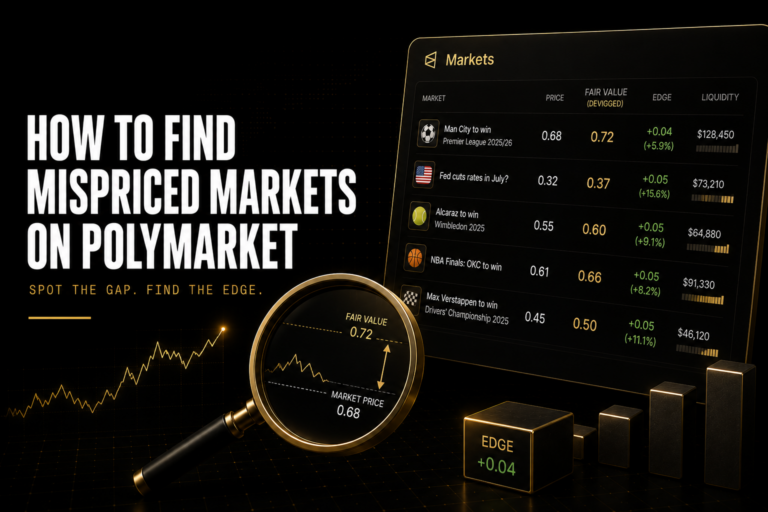
Discover corresponds to finding what is worth looking at, handled through live stream cards on the Deck and event or league search in Edge Finder. Type “rcb” or “arsenal scorer” and DG3 returns Polymarket markets ranked by EV gap, not by volume or recency. The EV chip on each result row shows the gap between current price and Pinnacle no-vig line before you click anything.
Analyze corresponds to the mispricing signal and the deeper read, handled through the EV figure attached to each market and the Intelligence Pane. The Book tab shows live Polymarket order book depth, spread, and mid-price before you size anything. The Sharps tab shows entries from wallets with a documented positive Closing Line Value track record: 50+ resolved trades, 90-day window, positive rolling CLV. The News tab surfaces injury updates and breaking developments via Optic Odds, scoped to the specific market you are looking at.
Automate corresponds to sizing and execution, handled through the Trade Desk’s Kelly-sized presets and 1-Click Trade. Clicking any outcome chip in Edge Finder pre-fills the Trade Desk with that outcome and the current Polymarket price, refreshed to under 10 seconds old at render time. In 1-Click mode, decision to submitted order takes under 2 seconds.
Where The Analogy Breaks Down, On Purpose
Not every part of this holds up, and it shouldn’t. Bloomberg covers equities across essentially every major global exchange, built over four decades of infrastructure. Nansen covers multiple blockchains with years of wallet-labeling data behind it. DG3’s current phase runs on Polymarket only, a single venue, in its first phase of build-out. That is a meaningfully smaller footprint than either reference point, and naming that plainly matters more than letting the comparison imply parity that does not exist yet.
What the DG3 Bloomberg alternative analogy is actually making a case for isn’t scale. It’s function. Discovery, signal, sizing, execution, tracking, a mature equities terminal and a mature crypto analytics platform both eventually had to solve those five, and a prediction market terminal has to solve them too, regardless of how many venues it currently covers. Getting the function right on one venue first is a normal, deliberate way to build toward covering more of them later.
The Seven-Tab Problem: The Real Case For A DG3 Bloomberg Alternative
The workaround this whole comparison is really about has a name inside DG3’s own content: the seven-tab problem. One tab for the market itself, opened at polymarket.com. Another for a competing venue carrying the same event. A spreadsheet for manually converting prices to implied probabilities. A notes app for tracking your own position sizing rules. A news tab to catch anything that might move the price before your order lands.
By the time all seven tabs are open, the market has moved.
Every time.
A terminal’s entire justification is collapsing that sprawl back into a single screen. Bloomberg did it for a trading desk drowning in phone calls and paper tickets. Nansen did it for a research process drowning in unlabeled blockchain data. Applied to prediction markets specifically, that same collapsing motion is the functional case for a dg3 bloomberg alternative, a dedicated terminal in this asset class rather than continuing to bolt together general-purpose tools that were never built with prediction markets in mind.
Before And After: What The Workflow Actually Looks Like
It helps to walk through one trader, one event, under both workflows side by side.
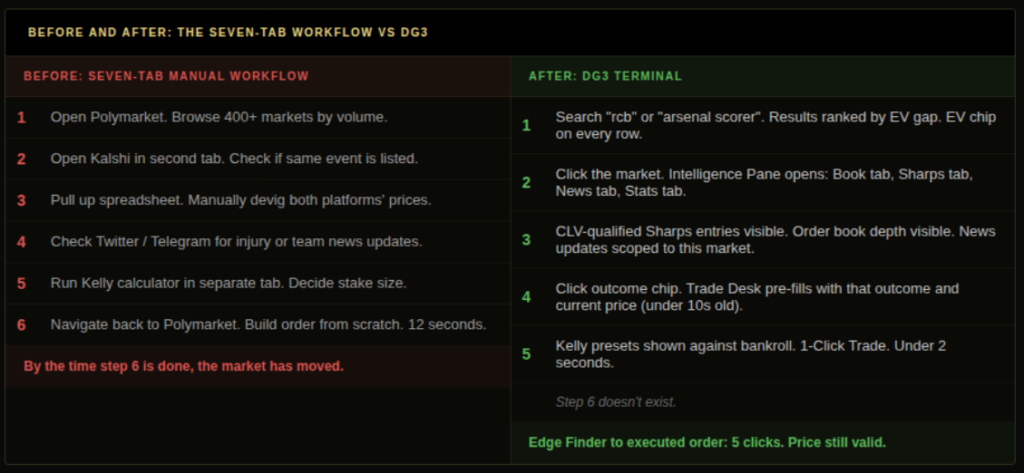
Before a consolidated terminal, finding a mispriced market on a Sunday afternoon means opening Polymarket directly, checking Kalshi in a second tab, pulling out a spreadsheet to convert prices into implied probabilities, stripping the vig by hand, and deciding a stake size based on gut feel.
Seven steps. None of them fast. By the time all of that is done, the market has often already moved past the price that made it worth checking in the first place.
After a consolidated terminal: type the event name. Edge Finder returns every market ranked by EV, fair-value already run.
A market with a meaningful gap carries a visible EV chip. Click it. Intelligence Pane opens with order book depth and Sharps tab entries. Click an outcome. Trade Desk pre-fills with sizing based on your Kelly fraction. The distance from noticing an opportunity to having a sized order ready shrinks from a multi-step manual process to a handful of clicks.
That is the same calculation Bloomberg and Nansen users don’t think twice about in their own asset classes. Applied here for the first time as a dedicated product instead of a personal spreadsheet.
Common Mistakes When Comparing Trading Terminals Across Asset Classes
Assuming coverage breadth and functional design are the same thing. Bloomberg’s decades of exchange coverage isn’t the same achievement as the underlying workflow design of consolidating pricing, news, and execution. A newer terminal in a newer asset class can nail the second without matching the first yet.
Treating a DG3 Bloomberg alternative comparison as a claim of scale. The useful part of this kind of comparison is the functional analogy, not an implied claim that a two-year-old product has forty years of infrastructure behind it.
Ignoring which specific problem a terminal solves. Bloomberg’s problem was fragmented sourcing. Nansen’s problem was unreadable raw data. Confusing the two misses what actually makes each one useful in its own domain.
Underrating translation as a form of value. Nansen didn’t invent blockchain data. It made existing data usable. A comparable distinction applies to a dg3 bloomberg alternative that doesn’t invent market prices, but does make the gap between price and fair value visible and usable before the edge closes.
Forgetting that single-venue coverage is a phase, not a ceiling. A terminal that starts on one exchange and expands later is following a similar build path to most infrastructure in adjacent markets. Judging a Phase 0 product as if it were a finished, fully scaled platform misreads where it sits in its own roadmap.
Frequently Asked Questions
Most questions about a dg3 bloomberg alternative come down to one thing: is the functional comparison valid, and where does it break down?
Q: What does Bloomberg actually provide that a raw stock exchange interface doesn’t? A: Consolidated pricing, news, and execution in a single workflow, removing the need to assemble that same information from scattered sources manually.
Q: What is Nansen’s core function for crypto traders? A: Translating raw, publicly available on-chain data into labeled, readable signals, such as identifying known smart-money wallets or recognisable flow patterns.
Q: What are the five things a prediction market terminal needs to provide? A: A way to discover worthwhile markets, a signal for mispricing, a consistent sizing method, fast execution, and a single place to track live exposure.
Q: Does DG3 cover the same range of venues as Bloomberg or Nansen? A: Not yet. DG3’s current phase runs on Polymarket only, a narrower scope than Bloomberg’s multi-exchange equities coverage or Nansen’s multi-chain crypto coverage.
Q: What is the seven-tab problem? A: A description of the fragmented manual workflow prediction market traders have historically used: multiple venue tabs, a manual fair-value spreadsheet, and separate tracking for news and position sizing.
Q: How does DG3 structure its approach to these problems? A: Around three pillars, Discover, Analyze, and Automate, corresponding to market discovery, edge signal plus deeper analysis, and sizing plus execution.
Q: Is comparing a newer product to Bloomberg or Nansen a claim of equivalent scale? A: No. The useful comparison is functional, what workflow problem each tool solves, not a claim of equivalent years of infrastructure or venue coverage.
Q: What is a DG3 Bloomberg alternative exactly? A: A prediction market terminal that consolidates the five core trading workflow needs, discovery, edge signal, sizing, execution, and position tracking, into one screen, the same function Bloomberg provides for equities and Nansen provides for crypto.
Final Thoughts
Every asset class eventually produces a tool that collapses its own version of the seven-tab problem into one screen. Equities got there with Bloomberg. Crypto got there with Nansen. Prediction markets are earlier in that arc.
Not at the finish line yet. But building.
The comparison only holds up if it’s read as a description of function rather than a claim of scale. What DG3 is actually doing, on the one venue it currently covers, is that same collapsing motion: discovery, signal, sizing, and execution, held in one place instead of scattered across ten tabs.
Prediction markets haven’t arrived at their Bloomberg moment in full. What’s true is narrower and more useful: the functional gap those two other asset classes eventually closed is visibly present here, and closing it doesn’t require inventing a new kind of tool. It requires building five capabilities, discovery, signal, sizing, execution, tracking, specifically for a market structure that hasn’t had them consolidated in one place before.
That is a narrower, more honest claim than “the Bloomberg of prediction markets” or any other DG3 Bloomberg alternative framing. It also happens to be the more useful one for a trader deciding whether a tool like this actually solves a problem they recognise from their own seven open tabs.
Also read:
Bloomberg for Equities. Nansen for Crypto. 7 tabs for Prediction Markets. Until Now.
The 5-Tab Problem
What Is a Prediction Market Terminal? (And Why Traders Outgrow Raw Polymarket)