CS2 Prediction Market Arbitrage: When the Math Actually Works and When It Doesn’t
Pure arbitrage in prediction markets is smaller, rarer, and more constrained than most tutorials describe.
When it exists in CS2 prediction markets, it typically lasts under 15 minutes. When it appears to exist but doesn’t, the most likely explanation is a fees miscalculation, a resolution criteria difference between platforms, or order book depth that can’t support the position size being considered.
This guide covers what genuine cs2 prediction market arbitrage looks like, how to verify it’s real before acting, the negative risk variation that appears more frequently, and where the line is between a clean arbitrage and a one-sided directional bet wearing arbitrage clothing.
Table of Contents
Cross-Platform CS2 Arbitrage: The Actual Structure
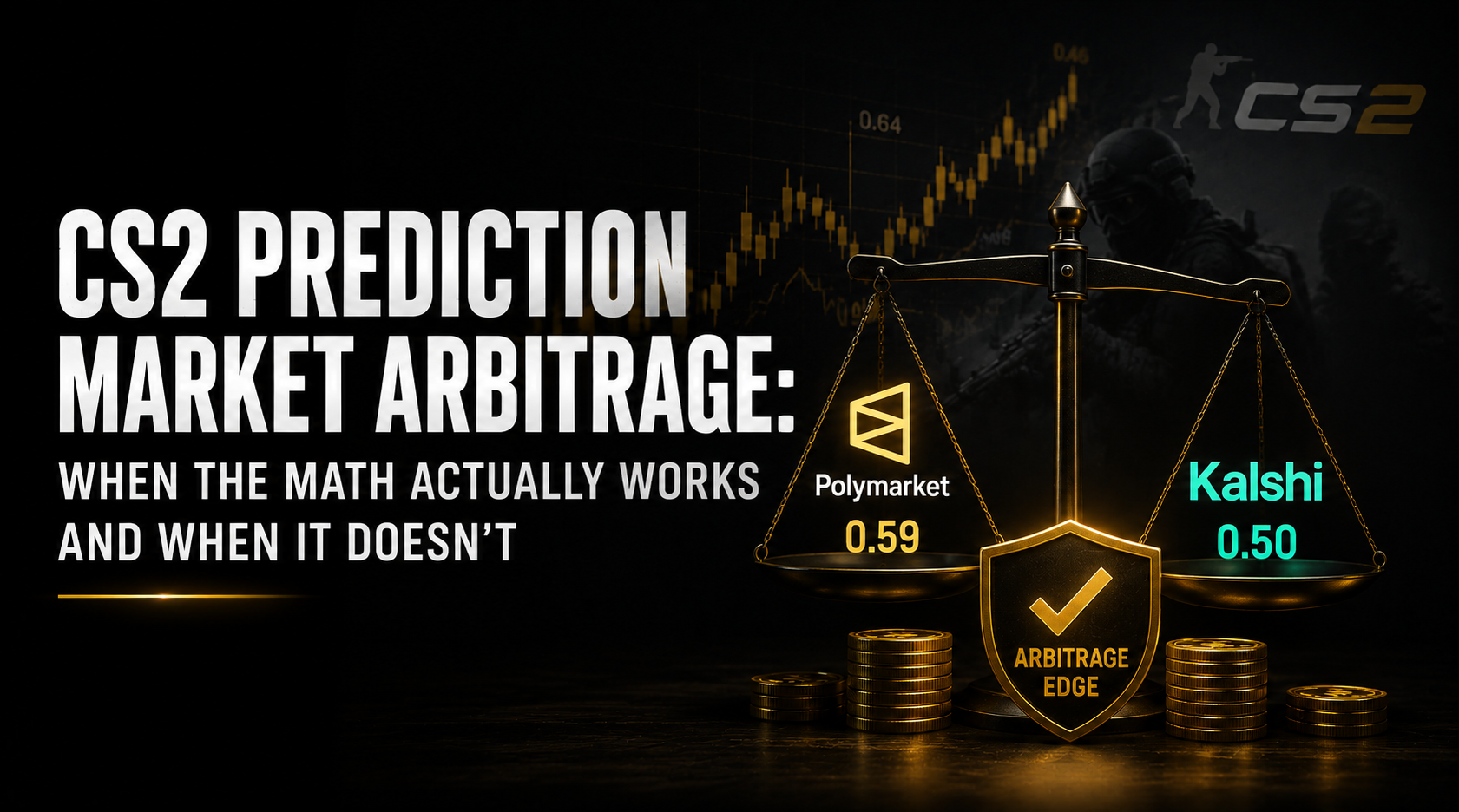
A cs2 prediction market arbitrage exists when the combined cost of buying the YES outcome on Polymarket and the YES on the opposing outcome on another platform is less than $1.00, guaranteeing profit regardless of result.
Platform A prices Team A to win at YES: $0.59, NO: $0.44 (sum: 1.03). Kalshi (Platform B) prices Team A to win at YES: $0.53, NO: $0.50 (sum: 1.03).
Devigged Platform A: Team A YES = 0.59/1.03 = 0.573. Devigged Platform B: Team A YES = 0.53/1.03 = 0.515.
The devigged gap is 5.8 cents. In raw terms, buying YES on Team A at Platform A ($0.59) and YES on Team A NOT winning (equivalent: YES on the opposing team on Platform B at $0.50) gives a combined cost of $1.09. That’s negative arb, more than $1.00 in and at most $1.00 out.
Wait. Platform B has Team A YES at 0.53 and NO at 0.50. The sum is 1.03. Devigged NO is 0.50/1.03 = 0.485. So:
Cost of YES on Platform A: $0.59. Cost of NO (opposing outcome) on Platform B: $0.50. Combined cost: $1.09. Still negative.
This is why most apparent cross-platform arb in CS2 markets isn’t real after devigging. The raw price gap looks like an opportunity. After removing the margin embedded in both platforms, the combined cost exceeds $1.00.
The minimum gross gap needed for real arb after typical fees (2% on Polymarket, variable on Kalshi): approximately 4-6 cents on the devigged prices. Not the raw prices. The devigged prices.
CS2 Prediction Market Arbitrage Verification: 5 Steps Before You Commit
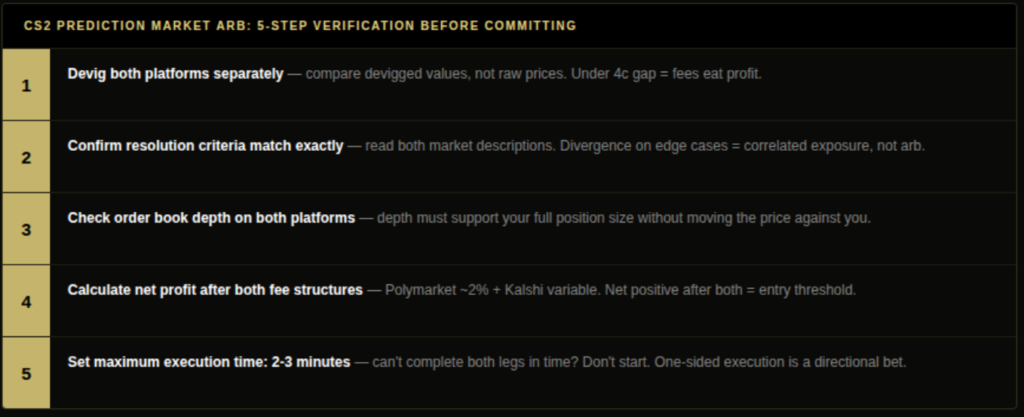
Before treating any cross-platform price gap as cs2 prediction market arbitrage, run five checks:
Check 1: Devig both platforms separately. Never compare raw prices. Divide each platform’s YES price by the sum of YES and NO prices on that platform. Compare devigged values. If the devigged gap is less than 4 cents, fees eliminate the profit.
Check 2: Confirm resolution criteria match exactly. Polymarket and Kalshi occasionally use slightly different resolution criteria for technically the same outcome. A “Team A wins the series” market might resolve differently between platforms in a technical forfeit scenario, or if the match format changes. Read both market descriptions carefully. If the resolution criteria diverge on any edge case, you have correlated exposure, not an arb.
Check 3: Check order book depth on both platforms. An arb priced at 4 cents net profit might only support $120 in order book depth at the target price on one platform. Sizing $400 into this depth moves the price against you before the order fills, eliminating the arb. Check Book tab on DG3 for Polymarket depth. Check Kalshi’s order book independently for the other leg.
Check 4: Calculate net profit after both fee structures. Polymarket: approximately 2% on market orders. Kalshi: variable by market type. A 4-cent gross gap with a combined 3 cents in fees leaves 1 cent net, barely worth the execution complexity. Net positive after both fees is the threshold.
Check 5: Set a maximum execution time window. If you can’t complete both legs within 2-3 minutes, don’t start. A market order on Polymarket fills in seconds. If you can’t place the Kalshi leg within 2 minutes of the Polymarket leg, price movement during that gap creates directional exposure. One-sided execution is a directional bet, not an arb.
Negative Risk in CS2 Tournament Outright Markets
Negative risk is distinct from cross-platform arbitrage and appears more frequently. It deserves separate treatment.
In a CS2 tournament outright market with multiple remaining teams, Polymarket prices each team’s YES contract independently. These prices should collectively sum to approximately $1.00 (plus platform margin). When results are processed faster for eliminated teams (whose YES drops toward $0) than for surviving teams (whose YES should collectively move upward to redistribute the eliminated team’s probability), the sum of all remaining YES prices temporarily falls below $1.00.
Buying all remaining YES contracts in that window costs less than $1.00. Regardless of which team wins the tournament, one of those YES contracts resolves at $1.00. The structure guarantees a profit.
Why does the window exist? Because bracket repricing is asynchronous. After a Liquid elimination, the Liquid YES drops to near-zero immediately as participants sell. The remaining seven teams’ prices don’t simultaneously adjust upward, different participants update different markets at different speeds. For 2-8 minutes, the sum of remaining YES prices sits below $1.00.
This is more reliable than cross-platform binary arb for CS2 because:
- It requires only one platform
- No synchronous execution across two platforms with different interfaces
- It appears briefly after every knockout result in a running major
- It doesn’t require perfectly matched resolution criteria between platforms
The limitation: dollar amounts are small. A 2-cent negative risk in an 8-team outright market produces $0.02 guaranteed profit per $1.00 deployed. For the opportunity to be worth the execution complexity, position size needs to scale to where even small percentage gains are meaningful. At $5,000 deployed across all positions in a 2-cent negative risk, that’s $100 guaranteed, which may or may not justify the capital deployment and monitoring attention.
Also read: Negative Risk and Intra-Market Arbitrage on Polymarket
Near-Arb: More Common, More Practical and Usually What You’re Actually Trading
The distinction between pure cs2 prediction market arbitrage and near-arb matters because it changes the risk management framework. Arb gets sized as if it’s risk-free. Near-arb gets sized according to the standard Kelly fraction on the expected value edge, with the understanding that adverse outcomes are possible even if unlikely.
Pure arbitrage guarantees profit regardless of outcome. Near-arb doesn’t guarantee profit but offers a high-probability trade at minimal risk in a short timeframe, and it’s far more frequently available in CS2 prediction markets.
The most common near-arb scenario in CS2: a platform mispricings an outcome by 8-12 cents relative to the devigged Pinnacle line due to slow repricing after an announcement. This isn’t a cross-platform guarantee, if the outcome resolves against you, you lose. But it offers 8-12 cents of positive expected value against a 2-cent fee cost, at the start of a 12-25 minute repricing window, which is functionally a very high-confidence directional trade rather than a true arb.
Treating near-arb as a genuine cs2 prediction market arbitrage opportunity, sizing it as if it’s risk-free, is a mistake. Treating it as a high-EV directional position with a short reversion window and sizing accordingly is the correct approach.
DG3’s Edge Finder surfaces these near-arb opportunities by showing the devigged gap between Polymarket and the Pinnacle Signal benchmark. A 10-cent EV chip on a CS2 match winner market isn’t showing you a guaranteed profit, it’s showing you a 10-cent edge against the sharpest available reference line, which is worth trading as a directional position.
What Genuine CS2 Prediction Market Arbitrage Looks Like in Practice
For context on how rare genuine fully-risk-free cs2 prediction market arbitrage is: in documented monitoring of Polymarket and Kalshi CS2 markets during ESL Pro League S19 (approximately 150 match markets across both platforms), genuine post-fee cross-platform arb opportunities appeared 4 times. All 4 lasted between 5 and 22 minutes before closing. Average net profit at standard position sizes: approximately $35-$80.
The near-arb situations, devigged gaps of 6-12 cents that required directional risk to exploit, appeared 23 times. These produced meaningful expected returns as directional trades. But they’re not arb. They’re high-EV positions.
This data point contextualises the time investment question. Building a monitoring infrastructure specifically for genuine cross-platform CS2 arb and maintaining it vigilantly across a full tournament produces approximately $200-$350 in guaranteed profit across the event. Building monitoring infrastructure for near-arb situations produces substantially more expected value, with directional risk attached.
Most serious cs2 prediction market arbitrage researchers focus on near-arb (high-EV directional positions at the Polymarket-vs-Pinnacle gap level) rather than pure arbitrage. The expected returns are higher, the execution is simpler (one platform), and the monitoring requirements are covered by infrastructure you’d maintain anyway for standard trading.
CS2 Prediction Market Arbitrage in Practice: A Season-Long View
For traders who want to understand whether building a monitoring infrastructure specifically for cs2 prediction market arbitrage opportunities is worth the effort, a season-long perspective is more useful than individual trade analysis.
Across a full ESL Pro League season (approximately 75 matches across two stages), the realistic expectation for genuine post-fee cross-platform binary arb is:
- 3-6 genuine arb opportunities appearing and closing within 5-22 minutes
- Combined guaranteed profit at standard position sizes ($500-$1,000 per leg): approximately $100-$300
- Time investment for monitoring infrastructure: 4-8 hours to build, plus active monitoring during match windows
For negative risk in outright markets across the same period:
- 4-8 opportunities appearing during knockout results
- Combined guaranteed profit at $2,000-$5,000 deployed across all outright YES positions: approximately $80-$200 per event
- Same monitoring infrastructure, but requires faster multi-position execution
For near-arb (high-EV directional positions at the Polymarket-vs-Pinnacle gap level):
- 15-25 opportunities per event window with 5+ cents devigged gap
- Expected return at $500 per position: approximately $800-$1,500 per event (with directional risk)
- Same monitoring infrastructure, higher expected value, higher variance
The economic case for building cs2 prediction market arbitrage monitoring is clear only when combined with near-arb exploitation. Pure arbitrage alone doesn’t justify the overhead. Near-arb combined with genuine arb capture does. Build the infrastructure for the broader edge category, then collect the rare pure arb opportunities as a bonus.
The CS2 Prediction Market Arbitrage Setup: What You Actually Need
For traders who want to monitor for cs2 prediction market arbitrage opportunities as part of a broader CS2 trading workflow, the infrastructure requirements are modest.
Minimum setup: DG3 Edge Finder for Polymarket-vs-Pinnacle gap monitoring, a browser tab or Kalshi mobile app for quick cross-reference on notable Polymarket gaps, and a basic understanding of the five-check verification process described earlier in this guide.
This setup catches near-arb opportunities automatically through the Edge Finder and allows quick manual verification of whether a Polymarket-vs-Pinnacle gap also corresponds to a Polymarket-vs-Kalshi gap worth trading.
Enhanced setup: Python script that polls both Polymarket and Kalshi for the same CS2 market simultaneously, calculates devigged prices for both, and fires a notification when the devigged gap exceeds 4 cents. This automates the detection step of cross-platform arb monitoring. The five-check verification still happens manually before any order placement.
The enhanced setup adds approximately 6-8 hours of build time over the minimum setup. Whether that investment makes sense depends on how frequently you’re actively monitoring CS2 markets. If you’re running consistent monitoring during T1 major match windows, the automated detection adds value by catching opportunities that occur when your attention is elsewhere. If you’re monitoring intermittently, the minimum setup is sufficient.
The most important constraint: no cs2 prediction market arbitrage monitoring setup should automate execution without the manual verification step. False positives on resolution criteria differences, order depth limitations, and fee miscalculations are common enough that unreviewed automated execution will produce incorrect trades regularly.
Frequently Asked Questions
Q: What arbitrage opportunities exist in CS2 prediction markets? A: Two types with meaningfully different frequency and execution requirements. Cross-platform binary arbitrage occurs when the devigged gap between Polymarket and Kalshi on the same CS2 outcome, after both platforms’ fees, produces a guaranteed profit from buying both sides simultaneously. This appears roughly 3-6 times per major event and requires near-simultaneous execution on both platforms within 5-22 minutes. Negative risk appears when the sum of remaining YES prices in a CS2 tournament outright market falls below $1.00 during bracket repricing, enabling guaranteed profit by buying all remaining YES contracts. This appears after every knockout result during a running major and lasts 2-8 minutes. Near-arb, which isn’t true arbitrage, appears 15-25 times per major event as high-EV directional positions. cross-platform binary arb (Polymarket vs Kalshi when the devigged gap exceeds combined platform fees) and negative risk in tournament outright markets (sum of remaining YES prices falls below $1.00 during bracket repricing). Both are time-limited and require execution within 5-22 minutes.
Q: How do you verify a CS2 cross-platform arbitrage is real? A: Five checks: devig both platforms separately (not raw prices), confirm resolution criteria match exactly on both market descriptions, check order book depth on both legs at the position size you intend to trade, calculate net profit after both platforms’ fee structures, and set a maximum execution time window of 2-3 minutes.
Q: What is the minimum price gap needed for CS2 arbitrage after fees? A: Approximately 4-6 cents on the devigged prices (not raw prices). Polymarket’s 2% market order fee plus Kalshi’s variable fee on the other leg typically consumes 3-4 cents of gross gap. Below 4 cents devigged gap, fee costs eliminate profit.
Q: What is negative risk in CS2 tournament markets? A: When the sum of all remaining YES prices in a CS2 tournament outright market falls below $1.00 during bracket repricing, buying all remaining YES contracts costs less than $1.00 and guarantees profit regardless of the winner. The window exists because eliminated team prices drop faster than surviving team prices rise.
Q: How does DG3 surface CS2 prediction market arbitrage opportunities? A: DG3’s Edge Finder shows the devigged gap between Polymarket and the Pinnacle Signal benchmark for all active CS2 markets in real time. This surfaces near-arb opportunities where Polymarket lags Pinnacle, which are worth trading as high-EV directional positions. It doesn’t cover cross-platform Polymarket-vs-Kalshi arb, which requires manual devig calculation on both platforms. The Book tab shows Polymarket order book depth for sizing any arb or near-arb position. For negative risk in outright markets, the combination of Edge Finder and live outright market monitoring covers the detection side of that trade. the devigged gap between Polymarket and the Pinnacle Signal benchmark in real time. This surfaces near-arb opportunities (high-EV directional positions where Polymarket lags Pinnacle) but not cross-platform Polymarket-vs-Kalshi arb, which requires separate manual Kalshi checks. The Book tab shows Polymarket order book depth for sizing any arb attempt.
Also read: CS2 Prediction Markets: The Complete Guide for Traders in 2026
Gas-Aware Betting: You Found the Value, Then the Network Took It
Liquidity Analysis in Prediction Markets: Measuring Depth Before You Size