
What Is a Tennis Walkover? Your Position, Explained
A player’s name is on the draw sheet. The match never starts. The scoreboard reads “w/o” instead of a score, and if you’re holding a position on that match, the notification tells you it’s over before you even knew something was wrong.
That’s a walkover, and it behaves differently from every other way a tennis match can end early. It’s exactly the kind of term worth having in a trading glossary & concepts reference, since knowing the definition matters less than knowing what it does to a position you’re already holding.
Table of Contents
Quick Answer
A walkover happens when a scheduled tennis match doesn’t start at all, because one player withdraws, is disqualified, or fails to appear after the draw is set. The opponent is awarded the win without playing a single point. This is distinct from a retirement, which happens after play has already begun.
Walkover: A match result awarded when a player fails to start a scheduled match, due to injury, illness, disqualification, or another reason, with the opponent advancing without play taking place.
Walkover vs Retirement: The Distinction That Matters
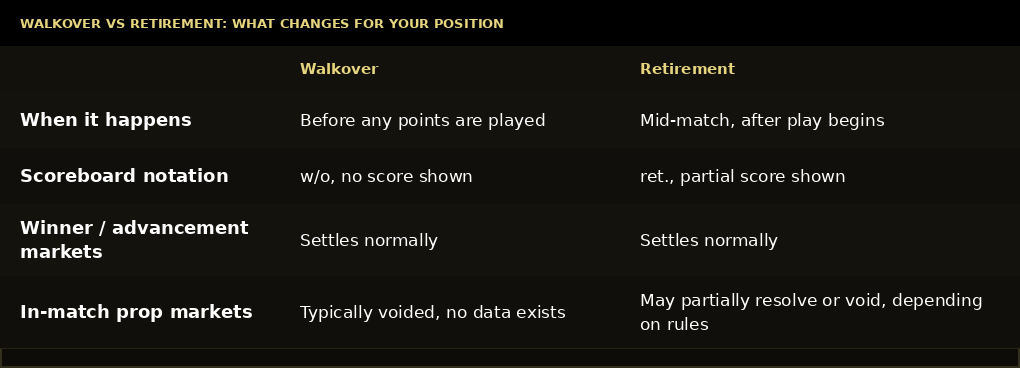
A retirement happens mid-match. Points have been played, a score exists, and the match ends early when a player can’t continue. A walkover happens before a single point is played. The scoreboard shows no score at all, just the notation that the match didn’t happen.
This distinction isn’t just terminology. It changes how different markets tied to that match can resolve.
When a Walkover Is Declared, and How Soon You Know
Walkovers typically get declared close to match time, sometimes just before the scheduled start, because withdrawal decisions often come down to a same-day fitness check that fails. Tournaments announce a walkover as soon as the decision is final, but “as soon as” can still mean minutes before the match was due to begin, not hours.
That timing matters if you’re holding a position. A retirement gives you a live match to watch, with the outcome becoming clearer in real time as it unfolds. A walkover gives you no in-match signal at all, just a status change from “scheduled” to “decided,” often with very little warning before it happens.
What a Walkover Means for an Open Market Position
Match-winner markets generally still resolve. A walkover counts as an official win for tournament purposes, so a contract on “Player X wins the match” typically settles the same way it would after a normal completed match.
Prop markets tied to in-match statistics don’t resolve the same way, because there’s no match to generate the stats. Total games, set scores, first-set winner, aces, tiebreak occurrence, none of that data exists when zero points get played. Markets built around these props are typically voided or refunded rather than settled either direction, since there’s no result to score them against.
Tournament-advancement and outright markets follow the same logic as the match-winner market. The winning player advances exactly as they would have with a played win, so any position tied to advancing through that round settles on the walkover result.
The practical takeaway: check whether your position is on the outcome of the match or on something that happens during the match. The first category is usually fine. The second category is where a walkover creates a settlement question worth understanding before it happens, not after.
Common Mistakes
Assuming a walkover voids every market on the match. It doesn’t. Winner and advancement markets typically still settle. Only the in-match statistical props are the ones affected.
Confusing a walkover with a retirement when reading a result. The notation is different (w/o versus ret.), and so is what markets are still live to trade in the minutes before it’s announced. A retirement mid-match still has real-time information available; a walkover doesn’t.
Not checking a specific market’s own resolution rules before assuming the general pattern applies. “Typically” isn’t “always.” Individual market rules can vary, and the specific contract terms for a given market are the actual source of truth, not a general rule of thumb.
Frequently Asked Questions
Q: What does walkover mean in tennis? A: A walkover means a scheduled match didn’t take place because one player withdrew, was disqualified, or failed to appear, and the opponent was awarded the win without playing.
Q: What is the difference between a walkover and a retirement? A: A walkover happens before any points are played. A retirement happens mid-match, after some points or games have already been completed, when a player can’t continue.
Q: Does a walkover count as a real win? A: For tournament advancement and official results, yes. The winning player advances the same way they would after a played match. For statistical records, some tours and databases treat walkovers differently than completed matches.
Q: What happens to prop bets or prop markets when a match is a walkover? A: Markets tied to in-match statistics, like total games or set scores, typically get voided or refunded, since no play occurred to generate that data. Match-winner and advancement markets generally still settle normally.
Final Thoughts
A walkover is a simple concept with one nuance worth remembering: the match result is real, but the match itself never happened. That split is exactly why a winner market and a prop market on the same walkover can resolve completely differently, and it’s worth checking which kind of position you’re holding before a scheduled match ever reaches its start time.
Both the ATP and WTA define this term formally in their own rulebooks, and Wikipedia’s summary of a walkover covers the general definition and its history across sports if you want background beyond the tennis-specific case covered here.