No Vig API: Pulling Fair Odds Programmatically
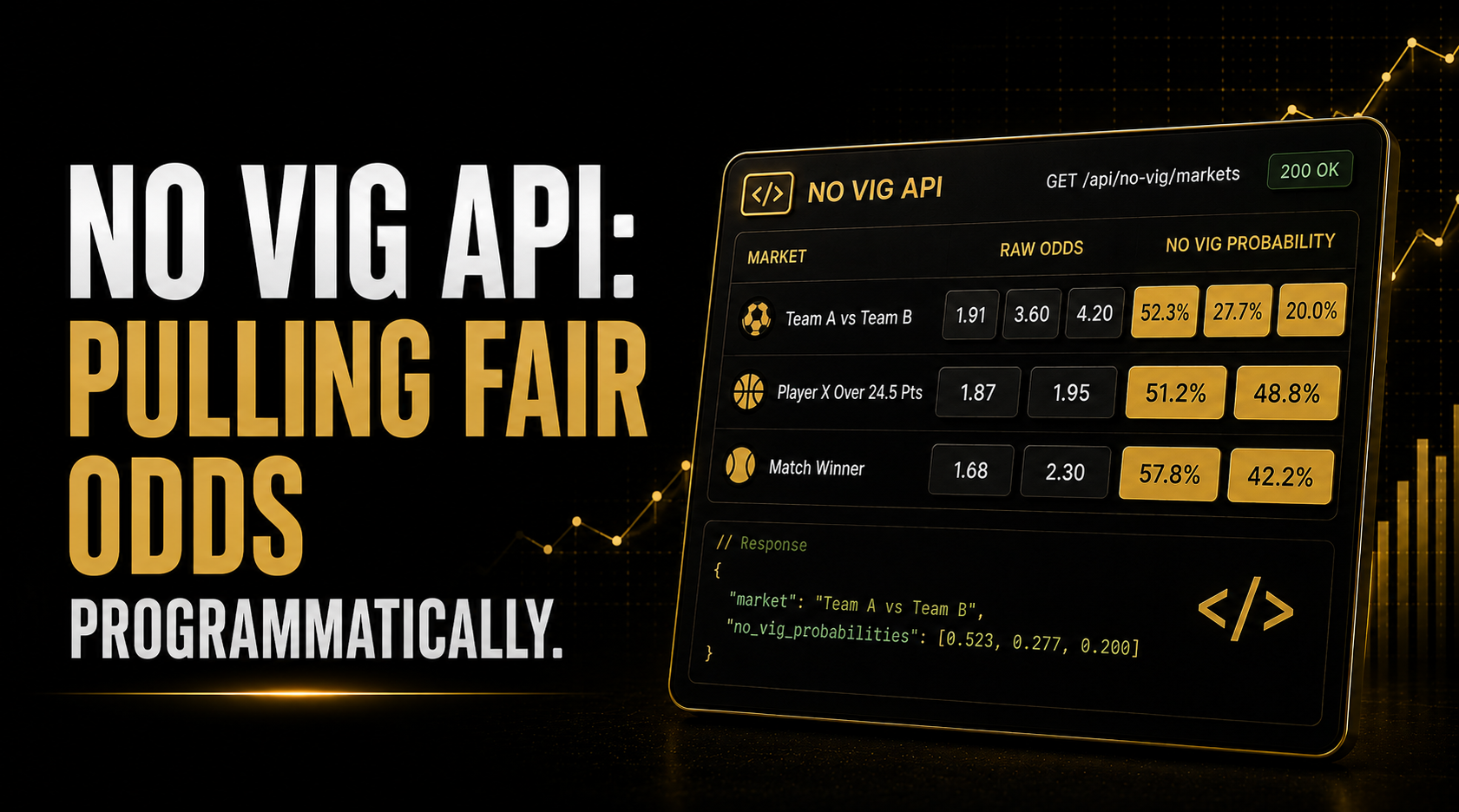
Devigging one line by hand takes thirty seconds. Devigging every market on a full slate, every ten seconds, all day, isn’t a hand calculation anymore. It’s a script, and the script needs a no vig API to call, not a formula to re-derive every time.
Here’s the part that surprises people: there’s no single, standard “no vig API” that every book or platform exposes. What exists is raw odds data, and a devig calculation you run on top of it, whether you build that layer yourself or buy access to one that’s already built.
Table of Contents
Quick Answer
A no vig API doesn’t come as a single universal product. It’s either a devig calculation you run yourself on top of a raw odds feed, using the same proportional formula covered in DG3’s no vig calculator guide, or a commercial odds-comparison tool that returns already-devigged numbers as part of a broader paid product. Which path makes sense depends on whether you need this for one script or as infrastructure you’re going to depend on daily.
Key Takeaways
- No vig odds meaning, in API terms, is just implied probability with the bookmaker’s margin already divided out, the same math whether you compute it yourself or pull it pre-calculated.
- There’s no vig odds calculator free option that scales past casual use. Free tools are built for one line at a time, not for a script pulling hundreds of markets on a schedule.
- Building your own no vig API layer is a small amount of code on top of any raw odds feed: convert to implied probability, sum, divide each by the total.
- A no-vig sportsbook feed and a no-vig prediction market feed aren’t the same input. One needs devigging before you trust it; the other, on a platform like Polymarket, already trades close to a no-vig price by construction.
- The free no-vig tools people compare are rarely tested apples-to-apples, since they can differ in devig method, decimal rounding, and how they handle three-way markets. A comparison is only useful if someone’s actually run the same lines through each one.
What a No Vig API Actually Returns
At its simplest, a no vig API takes a raw line, two or more prices for the same event, and returns the implied probability for each outcome after the bookmaker’s margin, known as vigorish or vig, has been removed and the numbers rescaled to sum to 100 percent. That’s it. The output is a probability, or a price if you convert it, not odds in the sportsbook sense.
The complexity isn’t in the math. It’s in what you feed the calculation. A stale line, a soft retail book, or a three-way market missing the draw all produce a confidently wrong number, the same failure modes covered in DG3’s 3-way no vig calculator guide for football specifically.
Building Your Own: The Process
- Get a raw odds feed. This is the part that costs money or effort, depending on your source. A sportsbook’s own API, a licensed odds-data provider, or a platform’s public market data endpoint (Kalshi’s and Polymarket’s are both public for reading prices, no auth required) all work as inputs.
- Convert each price to implied probability. Decimal odds: 1 divided by the price. American odds: the sign-based formula covered in how to calculate no vig odds.
- Sum the implied probabilities for the market, two outcomes for a moneyline, three for a market with a draw.
- Divide each probability by that sum. The results now total 100 percent. This is your no-vig output, ready to expose as an endpoint, a scheduled job, or whatever your own system needs.
- Cache and refresh on your own schedule. A no vig API is only as current as its input. Decide how stale a line can get before your script re-pulls it, based on how fast the markets you’re watching actually move.
None of this is exotic. It’s the same four-step devig formula from a manual calculator, wrapped in a loop that runs it across every market on a schedule instead of one line at a time.
Off-the-Shelf Options Exist Too
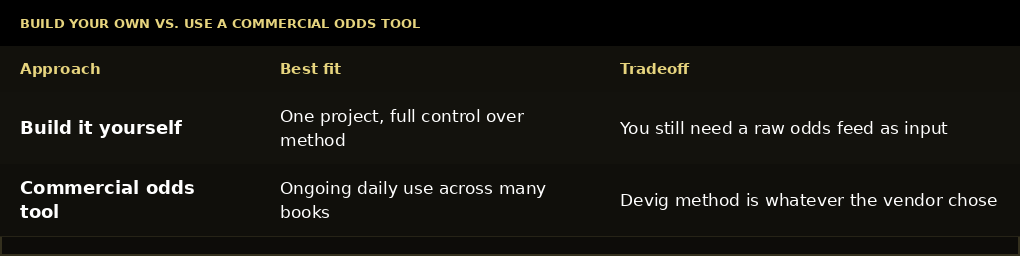
Commercial odds-comparison platforms, tools like OddsJam and Unabated are commonly mentioned in this space, bundle a devig calculation into a broader paid product that also handles line shopping and odds aggregation across many books at once. If you need this daily across a large number of markets rather than for a single project, checking what a paid tool actually offers is worth the time it’d take to build and maintain the same thing yourself.
What’s worth confirming directly with any vendor before relying on their number: which devig method they use, whether their feed distinguishes sharp books from soft ones, and how their tool handles three-way markets with a draw, since that’s the exact case where devig methods most visibly disagree.
Which No Vig Calculator to Trust: A Testing Checklist
Free no-vig calculator tools aren’t all computing the same thing, even when they look identical. Before trusting one, or before running your own comparison across a few of them, check:
Which method it uses. Proportional, additive, and power all produce slightly different answers on a lopsided line. A tool that doesn’t disclose its method is one you can’t fully trust on an extreme favorite or longshot.
Whether it handles three-way markets correctly. Feed it a line with a draw and confirm it has three input fields, not two with the draw dropped. This is the single most common failure mode in a free calculator built primarily for two-way US sports lines.
How it rounds. Small rounding differences compound across many markets. A tool that rounds to whole cents versus one that keeps two decimal places will disagree slightly even using the identical method.
Whether the output updates with the input book. A tool that only accepts one book’s line can’t tell you how the fair price shifts when you switch from a soft retail line to a sharp one.
Run the same handful of real lines through a few free tools side by side using this checklist, and the differences between them stop being a mystery. That comparison is worth doing before picking one as a default, but it’s a comparison someone actually has to run, not something to take on a tool’s own marketing claim.
Common Mistakes
Assuming “no vig” means the same calculation everywhere. Method matters. A tool or feed that doesn’t disclose whether it’s using proportional, additive, or another method is asking you to trust a black box.
Feeding a no vig API stale data. A devig calculation is only as current as its input line. A script pulling odds once an hour and calling it real-time will quietly drift from what the market is actually pricing.
Treating a prediction market price as needing the same devig treatment as a sportsbook line. A book’s price has margin baked in by design. A prediction market’s price is closer to a no-vig number already, since it comes from an order book rather than a bookmaker’s quote.
Building the devig layer without checking the three-way case. A two-way-only implementation will silently produce wrong numbers the first time it hits a market with a draw, if it hits one at all.
Frequently Asked Questions
Q: How do I calculate no-vig odds through an API instead of by hand? A: Pull the raw line from your odds feed, convert each price to implied probability, sum them, then divide each by that total. The same four-step process as a manual calculator, just run in code against a live feed instead of typed in by hand.
Q: What are no vig odds? A: No vig odds are a sportsbook line with the bookmaker’s margin removed, so the implied probabilities sum to exactly 100 percent instead of the 102 to 108 percent a typical raw line adds up to.
Q: Is a no-vig calculator the same as a devig calculator? A: Yes. “No-vig” and “devig” describe the same output, a price or probability with the bookmaker’s margin stripped out. The terms are used interchangeably across different tools and guides.
Q: Which no vig calculator should I trust? A: There’s no single answer without testing your specific use case against the checklist above: confirm the method, check the three-way handling, and check the rounding. A tool that’s transparent about its method is a safer default than one that isn’t, regardless of which specific tool you land on.
Q: Is there a free no vig odds calculator that handles football? A: Free two-way calculators are common. A free calculator that correctly handles a three-way football line with a draw is less common, and worth testing specifically on a lopsided line before trusting it, since that’s where the draw-handling failure shows up most clearly.
Final Thoughts
A no vig API isn’t a product you go shopping for the way you’d shop for a data feed. It’s a small, well-understood calculation, the same one covered across DG3’s calculator guides, that you either wrap around your own odds feed or pay a vendor to have already wrapped for you.
The math was never the hard part. The hard part is trusting the input, a stale line, a soft book, a dropped draw, and building or buying the version that doesn’t quietly get any of that wrong.