Kelly Criterion Calculator: Sizing in Cents, Not Odds
The Kelly criterion formula you’ll find in most explainers uses decimal odds: b, p, q, solve for f. That’s fine if you’re betting a sportsbook line. It’s an extra translation step if you’re sizing a position on a contract priced in cents, and that translation step is exactly where people either skip it and size wrong, or do it in their head and size wrong a different way.
Here’s the formula rebuilt for cents from the start, so there’s no odds-format conversion standing between you and the right stake.
Table of Contents
Quick Answer
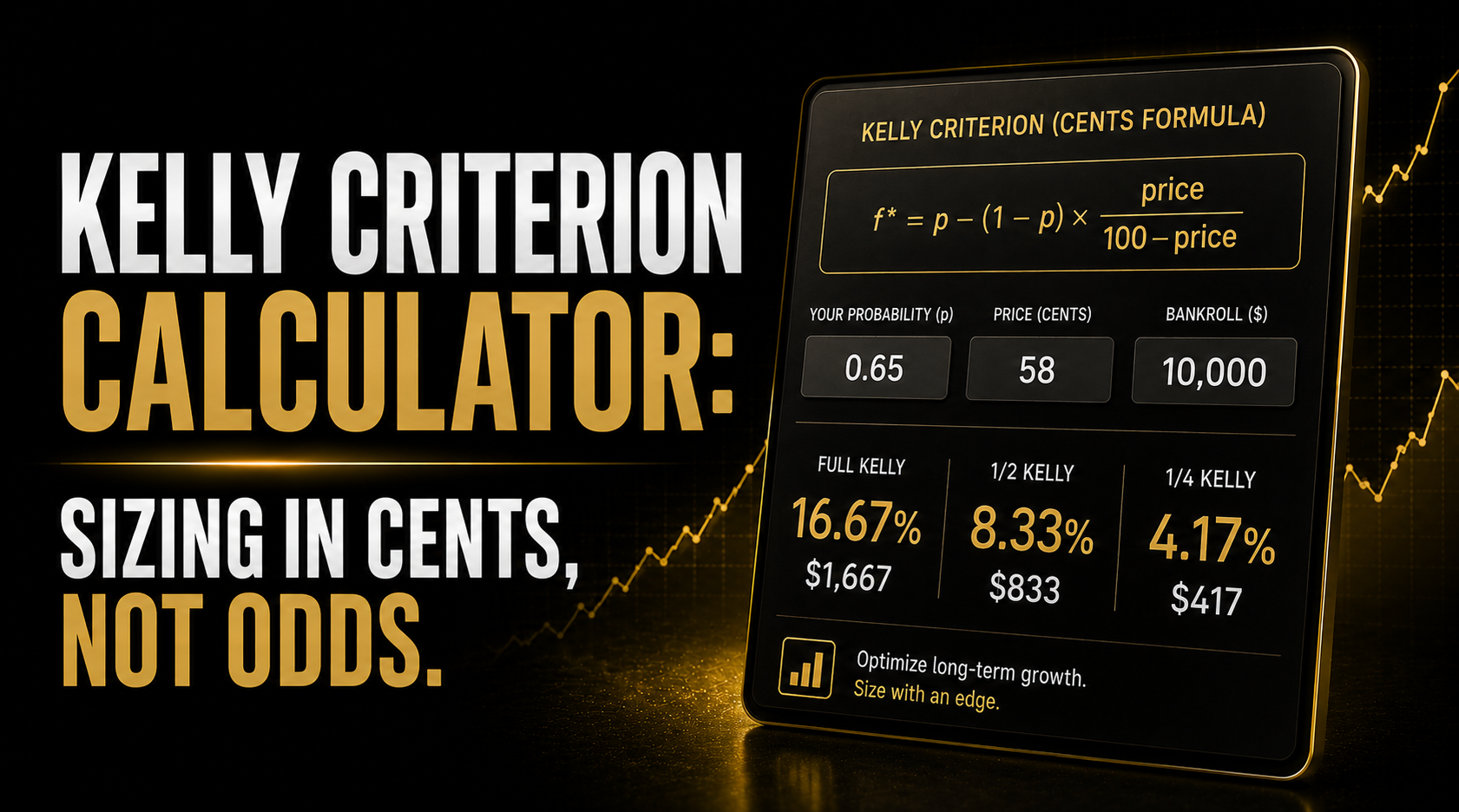
The Kelly criterion tells you what fraction of your bankroll to stake on a position with a positive expected edge, maximizing long-run growth rather than any single outcome. For a contract priced in cents, the cents-native version is: f* = p − (1 − p) × price ÷ (100 − price), where p is your estimated true probability and price is the cost in cents. No odds conversion required.
Kelly criterion: A formula for calculating the optimal fraction of a bankroll to stake on a favorable bet, designed to maximize the long-run growth rate of the bankroll rather than the expected value of any single wager.
Key Takeaways
- The classic Kelly formula, f* = (bp − q) ÷ b, uses b as net decimal odds. On a cents-priced contract, b works out to (100 − price) ÷ price, an extra conversion step the cents-native formula skips entirely.
- Full Kelly sizes aggressively and swings hard with variance. Most traders who use Kelly at all use a fraction of it, commonly a half or quarter, trading some growth rate for a much smoother equity curve.
- Kelly sizing requires your own probability estimate as an input. A wrong estimate produces a wrong stake with total confidence, since the formula has no way to know your probability was off.
- Kelly assumes you can size continuously and repeat the bet under similar conditions. A one-off illiquid market with a wide spread doesn’t fit those assumptions as cleanly as a liquid, frequently-traded one.
- A negative Kelly output means the trade doesn’t have positive edge at that price. The formula is telling you not to take the position, not asking you to size it anyway.
The Formula, Translated to Cents
Start from the standard form: f* = (bp − q) ÷ b, where b is the net odds (profit per unit staked if you win), p is your probability estimate, and q is 1 − p.
For a $1 contract priced at “price” cents, buying it costs price/100 dollars and pays $1 if correct, a profit of (100 − price)/100 dollars per dollar staked. That makes b = (100 − price) ÷ price.
Substitute that into the standard formula and simplify, and the odds term cancels out cleanly:
f* = p − (1 − p) × price ÷ (100 − price)
No decimal odds, no intermediate conversion. Feed it your probability estimate and the price in cents, and it returns the fraction of bankroll to stake directly.
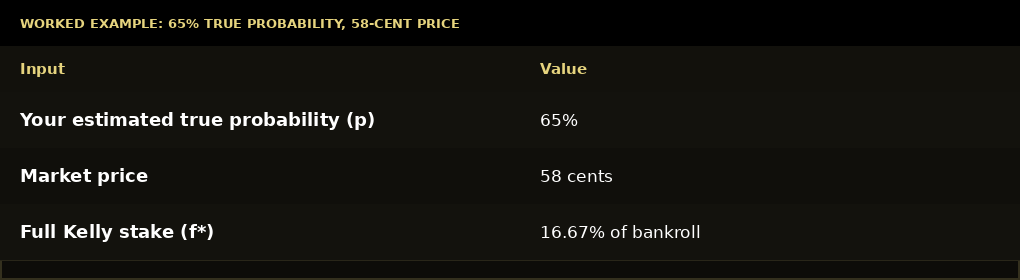
Run the numbers: f* = 0.65 − (0.35 × 58 ÷ 42) = 0.65 − 0.4833 = 0.1667, or 16.67 percent of bankroll. On a $10,000 bankroll, that’s $1,667 staked on this single position, at full Kelly.
Why Full Kelly Isn’t What Most People Actually Use
Full Kelly maximizes long-run growth rate mathematically, and it also produces a rough ride getting there. A string of losses at full Kelly size draws down the bankroll hard, even when the underlying edge is real, because full Kelly is sized for the mathematically optimal path, not the emotionally tolerable one.
Most practical Kelly use runs at a fraction of the full number, commonly half or a quarter. Half Kelly on the example above would be 8.33 percent of bankroll instead of 16.67 percent, trading some theoretical growth rate for meaningfully less variance along the way. DG3’s guide to choosing your Kelly fraction covers the tradeoff between the fractions in more depth than a single formula can.
What Happens When the Formula Returns Zero or Negative
If your estimated probability doesn’t clear the price by enough margin, the formula returns zero or a negative number. That’s not an error. It’s the formula correctly telling you there’s no positive edge at that price, and the correct stake is nothing, not a small position anyway.
Forcing a stake onto a trade the formula says not to take isn’t a Kelly strategy at that point. It’s a directional bet wearing Kelly’s math as a justification.
Common Mistakes
Using the decimal-odds formula on a cents price without converting correctly. Mixing formats produces a stake that looks plausible and is wrong. Use the cents-native formula directly instead of converting price to odds and back.
Running full Kelly without understanding the variance that comes with it. Full Kelly is mathematically optimal for growth rate and famously rough to actually hold through a losing streak. Most serious users size down deliberately.
Treating the Kelly output as fixed rather than probability-dependent. Change your probability estimate even slightly and the stake changes with it. A stale probability estimate produces a stale, and possibly wrong, position size.
Applying Kelly to a one-off bet the same way as a repeatable one. The formula’s growth-rate optimization assumes you can size similarly across many repeated, similar bets. A single illiquid market with no ability to repeat the position doesn’t fit those assumptions as cleanly.
Frequently Asked Questions
Q: What is the Kelly criterion? A: A formula for calculating the fraction of a bankroll to stake on a bet with positive expected value, designed to maximize the long-run growth rate of the bankroll across repeated bets rather than the outcome of any single one.
Q: What is the Kelly criterion formula? A: The standard form is f* = (bp − q) ÷ b, where b is net decimal odds, p is your probability estimate, and q is 1 minus p. For a cents-priced contract, the equivalent is f* = p − (1 − p) × price ÷ (100 − price).
Q: What are some Kelly criterion examples? A: A trader estimating a 65 percent true probability on a contract priced at 58 cents gets a full Kelly stake of roughly 16.67 percent of bankroll. A trader estimating only 55 percent on that same 58-cent price gets a much smaller stake, since the edge is thinner.
Q: Does the Kelly criterion work for stocks too? A: The same underlying math applies to any repeated bet with a defined edge and payout structure, stocks included, though estimating a reliable probability and payout structure is generally harder in equities than on a binary-outcome contract.
Final Thoughts
The Kelly criterion was never complicated math. What trips people up is doing an odds conversion in their head under time pressure, or applying full Kelly without understanding what full Kelly actually feels like during a losing streak. Cents-native math removes the first problem. The second one is a judgment call the formula was never going to make for you.
For the broader prediction-market framing of Kelly sizing beyond this cents-specific version, DG3’s full Kelly criterion guide covers the wider picture.