Is Polymarket Worth It in 2026? An Honest Assessment
Before you fund a Polymarket wallet, you deserve a straight answer instead of a review written by someone who benefits from you signing up.
Polymarket is the largest prediction market in the world by trading volume. It has genuine advantages over almost every competing platform. It also has real problems that no one who writes “Polymarket review” articles seems to want to discuss. The liquidity gap between its top markets and everything else is severe. The fee structure rewards volume in a way that punishes small traders. US residents cannot legally use it. And getting your USDC in and out requires enough crypto familiarity that a meaningful fraction of interested traders never make a second deposit.
Here is the honest version.
Table of Contents
Quick Answer
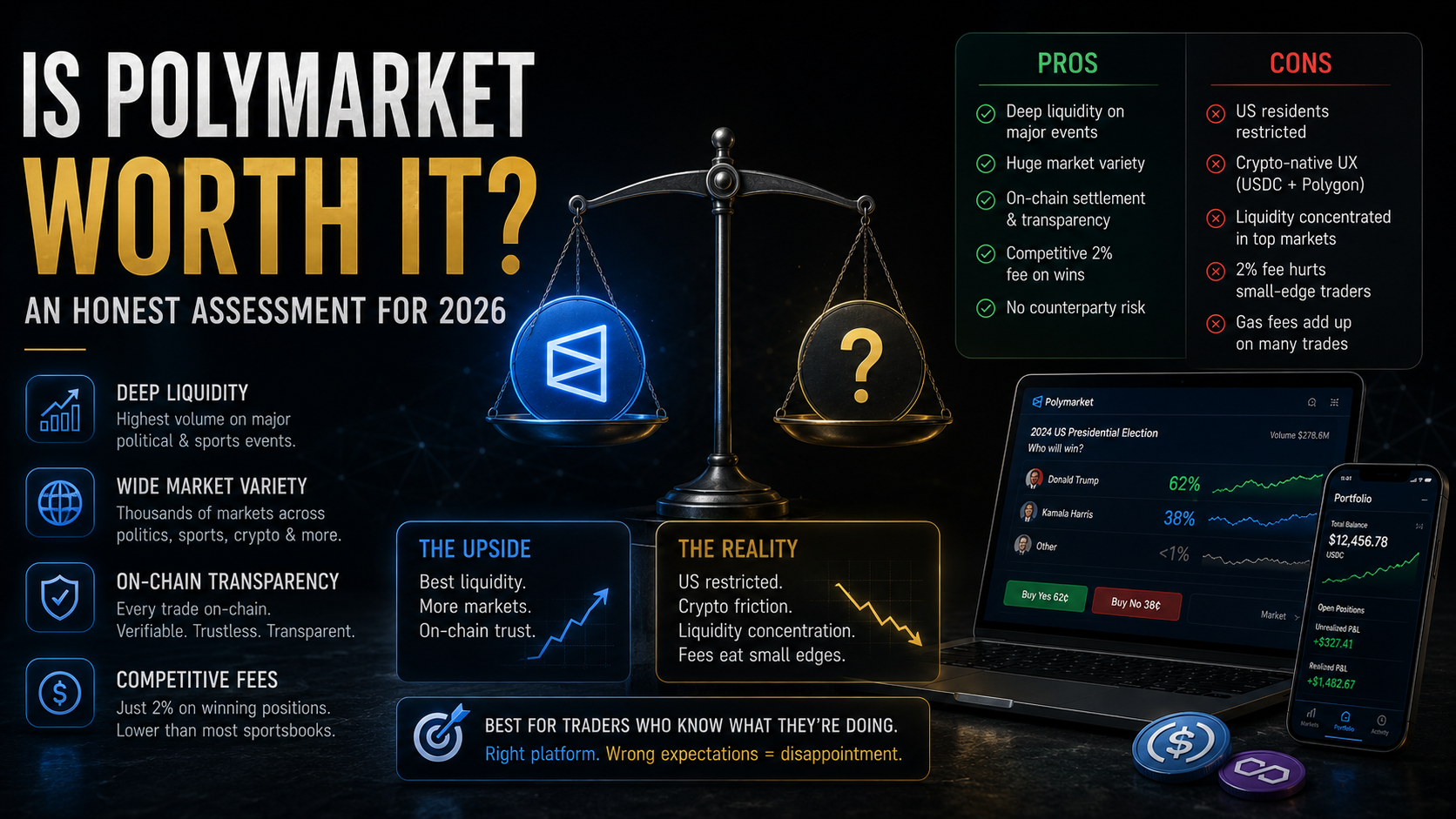
Polymarket in 2026 is genuinely the best prediction market platform for non-US traders with crypto experience who want to trade political, sports, and macro events. It has the highest liquidity on major markets, the widest event catalogue, and on-chain verification of every position. Its weaknesses are equally real: US restrictions, a crypto-native UX that creates friction for new users, severe liquidity concentration in a small number of top markets, and a 2% fee on winning positions that is nontrivial for small-edge trading. Whether it is worth it depends on who you are and what you are trying to do.
Key Takeaways
- Polymarket’s clearest advantage is liquidity depth on major markets. Political and sports markets for major events routinely attract millions of dollars in trading volume, which means large positions move prices less and bid-ask spreads are tighter than on any competing platform.
- The 2% fee on winning positions is material for traders operating on small edges. A 3-cent edge on a 0.50 market costs approximately 1 cent in fees on a winning position, leaving a 2-cent net edge. A trader working with 2-3 cent edges on high-volume positions needs to be right about their probability estimates with very high consistency for the fee to not be the dominant cost.
- US residents are restricted by Polymarket’s terms of service and have been the subject of CFTC enforcement activity. Kalshi is the regulated US alternative. If you are US-based, Polymarket is not a legal option regardless of how the product compares.
- Liquidity is not evenly distributed. The top 50 Polymarket markets by volume have deep, liquid order books. The remaining thousands of markets are thin, with wide spreads and order books that a $500 position can visibly move. Most of the “market variety” benefit is available only to traders who already know which markets to look at.
- On-chain settlement on Polygon means Polymarket cannot hold your funds, cannot block your withdrawal, and cannot dispute a resolution you can verify on-chain. For traders coming from offshore sportsbooks, this is a real improvement in trust and counterparty risk.
- The USDC and Polygon network requirement creates real friction. Buying USDC on a centralized exchange, bridging or withdrawing to Polygon, and managing gas – steps that are routine for crypto-native users – are real barriers for traders used to card deposits on betting platforms.
What Polymarket Gets Right
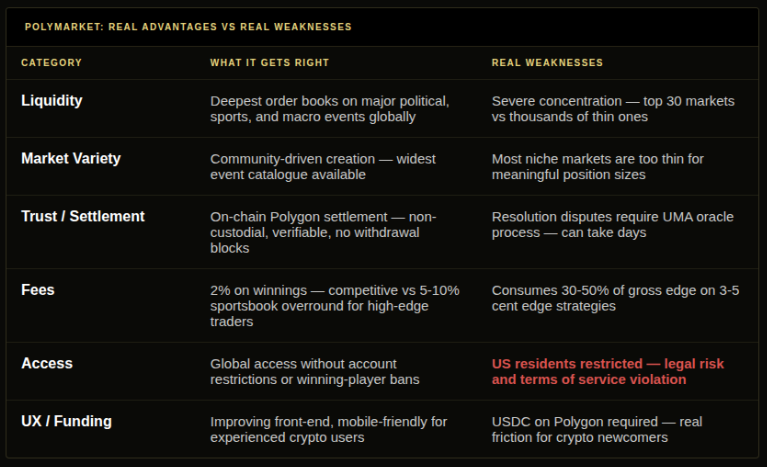
Liquidity on major events. When the 2024 US presidential election market was active, Polymarket saw hundreds of millions of dollars in trading volume. The 2026 FIFA World Cup markets attracted similarly deep liquidity on major match and tournament outcome contracts. On these events, Polymarket’s order books are deep enough that a $10,000 position moves the price by fractions of a cent. No other prediction market comes close to this on major political and sports events.
Market variety. Polymarket lists thousands of markets across political, sports, crypto, economic, and pop culture events. The community-driven market creation process (anyone can propose a market) means events that would never be covered by a traditional sportsbook appear on Polymarket weeks before they resolve. For traders with domain expertise in unusual areas, that is a real edge.
On-chain transparency. Every position on Polymarket is on-chain on Polygon, every wallet is publicly visible, and every resolution is verifiable. A trader who disputes a resolution outcome can see exactly what the UMA Protocol oracle recorded and what the rules said. There is no black box. This is not just marketing. For traders who have been burned by offshore sportsbooks that delay withdrawals, reverse profitable positions, or simply disappear, on-chain settlement is a meaningfully better arrangement.
Fee structure is reasonable at scale. The 2% fee on winning positions, while material for small-edge traders, is competitive with or better than traditional sportsbook margins on equivalent market types. A sportsbook’s built-in overround is typically 5-10%. A trader operating with a real 8-10 cent edge on Polymarket is paying 1-2 cents in fees on a winning position. At that scale, the fee is not the limiting factor.
What Polymarket Gets Wrong
US access. This is a non-starter for US-based traders and not a minor footnote. Polymarket has been subject to CFTC enforcement. The platform restricts US IP addresses. Trading on Polymarket as a US resident is a terms-of-service violation and potentially a legal risk. Kalshi is the regulated US alternative, with meaningfully lower liquidity on most markets but full legal standing. The Kalshi vs Polymarket comparison covers this in detail.
Crypto-native friction. Funding a Polymarket account requires USDC on the Polygon network. For traders unfamiliar with crypto, this means: create a crypto exchange account, complete KYC there, buy USDC, withdraw to a wallet address on Polygon (not Ethereum mainnet), manage gas. Each step is a drop-off point. The UX improvement Polymarket has made on the front end is real, but the underlying funding process remains friction-heavy by any measure compared to card deposits on traditional platforms.
Liquidity concentration. The top 20-30 markets on Polymarket at any given time have excellent liquidity. The next tier down has moderate liquidity. The remaining thousands of markets have thin order books where a $200 position can move the price by several cents. The “thousands of markets” stat that appears in every Polymarket review is technically true but practically misleading for most traders. If you want to trade a specific category consistently, check the specific market’s volume before assuming Polymarket’s overall liquidity applies to it.
No fiat on-ramp. Every dollar you put into Polymarket has to go through a crypto exchange first. Every dollar you take out has to go back through one. The friction this creates – and the exchange fees on both ends – is a real cost that does not appear in Polymarket’s fee disclosure.
The 2% fee on small-edge trading. If your edge on most positions is 3-5 cents, the 2% fee on winning positions consumes roughly 30-50% of your gross edge on a 0.50 market. A trader running a systematic low-edge high-volume approach needs to model the fee explicitly into every EV calculation. Traders who skip this consistently overstate their net return.
Who Polymarket Suits (And Who It Does Not)
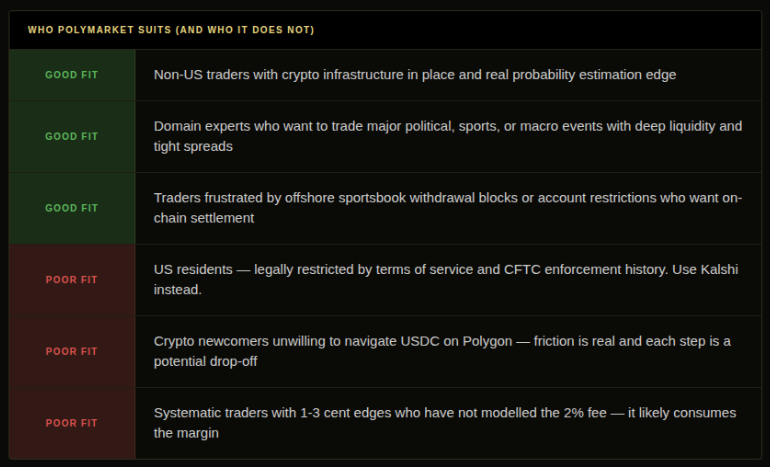
Polymarket suits: Experienced prediction market traders outside the US with crypto infrastructure already in place. Domain experts who want to trade specific political, sports, or macro events with real liquidity. Traders who value on-chain transparency and non-custodial settlement. Anyone who has been frustrated by offshore sportsbook account restrictions or withdrawal delays.
Polymarket does not suit: US residents (legally). Traders new to crypto who are not willing to navigate the wallet and USDC setup. Traders who primarily want to bet on niche sports events with large positions (most niche markets are too thin). Traders operating on 1-3 cent edges who have not modelled the fee structure carefully. Anyone who wants fiat deposits and withdrawals without an intermediate crypto step.
Polymarket vs Sportsbooks: What the Math Says
The comparison between Polymarket and a traditional sportsbook shifts sharply depending on your edge.
For a trader with a genuine 8-cent edge on a 0.55 market: the Polymarket fee costs approximately 1.8 cents on a winning position. A sportsbook’s equivalent market might carry a 6-8% overround, costing the trader 3-5 cents of implied edge before they even place the position. Polymarket wins.
For a trader with no genuine edge: Polymarket’s 2% fee is a slow drain that compounds across hundreds of positions. A sportsbook’s overround is a faster drain. Both lose in the long run. The difference is speed.
The Sports Betting vs Prediction Markets article covers the differences in detail. The short version: Polymarket is better for traders with edge. Both platforms extract money from traders without it, just at different rates.
Common Mistakes
Mistake 1: Funding a Polymarket wallet before understanding the fee structure. The 2% fee on winning positions interacts with edge size in ways that matter a great deal for small-edge systematic traders and barely at all for high-edge opportunistic traders. Model your specific edge size against the fee before deploying real capital.
Mistake 2: Treating all Polymarket markets as equally liquid. The liquidity you see on the US presidential election market does not transfer to the Paraguayan municipal election market. Check specific market volume and order book depth before sizing any position. A market with $8,000 in total volume cannot absorb a $2,000 position without moving the price several cents.
Mistake 3: Assuming on-chain settlement means instant withdrawal. Withdrawing USDC from your Polymarket-linked wallet to a centralized exchange takes time and involves steps that can go wrong (wrong network selection, exchange deposit address issues). Test the withdrawal process with a small amount before building up a real balance.
Mistake 4: Ignoring the exchange on-ramp and off-ramp costs. Every centralized exchange charges fees for USDC purchase and withdrawal. Those fees are not Polymarket fees, but they are real costs of using Polymarket. A trader making 50 separate deposits and withdrawals over a year is paying exchange fees each time. Factor this into your total cost of using the platform.
The Tool Layer That Makes It Work
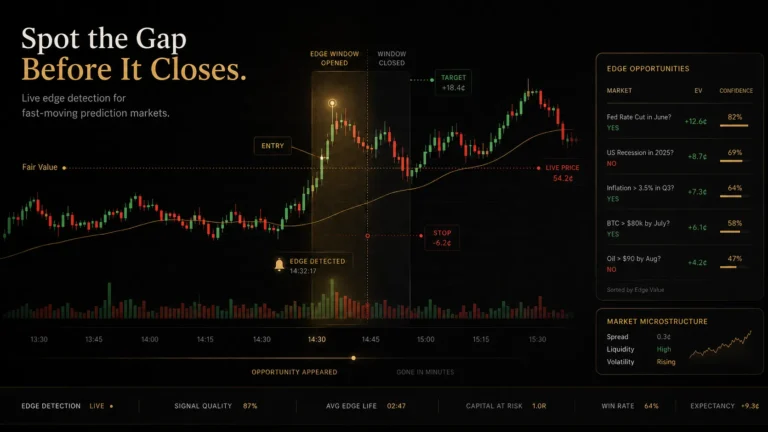
For traders who have decided Polymarket is the right platform, the next constraint is information infrastructure. Polymarket’s native interface shows prices and trade history. It does not rank markets by edge, calculate fair value, track EV-adjusted return, or surface breaking signals before prices move.
DG3 is a terminal built specifically for Polymarket. Its Fair Value Engine, Edge Finder, Intelligence pane, and Portfolio screen provide the analytical layer that the native Polymarket interface does not. Whether Polymarket is worth it for you depends partly on the platform and partly on whether you have the tools to use it well. The Best Polymarket Tools guide covers the full tool landscape.
Frequently Asked Questions
Q: Is Polymarket legit in 2026? A: Yes. Polymarket is a legitimate, functioning prediction market platform with billions of dollars in historical trading volume, on-chain settlement via Polygon, and a transparent resolution process through UMA Protocol. It has faced regulatory scrutiny in the US, and US residents are restricted from trading on it, but the platform itself is not a scam or exit risk in the conventional sense.
Q: Can you make money on Polymarket? A: Traders with genuine probability estimation edge, where their estimates of event outcomes are consistently better calibrated than market prices, can and do make money on Polymarket over large sample sizes. Traders without genuine edge will lose money to the 2% fee and variance over time, as with any market. The platform does not generate or guarantee returns.
Q: Is Polymarket good for sports trading? A: Polymarket is good for major sports events (World Cup, NFL playoffs, major football leagues) where liquidity is deep and prices are tightly set. For niche sports events or lower-tier competitions, markets are often thin and spreads are wide. The value proposition for sports traders depends heavily on which sports and which events you want to trade.
Q: How does Polymarket compare to sportsbooks? A: Polymarket’s advantage is lower margin in absolute terms for traders with real edge. A sportsbook’s overround costs traders 5-10% on every market. Polymarket’s 2% fee on winning positions is lower for high-edge traders. The disadvantage is the crypto-native UX, US restrictions, and variable liquidity across markets. For traders with real edge, Polymarket is the better platform. For traders without it, both platforms extract money at different rates.
Q: What are Polymarket’s biggest weaknesses? A: US access restrictions (the platform is not legally available to US residents), crypto-native UX requiring USDC on Polygon, severe liquidity concentration in a small number of top markets, and the 2% fee on winning positions that is material for small-edge systematic trading. The gap between the liquidity on major markets and the rest of the catalogue is larger than most reviews acknowledge.
Q: How does Polymarket’s withdrawal process work? A: Your USDC sits in a non-custodial wallet you control. To withdraw, you transfer USDC from your Polygon wallet to a centralized exchange that supports Polygon USDC deposits, then convert to fiat or hold as USDC. The steps require crypto exchange access and familiarity with network selection to avoid sending funds to the wrong chain. Test with a small amount first.
Q: Is Polymarket available in the US? A: No. Polymarket restricts US IP addresses and its terms of service prohibit US persons from trading. The CFTC has taken enforcement action against Polymarket in the past. Kalshi is the CFTC-regulated alternative for US residents, with full legal standing but lower liquidity on most markets.
Final Thoughts
Polymarket is worth it if you are the right trader in the right jurisdiction with the right tools and the right edge.
For non-US traders with crypto infrastructure, genuine probability estimation skill, and a systematic approach to position sizing and P&L tracking, Polymarket is the best prediction market available in 2026. The liquidity on major events is unmatched. On-chain transparency is a real improvement over traditional alternatives, and the fee structure is competitive for traders operating with real edge.
For everyone else, the gaps are real. US restrictions are not a technicality. Crypto friction is not a minor setup cost. Thin liquidity on most markets is not a reason to avoid Polymarket entirely, but it is a reason to check specific market volume before assuming the headline liquidity figures apply to your trades.
The answer to “is it worth it” is not the same for every trader. This article has given you the variables. The answer is yours to calculate.
Sign up now – DG3 Terminal
Also read:
Kalshi vs Polymarket: Fees, Liquidity, Markets, and Who Should Trade Where
Sports Betting vs Prediction Markets
The Best Polymarket Tools in 2026: What Serious Traders Are Actually Using