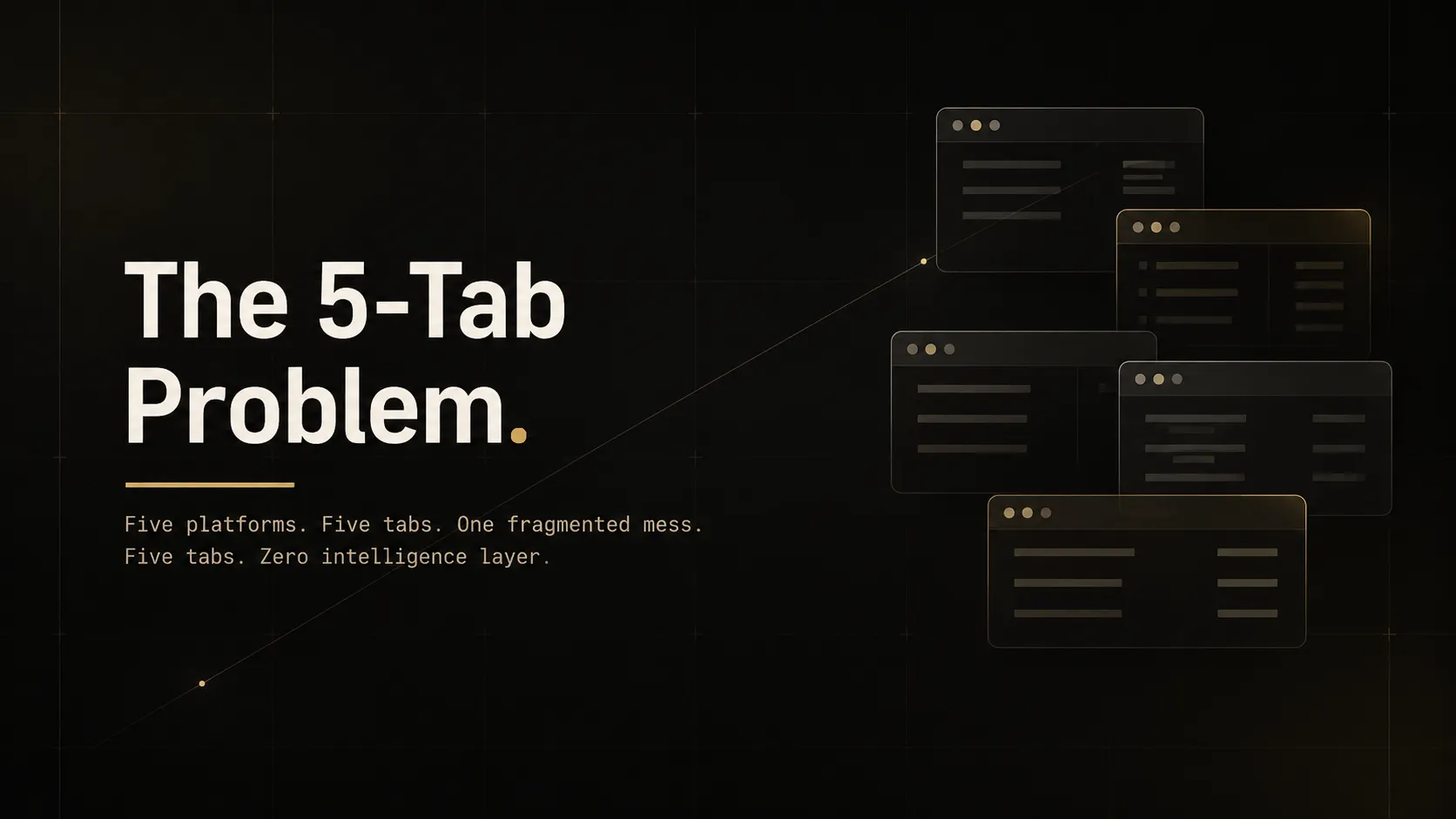
The 5-Tab Problem
Why serious traders are still stitching Polymarket, Kalshi, Azuro, Twitter, and a spreadsheet by hand.
It’s 7:43 AM. European open in 17 minutes.
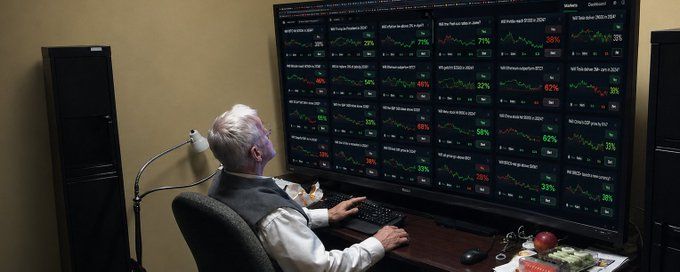
You’ve got a position to size, a line that’s moving, and five tabs open like you’re some kind of degenerate air traffic controller.
Table of Contents
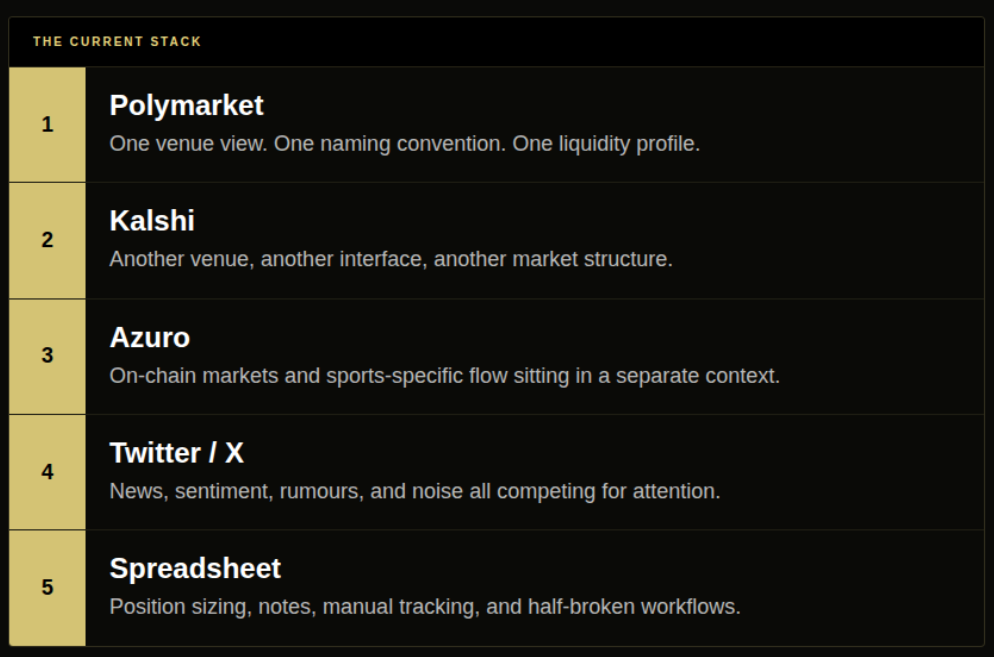
Polymarket. Kalshi. Azuro. Twitter. Spreadsheet.
This is the prediction market trading terminal of 2026 – except it isn’t a terminal. It’s a patchwork.
A bespoke, unauditable, non-scalable mess that serious traders have normalised because nobody built anything better.
The platforms were never built for traders
Let’s be honest about what Polymarket, Kalshi, and Azuro actually are: infrastructure plays. Polymarket lists markets. Kalshi adds regulatory credibility. Azuro brings on-chain composability. All genuinely impressive in their lane.
But none of them were built around a professional workflow. They were built around the listing. Get the contract live. Get liquidity in. Get resolution right. The trader experience was always the afterthought – because in the early days, traders were just happy prediction markets existed at all.
That era is over.
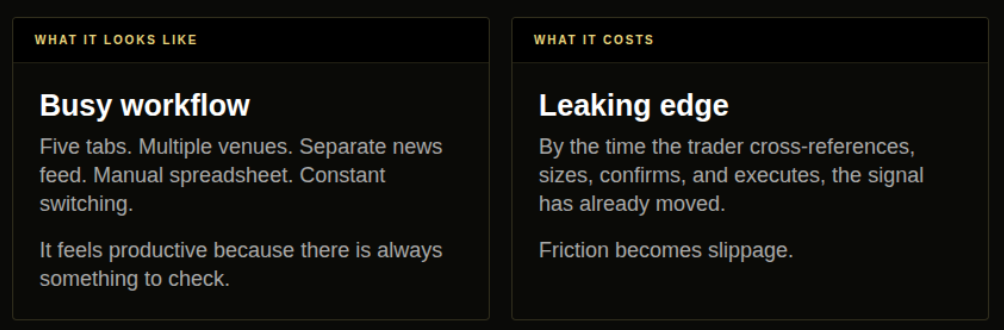
In traditional finance, professionals don’t manage their book through an exchange’s native UI. They use tools that aggregate across venues, surface line movement, alert on volume anomalies, and execute without friction. The prediction market world never built that layer. So traders built their own – five fragile tabs and a spreadsheet nobody else can run.
The hidden cost isn’t time. It’s edge.
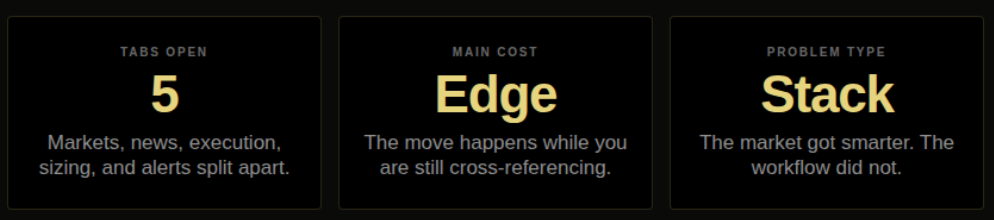
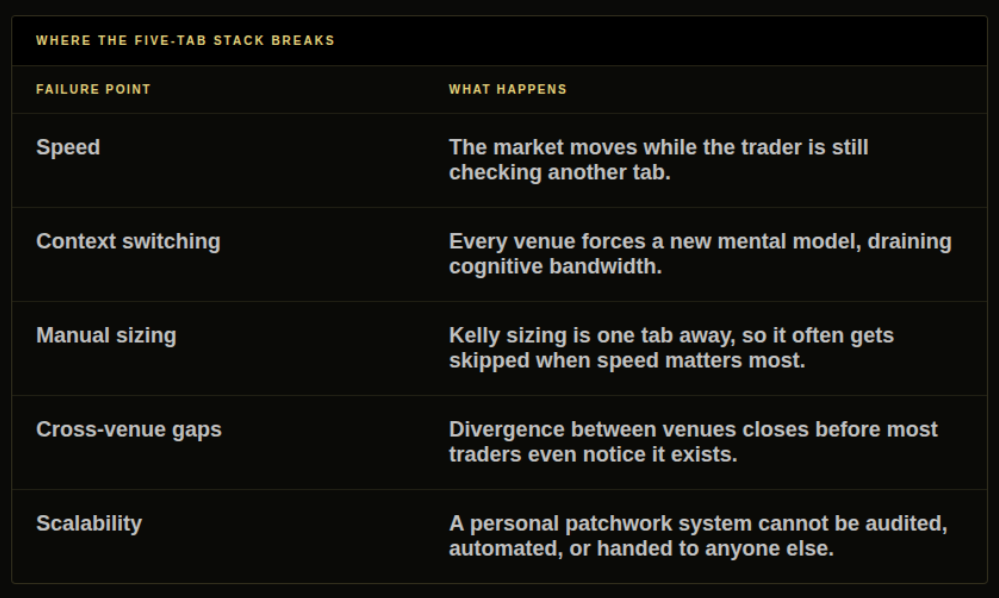
The obvious problem is speed. You’re reacting instead of anticipating. The move happens while you’re still cross-referencing.
But the deeper cost is cognitive bandwidth.
Switching platforms isn’t just switching tabs. It’s switching mental models. Each venue has different UX, different contract naming conventions, different liquidity profiles. Twitter demands a completely different mode of attention altogether. Every context switch burns capacity – capacity you could be spending on the actual prediction.
Think about what a sharp session actually looks like: running pre-match analysis on a Champions League fixture, checking asian handicap lines across venues, monitoring an open position on a Champions League outright, scanning for news flow that hasn’t hit price yet. You’re already near cognitive capacity. Friction at that point isn’t a minor annoyance – it’s where edge leaks.
The traders who feel this most aren’t casual users. They’re the semi-pros and professionals doing real volume, sizing real positions, and operating at the edge of what current tooling allows. Their system works. Until it doesn’t.
The market got smarter. The stack didn’t.
Two years ago the five-tab problem was tolerable. Mispricings were wide. Edge was obvious. The crowd was slow. If you were right, you got paid – operational friction barely mattered.
That’s not this market.
The easy arbs are gone. Liquidity is deeper. Implied probabilities on major events – from election contracts to gold market forecasts to correct score markets on top European fixtures – get sharp fast. Cross-venue divergence still exists, but it closes in minutes, not hours. Volume anomalies that used to sit open long enough to exploit are getting arbed out before most traders even see them.
In an efficient market, edge doesn’t come from a better hunch. It comes from better information, faster synthesis, and cleaner execution. The traders winning now built systematic workflow advantages. The ones still running the five-tab stack are watching their margins compress and wondering why.
The fragility is structural. You can’t scale your personal system. You can’t audit it. You can’t hand it to anyone else. It’s a workaround dressed up as a workflow – and in a maturing market, that gap costs real money.
What the intelligence layer actually looks like
The space doesn’t need more prediction markets. It needs a terminal on top of the ones that already exist.
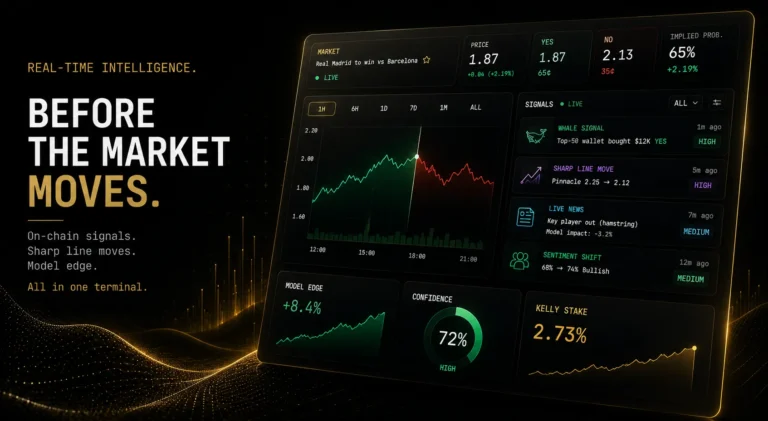
One unified view starting with Polymarket, the deepest prediction market liquidity pool with cross-venue expansion planned as the market matures. Real-time EV ranking. Volume anomaly alerts.
Volume anomaly alerts. Momentum shift detection before the crowd reprices.
A X search list. A spreadsheet they built themselves. A Kelly criterion calculator in a separate window. A Telegram group where someone sometimes mentions a sharp line move before it’s priced in.
Both traders are trying to find edge and act before the market adjusts. One has a trading terminal built for the job. The other is using scaffolding.
The answer is not another tab. The answer is a layer that turns scattered information into a trading workflow.
The infrastructure pattern every market follows
Bloomberg didn’t invent new data. It built the layer that made existing data usable: real-time, integrated, actionable. Crypto followed the same arc. On-chain traders were manually reading Etherscan until Nansen, Dune Analytics, and Glassnode built the intelligence layer. Whale wallet tracking became a product. Sentiment dashboards became standard. What had been manual and leaky became systematic.
Every maturing financial category follows this arc: raw markets first, infrastructure follows. Prediction markets are mid-transition. The liquidity is real. Contract quality on Polymarket, Kalshi, and Azuro has improved dramatically. Regulatory clarity is arriving.
The intelligence layer is arriving. Most traders are still on the five-tab stack.
What the gap costs, specifically
Sharp money moves invisibly. A line shift on a sharp venue is often the earliest signal that something has changed in an underlying market. By the time a prediction market trader manually checks their second tab, the market has adjusted. The signal existed. It was just somewhere they weren’t looking.
News-to-line lag is structural. When a key injury drops or a macro print surprises, the information hits Telegram and financial Twitter before it hits market prices. Traders with integrated news monitoring act in seconds. Traders with a separate news tab act in minutes. That window is where edge lives, and right now it belongs almost entirely to whoever built their own monitoring infrastructure.
On-chain data is public and almost entirely ignored. Large position flows on decentralized prediction markets often precede line movements by enough time to be actionable. The data is visible to anyone who can read it. Almost no prediction market trader can, because the translation layer doesn’t exist as a product.
Kelly sizing gets skipped. The math for optimal position sizing is one tab away, so it doesn’t get used. Edge leaks in the friction.
Cross-venue divergence goes unread. When Polymarket and Kalshi price the same event differently, that gap is a signal: one venue is getting information the other hasn’t priced yet. Nobody has a clean cross-venue view. The signal sits there, unclaimed.
The window is open now
The traders building systematic prediction market workflows today or finding the right analytics platform first are accumulating the same compounding advantage that early Bloomberg users did in equities, or early Nansen users did in crypto. Not because they are smarter. Because they can analyse the signals better in the same period of time.
That window closes as infrastructure catches up to liquidity. It always does.
Polymarket’s accuracy during the 2024 US election brought mainstream financial attention to decentralized prediction markets. Kalshi’s regulatory clarity opened institutional doors. The volumes that justify professional tooling today will look small in three years.
The intelligence layer for prediction markets doesn’t exist yet, not in any form that is functional, integrated, and built for how traders in this space actually operate. The market has outgrown its tools. That is the gap. And the gap is the opportunity.
The Bottom Line Serious prediction market traders are not short on information. They are short on usable infrastructure. The five-tab stack worked when markets were inefficient, slow, and forgiving. It breaks when liquidity deepens, signals move faster, and execution windows compress. DG3 is building the intelligence layer for prediction markets. If you’re serious about prediction markets and tired of duct-taping your own infrastructure, this terminal is for you.
Also read:
Bloomberg for Equities. Nansen for Crypto. 7 tabs for Prediction Markets. Until Now.
What Is a Prediction Market Terminal? (And Why Traders Outgrow Raw Polymarket)
Prediction Market Platforms Have Failed Both Casual & Pro Traders
Sign up now – DG3 Terminal