Kelly Criterion Calculator: Optimal Stake Sizing for Prediction Markets
You found the edge. You confirmed the fair value. You know the outcome is mispriced. The last question is: how much of your bankroll goes on this trade?
Most traders guess. They have a feeling about the size, larger when confident, smaller when uncertain, and they act on the feeling. The problem is that confidence and edge are not the same thing, and feelings about position size have no mathematical grounding. The Kelly criterion is the mathematical grounding.
Table of Contents
Quick Answer
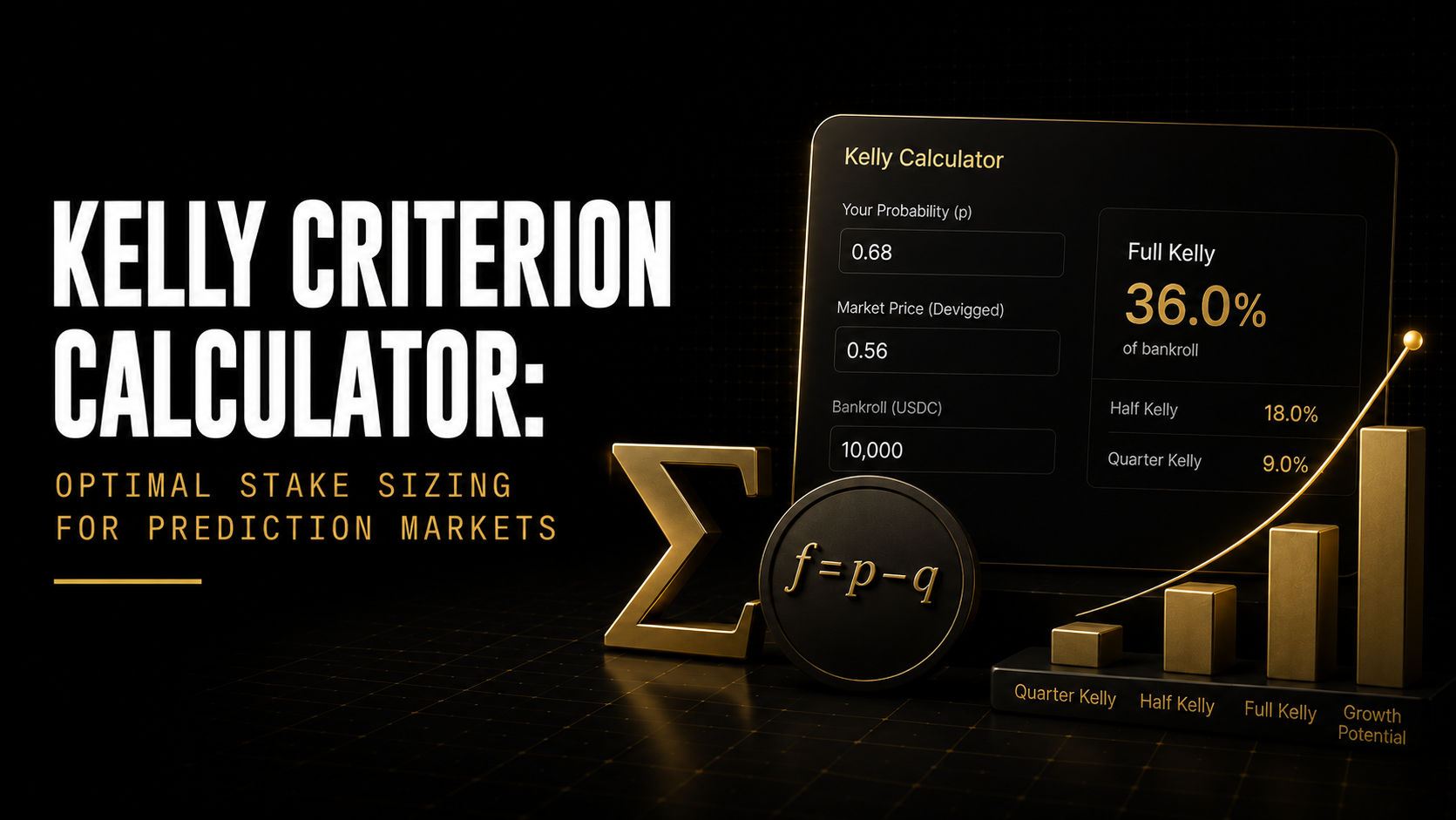
The Kelly criterion calculator for prediction markets uses three inputs, your probability estimate, the devigged market price, and your bankroll, to output the mathematically optimal position size. The formula is: f = (p – q) / 1, where f is the fraction of bankroll to stake, p is your estimated probability of winning, and q is your estimated probability of losing (1 – p). Most professional prediction market traders use half Kelly or quarter Kelly rather than full Kelly to reduce variance while preserving most of the growth rate advantage.
Key Takeaways
- The Kelly criterion does not predict outcomes. It calculates the position size that maximises long-run bankroll growth given your edge estimate. The distinction matters: a correctly sized Kelly position can still lose. The mathematics only holds over many positions, not on any individual trade.
- The Kelly formula’s output is a fraction of your bankroll, not a fixed dollar amount. This means position sizes automatically scale as your bankroll grows or shrinks. A 24% full Kelly fraction on a $2,000 bankroll is $480. The same fraction on a $1,000 bankroll after a losing period is $240. The position sizes adjust to protect against ruin automatically.
- Full Kelly maximises long-run geometric growth but produces severe variance. Half Kelly captures approximately 75% of maximum geometric growth with roughly 75% less variance. This asymmetric trade-off is why half Kelly is the near-universal professional default rather than a conservative choice.
- The most common error in Kelly calculation is using the raw Polymarket price as the probability estimate rather than the devigged fair value. The raw price includes approximately 2% platform margin. Using it as the benchmark understates your edge by the amount of that margin. Always devig before calculating.
- Kelly is only as good as the probability estimate going in. A miscalibrated probability model produces a confidently wrong position size. Kelly calculation and probability model quality are not separable. Build the calibration record first.
- Correlated positions break Kelly’s assumption of independence. Three Kelly-sized positions that all depend on the same team’s tournament result collectively represent far more than three independent Kelly fractions of bankroll. Portfolio-level exposure monitoring is essential alongside per-position Kelly calculation.
- Quarter Kelly is appropriate when edge estimate uncertainty is high, when the probability model has fewer than 50 resolved positions of calibration data, when the market category is new, or when external factors make fair value estimation unreliable. The key insight: Kelly assumes your edge estimate is correct. When that assumption is weaker, use a smaller fraction.
The Kelly Formula for Binary Prediction Markets
Kelly criterion (binary): f = p – q, where f is the fraction of bankroll to stake, p is your estimated probability of the outcome occurring, and q is your estimated probability of it not occurring (1 – p). This simplifies from the full Kelly formula for binary outcomes where the payout is $1.00 per $1.00 wagered.
The formula assumes: your probability estimate is accurate, the edge is real and not the result of a devigged price calculation error, and the position is independent from all other open positions.
Step-by-step calculation:
- Estimate your probability of the outcome occurring (p). This should come from your research, not from the market price.
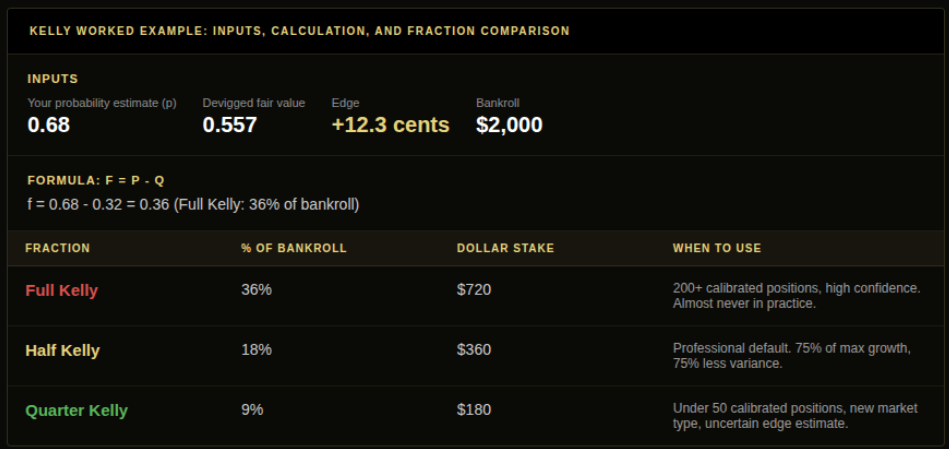
- Devig the current Polymarket price. If YES is priced at 0.58 and NO at 0.46, devig: YES fair value = 0.58 / (0.58 + 0.46) = 0.557. NO fair value = 0.46 / 1.04 = 0.443.
- Compare your estimate to the devigged fair value. If you estimate 0.68 and the devigged fair value is 0.557, your edge is 0.68 – 0.557 = 12.3 cents.
- Apply the formula: f = p – q = 0.68 – 0.32 = 0.36. Full Kelly recommends 36% of bankroll.
- Apply your fraction modifier. At half Kelly: 0.36 x 0.5 = 0.18, or 18% of bankroll. At quarter Kelly: 0.09 or 9%.
Also read: Kelly Criterion for Prediction Markets: Sizing Positions When Odds Move
Full Kelly, Half Kelly, Quarter Kelly: Which to Use
The choice of Kelly fraction is a judgment call about how confident you are in the accuracy of your probability estimate and how much variance you can tolerate between position sizes.
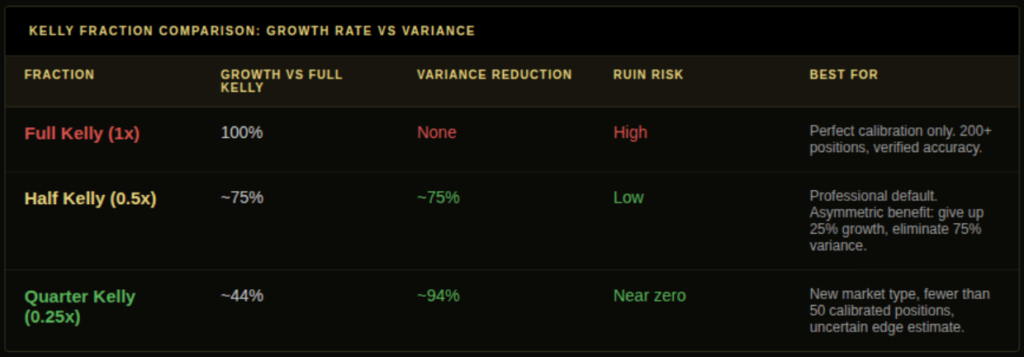
Full Kelly: Mathematically optimal for long-run growth given perfect probability estimates. In practice, almost no professional prediction market trader uses full Kelly, because the variance is severe enough that even a modest overestimate of edge produces a period of outsized drawdowns. Full Kelly is appropriate only if your calibration record shows strong accuracy across 200+ resolved positions and you are confident in the current estimate.
Half Kelly: The near-universal professional default. Captures approximately 75% of maximum geometric growth. Variance is reduced by approximately 75% relative to full Kelly. The mathematical asymmetry is the reason: you give up 25% of maximum growth to eliminate 75% of variance. Ed Thorp, who formalised Kelly application for investors, defaulted to half Kelly in practice.
Quarter Kelly: Appropriate when edge estimate uncertainty is high. A strategy with fewer than 50 resolved calibration positions should use quarter Kelly or smaller until the calibration record is more established. Also appropriate when the market type is new, when external factors make fair value estimation unreliable, or when you want to treat the position as a research investment in a new market category rather than a full-conviction bet.
Also read: Half Kelly, Quarter Kelly, Full Kelly: Choosing Your Fraction
Common Inputs and What They Produce
Running the Kelly formula across common market scenarios:
Scenario 1: Strong edge, liquid market
- Your estimate: 0.72 probability of YES
- Devigged fair value: 0.61
- Edge: 11 cents
- Full Kelly: f = 0.72 – 0.28 = 0.44 (44% of bankroll)
- Half Kelly: 22% of bankroll
- On $2,000 bankroll: $440 at half Kelly
Scenario 2: Modest edge, standard market
- Your estimate: 0.65 probability of YES
- Devigged fair value: 0.59
- Edge: 6 cents
- Full Kelly: f = 0.65 – 0.35 = 0.30 (30% of bankroll)
- Half Kelly: 15% of bankroll
- On $2,000 bankroll: $300 at half Kelly
Scenario 3: Thin edge, approaching minimum threshold
- Your estimate: 0.63 probability of YES
- Devigged fair value: 0.60
- Edge: 3 cents, likely below fee threshold at this price level
- Full Kelly: f = 0.63 – 0.37 = 0.26 (26% of bankroll)
- Half Kelly: 13% of bankroll
- But: The 2% Polymarket market order fee costs approximately 2 cents on a $0.60 price. Net edge after fees is 1 cent. This position does not have sufficient net edge to justify the Kelly stake. Pass.
Scenario 4: No edge found
- Your estimate: 0.60 probability of YES
- Devigged fair value: 0.61
- The market is pricing the outcome at a slightly higher probability than your estimate. There is no edge in the YES direction. Check whether NO has edge.
When Kelly Gives Wrong Answers
The Kelly criterion assumes your probability estimate is correct. When that assumption breaks, Kelly outputs a confidently wrong number.
Wrong input 1: Using the raw price instead of the devigged fair value. If YES is priced at 0.62 and you are comparing your 0.70 estimate against 0.62 rather than the devigged 0.597, you are overstating edge by approximately 2.3 cents. Kelly will tell you to stake 40% of bankroll when the correct answer is 30%.
Wrong input 2: Probability estimate with no calibration backing. A first-time assessment of a market type you have never traded produces an estimate with no track record to validate it. Kelly run on an uncalibrated estimate produces a number that sounds precise but has no mathematical validity. Use quarter Kelly or smaller until you have 30+ resolved positions in the same market type.
Wrong input 3: Correlated positions counted independently. You have four open positions: a tournament outright YES on Brazil at 10% Kelly, a group stage YES on Brazil at 12% Kelly, a Brazil top scorer prop at 8% Kelly, and a Brazil vs France match winner YES at 9% Kelly. Each is correctly sized at its individual Kelly fraction. But the four positions collectively represent 39% of bankroll on outcomes that are highly correlated, Brazil’s star player getting injured affects all four simultaneously. Kelly applied to each independently does not account for this.
Also read: Correlated Markets in Prediction Markets: Managing Portfolio Risk
Common Mistakes
Mistake 1: Skipping the devig step before calculating edge. Using the raw Polymarket price as your benchmark systematically understates edge by approximately 2%. On small-edge positions (3-6 cents), a 2-cent devig error can turn a positive-edge trade into a no-edge trade, or worse, cause you to stake a Kelly fraction on what is actually a negative-edge position.
Mistake 2: Running Kelly on the first 20 trades and wondering why the results are volatile. Kelly’s mathematical properties hold over large samples. Across 20 trades, variance dominates. A 70% probability outcome resolves 30% of the time in a 20-trade sample more often than intuition suggests. The Kelly framework is a long-run process. Judge it over 100+ resolved positions, not 20.
Mistake 3: Using full Kelly because “the edge is strong.” Full Kelly is not more appropriate when you are more confident, it is more dangerous, because overconfidence in your edge estimate is exactly the condition under which full Kelly fails catastrophically. When you are most confident, you are also most likely to have unconsciously overfit your estimate to available evidence. Half Kelly is not a hedge against low confidence. It is a hedge against the inevitable gap between your edge estimate and the true edge.
Mistake 4: Not applying a minimum edge threshold. Kelly will calculate a stake size for any positive edge, no matter how small. A 0.5-cent edge at a 0.60 price level produces a Kelly fraction of approximately 3%. On a $2,000 bankroll, that is $60. But the Polymarket market order fee eats approximately 2 cents on a $0.60 market, leaving net edge of -1.5 cents. The position is negative EV after fees despite appearing to have positive edge before fees. Set a minimum edge threshold (typically 3-4 cents after the 2% fee) before running Kelly.
Mistake 5: Changing position size mid-position based on new information without a systematic rule. Once you set a Kelly-based position size at entry, changing it requires a formal probability update, not a feeling. “I still believe this is right” is not a reason to add. “The reference book line has moved 3 cents in my direction and a CLV-qualified wallet entered at a price 5 cents worse than mine” is a reason to add, because it is a systematic update to your probability estimate with external evidence.
Frequently Asked Questions
Q: How do I use a Kelly criterion calculator for prediction markets? A: Three inputs: your probability estimate for the outcome (formed independently before checking the market price), the devigged fair value from the current Polymarket price, and your total bankroll. Calculate edge as your estimate minus the devigged fair value. Apply the formula f = p – q. Multiply by your fraction modifier (typically 0.5 for half Kelly). The output is the percentage of bankroll to stake.
Q: What inputs does the Kelly calculator need? A: Your probability estimate (p), your implied probability of losing (q = 1 – p), and your bankroll. For prediction markets specifically, you also need the devigged fair value as the honest benchmark for your edge calculation. Using the raw price systematically understates edge.
Q: What does the Kelly fraction output mean? A: The fraction of your total current bankroll to stake on this position. A Kelly fraction of 0.18 on a $3,000 bankroll means stake $540. Not $540 per trade as a fixed rule, the fraction applies to your current bankroll, so if your bankroll drops to $2,500, the next Kelly-sized position at 0.18 is $450.
Q: Should I use the full Kelly or half Kelly output? A: Half Kelly for most positions. Full Kelly only if your calibration record shows strong accuracy across 200+ resolved positions of the same type and you are confident the current edge estimate is well-founded. Quarter Kelly when the edge estimate has fewer than 50 calibration positions behind it or when the market type is new.
Q: How does DG3 help with Kelly position sizing? A: DG3’s Trade Desk shows Kelly-sized position presets against your bankroll in the Trade Desk. The Fair Value Engine devigs live Polymarket prices, giving you a clean benchmark for edge calculation rather than the margin-inflated raw price. The sizing step is built into the execution workflow rather than requiring a separate calculator.
Q: What is the minimum edge threshold for Kelly to apply? A: After the approximately 2% Polymarket market order fee, the minimum viable edge is approximately 3-4 cents at the mid-price range (0.40-0.60). Below that, the fee consumes the mathematical edge and the trade becomes negative EV in expectation regardless of the raw edge calculation.
Final Thoughts
The Kelly criterion is not complicated. Three inputs, one formula, one output. The difficulty is not the mathematics, it is the quality of the probability estimate going in and the discipline to apply the fraction consistently rather than adjusting based on how confident you feel in the moment.
Saturday afternoon Ryan and Tuesday afternoon Ryan are two completely different people. One of them has a carefully calibrated probability estimate and a disciplined Kelly fraction. The other has a strong feeling about the outcome and no systematic framework for translating that feeling into a position size.
The Kelly calculator does not help Saturday afternoon Ryan. It helps you build the infrastructure that makes Saturday afternoon Ryan irrelevant.
Also read:
Kelly Criterion for Prediction Markets: Sizing Positions When Odds Move
Positive EV Trading: A Practical Framework for Prediction Markets
Bankroll Management