How CS2 Prediction Markets Work: Contracts, Settlement, and What Happens After the Match
You bought YES on FaZe to win the series at 0.71. FaZe won 2-0. You expected to see $1.00 in your wallet within minutes. Two hours later, you’re still looking at an open position.
Understanding how CS2 prediction markets work at every stage, especially settlement is not a secondary concern. The mechanics determine when you get paid, what happens when a match is cancelled, and why the resolution process looks different from a traditional sportsbook.
Table of Contents
Quick Answer
CS2 prediction markets on Polymarket use an Oracle system to verify match outcomes against publicly available data sources (HLTV, official tournament operators). After a CS2 match concludes, the Oracle submits the resolution. A challenge window of 2 hours opens. If unchallenged, smart contracts automatically distribute $1.00 to YES holders and $0.00 to NO holders. Cancelled or postponed matches are typically resolved as NO (position refunded at $0.00) or voided depending on market rules. Settlement typically completes within 2-6 hours of match conclusion.
Key Takeaways
- CS2 prediction markets on Polymarket settle through UMA Protocol’s optimistic oracle, not through Polymarket staff manually confirming results. The oracle process is automated and uses HLTV match data and official tournament operator announcements as resolution sources.
- The 2-hour challenge window after Oracle submission is the period during which any participant can dispute an incorrect resolution. For CS2 matches with clear outcomes, challenges are rare. For ambiguous situations (technical forfeit, match replay, rule dispute) the challenge mechanism is the recourse.
- A CS2 match cancellation or postponement does not automatically resolve the prediction market. Market rules specify the resolution criteria. Most CS2 match winner markets on Polymarket specify that a cancellation or “no contest” result resolves the market as voided, with all positions returned at the original entry price. Read the market rules before entering any CS2 market.
- CS2 prediction markets don’t resolve in real time during the match. The settlement process begins after the match concludes, not after individual rounds or maps. Mid-match price movements reflect updated probability estimates from traders, not partial resolution.
- The resolution source hierarchy for CS2 markets on Polymarket: HLTV.org official match results are the primary data source. In cases of HLTV discrepancy (technical forfeit, rule dispute), official tournament operator announcements (ESL, BLAST, IEA) take precedence. For major disputes, Chainlink oracle services provide a secondary verification layer.
- Series length markets resolve differently from match winner markets. A “Series goes to 3 maps” contract doesn’t resolve until the third map is played and its result confirmed. If a team wins 2-0, the 3-map contract resolves NO regardless of round count. Confirm you understand the resolution criteria before entering series-specific CS2 markets.
- Settlement speed varies by event timing. CS2 matches that conclude during low-traffic blockchain periods (typically overnight UTC) resolve at the same accuracy as peak-traffic periods, but oracle submission queue times can extend the settlement window to 4-8 hours. This doesn’t affect your payout, it affects when the payout arrives.
The Anatomy of a CS2 Prediction Market: How Contracts Work
CS2 prediction market contract: A binary smart contract on the Polygon blockchain that pays $1.00 (in USDC) per YES share if the specified outcome occurs, or $0.00 per YES share if it doesn’t. The contract’s resolution is triggered by an Oracle system that verifies the outcome against external data sources. The contract executes automatically without requiring manual counterparty action.
When you buy YES on a CS2 match winner market, you are acquiring a tokenised contract on Polygon. The contract’s parameters include: the outcome specification (Team A wins the series), the resolution source (HLTV match results), the resolution criteria (Team A achieves the higher win count in the series), and the handling of edge cases (cancellation = void, replay = resolved when replay result is confirmed).
The payout is fully automated. Once the Oracle confirms the outcome and the challenge window closes, USDC flows to YES holders if the outcome occurred, and stays with NO holders if it didn’t. No human at Polymarket is manually processing your CS2 position.
This has a practical implication: resolution accuracy depends on the data source being unambiguous. For clear CS2 outcomes (2-0 win, map count unambiguous), resolution is clean and fast. For edge cases, a team forfeiting due to a server issue after one map, a match result under tournament review, the process takes longer because the Oracle needs the dispute process to surface the definitive resolution.
The Resolution Process Step by Step
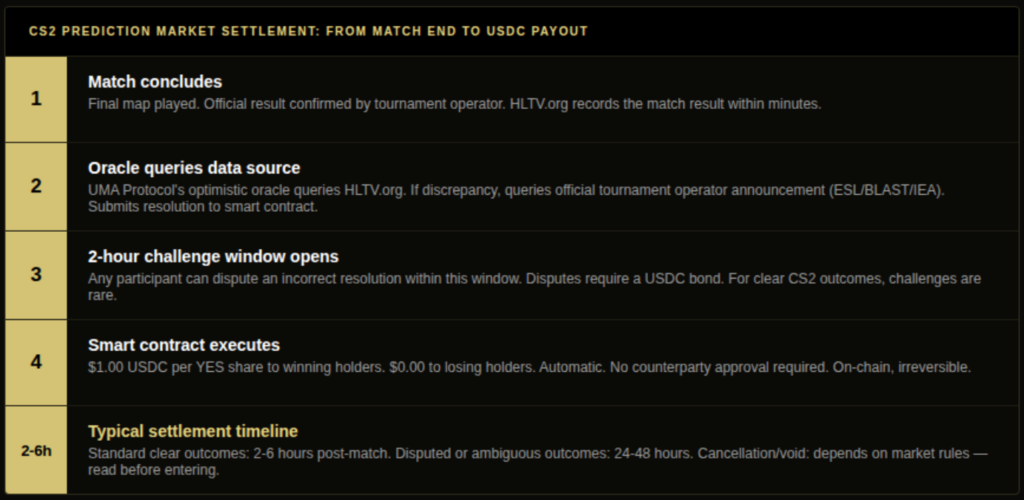
Step 1, Match concludes: The final map ends. Official result is confirmed by the tournament operator and recorded on HLTV.org.
Step 2, Oracle queries data source: UMA Protocol’s optimistic oracle queries the pre-specified data sources (HLTV result, tournament official announcement if HLTV has a discrepancy). The oracle proposer submits the resolution outcome to the Polymarket smart contract.
Step 3, Challenge window opens: A 2-hour window begins during which any market participant can dispute the proposed resolution if they believe it’s incorrect. Disputes require a USDC bond from the disputer, which is forfeited if the dispute is overturned.
Step 4, Resolution confirmed: If unchallenged, the proposed resolution is accepted. If challenged, UMA’s dispute resolution process begins, typically resolved within 24-48 hours through community vote weighted by UMA token holdings.
Step 5, Smart contract executes: USDC is automatically distributed. $1.00 per YES share goes to YES holders if outcome = YES. $0.00 per YES share if outcome = NO (position is worth zero). The settlement is on-chain, irreversible, and requires no action from market participants.
Typical timeline: 2-6 hours post-match-conclusion for standard CS2 outcomes. 24-48 hours for disputed or ambiguous outcomes.
Also read: How Do Prediction Markets Work? Contracts, Prices, and Payouts Explained
What Happens When a CS2 Match Is Postponed or Cancelled
This is the edge case that catches CS2 prediction market traders off guard. The answer isn’t universal, it depends on the market’s specific resolution criteria, which are listed in the market description on Polymarket.
Standard scenario, match cancelled before it starts: Most CS2 match winner markets on Polymarket specify that a “no contest” outcome (match cancelled, team forfeits without playing) resolves the market as voided. All positions are returned at $0.50 (50 cents per share), effectively refunding both YES and NO holders proportionally. Some markets specify resolution as NO, meaning the favourite loses their position value. Check the specific market rules.
Standard scenario, match postponed to a later date: The market typically remains open and active until the match is played, at which point normal resolution applies. If the match is postponed beyond the market’s stated expiry date, it resolves as voided.
Edge case, technical forfeit during the match: If a team forfeits after completing at least one map (e.g., due to a technical issue on map 2 of a best-of-three), the tournament operator’s ruling determines the result. BLAST, ESL, and IEA each have different default rulings on technical forfeits. The Oracle uses the tournament operator’s official ruling as the resolution source in these cases.
Edge case, match result under review: If the tournament operator places a match result under review (e.g., suspected cheating or rule violation), Polymarket’s Oracle process pauses pending the official ruling. Settlement completes after the ruling is issued. This can extend the timeline by days to weeks.
The practical advice: before entering any CS2 prediction market, read the resolution criteria in the market description. The 30 seconds spent reading the criteria is the difference between understanding your exposure and being surprised by the outcome.
Also read: What Is a Prediction Market? The Complete Guide for 2026
Oracle Sources for CS2 Markets
CS2 market resolution depends on data source quality and hierarchy. The following sources are used in order:
HLTV.org: Primary resolution source for CS2 match results. HLTV’s result database is considered the definitive record for professional CS2 match outcomes. Match results are typically reflected on HLTV within minutes of conclusion.
Official tournament operator announcements: ESL, BLAST, IEA, and Valve (for Majors) announcements take precedence over HLTV in cases of discrepancy. If HLTV’s result reflects an unofficial source or early report before the official result, the operator’s official announcement is the authoritative source.
Chainlink Oracle services: For additional verification on disputed or high-value markets, Chainlink’s data feeds provide a secondary verification layer. Used primarily when HLTV and the tournament operator announcement are inconsistent.
UMA dispute resolution: If the Oracle submits an incorrect resolution and a valid dispute is filed, UMA’s community governance resolves the dispute. UMA token holders vote on the correct outcome. Historical dispute resolution for CS2 markets has been accurate in the documented cases.
Common Mistakes About CS2 Market Settlement
Mistake 1: Expecting immediate settlement. CS2 prediction markets don’t settle the moment the final map ends. The Oracle process takes 2-6 hours for standard outcomes. If your USDC hasn’t arrived 20 minutes post-match, nothing is wrong, the process is running normally.
Mistake 2: Not reading cancellation/postponement rules before entering.
The gap between “resolves as NO” and “resolves as voided” is notable. On a 0.71 YES position, “resolves NO” means you lose 71 cents per share. “Resolves voided” means you get 50 cents per share back. These are different outcomes from the same event. The market description specifies which applies.
Mistake 3: Assuming all series markets resolve when the series winner is confirmed.
Series length markets (does the match go to 3 maps?) resolve when the third map is played if it occurs, not when the series winner is confirmed. A 2-0 win resolves the “3 maps” contract as NO. A 2-1 win resolves it as YES. The winner and the map count are independent outcomes with separate contracts.
Mistake 4: Holding through a technical dispute without monitoring.
If a CS2 match enters a dispute period (tournament under review, result conteste d), your position remains open and active on the secondary market. The price will typically move toward 0.50 while the dispute is pending. You can exit at the prevailing market price during the dispute window rather than holding through an extended resolution period.
Mistake 5: Confusing DFS resolution with prediction market resolution. Daily Fantasy Sports formats resolve based on statistical performance thresholds applied across the event. Prediction market contracts resolve on binary outcomes. A CS2 player kill prop (over/under 21 kills) resolves the moment the map ends and HLTV posts the official kill count. There’s no DFS-style scoring calculation.
Frequently Asked Questions
Q: How do CS2 prediction market contracts settle? A: UMA Protocol’s optimistic oracle queries HLTV.org and official tournament operator announcements after the match concludes. The oracle proposes a resolution. A 2-hour challenge window opens. If unchallenged, the Polymarket smart contract automatically distributes $1.00 per YES share to winning holders. Settlement typically completes 2-6 hours post-match.
Q: What happens if a CS2 match is postponed or cancelled? A: Depends on the market’s stated resolution criteria. Most match winner markets on Polymarket specify void resolution (50 cents per share returned) for cancellations and extended postponements. Some specify NO resolution. Read the market description before entering.
Q: Who decides the outcome of a CS2 prediction market? A: UMA Protocol’s optimistic oracle, using HLTV match results as the primary data source and official tournament operator announcements as the override source. Market participants can dispute incorrect resolutions within the 2-hour challenge window.
Q: How long does CS2 market settlement take? A: 2-6 hours for clear outcomes. 24-48 hours for disputes or ambiguous outcomes. Matches that end during low-traffic blockchain periods may extend to 4-8 hours without any issue in resolution accuracy.
Q: What resolution source do CS2 prediction markets use? A: HLTV.org for official match results as the primary source. ESL, BLAST, IEA, and Valve tournament operator announcements for override in cases of discrepancy. Chainlink Oracle services as secondary verification on high-value or disputed markets.
Q: Can you exit a CS2 prediction market position before settlement completes? A: Yes. The secondary market remains active after match conclusion during the settlement window. You can sell your YES or NO shares at the prevailing market price during this period. In most cases, the market price converges toward $1.00 or $0.00 immediately after match conclusion, before the official oracle settlement.
Q: What happens to a CS2 market position during a dispute? A: The market stays open on the secondary market. The price typically moves toward $0.50 during the dispute period as uncertainty is priced. You can exit at the prevailing market price or hold through resolution.
Final Thoughts
Understanding how CS2 prediction markets work at the settlement level separates traders who are genuinely comfortable with prediction market mechanics from those who are operating on assumptions that occasionally produce surprises.
The Oracle process, the challenge window, the cancellation rules, none of these are complicated. But not knowing them produces entirely avoidable confusion: holding a winning position and wondering why USDC hasn’t arrived, entering a market without knowing its cancellation resolution rules, or holding through a dispute period when exiting at $0.50 would have been the better choice.
The mechanics are in the market description. Read them before entering. Everything after that is just waiting for the Oracle to confirm what the final score already told you.
Also read: CS2 Prediction Markets: The Complete Guide for Traders in 2026
What Is a Prediction Market? The Complete Guide for 2026
How Do Prediction Markets Work? Contracts, Prices, and Payouts Explained