CS2 Odds Comparison Tool: How to Find the Best Line Across Prediction Markets
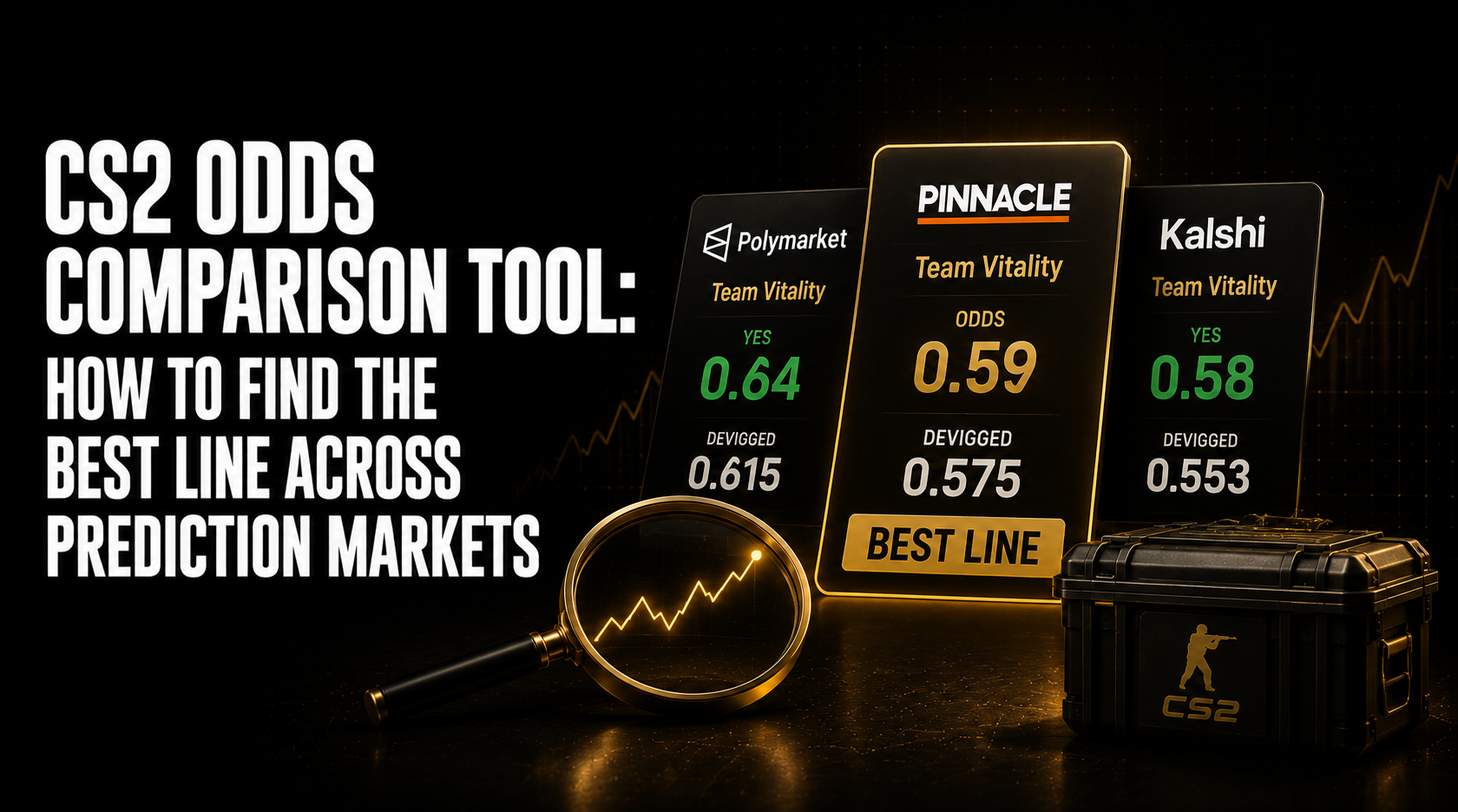
You checked Polymarket. The line is 0.64 for Team Vitality to win the series. You closed the tab. You placed the trade. You didn’t check anywhere else.
Two minutes later someone in a CS2 trading Telegram posts that Kalshi has the same market at 0.58. The gap is 6 cents. After devigging both, you entered on the wrong side of a material price discrepancy without knowing it existed.
The CS2 odds comparison step isn’t optional.
Table of Contents
Quick Answer
A CS2 odds comparison tool cross-references prices across prediction market platforms and sharp sportsbooks to surface the best available line for any CS2 match. The workflow: devig the Polymarket price, devig the Pinnacle line, compare your model estimate against both, and identify the platform where the devigged price diverges most from your estimate. DG3’s Edge Finder automates the Polymarket vs Pinnacle comparison step, showing the EV gap in real time on every active CS2 market.
Key Takeaways
- Line shopping in Line shopping in CS2 prediction markets isn’t a price-hunting exercise. It’s about finding the market where the current devigged price diverges most from your probability model, which may not be the same market with the highest raw price once fees are accounted for.
- The Pinnacle CS2 line is the sharpest publicly available reference for CS2 match odds. After devigging, it represents the most sophisticated aggregate pricing available to retail participants. Using it as your primary external benchmark before checking prediction market prices is the baseline for any serious CS2 odds comparison workflow.
- Cross-platform CS2 odds gaps of 4+ cents (after devigging both platforms) are worth investigating. In a sample of 34 ESL Pro League S19 matches listed on both Polymarket and Kalshi, the average opening gap was 3.8 cents. Gaps narrowed to under 1 cent within 47 minutes on average.
- CS2 odds comparison tools divide into three categories: manual comparison (you devig and compare yourself), aggregator APIs (tools that pull lines from multiple sources and display devigged probabilities), and terminal layers (DG3’s Edge Finder, which automates the Polymarket vs Pinnacle comparison and ranks markets by the resulting EV gap).
- Line shopping has a time constraint in CS2 markets. On liquid match winner markets during majors, a 5-cent gap across platforms typically narrows within 10-20 minutes. The value of a CS2 odds comparison tool is speed, not just accuracy.
- The fee structure affects which platform offers the best net line even when gross prices are identical. Polymarket’s 2% market order fee and Kalshi’s variable fee structure mean a 0.62 raw price on both platforms doesn’t produce the same net edge after fees.
- DG3’s Edge Finder is not a cross-platform aggregator, it covers Polymarket vs Pinnacle Signal, not Polymarket vs Kalshi. For cross-prediction-market comparison between Polymarket and Kalshi, you currently need to do the devig calculation manually on both platforms.
What a CS2 Odds Comparison Tool Actually Does
CS2 odds comparison tool: A workflow, aggregator, or terminal feature that pulls current prices from multiple CS2 prediction market or sportsbook sources, removes margin through devigging, and presents the resulting honest probabilities side by side to identify the best available line or the largest cross-platform divergence.
The goal is finding the largest gap between a devigged market price and your independent probability model output, because that gap, net of fees, is your edge.
Manual CS2 odds comparison works like this:
- Pull the raw price for Team A on Polymarket (YES = 0.64, NO = 0.40, sum = 1.04)
- Devig Polymarket: Team A devigged = 0.64 / 1.04 = 0.615
- Pull the Pinnacle line for the same match and devig it
- Pull Kalshi’s price if available and devig it
- Compare all three devigged probabilities against your map pool model estimate
- The platform with the largest gap in your model’s favour is your target
This process takes 5-8 minutes per match. For a CS2 major with 12 matches in the group stage, that’s 60-96 minutes of manual work before the first match starts. Tools that automate step 2 and step 3 compress this substantially.
Also read: CS2 Esports Odds: How to Read, Compare, and Trade Counter-Strike Markets
Pinnacle as the CS2 Reference Line
Pinnacle is the standard professional reference for CS2 line quality. Three structural reasons:
First, they accept professional bettors and don’t ban winning accounts. This means sharp money flows into Pinnacle rather than being excluded, which makes their line a more accurate aggregate of informed opinion.
Second, their margin on CS2 is the lowest available from any major sportsbook (1.8-2.2%), which means the raw price is closer to the true probability than any higher-margin alternative.
Third, they’re consistently first to move on notable CS2 events, stand-in announcements, map veto outcomes, coaching changes. Polymarket lags Pinnacle by 8-20 minutes on average on information events. That lag is the gap your comparison tool is trying to surface.
Available CS2 Odds Comparison Resources in 2026
Pinnacle.com: Pull the CS2 match line directly. No tool required. Devig manually (divide each price by the sum of both prices). The process is 60 seconds per match. Essential as your first comparison point before checking prediction markets.
DG3 Edge Finder: Automates the Polymarket vs Pinnacle Signal comparison for every active CS2 Polymarket market. The EV chip on each market row shows the devigged gap in real time. Markets are ranked by this gap, the largest EV divergences surface at the top of the list. This covers the Polymarket vs Pinnacle comparison. It doesn’t cover Polymarket vs Kalshi.
Manual Polymarket vs Kalshi: No automated aggregator covers this cross-platform comparison reliably in 2026. Both platforms require separate manual devig calculations. The 5-minute process: pull Polymarket price, devig. Pull Kalshi price, devig. Compare. Relevant primarily for US-based traders on Kalshi who want to calibrate against Polymarket pricing.
OddsJam and similar aggregators: Aggregator tools exist for traditional sportsbook CS2 lines. Their prediction market coverage is inconsistent. HLTV.org betting analytics pages aggregate some community-tracked CS2 lines but don’t cover prediction market devigged prices. Useful as supplementary context, not as a primary comparison tool.
Thunderpick and similar esports books: Additional CS2 sportsbook lines available. Variable margin (typically 4-8% on CS2), lower sharpness than Pinnacle. Worth checking as a third data point on fixtures where Pinnacle and your model disagree.
Also read: CS2 Prediction Markets: The Complete Guide for Traders in 2026
Building a CS2 Line Shopping Workflow
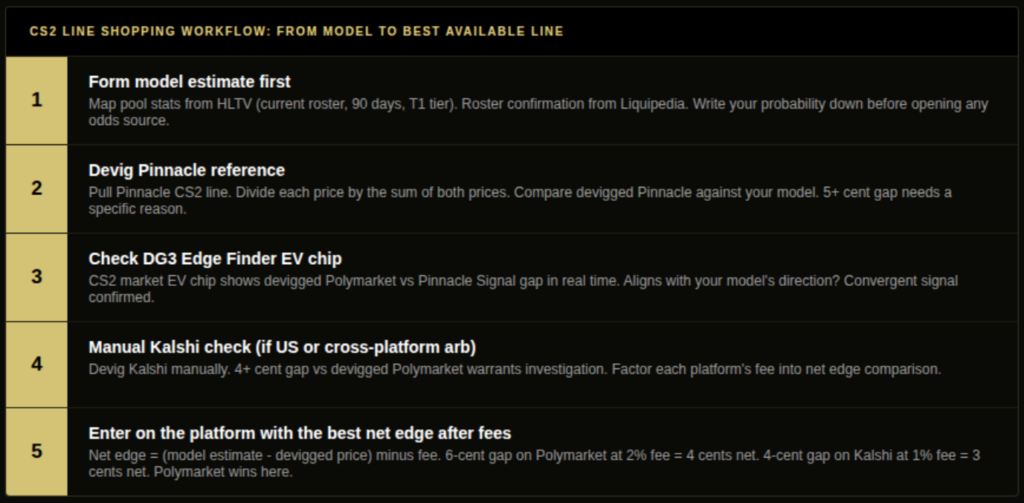
Time budget for a single CS2 match comparison: 8-12 minutes for a full workflow, 3-4 minutes using the DG3 Edge Finder for the Polymarket vs Pinnacle step.
Step 1 (Model first): Form your own probability estimate from map pool data and roster confirmation before checking any external line. Write the number down. This is your anchor.
Step 2 (Pinnacle reference): Devig the Pinnacle CS2 line. Compare against your model. Document the gap.
Step 3 (Polymarket check via DG3): Open the Edge Finder. The EV chip on the CS2 match already shows the Polymarket vs Pinnacle devigged gap. If it aligns with your model’s directional view, you’re looking at a convergent signal.
Step 4 (Kalshi check if relevant): If you’re US-based or want to confirm the cross-prediction-market gap, pull Kalshi manually and devig. A 4+ cent gap between devigged Kalshi and devigged Polymarket on the same outcome is either an arb opportunity (if fees allow) or a signal that one platform is meaningfully mispricing.
Step 5 (Best line selection): Enter on the platform where the devigged price gap relative to your model is largest, after fee adjustment. A 6-cent gap on Polymarket at 2% fee costs 2 cents. A 4-cent gap on Kalshi at 1% fee costs 1 cent. The net edge comparison determines the better entry.
Common Mistakes in CS2 Line Shopping
Mistake 1: Comparing raw prices without devigging. A Polymarket raw price of 0.64 and a Kalshi raw price of 0.62 for the same outcome are not a 2-cent gap. After devigging both, the gap may be larger, smaller, or directionally different depending on the NO side prices on each platform.
Mistake 2: Line shopping without checking liquidity depth.
Finding the best devigged price on Kalshi means nothing if the order book depth at that price supports only a $120 position and you need $800. Always check order book depth before committing to a platform based on line quality.
Mistake 3: Using line shopping as a substitute for independent probability estimation.
The CS2 odds comparison step confirms which market is most mispriced relative to your model. If you don’t have a model, you’re just finding which platform has the most retail flow, which tells you nothing about edge.
Mistake 4: Missing the time window.
CS2 cross-platform gaps above 4 cents typically narrow within 10-20 minutes on liquid fixtures. Line shopping is time-sensitive. A comparison process that takes 45 minutes is often too slow for match winner markets on major fixtures.
Mistake 5: Treating Pinnacle as the ground truth rather than the best available reference. Pinnacle’s line is the sharpest publicly available reference. It’s not infallible. On T2/T3 CS2 fixtures where Pinnacle’s research depth is lower, their line can be meaningfully mispriced. Treat it as one data point, weighted highly, not as an oracle.
Frequently Asked Questions
Q: What is the best CS2 odds comparison tool? A: For the Polymarket vs Pinnacle comparison, DG3’s Edge Finder automates the devigged gap calculation and ranks all active CS2 markets by the resulting EV gap in real time. For Polymarket vs Kalshi cross-platform comparison, manual devig on both platforms is currently the most reliable approach.
Q: How do you line shop for CS2 prediction markets? A: Form your probability estimate first. Devig the Pinnacle line as your sharp reference. Check the Polymarket price via DG3’s Edge Finder for the automated Pinnacle comparison. If relevant, manually check Kalshi. Enter on the platform where the devigged price gap relative to your model is largest, adjusted for each platform’s fee structure.
Q: Where is the sharpest CS2 line available? A: Pinnacle. Their 1.8-2.2% margin on CS2, combined with their policy of accepting professional bettors, makes their line the most sophisticated aggregate available to retail participants. Devig it before using it as a reference.
Q: How do you use Pinnacle as a CS2 reference line? A: Pull the raw Pinnacle prices for both outcomes of the CS2 match. Devig using the proportional method (divide each price by the sum of both prices). The resulting devigged probability is your external sharp reference. Compare against your own model estimate. A gap of 5+ cents warrants investigation, either your model or Pinnacle is mispricing the match.
Q: How does DG3 compare CS2 odds across venues? A: DG3’s Edge Finder compares devigged Polymarket prices against the Pinnacle no-vig Signal benchmark (via OpticOdds) for every active CS2 Polymarket market in real time. The EV chip on each market row shows this gap in cents. Markets are ranked by EV gap, surfacing the largest current divergences at the top of the list.
Final Thoughts
The CS2 odds comparison step is not the glamorous part of prediction market trading. It takes 5-10 minutes per match and produces a number, the net edge available at the best available line after fees. Most traders skip it because they found a price that looks reasonable and acted before checking anywhere else.
Those skipped comparisons compound. A trader who consistently enters on the second-best available line, 2 cents worse than they could have gotten with a 5-minute comparison step, is paying a systematic tax on every position they take. Across a season, that tax is the difference between a profitable operation and a break-even one.
Build the comparison into the workflow. Not as an occasional check, but as the standard third step after forming your model and pulling the Pinnacle reference.
Also read: CS2 Esports Odds: How to Read, Compare, and Trade Counter-Strike Markets
CS2 Prediction Markets: The Complete Guide for Traders in 2026
Devigging Sportsbook Lines to Find Fair Probabilities