
3 Prediction Market Trading Psychology Lessons That Separate Profitable Traders From the Rest
Priya had a great weekend. Six wins out of ten. Two upset calls that nobody else saw coming. She opened her account Sunday night expecting to see green.
Her balance was lower than Friday.
Ryan had a great Saturday. Back value, bet small, stay patient. Clean rules, easy to follow on a Tuesday afternoon. By 10pm Saturday he’d broken every one of them.
Luca watched 74% of the market pile onto Dortmund. He looked at the line. It was moving the wrong way. He took the other side.
Three traders. Three different problems. One thread connecting all of them: the gap between knowing what to do and actually doing it when real capital is at stake. That gap, and how to close it, is what prediction market trading psychology covers.
Table of Contents
The Scoreboard That’s Been Lying to You
Priya backed heavy favourites all weekend. Average odds of 1.20. Six came in. Four didn’t. Felt like a solid record.
At odds of 1.20, a threshold well-documented by Pinnacle in their betting resources, you need to win 83% of your bets just to break even. Priya won 60%. She was mathematically behind before the weekend started, and she didn’t know it because the scoreboard she was watching was win rate, not value.
Win rate is almost useless as a standalone performance metric in prediction markets. A trader who only takes positions at 0.85 or above will look sharp on paper. They’re probably losing to fees. A trader who consistently identifies 20-cent edges on 0.40 contracts will show a lower win rate and a growing account. The scoreboard lies. The math doesn’t.
The metric that cuts through this is closing line value, the gap between your entry price and the market’s final price before resolution. If you bought YES at 0.58 and the market closed at 0.71 before the match started, your CLV is +13 cents. That’s not luck. That’s evidence your research found something the market confirmed later.
Negative CLV over 50+ positions tells you one thing: you’re consistently entering after the market has already absorbed the information you’re acting on. You can still win individual positions through variance. The process is broken regardless.
Priya wasn’t unlucky. She was systematically picking situations where the expected return was negative before the events played out. The wins felt real. The math was silent about it.
The uncomfortable truth: a good position that loses is still a good position. A bad position that wins is still a mistake, and a quiet one, because it teaches you exactly the wrong habits.
What Expected Value Actually Changes
Jordan explained it to Priya over the phone that Sunday. “I stopped asking if I’d win,” he said. “I started asking if the price was wrong.”
Expected value in prediction markets is one question asked before every position: given the true probability of this outcome, is the current price offering me a positive return if I took this position a thousand times?
The framing that makes it click: imagine a coin flip at a fair price. YES costs 0.50. If it lands heads you collect 1.00. If tails you collect nothing. Over a thousand flips the return is exactly zero. Now imagine the same coin flip where YES costs 0.44 because the market has overweighted the narrative that this team always underperforms away from home. Same coin. Different price. Positive expected value, every time you find it.
That’s the entire game. Not finding winners. Finding prices that are wrong.
The practical application is the positive EV trading framework: before entering any position, compare your independent probability estimate against the devigged market price. The gap between them, after fees, is your edge. If the gap is positive and above your minimum threshold, the position has positive expected value regardless of what happens. If the gap is negative or zero, no amount of confidence about the outcome changes that.
Two traders, same ten matches. One chased certainty. One chased value. The one who chased certainty won more positions. The one who chased value made more money. Win rate lied. Expected value told the truth.
The fair value calculation is the foundation for this. You need an independent probability estimate before you open any odds source, otherwise you’re anchoring to the market’s view before forming your own. Write the number down first. Then check the price. The discipline of that sequence is more valuable than any individual trade.
The Slow Leak Most Traders Don’t Notice Until They’re Underwater
Ryan’s rules were good. Back value. Small positions. Patience. He’d built them on a Tuesday afternoon, calm and clear-headed. By Saturday evening he’d broken every one.
The problem wasn’t the rules. It was that by 10pm Saturday he wasn’t the same person who wrote them. He was on tilt, and it was costing him in a way that wouldn’t show up clearly in his results until three weeks later.
Tilt in prediction markets is not the obvious version. It’s not screaming at the screen or doubling up in obvious anger. The dangerous kind is much quieter. It creeps in across three recognisable stages:
Stage 1, Justification creep. You start finding reasons why this situation is different from the rule. The rule was for normal circumstances. These aren’t normal circumstances. The logic feels reasonable. It isn’t.
Stage 2, Position drift. Your sizes start moving away from your system without you deciding to change the system. One position is a bit bigger because you feel strongly about it. Another is smaller because you’re “being cautious.” The sizing is now driven by emotion rather than edge magnitude.
Stage 3, Objective collapse. You stop asking whether the position has positive expected value. You start asking whether it would feel good to win this one. Those are different questions, and only one of them leads anywhere useful.
Three weeks after her conversation with Jordan, Priya hit eight losses in a row. Every position had positive expected value. Every one lost. The old voice got loud: bet bigger, chase it back, change something. She rang Jordan. He asked one question: “Were these good positions?” They were. He told her to stay the course. Losing streaks end. Negative expected value never stops bleeding you.
The pattern that reveals tilt before you consciously notice it: you’re checking results more often than you’re checking your research process. When the emotional weight of individual outcomes starts overriding the discipline of the model, the tilt has already started.
The traders who manage this well don’t rely on willpower in the heat of the moment. They build rules before the pressure arrives, then treat those rules as binding contracts with themselves. Stop-losses defined before session start. Position size caps that aren’t negotiable. A maximum number of positions per day. The rules don’t need to be complicated. They need to exist before Saturday night.
Speed Makes Everything Worse
On a traditional exchange, placing a position takes 15 to 20 seconds. That tiny delay is protective. It gives your rational process a chance to interrupt the impulse.
Prediction markets on platforms like Polymarket have compressed execution dramatically. DG3’s 1-Click Trade moves a position from decision to submitted order in under 2 seconds. That speed is genuinely useful when you’re acting on a stand-in announcement with a 12-minute edge window. It’s dangerous when you’re acting on tilt at 11pm.
Cognitive load in fast markets compounds this. When the market is moving quickly and your portfolio is in motion and the news is breaking in three different tabs, the mental cost of good decision-making is higher than it’s ever been in a slower environment. Speed feels like freedom. At the wrong moment, it’s a trapdoor.
The structural fix isn’t to slow down execution. It’s to front-load the decision quality. Do the research before the session. Know your entry levels before the market opens. Set the rules before the match starts. If those three things are done, the execution speed works in your favour. If they aren’t, it’s working against you.
Reading the Market When the Crowd Has Already Decided
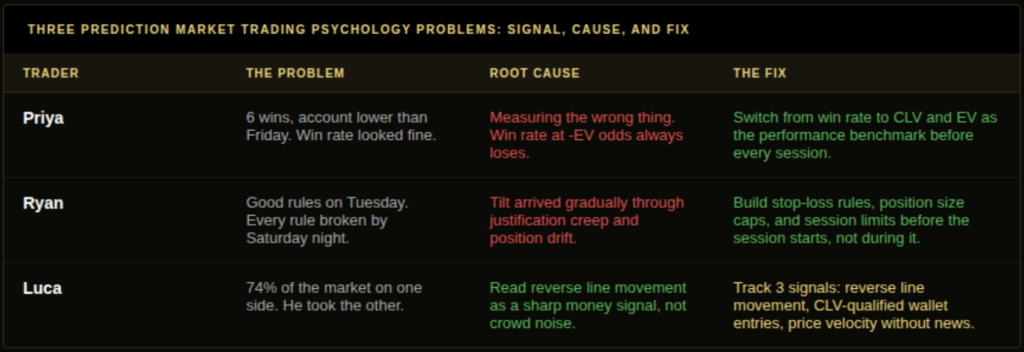
Sofia had 74% of the market with her on the Dortmund position. Luca had the line. When 74% of capital is on one side and the price moves against that side, the market isn’t making a mistake. It’s telling you that a small number of accounts the exchange respects have gone the other way, and their capital is moving the price regardless of ticket count.
This is what reading sharp money signals actually looks like in practice. Not a subscription. Not a tipster. Just the market disagreeing with the crowd in public, in the price, where anyone can see it.
Market efficiency in prediction markets is real but uneven. The market is most efficient where the most capital and research is concentrated, top-tier football, major political events, liquid crypto markets. It’s least efficient at the edges: lower-tier esports fixtures, early-open outright markets, regional events with thin participant pools. Sharp money concentration follows the same pattern. It arrives first on the highest-profile fixtures and takes longer to reach the thinner markets.
Understanding line movement in prediction markets is how you read the signal before it finishes moving. Three signals, visible in public data, no proprietary feed required:
Reverse line movement: The price moves against the direction of public ticket flow. 74% of participants are on Dortmund and the price goes down. That’s not noise. That’s the exchange repricing because of who’s on the other side.
Sharp wallet entries: On Polymarket, large positions from wallets with documented positive closing line value move prices more than hundreds of small retail orders combined. The DG3 Sharps tab filters specifically for wallets with 50+ resolved trades and positive 90-day rolling CLV, which means every entry flagged there comes from a wallet that has already demonstrated it finds edge before the market does.
Price velocity without news: A market moving 4 cents in 8 minutes without any public announcement is someone deploying capital on information that isn’t public yet. Not a guarantee. A signal worth investigating before taking the opposite side.
Dortmund’s narrative was real. Three consecutive wins, strong home record, a forward the press had written about five times by Wednesday. The story was compelling, which is exactly what made the price wrong. When a narrative reaches peak volume, the retail participants pile in. The price inflates past what the true probability justifies. The value migrates to the side nobody is writing about.
Narratives are what sharp traders fade. Not because the story is wrong. Because it’s already priced in.
Three Questions That Improve Your Prediction Market Trading Psychology
Six months after that Sunday night, Priya still loses positions. Some weeks 3 from 10. Her balance is steadily higher than October. She changed one thing: the question she asks before placing anything.
Not “will this win?” Three different questions:
Question 1: What is my independent probability estimate before I look at any price? This forces you to do the research before anchoring to the market’s view. Write a number. Then check the price. The gap between your number and the devigged market price is your edge. If you can’t produce an independent estimate, you don’t have a position yet.
Question 2: What would need to be true for this market to be mispriced? This is the information asymmetry question. Either you know something the market doesn’t, or you’ve modelled the probability more accurately than the crowd has. If neither is true, the position has no edge regardless of how strongly you feel about the outcome.
Question 3: Is this position in my system, or am I justifying an exception? This is the tilt question. If the answer requires any reasoning that wouldn’t apply on a calm Tuesday afternoon, the answer is no.
The rule-based process that follows from these questions isn’t restrictive. It’s the mechanism that keeps your process intact on Saturday nights and through eight-loss runs and when 74% of the market has already decided. The rules don’t need to cover every situation. They need to keep you in the game long enough for the edge to compound.
Your Research Process Is Your Bankroll Management
The traders who last in prediction markets are not the ones with the best gut instincts. They’re the ones who built a bankroll management system that kept them in the game through variance, a research process that generated genuine expected value, and enough self-awareness to recognise tilt before it rewrote their rules for them.
These three things aren’t separate skills. They’re the same skill applied at different moments in the trading session. Research quality determines whether your positions have positive expected value. Position sizing determines whether you survive the inevitable losing runs that even positive-EV strategies produce. Tilt management determines whether you actually execute the process you built or whether Saturday-night you starts making decisions for Tuesday-afternoon you.
Priya’s prediction market trading psychology isn’t perfect. It doesn’t need to be. It just needs to be honest about what the math is saying, consistent through the variance, and protected from the versions of herself that appear at 11pm when the account is down.
Find the edge. Size it correctly. Stay in the game long enough to collect.
The money follows the process. It always has.
Frequently Asked Questions
Q: What is prediction market trading psychology? A: Prediction market trading psychology covers the mental and process disciplines that determine whether traders consistently execute positive-expected-value strategies rather than making decisions driven by emotion, narrative bias, or tilt. It includes understanding expected value, managing tilt through losing runs, reading sharp money signals, and building rules that hold up under emotional pressure.
Q: Why does win rate mislead prediction market traders? A: Win rate measures how often you’re right, not whether you’re finding genuine edge. A trader backing 1.20 favourites at 60% strike rate is losing money on every position because the breakeven rate is 83%. CLV, closing line value, is the metric that separates skill from variance: it measures whether you consistently entered positions before the market moved in your direction.
Q: What is tilt in prediction markets and how do you manage it? A: Tilt is the state where emotional responses to losses (or wins) start driving position decisions instead of your research process. It arrives gradually through justification creep, position size drift, and objective collapse. Managing it requires rules built before the session starts, position size caps, stop-losses, a maximum number of daily positions, because once tilt has started, willpower is an unreliable defence.
Q: How do you read sharp money on Polymarket? A: Three signals: reverse line movement (price moving against the direction of public money flow), large wallet entries from accounts with documented positive closing line value, and price velocity without any public news event. The DG3 Sharps tab filters Polymarket wallet activity to accounts with 50+ resolved trades and positive 90-day rolling CLV, surfacing only the entries that carry a documented track record of finding edge before the market does.
Q: What is the most important question before entering a prediction market position? A: What is your independent probability estimate before you look at any price? If you can’t produce that number from your own research, you don’t have a position, you have an opinion about an outcome you’ve looked at a price for. The entire expected value calculation depends on having an honest, independent estimate to compare against the devigged market price.
Q: How does expected value work in prediction markets? A: Expected value is the return you’d generate if you took an identical position at the same price an infinite number of times. A YES position at 0.44 on an outcome you calculate has 0.52 true probability has positive expected value: 0.52 multiplied by 0.56 (the profit per dollar) minus 0.48 multiplied by 0.44 (the cost per dollar) equals approximately +8 cents per dollar. That’s the edge. Whether the individual position wins or loses doesn’t change the calculation.
Also read:
Closing Line Value: The Number That Tells You If You’re Actually Good
What Is EV Trading? Expected Value Explained
Why Rule-Followers Beat Gut Traders
Line Movement in Prediction Markets: Reading Sharp Moves Before They Finish