
Why Liquipedia CS2 Is the Most Underused Research Tool in Prediction Markets
Ask any serious liquipedia cs2 prediction market trader what their primary research tool is. HLTV gets mentioned first, every time.
Ask them where they check the tournament format, the tiebreaker rules, or the exact roster that played six months ago. Watch them pause.
Liquipedia CS2 does these things better than HLTV. The two tools are complementary rather than competitive, and liquipedia cs2 traders who use only one are leaving a specific category of research consistently half-finished. The half that gets left unfinished, bracket structure, tournament format, historical roster precision, tends to be exactly the research that drives edge in group stage outright markets and tournament outright positions.
Table of Contents
What Liquipedia CS2 Does That HLTV Doesn’t
This isn’t about which platform is better. It’s about which tool to open first for which research task.
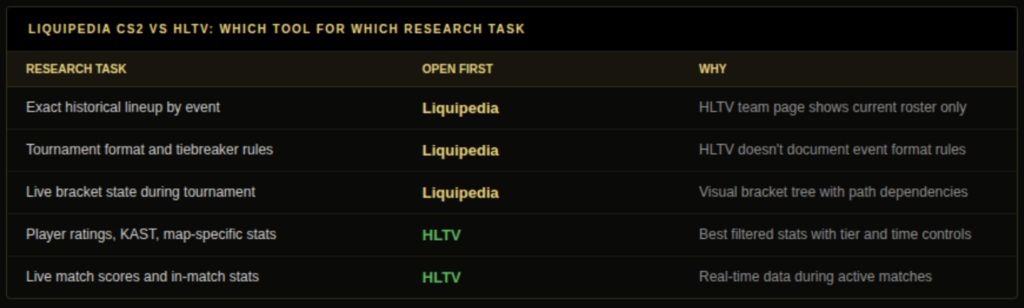
Open Liquipedia CS2 first when:
You need the exact lineup that played a specific historical match. Current HLTV team pages show the current roster. Liquipedia shows the roster for every event, by event. When you’re running a backtest or building a historical model and need to know who actually played at IEM Katowice 2024, Liquipedia’s event pages show the submitted lineup for every match in the bracket.
You need tournament format documentation. The specific format of a group stage, Swiss system vs GSL vs round-robin, determines how many matches a team needs to win to qualify. The tiebreaker rules (which apply when teams finish level on wins) vary by organiser and by event. Getting this wrong leads to incorrect probability estimates for group stage outright markets. Liquipedia documents it precisely for every event.
You need the current bracket state during a running tournament. Liquipedia’s bracket pages update as results come in. For knockout outright markets, the bracket tree shows exactly which matchups are coming, which paths require facing stronger opponents, and which teams have drawn easier routes to the final. HLTV shows results. Liquipedia shows the structural consequences of those results.
You need H2H records filtered by event tier. Liquipedia’s match history for any team can be cross-referenced against any opponent. Filtering to S-tier and A-tier events in the last 12-18 months gives you the meaningful H2H context, not the all-time record that includes matches from entirely different roster configurations.
Open HLTV first when:
You need current player ratings, KAST, or ADR statistics with time and tier filtering. You need map-specific win rates for the expected map pool. You need opening kill rate data. You need match preview coverage or recent form context. You need live scores during an active match.
The research process is: Liquipedia for structure and history, HLTV for performance data. Together they cover everything. Separately each one has a notable gap.
The Tournament Format Research That Changes Outright Market Estimates
Group stage outright markets, will Team X advance from this group, are where Liquipedia’s format documentation creates the most direct prediction market value.
Consider a CS2 Swiss group stage (format documented in detail on HLTV’s event pages). The format determines exactly how many wins are needed to advance and how many losses lead to elimination, as well as the seeding rules that determine which opponents each team faces at each round. A team with a 65% win probability against average opponents might have a 58% chance of advancing in a Swiss system (where the path to 3-0 requires facing progressively stronger opposition) versus a 71% chance in a round-robin format (where all matches against all opponents happen regardless of current standing).
Most Polymarket participants checking group stage outright prices don’t know the format they’re pricing. They estimate “Team X is good, they should advance” and the price reflects that collective vague conviction. A trader who knows the Swiss seeding algorithm, has modelled Team X’s win probability against each likely opponent at each round, and has calculated the actual advancement probability from those inputs has a fundamentally different basis for assessing whether the current market price is fair.
Liquipedia’s event pages contain the precise format documentation and historical seeding outcomes that make this calculation possible.
Building the Historical Roster Database From Liquipedia
The most laborious but highest-value Liquipedia CS2 research task is building a historical roster database, a record of exactly which five players represented each team at each event in your research period.
This is the foundational component of lookahead-bias-free CS2 backtesting. When you run a backtest of a CS2 prediction strategy over 2022-2025 data, the team stats you use for each simulated position need to reflect who was on the team at the time of that match, not who’s on the team now.
Liquipedia’s event pages for each CS2 tournament show the submitted five-player roster for every team in the event. Cross-referencing your backtest’s match list against Liquipedia gives you the historically accurate team composition for each simulated position, rather than projecting current stats backward in time.
For active trading (not backtesting), this same approach provides real-time roster confirmation as an independent verification of team social media announcements. If an official team account announces a stand-in, Liquipedia typically reflects this in the event roster within 30-90 minutes. Confirming the lineup on Liquipedia before acting on a stand-in signal adds a verification step that prevents incorrect entries when social media posts are ambiguous or retracted.
Tiebreaker Rules: The Hidden Edge in Group Stage Markets
CS2 major group stages regularly produce three-way ties. When three teams finish with identical win-loss records in a Swiss or round-robin group, the tiebreaker procedure determines advancement. Getting this wrong, or ignoring it entirely, means your group stage outright probability estimates are potentially incorrect in close finishing scenarios.
Different organiser tournaments use different tiebreaker sequences. ESL events historically use head-to-head record first, then map differential, then a tiebreaker match series if still equal. BLAST Premier uses different initial criteria. Valve Majors have their own format for the New Legends and New Challengers stages.
Liquipedia documents the exact tiebreaker rules for every CS2 event it covers. A trader who builds group stage outright models without checking the tiebreaker rules is potentially estimating the wrong probability for scenarios that would resolve differently depending on which teams are tied. In competitive group stages where 3-4 teams are within range of the same record, this isn’t a minor technical footnote, it’s a scenario that occurs in roughly 60% of Swiss-format group stages at major events.
H2H Records the Right Way
Head-to-head records on Liquipedia require the same filtering discipline as HLTV performance data.
The correct filter set for H2H research:
Time filter: last 12-18 months. Beyond this, the roster configurations are likely different enough that the record describes matches between teams that no longer exist in their current form.
Event tier filter: S-tier and A-tier only. H2H records from B-tier and C-tier qualifiers tell you almost nothing about T1 match performance. Both teams may have been rotating rosters or preparing differently for non-premium events.
Format filter: same match format where possible. H2H performance in Bo1 matches doesn’t generalise to Bo3 performance. Map selection, preparation, and tactical depth vary notably between formats.
After applying these filters, a three-match filtered H2H record is more informative than a fifteen-match unfiltered all-time record. The filtered record describes teams that exist now, performing at the level that matters for the match you’re pricing.
Also read: HLTV Rating and CS2 Prediction Markets: How Player Stats Drive Market Prices
The Practical Liquipedia CS2 Prediction Market Research Workflow for Outright Markets
When a CS2 major is announced and outright markets open on Polymarket, this is the Liquipedia research sequence:
Step 1: Navigate to the event page. Confirm the group stage format (Swiss, GSL, round-robin), the number of advancement and elimination spots, and the documented tiebreaker procedure.
Step 2: Check the bracket structure for the playoff phase. If the upper bracket finalist faces a lower-bracket participant, what’s the expected path for each team? Are any likely bracket matchups particularly asymmetric?
Step 3: Pull the confirmed rosters for each team from Liquipedia’s event participant list. Cross-reference against your scenario library for any lineup changes relative to the previous major.
Step 4: For each team you’re considering an outright position on, run their H2H records against likely group stage opponents (filtered to last 12-18 months, S/A-tier, same format).
Step 5: Combine Liquipedia structural data with HLTV performance data (filtered to current roster, 90 days, T1 tier) to produce a complete pre-tournament probability estimate for each team.
Total time for a full major outright research pass using this Liquipedia CS2 workflow: 45-90 minutes. Researchers who skip the Liquipedia layer and rely solely on HLTV are systematically missing the bracket and format data that most differentiates their probability estimates from the crowd. Built once and repeated across each event, the framework compounds, each subsequent major takes 20-30 minutes to run because the team-level data structures persist from event to event. The traders doing this work are pricing outright markets with more complete information than the participants who checked the team’s recent win-loss record and stopped there.
Liquipedia CS2 and Live Tournament Tracking
During a running CS2 major, Liquipedia becomes a different kind of tool from the pre-tournament research resource it is in the preparation phase. Live tournament tracking on Liquipedia surfaces information that feeds directly into outright market positioning.
As each match resolves, Liquipedia’s bracket page updates. For traders holding outright positions, the bracket update is the signal to reassess: does the new bracket structure favour your team’s path to the final, or has an elimination created a harder bracket matchup than you priced?
The Swiss stage requires particular attention. After each round of a Swiss group stage, the seeding algorithm determines matchups for the next round. Teams that advance 1-0 face other 1-0 teams. Teams at 1-1 face other 1-1 teams. The specific matchup that results from this seeding is knowable from the bracket page before that match is played and before most Polymarket participants have calculated what it means for tournament outright probabilities.
For example: Team A advances 2-0 and draws Team B (also 2-0) in the next round. Team B is Team A’s worst historical matchup based on H2H filtered data. The probability of Team A advancing from the group has just changed based on the bracket matchup, even though no new match has been played. Liquipedia shows you this immediately. The outright market reprices when participants notice it. The gap between when Liquipedia updates and when the outright market fully adjusts is a small but real window.
This type of live bracket analysis is the tournament outright equivalent of stand-in signal monitoring for match winner markets. Different information, same structural opportunity.
The Liquipedia CS2 Research Habit That Changes Your Outright Market Accuracy
One habit, consistently applied before every CS2 major, that measurably improves tournament outright market probability estimates: reading the tiebreaker rules.
Every CS2 major’s Liquipedia event page documents the specific tiebreaker procedure for its group stage. Most traders skip this page entirely. The ones who read it are the ones who correctly assess advancement probability in competitive group stages where three or four teams are likely to finish with similar records.
Here is the pattern: in roughly 60% of CS2 major Swiss group stages, at least one tiebreaker scenario affects which teams advance. A trader who knows that the tiebreaker favours head-to-head record (advantaging a team with a strong H2H against the likely tied opponents) over map differential (which might favour a different team) has a more accurate advancement probability estimate for those specific teams.
The research investment is 5 minutes per event. Find the Liquipedia event page. Read the tiebreaker section. Note which teams benefit from each tiebreaker method given their H2H records and typical map differentials. Update your group stage outright probability estimates accordingly.
This single adjustment to the pre-major research process corrects an error that most participants make in competitive groups. The liquipedia cs2 data is there. The tiebreaker rules are documented. Reading them before buying a group stage outright is the simplest edge improvement available to anyone trading these markets.
Frequently Asked Questions
Q: How should traders start using liquipedia cs2 for prediction market research? A: For tournament structure (format documentation, tiebreaker rules, bracket visualisation), historical roster confirmation by event date (not current roster page), H2H records filtered by tier and time period (last 12-18 months, S/A-tier only), and live bracket state tracking during running tournaments. Use HLTV for player performance statistics, map-specific win rates, and live in-match data. The Liquipedia research completes the picture that HLTV performance data alone can’t provide, bracket dynamics, format-specific probability adjustments, and the historical roster precision needed for lookahead-bias-free model building and backtesting. (format, tiebreaker rules, bracket), historical roster confirmation by event (not current page), H2H records filtered by tier and time period, and bracket state tracking during running tournaments. Use HLTV for player performance statistics.
Q: What does liquipedia cs2 provide that HLTV doesn’t? A: Historical roster by specific event with date precision, tournament format and tiebreaker rule documentation, complete bracket visualisation for knockout events, and structured H2H match history with event tier context.
Q: How do you find H2H records using liquipedia cs2 prediction market research? A: Navigate to either team’s Liquipedia page, access their match history, and filter by opponent. Apply date and event tier filters before drawing conclusions. A filtered 3-match record over 12 months at S/A-tier is more useful than an all-time 15-match record with no filters.
Q: Why do liquipedia cs2 tiebreaker rules matter for outright markets? A: Tiebreaker rules determine which teams advance in multi-way tied scenarios, which occur in roughly 60% of Swiss-format major group stages. A trader who ignores tiebreaker rules may estimate the wrong advancement probability for competitive groups where three or more teams are likely to finish with similar records.
Q: How does DG3 aggregate liquipedia cs2 style data for live sessions? A: DG3’s Stats tab shows confirmed starting lineups and H2H records for open CS2 markets as they become available before match start. This delivers the lineup confirmation function that Liquipedia serves for historical research, within the same terminal interface as the Edge Finder, Sharps tab, and 1-Click Trade. For pre-event tournament research requiring historical roster data or format documentation, Liquipedia remains the primary source. For the live pre-match window confirmation step, DG3’s Stats tab provides the same data in a faster, more integrated workflow. and H2H records for open CS2 markets as they become available before match start. This delivers the lineup confirmation function Liquipedia serves for historical research, within the same interface as the Edge Finder, Sharps tab, and 1-Click Trade during live sessions.
Also read: CS2 Fair Value Model: How to Build a Probability Model for Counter-Strike
CS2 Backtesting Prediction Strategies: Data Sources and What Actually Works
CS2 Betting Predictions: How to Separate Signal From Noise