.png?updatedAt=1779992389202)
Price Discovery in Prediction Markets vs Sportsbooks: Why Trading Beats Bookmaking
That is the whole story. One number gets set behind a curtain and slid in front of you with a markup. The other gets built in the open, trade by trade, by people betting real money on what they know. Same outcome, two completely different machines. Only one of them is telling you the truth.
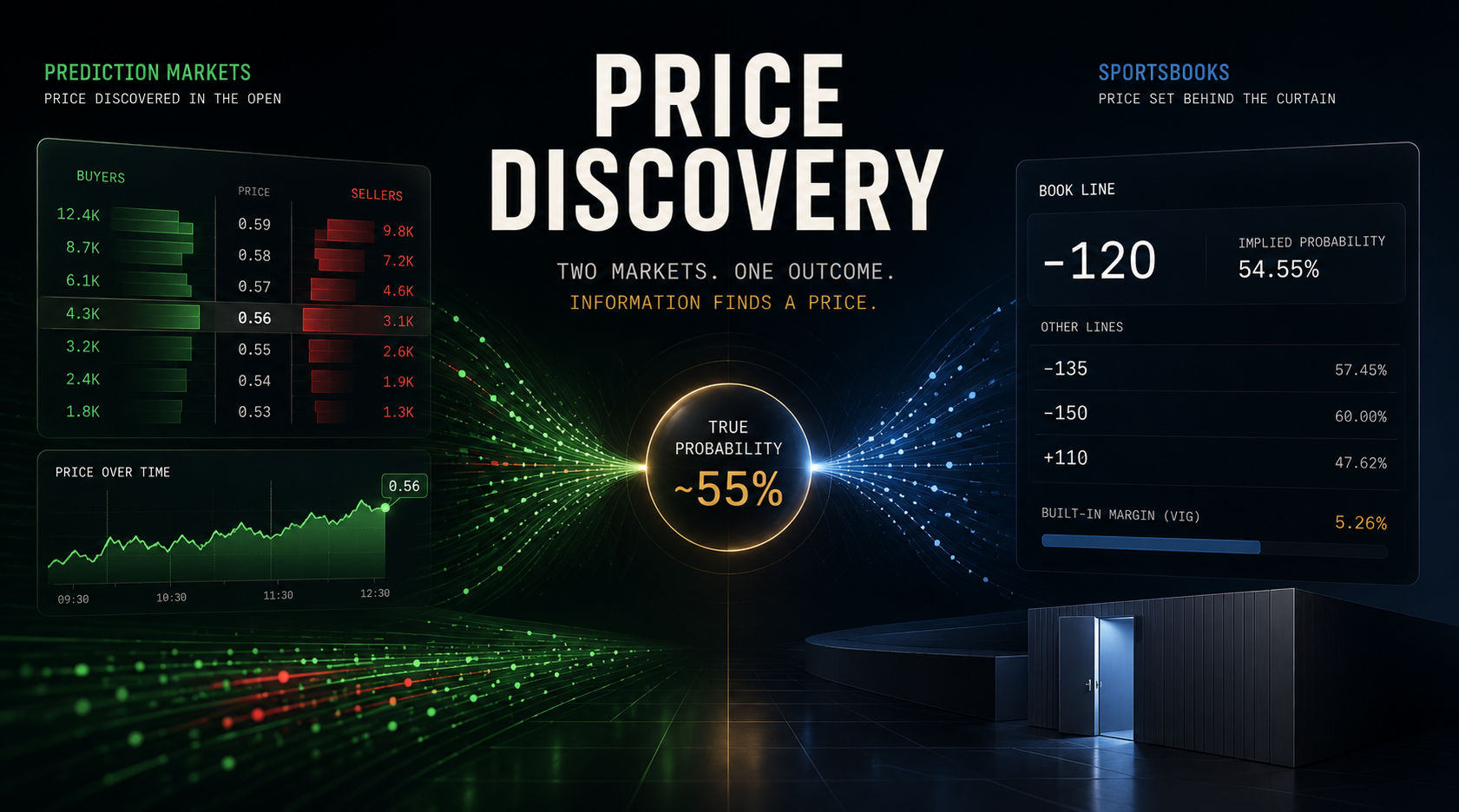
Prediction markets discover price through two-sided trading. Buyers and sellers meet, and the price lands wherever supply matches demand. Sportsbooks run the opposite play. They set an opening price, bake in a margin, then nudge it to balance their book. The first is a live signal. The second is a product with a sticker price.
What price discovery means
Price discovery is how a market arrives at a price through the actions of many buyers and sellers, instead of having one handed down by a single party.
How a prediction market builds a price
Start with nothing. No house number, no opening line. The first trade sets a level. Every trade after that shoves it up or down.
Think it is underpriced? Buy. Think it is too rich? Sell, or take the other side. Your money is your vote. And here is the kicker. A loud opinion on Twitter costs nothing. A position costs real cash. So positions carry weight that opinions never will.
The price you see is the weighted read of everyone with capital on the line. Wisdom of crowds, except the crowd is paying to be there.
Now watch what happens when news drops. A roster change. A poll. A court ruling. Someone reads it, clocks the edge, and trades. The price absorbs that information in seconds. Nobody approves it. No committee signs off. The order book just moves.
Real supply. Real demand. No gatekeeper.
How a sportsbook builds a price
A sportsbook works backward. Oddsmakers open a line from models and history and a read on where the money will pile up. That number already carries a built-in margin, the vig. You are not getting clean probability. You are getting probability plus the house's cut, stapled on before you ever click.
From there the book plays defense. Too much money on one side, they shift the line to drag action to the other. The aim is a balanced book, not an honest price. A sportsbook wins on the spread no matter who covers, so its incentive is balance, not truth.
The line still moves on news. Sharps hit a soft number and the book reacts. But you are always trading against a counterparty who wrote the terms and is guarding a margin. That is a managed product. Not an open signal.
Why the market price reads sharper
Strip the margin and a market price sits right on top of true probability. A contract at 64 cents implies roughly a 64 percent shot, before fees. A sportsbook line at -180 implies about 64 percent too, except that number is puffed up by the vig. Devig it and the real probability drops.
The efficient market hypothesis says prices reflect all available information when enough informed people trade freely. Prediction markets live on this idea. Anyone can take either side, so mispricings get hunted down and arbitraged away fast. Informed trading is the engine. More sharp money in, tighter the price.
Neither system wins everywhere, though. Hold that thought.
A worked example
An election market opens. Candidate A trades at 55 cents. Then the debate happens, and A face-plants. Within minutes sellers pour in, buyers back off, and the contract slides to 47 cents. That eight cent drop is the market repricing live, in front of everyone, with no referee.
A sportsbook on the same outcome at -120 (around 55 percent) moves too. But it moves on the book's clock, padded with margin, and you fight the house the whole way down.
The data is not subtle either. A study of the Iowa Electronic Markets found its election-eve prices beat the final Gallup poll in 74 percent of cases across multiple elections. Traders with skin in the game outforecasting the pollsters, and they have been doing it for decades.
Prediction markets vs sportsbooks at a glance
Where each one wins
Prediction markets shine when a flood of informed people trade a liquid, high-attention event. Elections. Macro calls. Big sports. The catch is liquidity. A thin market can sit on a dead price for hours because nobody is trading it.
Sportsbooks own coverage and speed. They post lines on obscure games a prediction market would never touch, and they post them early. For a casual swing at a third-tier match, the book is often the only door open. Efficiency follows liquidity, and books still run the long tail.
FAQ
Are prediction markets more accurate than sportsbooks? On liquid, high-volume events, yes. Smaller margin, two-sided trading, prices that hug true probability. On thin markets, a well-modeled book line can be the sharper number.
What is the vig? The margin a sportsbook builds into its odds. It is why both sides add up to more than 100 percent. That overround is the house edge, and you pay it whether you win or lose.
Does a market price equal probability? Almost. A contract maps to implied probability on a 0 to 100 scale, so 70 cents means about 70 percent. Fees pull it slightly off, but it is miles cleaner than a vig-padded line.
Why do market prices move so fast? Traders act on news directly. Something breaks, anyone can buy or sell, and the order book reprices in real time. No central party in the loop.
Can you profit off the gap between the two? Yes. When a book line and a market price disagree on the same outcome, the spread can be an edge. Catching it and acting is the heart of cross-venue trading.
Key takeaways
- Prediction markets discover price through two-sided trading. Sportsbooks set a line and bend it to balance their book.
- A market price sits close to true probability. A sportsbook line is padded with vig.
- Markets reprice in seconds because traders act on news directly, with no gatekeeper.
- Sportsbooks still win on coverage, early lines, and thin niche markets.
- The gap between the two on a shared outcome is where cross-venue edge lives.
Related reading
Start with how sports betting stacks up against prediction markets for the practical side-by-side. To pin down the number a sharp price is really chasing, read fair value in prediction markets. Then see why the closing line is the truest price a market prints, and how sharp money moves differently from the public. When you want to act on price gaps across venues, the DG3 terminal puts live edges in one view.
Author note
Written by the DG3 research desk. We build tools for traders who treat probability as a number to beat, not a line to accept. We track market microstructure, edge detection, and cross-venue pricing across prediction markets every day.