The Best Polymarket Tools in 2026: What Serious Traders Are Actually Using
Polymarket’s raw interface gives you a market. It does not give you an edge.
The traders who consistently pull profit from prediction markets are not faster readers of news. They are better equipped. They use tools that surface order flow anomalies before prices move, track wallet behavior across thousands of positions, and identify markets where the implied probability has drifted away from fair value. The gap between trading on Polymarket with no tooling and trading with a full analytics stack is roughly the gap between playing poker without tracking your opponents’ tendencies and playing with a comprehensive database on every player at the table.
This guide maps that full stack. Every major tool type, what each does, and how they fit together.
Table of Contents
Quick Answer
The best Polymarket tools in 2026 include dedicated analytics terminals for order flow and whale tracking, edge detection tools that identify mispriced probabilities, market scanners for discovery, and portfolio trackers for position management. No single tool covers every layer. The most effective traders combine a primary intelligence terminal with a focused edge detection workflow. DG3 is the terminal built specifically for this stack.
Why Polymarket Traders Need Dedicated Tools
Polymarket processes over $1 billion in trading volume across hundreds of active markets. The platform’s native interface shows you current odds, trading volume, and a basic order book. That is the starting line, not the finish.
Three structural problems push serious traders toward dedicated tooling:
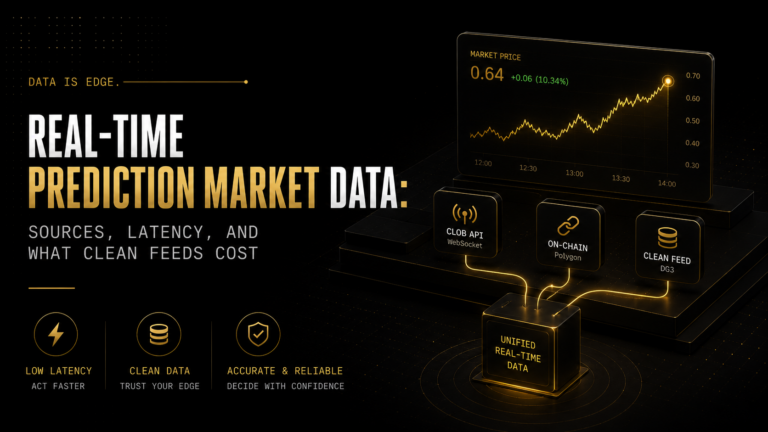
The data problem. Polymarket’s API exposes rich order flow, wallet-level position data, and historical pricing. Almost none of this is surfaced in the main interface. Traders who cannot read raw API data miss signals that are sitting in plain view for anyone with the right layer on top.
The speed problem. Sharp money moves markets fast. A whale position taken at 48 cents can push a market to 54 cents within minutes. By the time that price move is visible in the UI, the edge is mostly gone. Detection tools that monitor order flow in real time give traders 30 to 90 seconds of advance signal in many cases.
The scale problem. Polymarket had over 1,200 active markets at peak 2024 election volume. No trader can monitor all of them manually. Discovery tools that surface markets by EV, by unusual activity, or by line movement transform a chaotic feed into a workable shortlist.
Key Takeaways
- Polymarket’s native interface does not surface the order flow, wallet, or historical data traders need to trade with edge
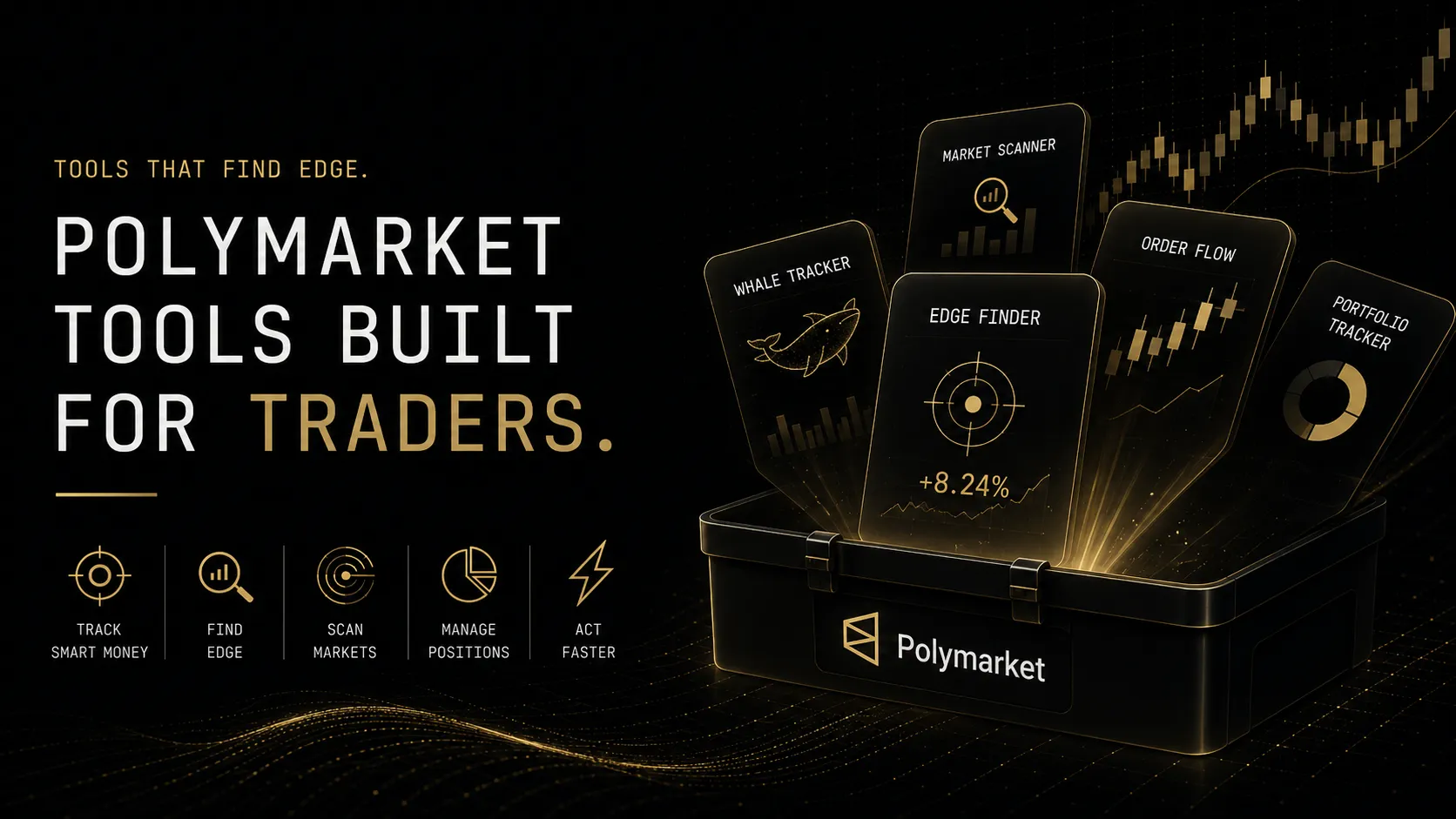
- The five core tool categories are: market intelligence terminals, whale trackers, edge finders, market scanners, and portfolio managers
- Whale and sharp tracking tools provide the highest direct edge signal for active traders
- Edge detection depends on a fair value engine – without one, you are guessing at mispricing
- The most common mistake is using free tools that have 10-15 minute data delays, which eliminates most real-time edge
- DG3’s terminal consolidates intelligence, order flow, and edge detection into one workspace
- Tool selection should match your trading style: scanner-first for discovery traders, order flow-first for position traders
The Polymarket Tool Categories (What Actually Matters)
Not every type of tool delivers equal value. Here is how to think about the stack by layer:
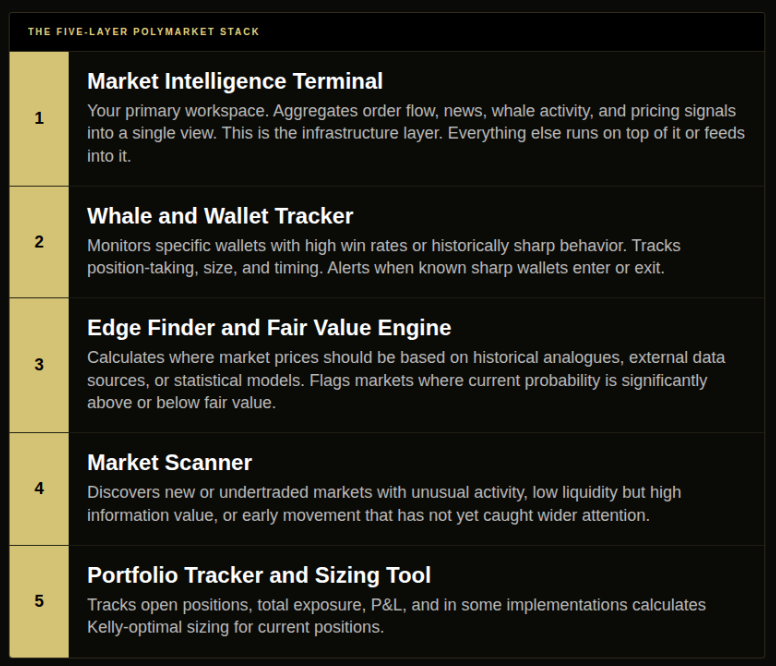
The Full Stack Compared: Tools Ranked by Function
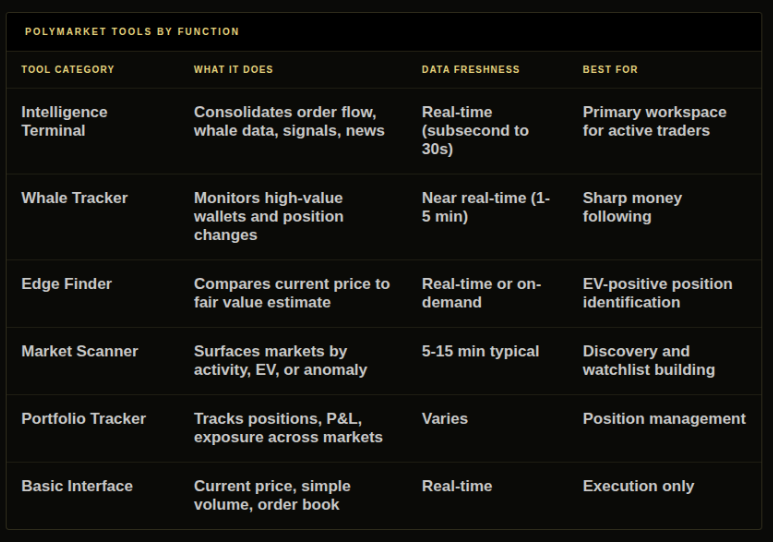
The critical column is data freshness. Many free tools and browser extensions operate with 10 to 30 minute delays. For whale tracking and line movement signals, that delay eliminates almost all usable edge. Real-time or near-real-time data access is a non-negotiable for serious traders.
Whale Tracking and Order Flow Intelligence
Whale tracking is the highest-signal category for active traders, and it is also the most misunderstood.
A “whale” on Polymarket is not simply someone with a large account. Whales worth tracking are wallets with documented track records of sharp position-taking – entering early, entering large, and being right more often than random. The presence of an unknown large wallet in a market is noise. The presence of a known high-accuracy wallet taking a directional position is signal. This is the same distinction that separates sharp money from public money in any liquid market.
How to evaluate a whale tracker:
First, check whether it tracks wallet-level P&L over time, not just position size. A tracker that only shows position size without historical accuracy data is showing you money, not edge. Size and accuracy are different variables.
Second, check whether it monitors position changes in real time or on a delay. The best whale signals come from early detection – entering a position when a sharp wallet has just opened theirs, before the market price moves to reflect that signal.
Third, check whether it distinguishes between liquidity provision and directional bets. Some large positions are market-making activity, not information-driven. A tool that cannot separate these two types of large position will generate false signals.
During the 2024 US presidential election, several documented wallets entered YES positions on the Republican candidate at prices between 40 and 45 cents weeks before mainstream polls reflected similar probabilities. Traders with access to real-time wallet monitoring had a documented window of several days to follow those positions before the market converged.
Edge Detection and Fair Value Tools
Every market on Polymarket has an implied probability. That probability may or may not reflect fair value.
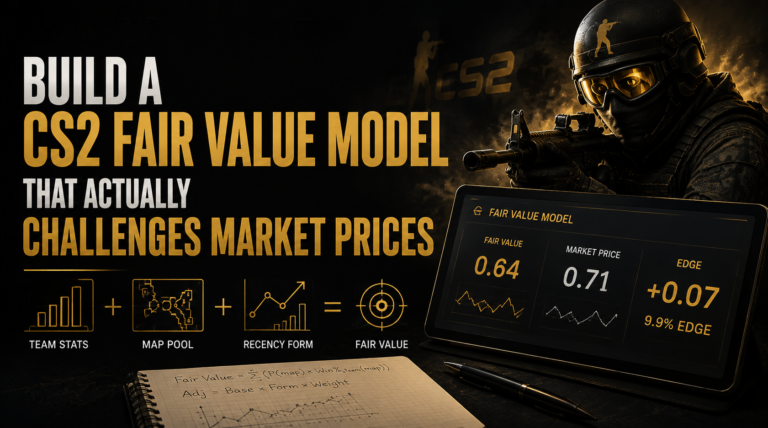
Fair value is the probability you would assign to an outcome if you had full information and no position. Edge is the gap between fair value and current implied probability. If you estimate the real probability of an event at 62% and the market is priced at 55 cents, you have approximately 7 cents of positive expected value per position unit – if your fair value estimate is correct.
Edge detection tools automate the fair value estimation step by:
- Pulling in external odds from sportsbooks (for sports markets) or polling data (for political markets)
- Running historical base rates for similar event types
- Applying statistical models to normalize for market noise and trading volume
- Surfacing the delta between estimated fair value and current price
The simplest version of this is manual comparison: look at what a sportsbook is pricing an outcome at, convert to implied probability, compare to Polymarket’s current price. If Polymarket shows 58 cents and the sharpest sportsbooks are pricing the equivalent at 63 cents, there is a 5-cent gap worth investigating.
Automated edge finders do this across hundreds of markets simultaneously, flag the widest gaps, and rank them by confidence level and liquidity depth (since a 10-cent edge in a market with $5,000 in liquidity is not meaningfully tradable).
Common Mistakes When Choosing a Polymarket Tool
Using tools with stale data. The free tier of most Polymarket analytics tools operates with 10 to 30 minute delays. For news-driven markets, that delay is longer than the entire window of edge. Always check the data freshness policy before relying on any tool for active trading.
Optimizing for features, not workflow. The most feature-rich tool is not always the most useful one. A trader whose edge comes from political market analysis needs a different stack than a sports markets specialist. Map your use case before evaluating tools.
Ignoring liquidity when reading edge signals. A 15-cent edge in a market with $3,000 in total liquidity might absorb $300 of your position before the price moves against you. Edge signals are only meaningful in markets with enough depth to take the position you need.
Over-indexing on whale tracking without historical accuracy data. Following large wallets without knowing their historical accuracy rate is the prediction market equivalent of copying a trade from someone who just started. Position size and track record are separate variables.
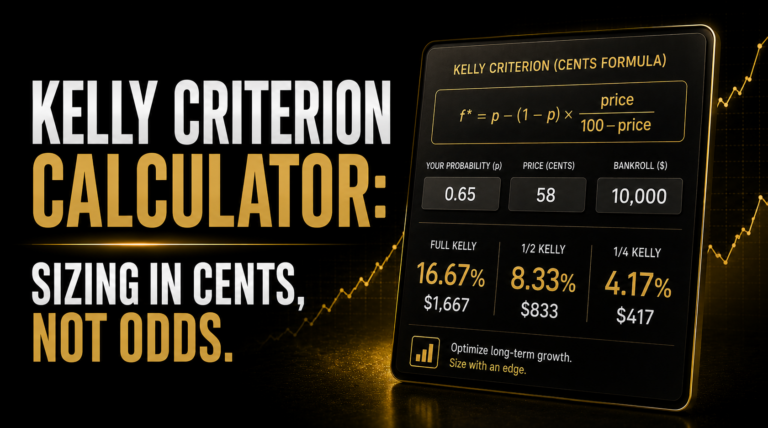
Treating portfolio tracking as optional. Traders who do not track total exposure across markets frequently over-concentrate in correlated positions without realizing it. A portfolio tracker is not a luxury – it is how you manage risk across a multi-market book, and it is where expected value and Kelly-optimal position sizing actually get applied.
The Stack Consolidation Problem
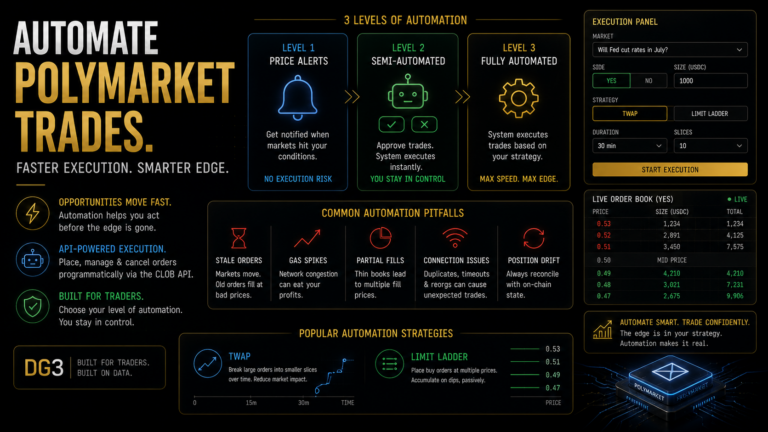
The core problem with assembling a Polymarket tool stack from separate products is that each tool uses a different data feed, different refresh intervals, and a different interface. You end up context-switching across five browser tabs to make a single trading decision.
DG3 is a prediction market intelligence terminal built to consolidate that stack. The Intelligence Pane brings together a live Sharps feed, real-time Signals panel, Order Book depth, News integration, and a Chart layer in one workspace. The Edge Finder surfaces markets ranked by EV delta so traders do not have to manually scan for mispricing. The Intelligence pane’s Signals tab monitors order flow patterns and flags anomalies in real time.
The terminal is built primarily on Polymarket data with the architecture to expand across venues – the same intelligence layer, one interface.
Frequently Asked Questions
What is the best Polymarket tool for beginners? Beginners benefit most from a market scanner that surfaces active, liquid markets ranked by trading volume and clear event resolution criteria. Starting with edge detection tools before understanding fair value estimation can lead to poor position sizing. Learn the market structure first, then add analytical layers.
Are there free Polymarket analytics tools? Several browser extensions and community-built dashboards offer free Polymarket data. Most operate with 10 to 30 minute data delays and limited wallet tracking. For casual observers this is acceptable. For active traders seeking real-time edge signals, the delay eliminates most of the value these tools could provide.
How do whale trackers work on Polymarket? Whale trackers pull wallet-level position data from Polymarket’s public API, track position changes over time, and flag wallets with high historical accuracy or large position sizes. The best trackers combine position size data with documented win rate and entry timing to help traders identify genuinely sharp wallets versus simply large ones.
What is edge detection in prediction markets? Edge detection identifies markets where the current implied probability differs meaningfully from an estimated fair value. The gap between fair value and market price, weighted by your confidence in the estimate and the market’s liquidity, determines whether a position has positive expected value.
How accurate are Polymarket edge finders? Accuracy depends on the quality of the fair value model underlying the tool. Tools that use sportsbook comparison for sports markets are typically more reliable than models built on polling data for political markets. Any edge estimate should be treated as a signal to investigate further, not a guaranteed positive expected value position.
Does DG3 work with Polymarket? Yes. DG3 is built primarily on Polymarket data and provides real-time order flow intelligence, whale tracking, edge detection, and market scanning across Polymarket markets through a unified terminal interface.
What data does Polymarket expose via API? Polymarket’s public API exposes market prices, trading volume, order book depth, wallet-level position data, historical price timelines, and resolution data. This is significantly richer than what the native interface displays, which is why third-party tools built on the API can surface so much additional signal.
How do Polymarket tools compare to sportsbook analytics tools? Sportsbook analytics tools are built around line movement and closing line value, concepts that map well to prediction markets. The key difference is that prediction markets expose individual wallet data publicly, which sportsbooks do not. This means prediction market tools can offer whale tracking capabilities that have no sportsbook equivalent.
Is there a Bloomberg Terminal equivalent for prediction markets? DG3 is explicitly positioned as a prediction market intelligence terminal – the infrastructure layer for traders who need real-time data, order flow analysis, and edge detection in one workspace rather than assembled from separate tools.
What should I look for in a Polymarket portfolio tracker? Look for tools that track unrealized and realized P&L separately, show total exposure by market category, flag correlated positions, and ideally integrate Kelly-optimal sizing recommendations based on your current bankroll and edge estimates.
Related reading
For the workflow problem dedicated tooling solves, read the 5-Tab Problem, and for the broader frame on where this category is heading, see Bloomberg for equities, Nansen for crypto, and what comes next for prediction markets.
Final Thoughts
The Polymarket tool ecosystem in 2026 is larger and more sophisticated than most traders realize. The gap between trading with raw platform access and trading with a full intelligence stack is measurable in edge percentage and long-run P&L. The traders winning consistently are not finding different information – they are processing the same publicly available data faster and more systematically.
Build your stack around your trading style. Start with real-time data access. Add whale tracking calibrated to accuracy, not just size. Layer in edge detection once you have a framework for estimating fair value. DG3 consolidates that stack into a single terminal if you want one workspace rather than five tabs.
Author note
Written by the DG3 research desk. We build tools for traders who treat probability as a number to beat, not a line to accept. We track market microstructure, order flow, and pricing across prediction markets every day.
See the full stack in one terminal Order flow, whale tracking, and edge detection on one screen. Sign up now – DG3 Terminal
Also read:
The 5-Tab Problem
The Gap Closes Before Most Traders See It.
What Is a Prediction Market Terminal? (And Why Traders Outgrow Raw Polymarket)