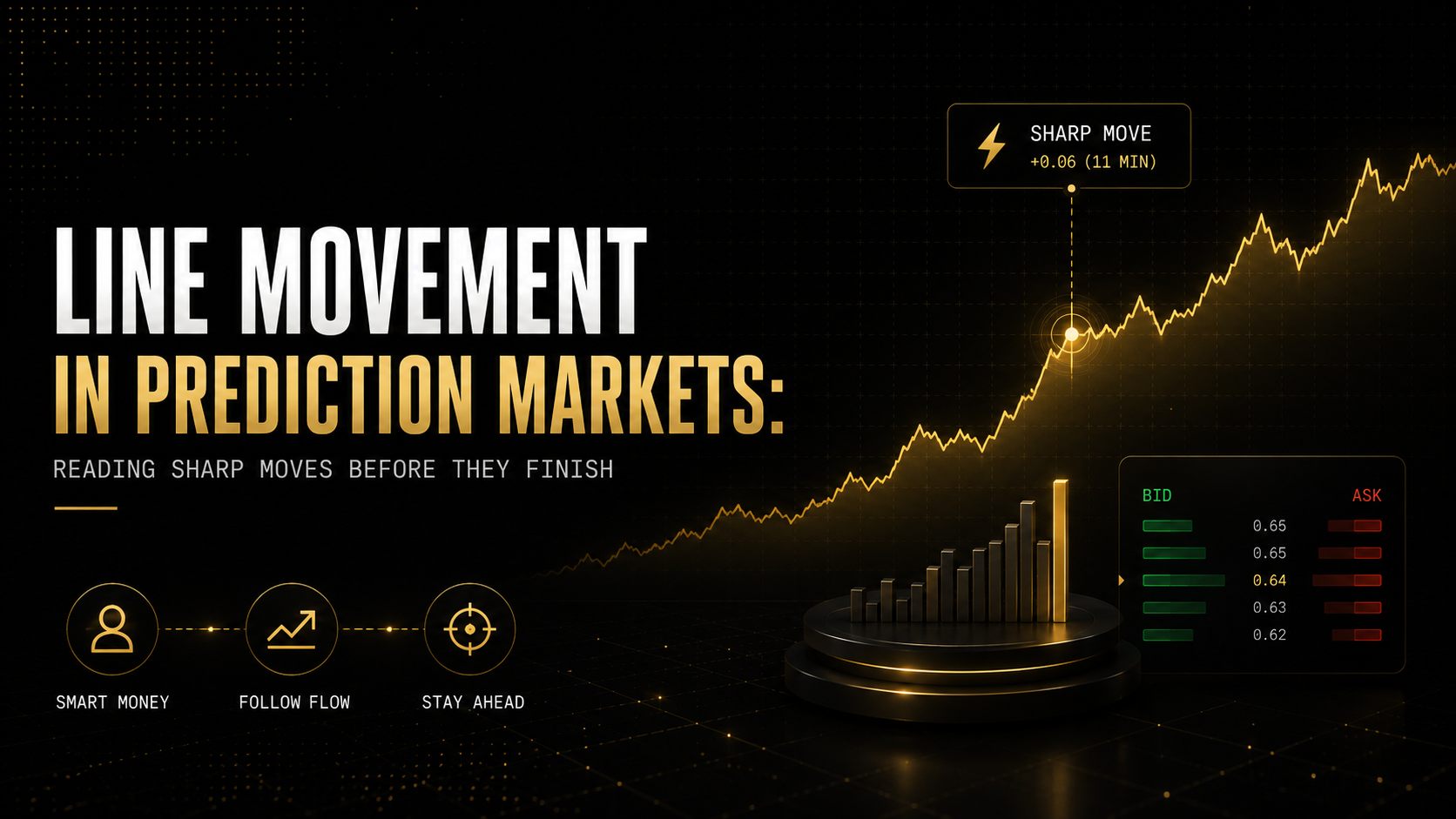
Line Movement in Prediction Markets: Reading Sharp Moves Before They Finish
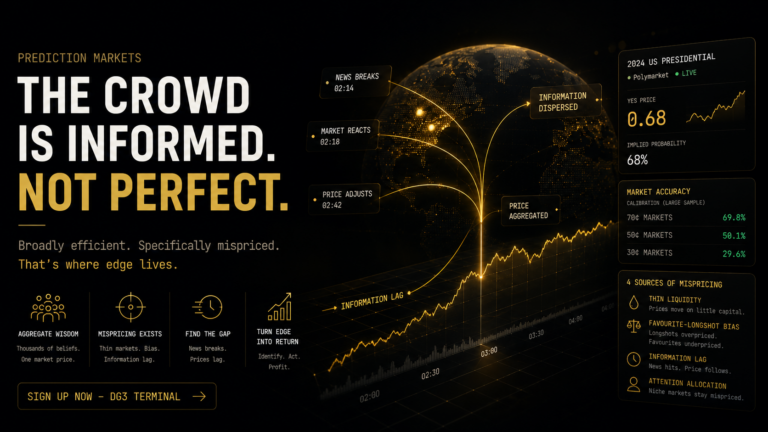
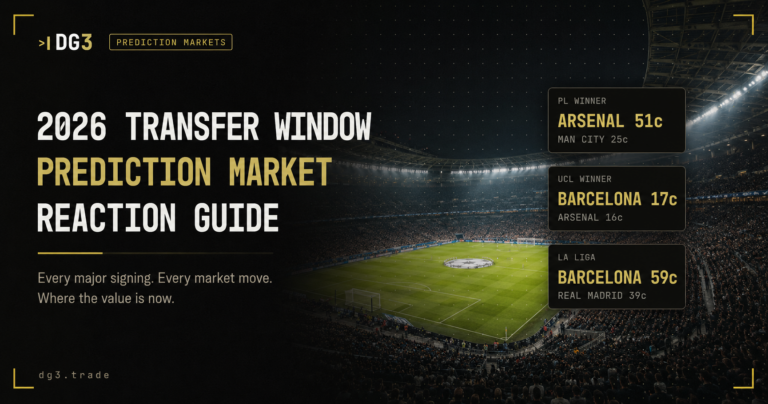
The Polymarket market on a top-flight football match moved 6 cents in 11 minutes with no visible news. No injury report. No pre-match press conference. Nothing on the social feeds that explained it. Forty minutes later, the official team line-up was released and showed a surprise tactical change. The market had already priced most of it.
Someone knew. Or someone’s model knew. Either way, the 6-cent move before the announcement was line movement carrying genuine information. The traders who read it acted. The traders who ignored it watched the remaining 4 cents of edge close in front of them.
Table of Contents
Quick Answer
Line movement in prediction markets is a price shift caused by capital entering or leaving a market. Not all line movement is equal. A sharp move driven by informed money from verified high-accuracy wallets is fundamentally different from a public-money move driven by retail sentiment buying the favourite. The skill is reading the cause before acting on the direction. Entering behind a sharp move is edge. Entering behind a public move is chasing price.
Key Takeaways
- Line movement is the price record of capital flows, not a direct record of information. The interpretation of what caused a move determines whether it is worth following or fading.
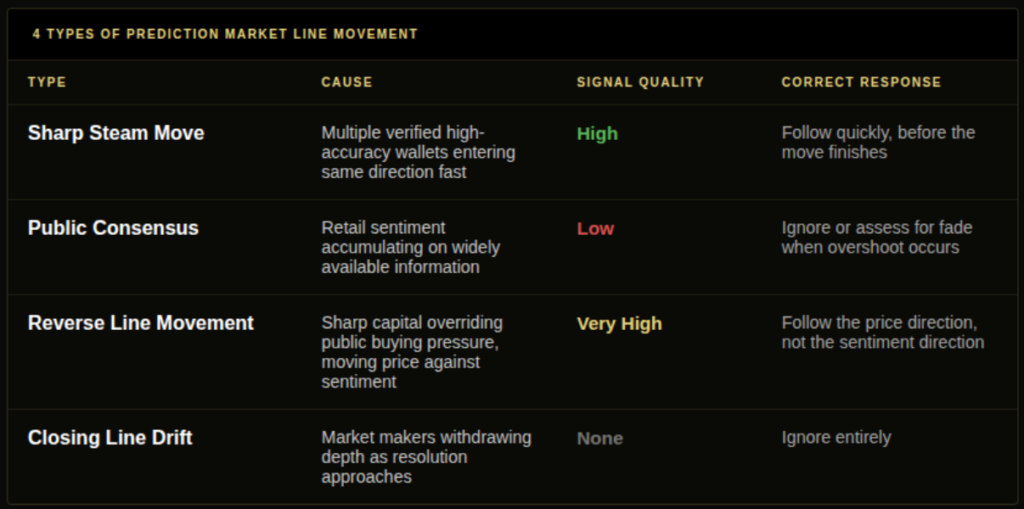
- Four types of line movement create different trading opportunities: sharp steam moves (fast, informed, follow), public consensus moves (slow, sentiment-driven, fade), reverse line movement (counter-intuitive, high-conviction), and closing line drift (liquidity-driven, typically ignore).
- The comparison between sportsbook line movement and prediction market line movement matters. On sharp sportsbooks like Pinnacle, a line move is primarily driven by sharp money and is therefore informative about the true probability. On Polymarket, a price move requires additional context before it carries equivalent information value.
- Closing Line Value is the retrospective measurement of whether you entered before the smart money finished moving. Consistent positive CLV across a category means your entries are systematically ahead of sharp line completion. Closing Line Value covers how to measure this systematically.
- Reverse line movement is the highest-conviction signal in prediction market line reading. When a market moves against the direction of public sentiment (price falls despite high public buying pressure), it means sharp money is taking the other side with enough force to override the crowd.
- Timing your entry to a line move requires knowing approximately how far the move still has to travel. A move that is 70% complete offers less edge than one that is 20% complete. DG3’s Edge Finder shows price history at tick granularity through the Intelligence pane, helping estimate how far a move has already traveled relative to recent history.
What Causes Line Movement in Prediction Markets
Line Movement: A directional price shift in a prediction market caused by an imbalance between buying and selling pressure. The cause of the imbalance determines the signal quality of the move.
In a sportsbook context, line movement is primarily driven by the book’s need to balance action. When sharp money (informed, high-stakes bettors) enters on one side, the book moves the line to attract action on the other side. The line move is a direct response to sharp capital.
In a prediction market like Polymarket, the mechanism is different but the interpretive principle is the same. Price moves when buyers exceed sellers or vice versa. The question is who is buying and why.
Four causes produce four different types of line movement, each with a different correct response:
Sharp money entering: An informed wallet or group of wallets with a high historical accuracy rate enters a material position. Price moves because the supply of YES at the old price is consumed. The move is typically fast and the new price level tends to hold.
Public consensus accumulating: A broader group of retail traders buys the same direction over time, usually following news that has already been widely distributed. The move is slower, the new level is less stable, and the move is more likely to partially correct when the crowd exhausts itself.
Reference book divergence: A sharp sportsbook (Pinnacle or similar) has already moved its line before Polymarket adjusts. Systematic traders arbitraging the gap between reference books and Polymarket push the Polymarket price toward the reference book’s new level.
Liquidity event: Market makers adjust their quotes (withdrawing depth on one side or adding it on the other) without any new information entering the market. This creates price movement that looks like a signal but is not one.
The 4 Types of Line Movement
Type 1: Sharp Steam Move
A steam move is a fast, coordinated line movement across a market or group of correlated markets. In prediction markets, it is most visible as a sudden 5-10 cent move in under 10 minutes with high transaction volume in the order book.
Steam moves carry information. When multiple high-accuracy wallets enter the same direction in a compressed time window, the information signal behind the move is strong. The correct response is to follow quickly, before the move finishes. The window is narrow.
Steam moves on Polymarket are identifiable through order book history: look for multiple large transactions in the same direction within a short time window, combined with wallet quality data. A steam move from low-quality wallets is not a steam move. It is a coordinated retail sentiment push.
Type 2: Public Consensus Move
The price drifts steadily in one direction over 30-60 minutes without a visible catalyst. Volume is elevated but individual transaction sizes are small. The move tracks the sentiment on social media for the same event.
Public consensus moves carry low information signal. The crowd is processing widely available information that the sharper market participants have already priced. The correct response is one of two things: ignore the move, or assess whether the crowd has moved the price to a level that now diverges from fundamental probability and set up a fade.
Type 3: Reverse Line Movement
The most contrarian and highest-conviction signal in prediction market line reading. Public data (social sentiment, visible buying pressure) clearly points to one direction. The price moves the other way.
Reverse line movement is caused by sharp money taking the opposite side of the public with enough force to override the public buying pressure. To move a price against the direction of net retail buying requires a meaningful volume of capital betting counter to the consensus.
On Polymarket, reverse line movement is visible when: the market price falls while the order book shows more YES bids than asks, or rises while showing more NO bids. The imbalance between visible retail flow and actual price direction is the signal. Sharp Money vs Public Money covers the mechanics in depth.
Type 4: Closing Line Drift
As a market approaches resolution, liquidity providers narrow their participation or widen spreads. Price can drift in either direction as the order book thins. This drift is a liquidity event, not an information event.
Closing line drift is the type of line movement most likely to mislead. A 4-cent move on a market resolving in 6 hours may look like a sharp signal. If the move is accompanied by a widening spread and declining volume, it is almost certainly liquidity drift, not information.
Sportsbook vs Prediction Market Line Movement
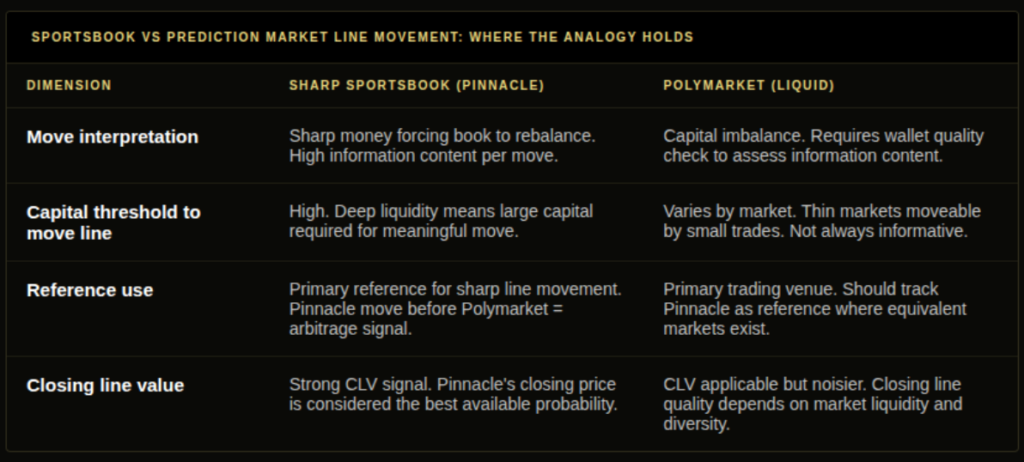
The parallel between sportsbook line movement and prediction market line movement is useful but imperfect. Understanding where it holds and where it breaks is what separates traders who use the analogy correctly from those who misapply it.
Where the analogy holds:
Sharp money drives meaningful line movement in both contexts. The Pinnacle line is the gold standard for sports probability because sharp bettors filter the market toward true probability over time. When Pinnacle moves a line on a football match, it is informative about the underlying probability distribution. When a high-accuracy Polymarket wallet cluster moves a prediction market price, the information content is analogous.
Reference book arbitrage works in both directions. When Pinnacle’s line and Polymarket’s price diverge by more than the transaction cost, traders will close the gap. The direction of Pinnacle’s line relative to Polymarket’s price is a directional signal for the expected Polymarket price adjustment.
Where the analogy breaks:
Polymarket has no single market maker with an incentive to balance the book. A sportsbook needs balanced action to manage risk. Polymarket market makers have no equivalent incentive. Price movement on Polymarket is a purer expression of capital imbalance, without the book-balancing adjustment that makes sportsbook line movement even more informative.
On thin Polymarket markets, a small number of participants can move prices without implying any meaningful information. A sportsbook with deep liquidity requires substantial capital to move a line, making each move more informative. A thin Polymarket market with $15,000 in total volume can be moved by a $2,000 trade, making single-move signals much less reliable.
The Timing Workflow: Getting In Before the Move Finishes
The trading edge in line movement is not just identifying which direction the smart money is going. It is identifying early enough in the move that meaningful edge remains.
A line move that is 90% complete offers 10% of the available edge. A move that is 20% complete offers 80%. The question is always: how far has this move already traveled, and how far does it have left to go?
Estimating move completion requires context about the typical size of moves for this event type on this market. A football match winner market that has moved 6 cents on smart money entering before a tactical change typically travels 8-10 cents total before the new equilibrium. If you are entering at the 6-cent mark, 2-4 cents of edge may remain. If your transaction cost plus minimum edge threshold is 3 cents, the position is borderline.
The workflow:
- Identify a line movement in progress through order book history and price rate of change.
- Assess the cause: check wallet quality for order flow moves, check reference book prices for arbitrage-driven moves, check social sentiment to distinguish sharp from public.
- Estimate how far the move has already traveled relative to the likely total move size for this event type.
- Calculate remaining edge: likely total move minus current move minus transaction cost.
- If remaining edge exceeds your minimum threshold, enter. If not, wait for the post-move fade setup instead.
Common Mistakes
Mistake 1: Following all line movement without distinguishing cause. A price move is not a signal. A price move with a verified cause is a signal. A trader who follows every line movement on every Polymarket market will follow public consensus moves into overpriced positions, close line drift into positions with no fundamental basis, and occasionally catch a sharp move. The sharp-to-noise ratio in undifferentiated line following is too low to be a profitable strategy.
Mistake 2: Entering a move that has already traveled most of its range. If you see a sharp move after it has already happened, the edge is partially or fully consumed. The traders who positioned during the move have already captured it. Entering at the end of a move is not following smart money it is paying the price that smart money set and hoping for continuation. Check timing and remaining edge before entering any in-progress move.
Mistake 3: Treating Polymarket line movement as equivalent to Pinnacle line movement. A 6-cent move on Polymarket from an unclassified wallet in a thin market is not equivalent to a 6-cent move on Pinnacle. The information content is completely different. Apply the sportsbook line movement analogy only when the Polymarket move has verified sharp wallet participation or is clearly driven by reference book arbitrage.
Mistake 4: Ignoring reverse line movement because it feels counterintuitive. Reverse line movement is uncomfortable to follow because it requires betting against the visible direction of public pressure. Most retail traders avoid it for this reason. Sharp traders follow it specifically because it is the signal that filters most clearly for informed money versus public money. The discomfort is not a reason to pass. It is the reason the edge exists.
Reading the Move While It Is Still Moving
Reading line movement correctly requires three data layers that are not available simultaneously on Polymarket’s native interface: wallet quality for order flow moves, reference book prices for arbitrage comparison, and price history at sufficient granularity to assess move timing.
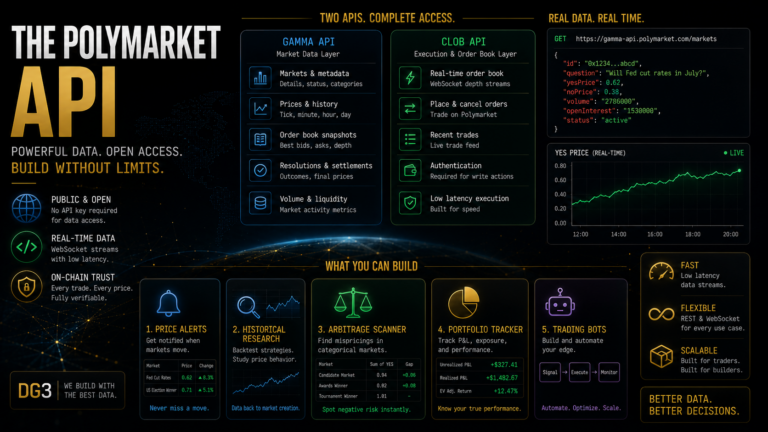
DG3’s Intelligence pane combines all three data layers for the selected market. The Whale tab shows wallet entries and order flow as they occur. The Chart tab shows price history at granularity that helps estimate how far a move has traveled relative to the typical total range. The Book tab shows current order book depth for assessing remaining move room.
When multiple large wallet entries appear in the same direction within a short window, the Whale tab makes the pattern visible before the move finishes — giving the trader a decision window rather than a historical record to review after the fact.
Frequently Asked Questions
Q: What causes line movement in prediction markets? A: Four causes: sharp informed money entering a position (informative, follow), public consensus accumulating (low signal, potentially fade), reference book arbitrage (follow in the direction of the reference book move), and liquidity events as market makers adjust quotes (not informative, ignore). The cause determines the correct response.
Q: How do you distinguish sharp from public-driven line movement on Polymarket? A: Check three things: order book wallet quality (high-accuracy wallet entries suggest sharp money), reference book comparison (if a sharp sportsbook has already moved in the same direction, the Polymarket move is likely arbitrage-driven), and social sentiment direction (if the price is moving against visible public sentiment, it is reverse line movement driven by sharp capital).
Q: What is a steam move in prediction markets? A: A steam move is a fast, coordinated line movement, typically 5-10 cents in under 10 minutes, driven by multiple informed entries in the same direction within a compressed time window. It carries high information signal. The correct response is to enter quickly in the same direction before the move finishes.
Q: How do you get in before a line move finishes? A: Identify the move early through order book history and rapid price rate of change. Verify the cause through wallet quality and reference book comparison. Estimate remaining move range relative to the typical total move size for that event type. Calculate remaining edge after transaction costs. Enter if remaining edge exceeds your minimum threshold.
Q: How does DG3 track sharp line movement in real time? A: DG3’s Intelligence pane tracks wallet entries through the Whale tab, showing large order flow as it enters the market. The Chart tab shows price history at granularity that lets you assess how far a move has already traveled. The Book tab shows current order book depth. Together these three views give the data needed to assess cause and remaining range before acting on any line move.
Q: What is reverse line movement in prediction markets? A: Reverse line movement is when a prediction market price moves against the direction of visible public buying or selling pressure. It signals that sharp informed money is taking the opposite side of the public with enough capital to override the consensus. Reverse line movement is among the highest-conviction signals in prediction market line reading because it directly reveals the divergence between informed and retail capital.
Q: How do you read line movement on Polymarket? A: Open the order book history for the market. Check transaction timing (how compressed are the entries), transaction size (small consistent buys versus large informed entries), wallet quality (verified high-accuracy versus unknown), and price rate of change (fast move versus slow drift). Compare against any reference book prices for the same event. Combine the outputs to assess cause and remaining edge.
Final Thoughts
Line movement is the most democratically visible signal in prediction markets. The chart is public. The price history is public. What is not public is the cause of each move. Cause is the only thing that determines whether following a move produces edge or costs money chasing someone else’s position.
Sharp steam moves are worth following, but only early and only with verified wallet quality. Public consensus moves are worth fading when they overshoot. Reverse line movement is worth following when the discomfort is highest. Closing line drift is worth ignoring.
The habit of distinguishing cause before acting on direction is the single most valuable practice in line movement trading. A trader who builds that habit across 50 markets will outperform a trader who follows price direction without context, every time, over any meaningful sample.
How line movement fits into the full signal hierarchy is covered in Trading Signals That Actually Move Event Markets.
Also read:
How to Read Polymarket Signals: A Field Guide
Trading Signals That Actually Move Event Markets
Edge Decay in Prediction Markets: Why Alpha Disappears
Sign up now – DG3 Terminal