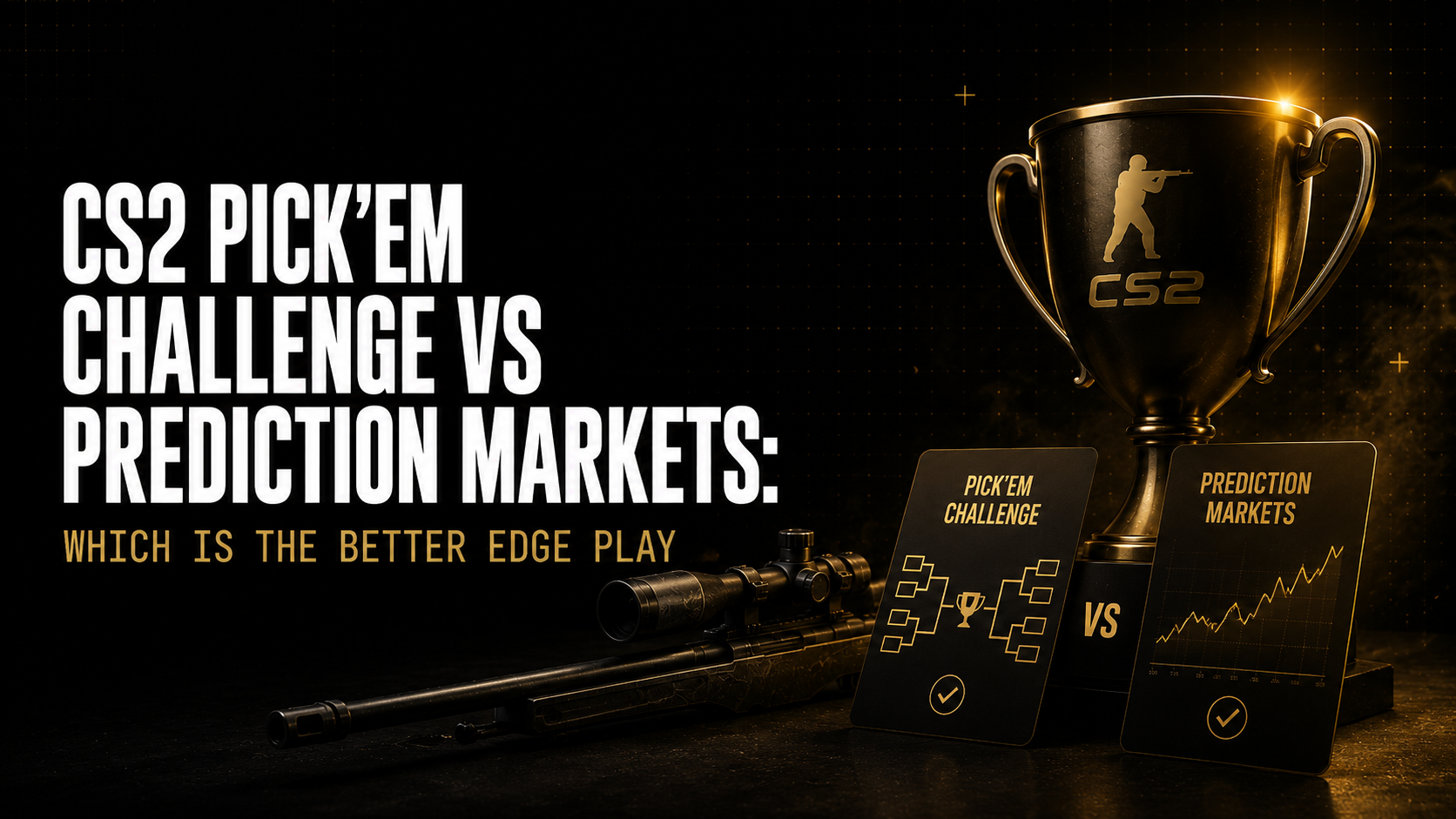
CS2 Pick’em Challenge vs Prediction Markets: Which Is the Better Edge Play
Every CS2 major, thousands of players fill out CS2 pick’em brackets hoping their group stage predictions land. Most of them are also sitting on Polymarket positions covering the same matches. They think they’re doing the same thing twice. They’re not.
The CS2 pickems challenge and prediction markets look similar from the outside from the outside. Both involve CS2 pickems-style prediction of outcomes. That’s where the similarity ends.
Table of Contents
Quick Answer
CS2 pick’ems are a free-to-play cosmetic prediction challenge tied to major tournaments, where correct picks earn sticker capsule rewards with no monetary value at stake. CS2 prediction markets are financial contracts where real capital is at risk, positions can be exited before resolution, and prices reflect genuine probability estimates. Pick’ems reward directional accuracy across a bracket. Prediction markets reward calibrated edge, the gap between your probability estimate and the market price.
Key Takeaways
- CS2 pick’ems have no entry cost and no monetary payout. The reward is cosmetic: sticker capsules that may have secondary market value on Steam. You can’t lose money on a pick’em, and you can’t size your position based on conviction level. Every pick carries the same weight.
- Prediction markets let you size proportionally to your edge. A 12-cent gap on a match you’ve researched thoroughly can carry a $600 position. A 2-cent gap on a match you’re less certain about carries $80. Pick’ems don’t allow this. Every bracket slot is equal.
- The research required for optimal CS2 pick’ems is almost identical to prediction market research: map pool analysis, roster confirmation, head-to-head records. The difference is what you do with the output. Pick’em uses it to fill a bracket. Prediction markets use it to size a position.
- Pick’em optimization is a combinatorial problem. The goal isn’t to pick the most likely winner in every slot. It’s to find the combination of picks that maximises expected reward given how other participants are likely to pick. Contrarian picks in early group stages often generate more expected reward than chalky consensus picks.
- Prediction markets run throughout the tournament. Pick’ems lock when the tournament starts. If you do your research before the major begins, prediction markets let you continue acting on that research as new information arrives across every match day. Pick’ems freeze your predictions on day one.
- The uncomfortable truth: most CS2 pick’em participants are not doing meaningful research. They’re picking teams they like, seeding their favourites into the bracket, and hoping for the best. That same crowd is in the Polymarket CS2 participant pool. Their systematic biases, favourite-longshot bias, brand recognition over current form, create the edges you’re looking for.
- Pick’ems and prediction markets aren’t mutually exclusive. The best use of pick’em research is to run your full match probability model for the major, use it to optimize your pick’em bracket, and then identify the markets where your probability estimate diverges most from Polymarket’s devigged price.
What the CS2 Pickems Challenge Actually Is
CS2 pick’em challenge: A Valve-operated bracket prediction contest run during CS2 major tournaments. Participants predict group stage results (advance/eliminate), quarterfinal, semifinal, and grand final outcomes. Correct predictions at each stage unlock sticker capsule rewards that can be redeemed in-game or traded on the Steam marketplace.
The pick’em challenge has existed in various forms since the original CS:GO major format. The current CS2 implementation runs across the New Legends Stage (group stage), the Playoffs, and the Grand Final. Each correct prediction at each stage contributes toward unlocking the associated capsule.
The sticker capsules themselves have variable Steam market value, typically $1-$8 for base capsules during the event, rising if the major generates notable viewership or features historically popular teams in the final. The expected monetary value of a perfect pick’em bracket runs to roughly $15-$45 in capsule value at current market rates, before any Steam marketplace fees.
Three things to understand about the format that affect how you should approach it:
The group stage uses an elimination format where teams advance or get knocked out across multiple rounds. You predict which teams finish in the top half (advance to playoffs) and which finish in the bottom half (eliminated). You don’t need to predict the exact order, just the correct side.
The playoff bracket operates as a traditional single-elimination tree. You predict the winner of each match from quarterfinals through the grand final.
Other participants’ picks affect your expected reward. Valve distributes capsule rewards based on prediction accuracy thresholds. If everyone picks the same bracket, the reward for being right is diluted. If you pick a correct upset that most participants missed, the contrarian pick yields higher marginal value.
Also read: CS2 Prediction Markets: The Complete Guide for Traders in 2026
CS2 Pickems vs Prediction Markets: Structural Differences That Matter
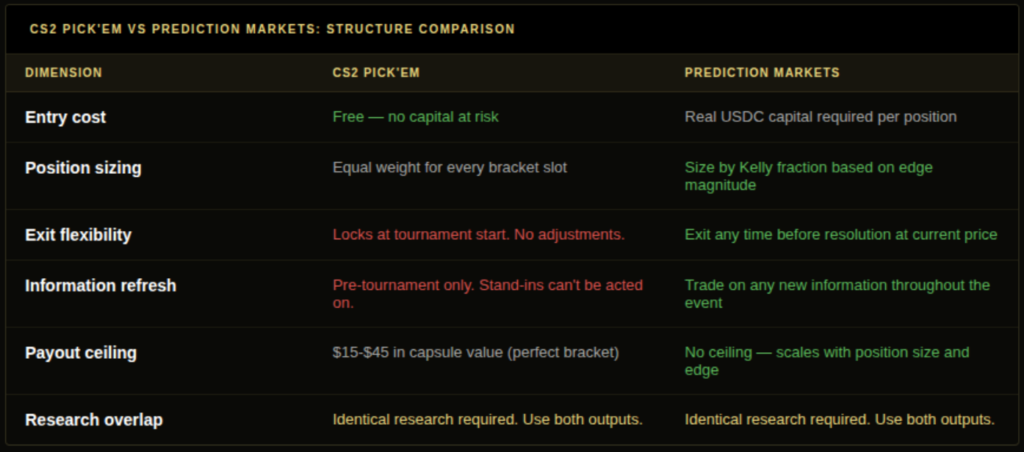
These aren’t just different formats. They’re different problems requiring partially different skills.
Position sizing: In pick’ems, every slot is binary and equal. You can’t put more on a result you’re 80% confident about versus one you’re 55% confident about. Prediction markets let you size proportionally using Kelly criterion. A pick’em treats a 55% edge and an 80% edge identically. A prediction market doesn’t.
Exit flexibility: Once you submit your CS2 pick’em bracket, it’s locked. If your group stage pick looks wrong after the first match day, you can’t adjust. Prediction markets let you exit positions, add to them, or reverse them as new information arrives across the full tournament.
Information refresh: Pick’ems reward pre-tournament research. Prediction markets reward research at every point during the event. A stand-in announcement on day 2 of the major can be traded in prediction markets. It changes nothing in your already-locked pick’em.
Payout structure: Pick’ems pay flat cosmetic rewards based on accuracy thresholds. Prediction markets pay proportionally to both the size of your position and the accuracy of your probability estimate. There’s no upper bound on prediction market returns from a single tournament. There’s a very clear ceiling on pick’em rewards.
Competitive field: Your pick’em accuracy is measured against the accuracy thresholds set by Valve, not directly against other participants. Prediction markets pit you against every other participant’s capital. The competitive dynamics are completely different.
Also read: What Is a Prediction Market? The Complete Guide for 2026
How to Optimize Your CS2 Major Pick’em
Pick’em optimization skips the obvious question of who wins each match. The real question is which combination of picks maximises expected capsule reward given the reward structure and the likely picks of other participants.
Step 1: Build your match probability model. Use the same map pool analysis from HLTV.org, roster data from Liquipedia, and head-to-head records you’d use for prediction market research. Assign probabilities to each group stage match outcome for each team. This is your baseline.
Step 2: Identify high-consensus vs low-consensus picks. Some group stage outcomes will be picked by the vast majority of participants (the #1 seed advancing from groups). Others will have divided opinion (two similar-strength T2 teams in the same group). The value in pick’ems concentrates in the low-consensus picks where you correctly identify an outcome the crowd missed.
Step 3: Weight your bracket toward contrarian upsets where your model has above-average confidence. If your model gives Team Spirit a 62% chance to advance from a group where most participants are picking NAVI, Spirit is the higher expected-value pick for the slot, not because they’re likely to advance, but because the marginal reward for correctly picking them is higher than the marginal reward for correctly picking the consensus choice.
Step 4: Run the same model for prediction markets. After completing your pick’em bracket, open Polymarket and compare your probability estimates against the devigged market prices for every match in the major. The markets where your estimate diverges by 4+ cents from the devigged price are your prediction market targets.
The pick’em research and prediction market research are the same research. The pick’em bracket is one output. The prediction market position list is a second output from exactly the same input.
Where CS2 Pickems Have a Genuine Edge Over Prediction Markets (and Vice Versa)
Pick’ems have genuine advantages in specific scenarios. If you don’t have enough capital to make prediction market positions meaningful, pick’ems give you a structured way to use your tournament research with zero capital at risk. If you’re building a CS2 probability model for the first time, pick’em results across two or three majors are a calibration dataset, did your group stage picks outperform the consensus? That tells you something real.
Prediction markets win on flexibility, sizing, and the ability to act on post-lock information. If you could only pick one research output to monetize from a CS2 major, prediction markets are the answer. The pick’em capsule ceiling is $15-$45. A well-researched prediction market approach to the same major, with appropriate position sizes, has no comparable ceiling.
The honest comparison isn’t pick’em versus prediction market. It’s both. Use the model for the bracket. Use the same model for the Polymarket positions. The marginal research cost of doing both is near zero once you’ve built the probability estimates.
Common Mistakes CS2 Pick’em Players Make
Mistake 1: Picking every favourite. The consensus chalk pick gets you to the accuracy threshold everyone else is also hitting. You’re not wrong, you’re just not different. Pick’em edge comes from correctly identifying results the crowd missed, not from correctly predicting the results everyone predicted.
Mistake 2: Locking the bracket without checking prediction market prices first.
Your pick’em bracket and your Polymarket positions should be derived from the same probability model. If you’ve built one, running the other takes 20 minutes. Most players who do pick’ems never open Polymarket. Most Polymarket CS2 traders never think about the pick’em optimization layer.
Mistake 3: Treating capsule value as the only return.
Pick’em research, done properly, produces a full probability model for the major. That model has value in prediction markets that dwarfs the capsule reward. The capsule is a side product of the research, not the main output.
Mistake 4: Not tracking your bracket history.
If your pick’em brackets have been consistently above average over three or four majors, you have documented evidence that your CS2 model has predictive value. If your brackets have been consistently average despite doing research, your model needs recalibration. Most pick’em players have no idea how their accuracy tracks over time.
Frequently Asked Questions
Q: What is the CS2 pickems challenge? A: A Valve-operated bracket prediction contest where participants predict CS2 major tournament outcomes in exchange for in-game sticker capsule rewards. No money changes hands. Capsules have Steam marketplace secondary market value, typically $1-$8 each during an active major.
Q: How does CS2 pick’em differ from prediction markets? A: Pick’ems are free-to-play, lock when the tournament starts, pay flat cosmetic rewards, and treat every bracket slot identically regardless of confidence level. Prediction markets involve real capital, can be exited at any time before resolution, pay proportionally to position size and accuracy, and let you size based on the degree of your edge.
Q: Which gives better edge: pick’em or prediction markets? A: For financial return, prediction markets aren’t comparable to pick’ems. The pick’em capsule ceiling is $15-$45. Prediction markets have no equivalent ceiling for a well-researched approach. For zero-risk engagement with your CS2 research, pick’ems are genuinely useful. For monetizing that research, prediction markets are the vehicle.
Q: How do you optimise your CS2 major pick’em? A: Build a full match probability model using map pool data, roster confirmations, and head-to-head records. Identify which outcomes are high-consensus (everyone will pick the same thing) and which are low-consensus (divided opinion). Weight your bracket toward contrarian picks where your model shows above-average confidence in an outcome the crowd is likely to miss.
Q: Where can you trade CS2 major bracket outcomes as contracts? A: Polymarket lists CS2 major match winner, series length, and tournament outright contracts throughout major events. Individual group stage qualification markets and playoff bracket contracts typically open at tournament announcement and carry increasing liquidity as the event approaches.
Q: How does DG3 help with CS2 major trading? A: DG3’s Edge Finder ranks all active CS2 Polymarket markets by the gap between current price and the Signal no-vig benchmark in real time. During a CS2 major, this surfaces the matches where Polymarket’s current price diverges most from the sharpest available probability estimate, exactly the same analysis you’d run manually for pick’em optimization, delivered continuously throughout the event.
Q: Can you profit from both pick’ems and prediction markets on the same major? A: Yes. The research required is identical. Build the probability model once, use it for both the pick’em bracket and the Polymarket position list. The marginal effort of doing both after the model is built is minimal, and the pick’em capsule reward is a free side output of research you were doing anyway.
Final Thoughts
The CS2 pickems challenge is a feature. CS2 prediction markets are a market. The feature exists to drive tournament engagement. The market exists because participants have genuine information asymmetries and are willing to back their views with capital.
Both deserve serious research. The pick’em bracket forces you to have a view on every match in the tournament before it starts, which is exactly the kind of pre-tournament model that produces the most disciplined Polymarket positions. Most prediction market traders drift into positions reactively, responding to each match as it unfolds. Pick’em players who build proper models are already thinking about the whole bracket before the first map is played.
Build the model. Fill the bracket. Then use the same output to find the Polymarket markets where your estimate diverges from the crowd. The research is the same. The returns are very different.
Also read: CS2 Prediction Markets: The Complete Guide for Traders in 2026
CS2 Esports Odds: How to Read, Compare, and Trade Counter-Strike Markets
What Is a Prediction Market? The Complete Guide for 2026