Is Polymarket the Best Platform for CS2 Esports Betting in 2026
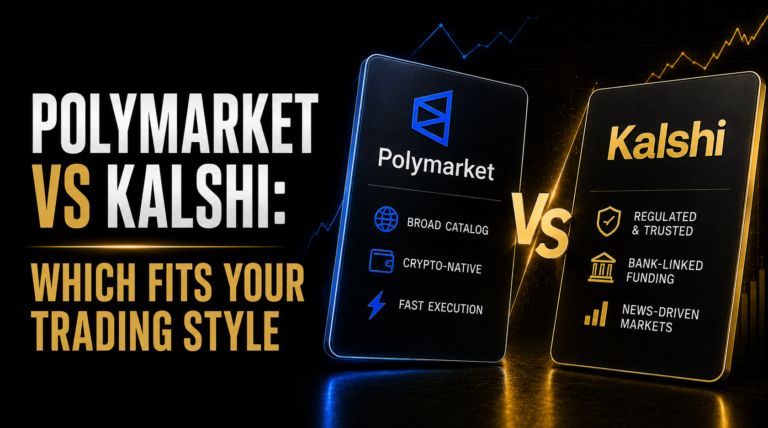
Finding the best platform for CS2 prediction markets in 2026 isn’t obvious. Three platforms are running meaningful volume. They serve different trader profiles. The wrong choice costs you real money in liquidity friction, fee drag, or, if you’re US-based, regulatory exposure.
Here’s the honest breakdown of what each one offers, where each one falls short, and why the choice isn’t as obvious as it looks.
Table of Contents
Quick Answer
Polymarket is currently the deepest CS2 prediction market platform by volume, covering major match winners, series markets, and tournament outrights with $80,000-$400,000 per match winner market during major events. Kalshi offers regulated US access to esports markets with lower liquidity. The right platform depends on geographic access, position size, and whether you need CFTC regulation. For non-US traders prioritising depth and flexibility, Polymarket leads. DG3 adds the Intelligence Pane on top of Polymarket, Edge Finder, Intelligence Pane, and 1-Click Trade, without changing where your positions live.
Key Takeaways
- CS2 Polymarket volume on major match winner markets runs 3-5x deeper than Kalshi equivalents during the same events. For position sizes above $300, Polymarket’s order book depth is meaningfully better for clean entry without market impact.
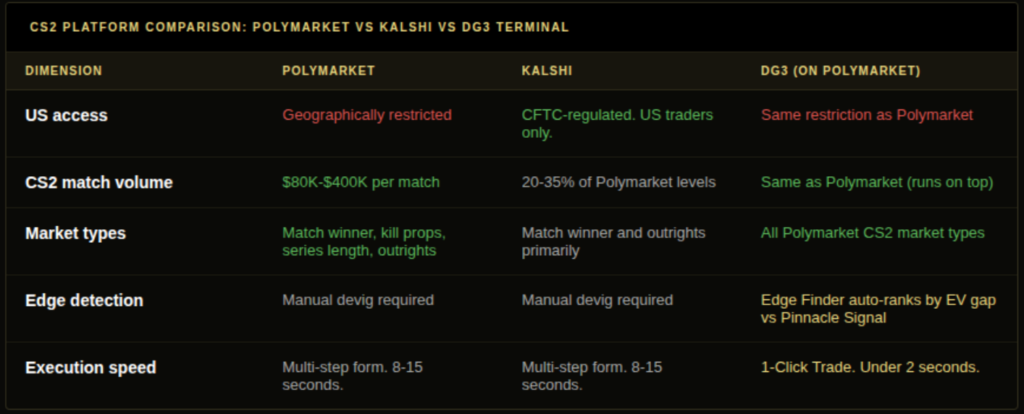
- Kalshi is CFTC-regulated and accessible to US traders. This is the decisive factor for US-based participants. Polymarket is geographically restricted for US users. If you’re in the US and want regulated CS2 prediction market access, Kalshi is your primary venue.
- Platform fee structures differ materially. Polymarket charges approximately 2% on market orders. Kalshi’s fee structure varies by market type. Both fee structures need to be factored into your edge calculation before entering any CS2 position.
- CS2 Polymarket offers a wider range of market types beyond match winners: series length contracts, player kill prop markets, and tournament outrights. Kalshi’s CS2 market coverage in 2026 is narrower, concentrated on match winners and tournament outrights for major events.
- The sharpest CS2 reference line remains Pinnacle, not either prediction market platform. Both Polymarket and Kalshi lag Pinnacle‘s price discovery on notable events by 8-20 minutes on average. The Pinnacle no-vig line is your external calibration point regardless of which platform you’re trading.
- DG3 is not a separate platform. It’s an intelligence and execution terminal built on top of Polymarket. Your wallet, USDC, and position history stay on Polymarket. DG3 adds the Edge Finder (real-time EV gap ranking), Intelligence Pane (Book tab, Sharps tab, News tab), and 1-Click Trade without replacing the underlying venue.
- Platform comparison without position size context is meaningless. A trader entering $100 positions can use any platform with available CS2 markets and the fee structure barely matters. A trader sizing $1,000-$5,000 positions needs to check order book depth before every entry, and at that size, Polymarket’s current depth advantage over Kalshi on CS2 fixtures is substantial.
CS2 Polymarket: What It Actually Offers in 2026
CS2 Polymarket is the dominant prediction market venue by volume in 2026. During ESL Pro League, BLAST Premier, and IEA major events, the platform generates the following CS2 market depth:
Match winner markets: $80,000-$400,000 in trading volume on notable fixtures. Spreads of 2-5 cents on liquid matches, 5-10 cents on lower-tier fixtures.
Series length markets: $5,000-$30,000 per market. More market-specific variance in liquidity.
Player kill prop markets: $1,000-$20,000 per player per event during majors. Concentrated on the game’s highest-profile players.
Tournament outright markets: $200,000-$2M+ during major events. The World Electronic Sports Games 2025 finals exceeded $2.1 million across all related CS2 markets.
The fee structure: approximately 2% on market orders. Limit GTC orders at the mid-price avoid the market order fee spread but require liquidity at your target price.
Polymarket’s CS2 coverage is broadest in terms of market types. The platform lists markets that Kalshi doesn’t: player kill props, series length contracts, and map-level markets on major fixtures. If you want to trade anything beyond match winner and tournament outright, Polymarket is currently the only practical venue.
Also read: CS2 Prediction Markets: The Complete Guide for Traders in 2026
Kalshi for CS2: The Regulated Alternative
Kalshi holds CFTC designation as a designated contract market in the United States. For US-based traders, this matters: Polymarket is geographically restricted for US users due to regulatory status. Kalshi is the primary regulated US access point for CS2 prediction markets.
The tradeoff is liquidity depth. Kalshi’s CS2 match winner markets in 2026 run approximately 20-35% of the equivalent Polymarket volume on comparable fixtures. Spreads are wider. The order book depth at target price is shallower. For small positions ($50-$200), the difference is manageable. For positions above $500, the Kalshi depth profile requires more attention to market impact.
Kalshi’s fee structure varies by market type, check their current fee schedule at the time of trading, as rates have been adjusted periodically. The CFTC-regulated status also provides dispute resolution mechanisms and investor protections that Polymarket’s offshore structure doesn’t replicate.
The market type coverage on Kalshi CS2 is narrower: primarily match winners and tournament outrights for major events. The kill prop and series length market types that exist on Polymarket are not consistently available on Kalshi.
How DG3 Fits Into CS2 Platform Choice
DG3 isn’t a third platform competing with Polymarket and Kalshi. It’s an intelligence and execution terminal built specifically on top of Polymarket for the Phase 0 build.
The practical distinction: your Polymarket account, USDC balance, wallet, and position history are unchanged when you use DG3. What changes is the workflow before and during your trades.
DG3’s Edge Finder processes every active CS2 Polymarket market in real time, ranking them by the gap between the current devigged price and the Pinnacle Signal no-vig benchmark. When a stand-in announcement drops and a CS2 match winner market reprices faster on Pinnacle than on Polymarket, that market rises to the top of the Edge Finder ranking, visible immediately without you needing to monitor individual markets.
The Intelligence Pane opens on any selected CS2 market: the Book tab shows live order book depth before you commit to a position size. the Sharps tab shows CLV-qualified wallet entries (50+ resolved trades, 90-day positive rolling CLV) scoped to that specific CS2 market. the News tab surfaces relevant announcements and team updates via Optic Odds.
1-Click Trade compresses the decision-to-order sequence to under 2 seconds. In a CS2 market moving at 0.5 cents per second following a stand-in announcement, the difference between 2 seconds and 12 seconds of order form friction is measurable in entry price.
Also read: Is Polymarket Worth It in 2026? An Honest Assessment
Platform Choice by Trader Type
Different CS2 trader profiles have genuinely different optimal platform choices:
US-based trader, any size: Kalshi is the only regulated option. The liquidity constraints are a genuine cost, but the alternative is using a geographically restricted platform in violation of its terms.
Non-US trader, positions under $300: Polymarket or Kalshi both work. At this size, fee structure matters more than order book depth. Compare the 2% Polymarket market order fee against Kalshi’s current schedule for the specific market type.
Non-US trader, positions $500+: Polymarket. The order book depth advantage at larger position sizes is substantial. Check the Book tab or order book before every entry to confirm depth at target price.
Non-US trader, any size, wanting CS2 market coverage beyond match winner: Polymarket. Kalshi doesn’t consistently offer series length, kill props, or map-level CS2 markets.
Trader who wants the Edge Finder, Sharps tab, and 1-Click Trade workflow: DG3 on top of Polymarket. Same positions, same venue, substantially different research and execution infrastructure.
Common Mistakes in CS2 Platform Selection
Mistake 1: Choosing a platform without checking CS2 market availability. Not every CS2 event is listed on every platform. Check whether the specific fixture you want to trade is actually available and has meaningful liquidity before building a research model around it.
Mistake 2: US traders using Polymarket via VPN.
This violates Polymarket’s terms of service and creates platform account risk. Kalshi exists specifically for this use case.
Mistake 3: Ignoring fee drag on small-edge positions.
On a 3-cent edge position at a price level of 0.55, Polymarket’s 2% market order fee costs approximately 2 cents. Your net edge is 1 cent, below the minimum viable threshold. Always calculate edge after fees, not before.
Mistake 4: Assuming DG3 replaces Polymarket.
DG3 is a terminal layer, not a venue. Your Polymarket positions execute on the Polymarket CLOB. DG3 changes what you see and how fast you execute, not where your trades settle.
Mistake 5: Not comparing platforms on the specific market type you want to trade. Polymarket leads on market type coverage. Kalshi leads on regulatory status. Neither consistently dominates on all dimensions for all trader types.
Frequently Asked Questions
Q: Is Polymarket the best platform for CS2 betting? A: For non-US traders wanting the deepest CS2 market liquidity and broadest market type coverage, yes. For US-based traders, Kalshi is the only regulated option regardless of liquidity comparison. DG3 adds research and execution infrastructure on top of Polymarket for traders who want the Edge Finder, Sharps tab, and 1-Click Trade workflow.
Q: How does Polymarket CS2 compare to Kalshi CS2? A: Polymarket runs 3-5x deeper CS2 match winner volume on comparable fixtures. Polymarket offers kill props, series length, and map-level markets that Kalshi doesn’t consistently list. Kalshi offers CFTC-regulated access for US traders that Polymarket doesn’t. For non-US traders sizing above $500 per position, Polymarket’s order book depth is meaningfully better.
Q: Which platform has the most CS2 liquidity? A: Polymarket. Major match winner markets generate $80,000-$400,000 in volume on notable fixtures. Tournament outright markets during major events exceed $200,000-$2M+. Kalshi CS2 markets typically run 20-35% of equivalent Polymarket volumes.
Q: How does DG3 add to Polymarket for CS2 traders? A: DG3’s Edge Finder ranks active CS2 Polymarket markets by EV gap against the Pinnacle Signal benchmark in real time. The Intelligence Pane shows live order book depth, CLV-qualified wallet entries on the selected market, and injury/news updates via Optic Odds. 1-Click Trade compresses execution to under 2 seconds. Positions still settle on Polymarket, DG3 is the layer above.
Q: Are there better CS2 prediction market alternatives to Polymarket? A: For US traders, Kalshi is the regulated alternative. For non-US traders wanting the deepest liquidity and widest CS2 market type coverage, there isn’t a direct competitor to Polymarket in 2026. The platform comparison matters most for US access and for position size, both of which have clear answers.
Final Thoughts
Platform comparison questions usually have a simple answer once you know two things: your geographic access constraints and your position sizing.
US trader: Kalshi. Non-US trader above $500 per position who wants CS2 kill props and series markets: Polymarket. Both categories of trader who want real-time EV ranking, Sharps tab signal context, and 1-Click Trade: DG3 on top of Polymarket.
The platform choice is infrastructure. The edge still comes from the probability model. A trader using the right platform with a poor CS2 model consistently underperforms a trader using a suboptimal platform with a well-calibrated model. Get the research right. Then pick the platform that fits.
Also read: CS2 Prediction Markets: The Complete Guide for Traders in 2026
Is Polymarket Worth It in 2026? An Honest Assessment
Polymarket Alternatives in 2026: Kalshi, Azuro, Manifold, and Where Each One Fits