Crypto Holidays Calendar 2026: The Dates That Move Polymarket Prices
Most traders treat January 3rd as just another Thursday. The people who’ve been in crypto since 2013 open a beer and think about Satoshi. Both groups watch the same price charts. Only one of them understands why certain dates carry weight in this market.
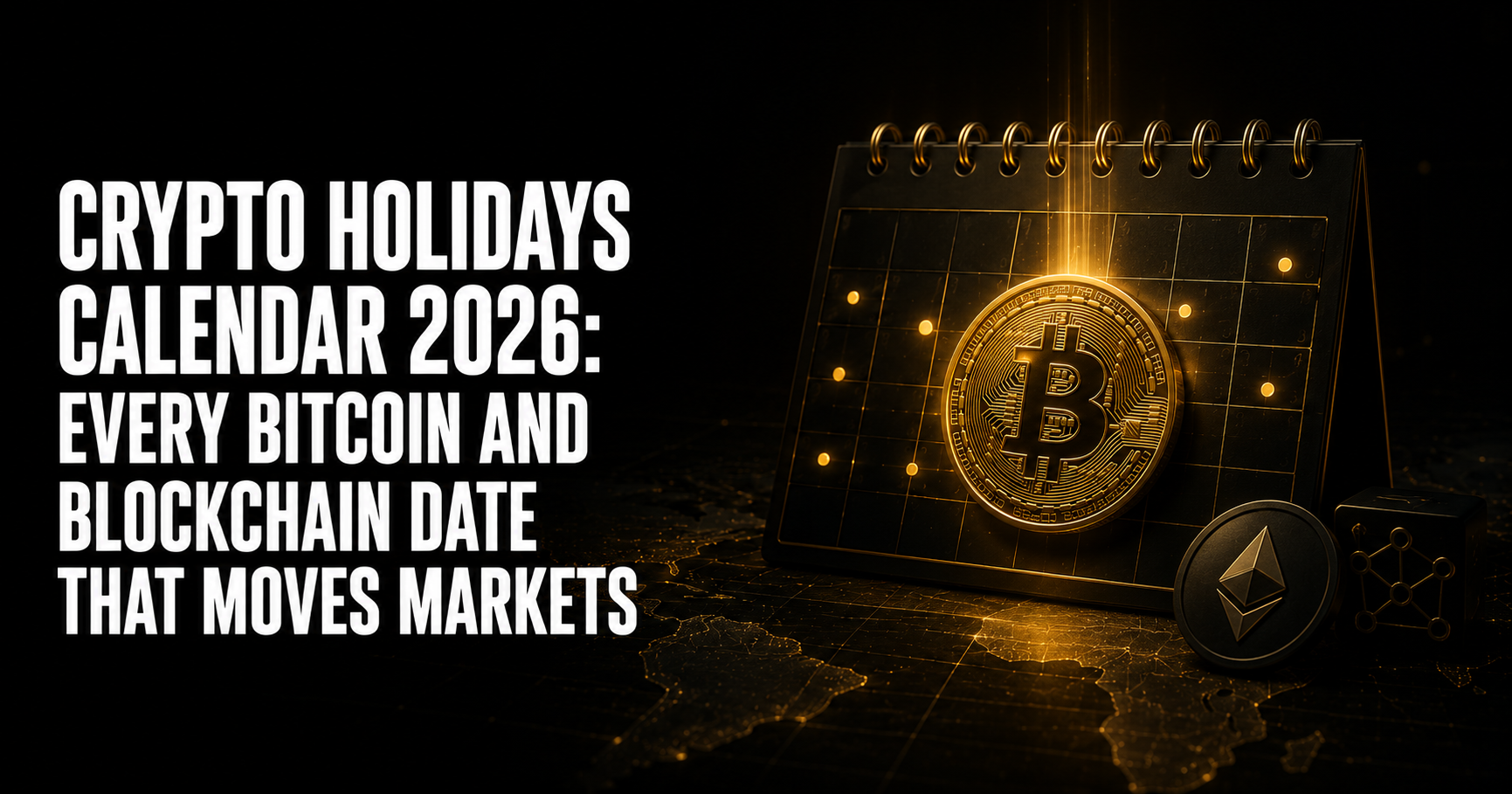
The crypto holidays calendar 2026 isn’t a novelty item for crypto traders. It’s a signal layer for anyone trading on prediction markets. Halvings, genesis anniversaries, whitepaper day, major protocol events – these dates generate measurable shifts in sentiment, volume, and prediction market pricing across both crypto and sports. The same structural awareness that helps you position on a BTC milestone contract helps you understand why liquidity conditions change around these dates, which affects every open Polymarket position you hold, including football outrights and esports match winners.
This is the complete 2026 calendar with the context that actually matters for traders.
Table of Contents
Why the Crypto Calendar Is a Trading Tool, Not a Trivia List
Crypto markets run 24/7. There’s no closing bell, no earnings season, no Fed meeting schedule that governs everything. What there is: a loose but real event cadence built around network milestones, community anniversaries, and institutional conference cycles.
Each one does something slightly different to market dynamics.
Community dates like Bitcoin Pizza Day and Genesis Block Day generate social media volume spikes that push retail participation higher for 24-48 hours. This matters in thin prediction markets because retail flow moving into a market at 0.60 can push the price to 0.63 before any real information has changed. That’s a pricing distortion, and distortions are tradeable.
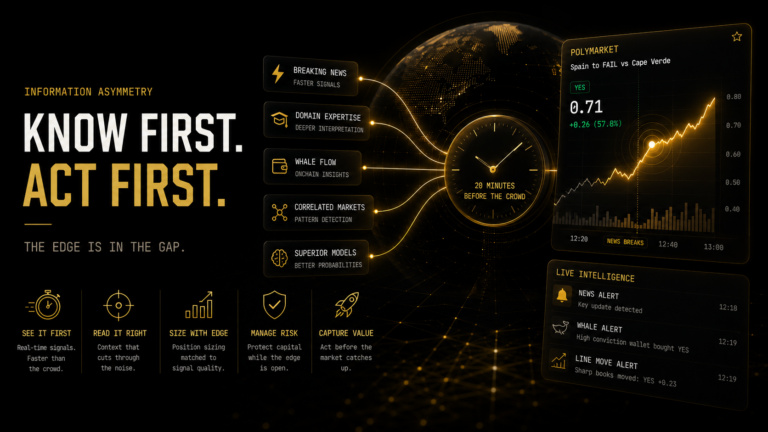
Conference cycles matter for different reasons. When Consensus, ETHDenver, or DevCon clusters institutional attention, protocol upgrade announcements tend to cluster there too. Price impacts from those announcements are often front-run by participants who track the development pipeline closely, which means Polymarket prices on upgrade-related markets will move before the announcement is official. Information asymmetry in prediction markets is the structural feature that makes calendar awareness valuable.
Halvings operate on a different timescale entirely. Their price impact is debated endlessly, but their effect on market sentiment and positioning is documented. The 2024 halving triggered a months-long narrative cycle that drove Polymarket BTC price milestone markets to their highest 2024 volumes. The 2028 halving is still two years out, but the post-2024 supply dynamics are still playing out in 2026 pricing.
Bitcoin Dates on the Crypto Holidays Calendar 2026 That Traders Watch
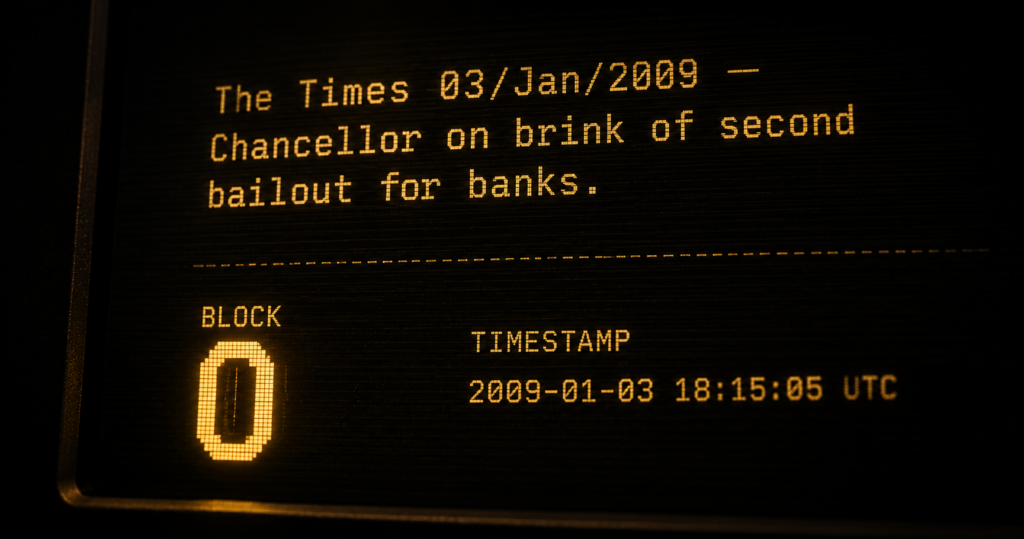
January 3, Genesis Block Day
The first Bitcoin block was mined on January 3, 2009. Satoshi embedded the headline “Chancellor on brink of second bailout for banks” in the coinbase transaction, a statement of intent that the crypto community still quotes sixteen years later.
Practically for 2026: Genesis Block Day generates consistent social volume spikes and tends to produce small but real increases in Bitcoin-adjacent prediction market participation. Not a high-magnitude event, but worth noting on any serious crypto market calendar.
May 22, Bitcoin Pizza Day
On May 22, 2010, Laszlo Hanyecz paid 10,000 BTC for two pizzas. At today’s prices that’s a number nobody wants to calculate out loud. The date has become the community’s annual benchmark for how far the network has come.
Trading relevance: moderate. Pizza Day generates retail attention that briefly moves speculative sentiment indicators. Experienced traders tend to fade the narrative-driven enthusiasm that spikes around it.
October 31, Bitcoin Whitepaper Day
Satoshi Nakamoto published the Bitcoin whitepaper on October 31, 2008. The document is nine pages. It described a peer-to-peer electronic cash system that made every central bank in the world uncomfortable. Every blockchain project that followed traces its intellectual lineage here.
The 2024 Halving, Effects Still Running
The most recent Bitcoin halving occurred in April 2024, reducing the block reward from 6.25 BTC to 3.125 BTC. Halvings don’t produce immediate price spikes on the day, the well-documented “buy the rumor, sell the news” dynamic typically plays out in the months before. The supply-side effect compounds over the following 12-24 months as the reduced issuance rate interacts with demand.
For 2026 prediction market traders, CoinGlass halving cycle data shows the post-halving supply environment is the relevant context for any BTC price milestone market. Understanding how crypto event markets work on Polymarket, specifically how BTC threshold-crossing probability is modelled, requires this cycle backdrop.
The Crypto Holidays Calendar 2026: Ethereum and Protocol Events
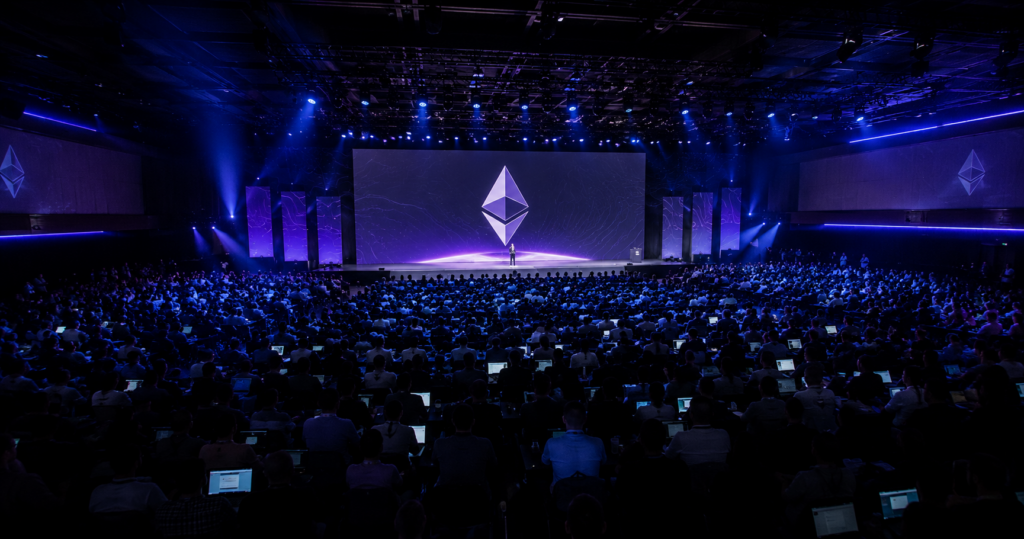
Ethereum’s 2026 event calendar is the most densely packed it’s ever been, with major developer and institutional conferences across four continents.
February 17-21, ETHDenver (Denver, Colorado) The annual Ethereum-focused hackathon and developer conference. ETHDenver has historically been where new DeFi primitive ideas surface before they become tradeable narratives. Protocol announcements from ETHDenver regularly move Ethereum ecosystem tokens within 48 hours of presentation.
March 30 to April 2, EthCC (Cannes) The largest annual Ethereum community conference in Europe. EthCC tends to be where the Ethereum Foundation signals roadmap priorities. For Polymarket traders watching upgrade activation markets, the tone from EthCC often sets expectations that prediction market prices start pricing in immediately.
April 3-5, ETHGlobal Cannes Global hackathon running concurrently with EthCC. These events historically generate the DeFi and L2 narrative cycles that drive sector-specific prediction market volume 4-8 weeks after the event.
November 3-6, DevCon 8 The official Ethereum Foundation conference. DevCon is the highest-signal Ethereum calendar event for protocol development. Major technical announcements, consensus changes, EIP statuses, scaling decisions, tend to cluster here. This is the one conference that directly feeds into upgrade activation timeline prediction markets.
Major Industry Conferences With Market-Moving History
May 5-7, Consensus (Miami)
CoinDesk’s Consensus is the largest general-purpose crypto conference by attendance, drawing 20,000+ participants across finance, technology, and government sectors. Consensus has historically been where institutional positioning narratives get announced to a broad audience.
For traders: the week before Consensus often sees elevated prediction market activity on regulatory-adjacent markets, as the conference provides a stage for policy signals. Markets on ETF decision timelines and regulatory outcomes have shown consistent pre-conference volume spikes in past years.
April 27-29, Bitcoin 2026 (Las Vegas)
The Bitcoin-specific conference that has become an unofficial gathering point for corporate treasury announcements and political engagement with Bitcoin. Since 2021, major corporate Bitcoin adoption announcements have clustered around this event.
October 7-8, TOKEN2049 Singapore
The largest institutional Web3 conference in Asia. TOKEN2049 Singapore consistently drives Asian-market-focused crypto price momentum and has become a notable calendar point for prediction markets covering Asian institutional adoption narratives.
November 15-17, Solana Breakpoint
Solana’s flagship annual conference. Major ecosystem announcements, new chains, major integrations, ecosystem fund deployments, cluster here. Given the ongoing Solana ETF application process in the US, Breakpoint 2026 carries above-average market significance.
The Altcoin Event Calendar That Most Traders Miss

Most calendar coverage focuses on Bitcoin dates and Ethereum conferences. The altcoin event calendar gets less attention, which means the prediction market prices around altcoin-adjacent events tend to be less efficiently priced.
TOKEN2049 Dubai (April 29-30) draws the Middle East institutional audience and has increasingly been a catalyst for regional crypto adoption announcements that ripple into global markets.
Binance Blockchain Week (TBA 2026) hasn’t confirmed dates but historically runs in Q4. Given Binance’s ecosystem size, any confirmed date will move BNB-adjacent markets in the weeks before.
Token anniversary events, the anniversary of major token launches periodically generate social volume and speculative positioning. Not high-conviction trades, but worth noting in any comprehensive crypto market calendar.
Why Prediction Market Traders Beyond Crypto Should Track This Calendar
If your primary markets are sports, politics, or esports on Polymarket, the crypto calendar still affects you directly. Three ways it shows up:
Liquidity conditions tighten around major crypto events. When Consensus or a Bitcoin halving dominates attention, retail capital rotates toward crypto markets. Spreads on sports and esports prediction markets widen temporarily as market makers reduce their exposure across the platform. Entering a CS2 or football position during a peak crypto event window costs more than the same entry two days later.
Platform-wide volume spikes change price dynamics. On days when BTC price milestone markets are resolving or a major ETF decision lands, total Polymarket volume surges. This creates unusual price movements even on non-crypto markets as capital flows in and out. DG3’s Edge Finder shows EV gaps in real time across all active markets — on high-volume crypto event days, sports market EV gaps often widen as crypto participants briefly misprize non-crypto contracts.
The same research framework applies everywhere. Whether you’re modelling a BTC threshold-crossing probability or a CS2 match winner, the core process is identical: independent probability estimate, devigged market price comparison, edge calculation, calibrated sizing. The crypto calendar is an entry point into prediction market thinking for traders who came from crypto. The terminal they’ll end up using covers every market on Polymarket, not just crypto.
How to Use This Calendar as a Trading Framework
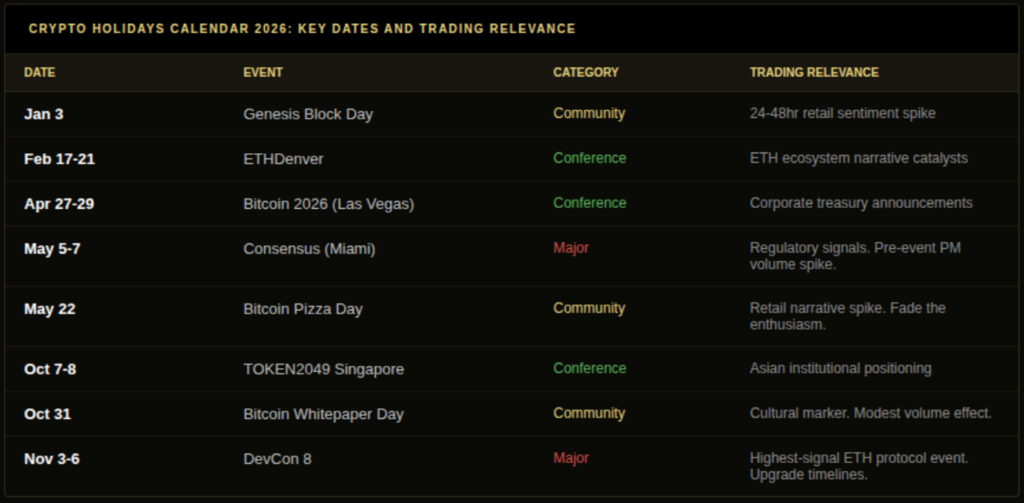
Knowing the dates isn’t the edge. The edge is in understanding what type of market response each event category typically produces, and whether the current Polymarket price already reflects that expectation.
For community dates (Pizza Day, Genesis Block Day): These produce short-duration retail sentiment spikes. The edge for serious traders is usually to have entered before the narrative peaks, not during it. Line movement in prediction markets often begins 48-72 hours before the community date itself.
For conference events: The usable window is typically in the 72 hours after a major announcement. Protocol upgrade timelines, ETF signals, regulatory statements, these reprice related prediction markets quickly. The pre-conference period often shows gradual price drift toward the event’s expected outcome, which provides positioning opportunities for traders who’ve done the underlying research.
For halving and cycle events: These operate on a different timescale. Position sizing discipline and bankroll management matter more here because the price impact plays out over months, not hours. Short-duration prediction market positions on halving-adjacent BTC price milestones require modelling the full probability distribution of BTC’s price path, not just the directional view.
For regulatory deadlines: ETF decision dates, CFTC ruling timelines, legislative deadlines, these are the highest-volatility prediction market events in the crypto calendar. Prices on related contracts have moved 30-40 cents in under an hour on surprise announcements. Position size accordingly.
One framework that helps: treat each calendar category as a distinct market type with its own edge profile and appropriate position size. A community date trade is a short-duration sentiment play requiring small size and a tight exit window. A regulatory deadline trade requires deeper research, higher information quality, and appropriately smaller sizing to account for decision variance. A conference-cycle trade sits between the two: medium duration, medium edge quality when you’ve tracked the development pipeline, and medium sizing.
The crypto calendar doesn’t predict outcomes. It maps the windows where outcomes concentrate. That’s the distinction that separates a trading framework from a trivia list. And it’s the same distinction that applies whether you’re positioning on a BTC price milestone, a Solana ETF approval, or the next CS2 major winner – the framework is the same, the market is Polymarket, and the tool that surfaces edge across all of it is DG3.
Frequently Asked Questions
Q: What are crypto holidays and why do they matter for traders? A: Crypto holidays are symbolic calendar dates tied to historical blockchain milestones, Bitcoin’s genesis block, the first BTC transaction, halving events, and major whitepaper anniversaries. They matter to traders because they generate predictable social volume spikes, sentiment shifts, and in some cases concentrated volatility in prediction markets tied to crypto price and regulatory outcomes.
Q: What is the most important crypto event in 2026? A: From a prediction market perspective, Consensus Miami (May 5-7) and DevCon 8 (November 3-6) carry the highest signal value for protocol and institutional developments. Bitcoin 2026 in Las Vegas (April 27-29) is the highest-profile stage for corporate BTC adoption announcements. The post-2024 halving supply dynamics continue to underpin BTC price milestone markets throughout 2026.
Q: How does the Bitcoin halving affect prediction market prices? A: The halving reduces Bitcoin’s new issuance rate by half, tightening supply-side economics over the following 12-24 months. In prediction markets, this affects the probability distribution used to price BTC price milestone contracts, higher structural supply scarcity increases the probability mass above any given threshold for a given time horizon, which should be reflected in fair value estimates for BTC milestone markets.
Q: When is Bitcoin Pizza Day 2026? A: May 22. It marks the anniversary of the first documented real-world Bitcoin transaction in 2010, when 10,000 BTC were paid for two pizzas. The date generates retail sentiment spikes and short-term prediction market participation increases for 24-48 hours around the anniversary. For traders, it’s more useful as a background context event than a primary trade catalyst — the narrative is well-known and therefore largely pre-priced. It marks the anniversary of the first documented real-world Bitcoin transaction in 2010, when 10,000 BTC were exchanged for two pizzas. The date generates retail sentiment spikes and modest prediction market volume increases for 24-48 hours around the anniversary.
Q: What conferences should prediction market traders track in 2026? A: Consensus Miami (May 5-7) for regulatory and institutional signals, ETHDenver (February 17-21) and EthCC Cannes (March 30 to April 2) for Ethereum protocol signals, DevCon 8 (November 3-6) for upgrade timelines, Bitcoin 2026 Las Vegas (April 27-29) for corporate adoption announcements, and TOKEN2049 Singapore (October 7-8) for Asian institutional positioning.
Also read: Crypto Event Markets: Trading BTC Milestones and Protocol Catalysts
Trading the News: An Event Driven Playbook for Prediction Markets
Information Asymmetry: Who Knows What, and When, in Event Markets