
15 Bitcoin History Events That Shaped How Prediction Markets Work Today
Every market has a founding mythology. Bitcoin’s is more documented than most, timestamped on-chain, published in whitepapers, and occasionally burned into infamy by a $450 million exchange collapse.
Understanding Bitcoin history isn’t nostalgia. It’s pattern recognition. The cycles that shaped BTC’s price behaviour, the structural shifts that changed how the market prices risk, the protocol upgrades that expanded what the network could do – these events are the architecture of the prediction market ecosystem you’re operating in today. Polymarket exists because Bitcoin made decentralised financial contracts possible. The same platform where you trade CS2 match winners and football outrights runs on the same infrastructure Bitcoin created.
Here are the 15 bitcoin history events that matter most, with the context that doesn’t usually make the timeline graphics.
Table of Contents
1. The Bitcoin Whitepaper, October 31, 2008
On Halloween 2008, a person or group using the name Satoshi Nakamoto published a nine-page document available in full at bitcoin.org titled “Bitcoin: A Peer-to-Peer Electronic Cash System” to a cryptography mailing list. The paper described a system for transferring value between parties without a trusted intermediary, solving the double-spend problem that had made digital cash unworkable for decades.
The whitepaper wasn’t greeted with immediate fanfare. It arrived in the middle of the 2008 financial crisis, which gave the founding text an implicit editorial context: the entire premise was designed in response to exactly what was happening in global banking at the time.

2. The Genesis Block, January 3, 2009
The first Bitcoin block was mined on January 3, 2009. Satoshi embedded a message in the coinbase transaction: “The Times 03/Jan/2009 Chancellor on brink of second bailout for banks.” It’s one of the most deliberate acts of editorial curation in financial history. The first block of the first decentralised financial network was timestamped with a headline about the failure of centralised banking.
This date, January 3, became Genesis Block Day, one of the anchor points on the crypto community calendar.
3. The First Bitcoin Transaction, January 12, 2009
Nine days after the genesis block, Satoshi sent 10 BTC to cryptographer Hal Finney, completing the first peer-to-peer Bitcoin transaction in history. Block number 170 on the Bitcoin blockchain records it permanently.
Finney was one of the earliest contributors to Bitcoin’s development and ran the first-ever Bitcoin client software the same day Satoshi released it. His participation in the first transaction wasn’t coincidence, he was the person in the world most prepared to receive it.
4. Bitcoin Pizza Day, May 22, 2010
Laszlo Hanyecz paid 10,000 BTC for two pizzas on May 22, 2010, making it the first documented real-world commercial transaction using Bitcoin. At the time, the exchange rate was roughly $0.0025 per BTC, meaning the pizzas cost about $25 in fiat terms.
The trade has since become the community’s benchmark for how dramatically the value proposition of Bitcoin changed. May 22 became Bitcoin Pizza Day, now one of the most-observed dates on the annual crypto calendar.
5. Mt. Gox Peak and Collapse, 2011-2014
Mt. Gox began as a Magic: The Gathering card trading site, pivoted to Bitcoin exchange in 2010, and at its peak handled 70% of all global Bitcoin transactions. In June 2011, it was hacked for the first time. In early 2014, it collapsed entirely after revealing that 850,000 BTC belonging to customers had disappeared, approximately $450 million at the time.
The Mt. Gox collapse set the template for exchange risk in crypto. Every subsequent exchange failure, FTX included, follows structural patterns that were first documented here: custodial risk, commingled funds, inadequate security, and a gap between what exchanges claim to hold and what they actually hold.
For prediction market traders, the historical lesson is about information asymmetry, the participants who knew Mt. Gox was insolvent well before the public announcement had information that the public market price hadn’t absorbed. That pattern recurs.

6. The First Bitcoin Halving, November 28, 2012
On November 28, 2012, Bitcoin’s block reward was cut from 50 BTC to 25 BTC. The halving mechanism was written into the protocol from the beginning, every 210,000 blocks, the reward to miners is halved, hardcoding a disinflationary supply schedule into the network.
The 2012 halving preceded Bitcoin’s first major bull cycle. The 2016 halving preceded the 2017 cycle. The 2020 halving preceded the 2021 cycle. The 2024 halving, the most recent, produced a peak near $122,000 in 2025. The mechanism is the same each time. The timing of the price response varies. Understanding how halving cycles affect crypto event prediction markets is fundamental for any trader positioning on BTC price milestone contracts.
7. The Bitcoin ATM, May 2, 2013
The first Bitcoin ATM launched in Vancouver, Canada on May 2, 2013. The machine allowed users to buy Bitcoin with cash, removing the requirement for a bank account or exchange account. At the time, the friction involved in acquiring Bitcoin was notable enough that the ATM represented a genuine access expansion.
By 2026, there are over 35,000 Bitcoin ATMs globally, tracked by Coin ATM Radar. The Vancouver machine was the proof of concept.
8. HODL Day, December 18, 2013
On December 18, 2013, a user on the Bitcointalk forum posted a message titled “I AM HODLING” explaining why, despite a sharp price drop, they were not selling. The post contained several typos, including the now-famous misspelling of “holding.”
The term HODL has since entered permanent use in crypto culture as shorthand for holding through volatility rather than reacting to price movement. The psychology behind it — managing tilt, staying with a position through adverse movement – is identical to what separates profitable prediction market traders from reactive ones across every market category. Whether you’re holding a CS2 tournament outright through a rough group stage or a BTC price milestone contract through a 10-cent drawdown, the discipline is the same. Prediction market trading psychology covers exactly this.
9. The Lightning Network White Paper, January 14, 2016
Joseph Poon and Thaddeus Dryja published the Lightning Network white paper on January 14, 2016, proposing a Layer 2 payment channel network that would allow Bitcoin transactions to occur off-chain at high speed and low cost. The paper addressed Bitcoin’s throughput limitation directly, the base layer was never designed to handle millions of transactions per second.
The Lightning Network launched on mainnet in December 2017. By 2026, it carries billions of dollars in payment volume monthly and is the primary infrastructure for Bitcoin’s role in micropayment and remittance applications.
10. SegWit Activation, August 24, 2017
Segregated Witness (SegWit) activated on the Bitcoin network on August 24, 2017 at block height 481,824. The upgrade addressed transaction malleability, a bug that had complicated second-layer development, and effectively increased block capacity by restructuring how transaction data is stored.
SegWit’s activation was contentious. It was achieved through a mechanism called BIP91 and only after months of miner and community negotiation. The upgrade laid the technical foundation for the Lightning Network and for subsequent Taproot improvements.
11. CME Bitcoin Futures, December 2017
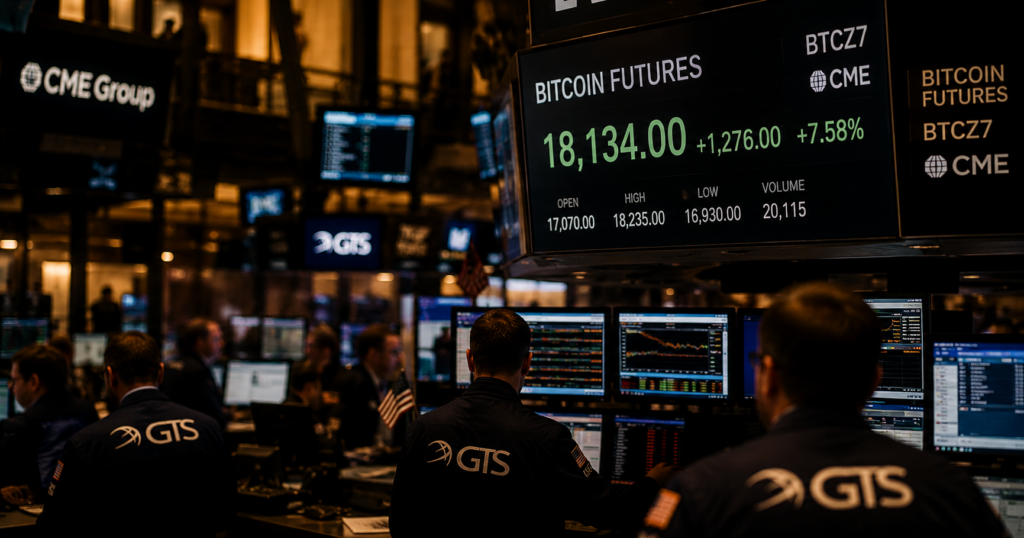
On October 31, 2017, the CME Group announced Bitcoin futures trading, launching in December 2017. Bitcoin’s price hit $6,600 the day of the announcement. The launch of regulated derivatives was notable not because it immediately brought institutional money in, it initially did the opposite, but because it created the first regulated mechanism for institutional investors to take short positions on Bitcoin, changing the structure of market cycles.
12. The SEC Spot Bitcoin ETF Approval, January 10, 2024
On January 10, 2024, the US Securities and Exchange Commission approved spot Bitcoin ETF applications from multiple asset managers including BlackRock, Fidelity, Bitwise, and others. The approval ended a decade of rejections and opened direct Bitcoin exposure to every retail brokerage account in the United States.
BlackRock’s iShares Bitcoin Trust accumulated over 773,000 BTC in its first year. The structural impact, a persistent, large-scale institutional bid that doesn’t have the redemption dynamics of hedge funds, fundamentally changed Bitcoin’s demand floor. For anyone modelling BTC price milestone markets on Polymarket in 2026, the ETF baseline bid is the most important structural change in the asset’s history.
The prediction market for this event was one of the highest-volume crypto events in Polymarket history. Participants who were tracking SEC docket activity were positioned weeks before the public announcement, the textbook example of information asymmetry creating edge in regulatory event markets.
The same information asymmetry framework applies to every prediction market category DG3 covers. A CS2 stand-in announcement, a football team sheet publication, a Solana ETF filing – all of them create the same edge window: a 12-25 minute gap between when the information exists and when the market price fully reflects it. The ETF approval market is the largest-scale version of a pattern that repeats on Polymarket every single day.
13. The Bitcoin Ordinals Protocol, January 21, 2023
Developer Casey Rodarmor introduced the Ordinals protocol on January 21, 2023, enabling the creation of Bitcoin-native NFTs by inscribing arbitrary data onto individual satoshis. The protocol generated immediate controversy, Bitcoin maximalists argued it was network bloat, others saw it as a natural extension of what the base layer could support.
Whatever the ideological debate, Ordinals drove a notable spike in Bitcoin transaction fees and on-chain activity in 2023-2024 and triggered the subsequent BRC-20 token standard.
14. The 2024 Bitcoin Halving, April 2024
The fourth Bitcoin halving occurred in April 2024, reducing the block reward from 6.25 BTC to 3.125 BTC. Unlike previous halvings, this one occurred with spot Bitcoin ETFs already live and accumulating, meaning the supply reduction from halving coincided with unprecedented new institutional demand.
The result was a faster post-halving price response than previous cycles, with Bitcoin reaching $122,000 in 2025. The supply and demand dynamics established in April 2024 are the structural backdrop for every BTC prediction market in 2026.
15. Bitcoin as Corporate Treasury Reserve, 2020-Present
The institutional Bitcoin treasury movement started with MicroStrategy’s initial purchase in August 2020. What followed, Square, Tesla, Marathon, Riot, Semler Scientific, and eventually Trump Media with a $2.5 billion Bitcoin investment, established a new category of Bitcoin demand: corporations using BTC as a primary treasury reserve asset rather than a speculative allocation.
By 2026, corporate Bitcoin treasury holdings represent a structurally different demand source from retail or hedge fund exposure. This capital doesn’t redeem on margin calls. It doesn’t sell during drawdowns to meet investor redemptions. The presence of this base reduces the kind of liquidity-driven cascades that defined previous Bitcoin bear markets.
Understanding this structural shift is necessary context for any crypto bull run analysis or BTC price milestone modelling in the current cycle.

What 15 Bitcoin History Events Have in Common
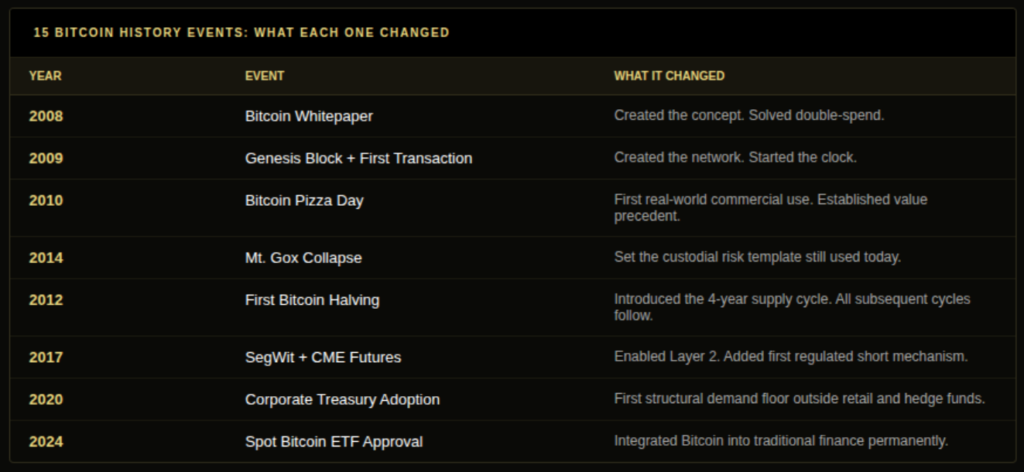
Every event on this list changed one of three things: who could access Bitcoin, what Bitcoin could technically do, or who believed in it as an asset worth holding.
The whitepaper and genesis block created access. Pizza Day and the first transaction created precedent. Mt. Gox and the halving cycles shaped market structure. SegWit and Lightning expanded capability. The ETF approval and corporate treasury wave transformed the demand profile permanently.
The traders and researchers who understand this progression are working with a more complete model than those who only look at the price chart. Market efficiency in prediction markets is partly a function of how many participants understand this structural history. But the same principle – acting on information before the price catches up – applies whether you’re trading a BTC price milestone on Polymarket or a football match winner. The infrastructure is shared. The edge framework is identical. DG3 is built for traders who operate across all of it.
Frequently Asked Questions
Q: What is the most important event in Bitcoin history? A: The genesis block (January 3, 2009) created the network. The SEC spot ETF approval (January 10, 2024) institutionalised it. Both represent structural shifts of roughly equal long-term significance, the first created Bitcoin, the second integrated it into traditional finance permanently.
Q: How many Bitcoin halvings have there been? A: Four. November 2012 (50 to 25 BTC), July 2016 (25 to 12.5 BTC), May 2020 (12.5 to 6.25 BTC), and April 2024 (6.25 to 3.125 BTC). The next halving is expected around 2028.
Q: What happened to Mt. Gox Bitcoin? A: Mt. Gox lost approximately 850,000 BTC in a hack that occurred over an extended period, with the collapse announced in early 2014. Legal proceedings have continued for over a decade. A portion of the recovered BTC was distributed to creditors beginning in 2024, a distribution that itself became a prediction market event due to its potential market impact.
Q: What was the first real-world Bitcoin transaction? A: The first peer-to-peer transaction was Satoshi sending 10 BTC to Hal Finney on January 12, 2009. The first commercial transaction was Laszlo Hanyecz paying 10,000 BTC for two pizzas on May 22, 2010, now commemorated as Bitcoin Pizza Day.
Q: Why does the Bitcoin halving affect price? A: The halving reduces the daily supply of new BTC reaching the market by 50%. When demand stays constant or increases against a reduced supply rate, basic supply and demand dynamics create upward price pressure over the following 12-24 months. The mechanism is built into the protocol and known years in advance, but the market consistently underprices the post-halving supply effect until it’s already happening.
Also read: Crypto Event Markets: Trading BTC Milestones and Protocol Catalysts
Market Efficiency in Prediction Markets: Are They Really Smarter Than the Crowd?
Information Asymmetry: Who Knows What, and When, in Event Markets